ISO 14184 Water Extraction Formaldehyde Acceptance Testing Methods
ISO 14184-1 quantifies free formaldehyde via water extraction at 40°C and spectrophotometry at 412 nm, enforcing batch release limits from 16 to 75 mg/kg.
Flask
Specimen preparation under EN ISO 14184-1 commences with cutting cloth swatches into fragments weighing precisely one gram. Technicians deposit the weighed cut material into a 250-millilitre Erlenmeyer container equipped with a ground-glass stopper. One hundred millilitres of distilled or demineralised water fills the container, which then sits in a thermostatically controlled water bath kept at forty degrees Celsius for sixty minutes.
The bath agitates the liquor continuously or receives manual agitation every five minutes to drive water-soluble formaldehyde out of the cellulose matrix. Extraction temperatures exceeding forty degrees trigger hydrolysis of polymerised finish residues, which invalidates the extraction measure.
Incubation takes exactly sixty minutes.
An extraction temperature exceeding forty degrees Celsius accelerates resin hydrolysis and yields artificially elevated free formaldehyde concentrations.
Filtration separates the liquid phase from the textile fragments immediately upon removal from the bath. The laboratory technician transfers a five-millilitre aliquot of the clear eluate into a test tube, followed by five millilitres of acetylacetone reagent, commonly termed Nash reagent. A second test tube receives five millilitres of distilled water alongside five millilitres of Nash reagent to serve as the analytical reagent blank.
Both tubes sit in a secondary water bath held at forty degrees Celsius for thirty minutes, during which the reaction between formaldehyde, ammonium ions, and acetylacetone produces 3,5-diacetyl-1,4-dihydrolutidine. The solution cools to room temperature in dim light over thirty minutes before spectroscopic measurement.
Absorbance peaks at 412 nanometres.
Aqueous Extraction Conditions and Liquor Ratios
The analytical protocol specifies one hundred millilitres of demineralised water placed into an airtight vessel. The ratio of specimen mass to liquid volume sits firmly at 1:100. Altering this liquor ratio changes the mass transfer gradient across the textile boundary, artificially skewing the extracted formaldehyde concentration.
Dense wovens and heavy knits absorb twenty to forty percent of the solvent volume during initial wetting, reducing the free drainable liquor. Laboratories handling heavy fleece or heavyweight woollens must verify that sufficient extract remains post-filtration to fill spectroscopic cuvettes without diluting the primary liquor.
The calibration curve demands five points.
- Specimen Conditioning proceeds inside an atmospheric chamber at twenty degrees Celsius and sixty-five percent relative humidity for four hours, preventing moisture bias from altering the initial dry mass calculation.
- Precision Cutting reduces the conditioned sample into five-millimetre squares using ethanol-cleaned shears, avoiding cross-contamination from handling surfaces.
- Aqueous Immersion submerges the fragments in one hundred millilitres of grade-three laboratory water, immediately sealing the container with a ground-glass stopper to arrest vapour escape.
- Controlled Incubation maintains the bath temperature at forty degrees Celsius plus or minus one degree, shaking the container systematically to standardise mass transfer.
- Immediate Separation decants the extract through a sintered glass funnel, isolating the liquid before unreacted methylol compounds begin thermal degradation.

Calibration Curves and Spectrophotometric Detection
Absorbance measurements run on a double-beam spectrophotometer tuned to four hundred twelve nanometres. Standard stock solutions dilute formalin across five distinct concentration steps spanning zero to three micrograms of formaldehyde per millilitre. The spectrometer uses path-length quartz cells of ten millimetres, zeroed against the reagent blank.
If the textile extract yields an absorbance reading above the highest calibration point, the technician dilutes the primary extract with demineralised water rather than adjusting the photometric scale.
The reporting threshold sits at sixteen.
| Standard Designation | Extraction Medium | Thermal Incubation | Duration | Detection Limit |
|---|---|---|---|---|
| EN ISO 14184-1 | Demineralised Water | 40°C ± 1°C | 60 Minutes | 16 mg/kg |
| EN ISO 14184-2 | Vapour Over Water | 49°C ± 1°C | 20 Hours | 20 mg/kg |
| AATCC TM112 | Vapour Over Water | 49°C ± 1°C | 20 Hours | 16 mg/kg |
| JIS L 1041 Method A | Aqueous Solution | 40°C ± 1°C | 60 Minutes | 15 mg/kg |
| Method reporting limits correspond to accredited commercial testing laboratory performance baselines. | ||||
Readings below sixteen milligrams per kilogram register formally as unquantifiable content. Commercial certificates describing values below sixteen milligrams as absolute zero violate the reporting boundaries established by the International Organization for Standardization. The technician records the raw absorbance value directly into the instrument ledger.
Reagent
The Nash chemistry relies on acetylacetone dissolved in ammonium acetate solution buffered with glacial acetic acid. Preparation requires dissolving 150 grams of ammonium acetate in eight hundred millilitres of demineralised water, mixing three millilitres of glacial acetic acid, adding two millilitres of acetylacetone, and diluting to one thousand millilitres. The solution stores in dark glass containers shielded from UV exposure.
Ambient light and temperature spikes decompose acetylacetone into volatile ketones, pushing background absorption upward.
Reagent blank values exceed normal baselines.
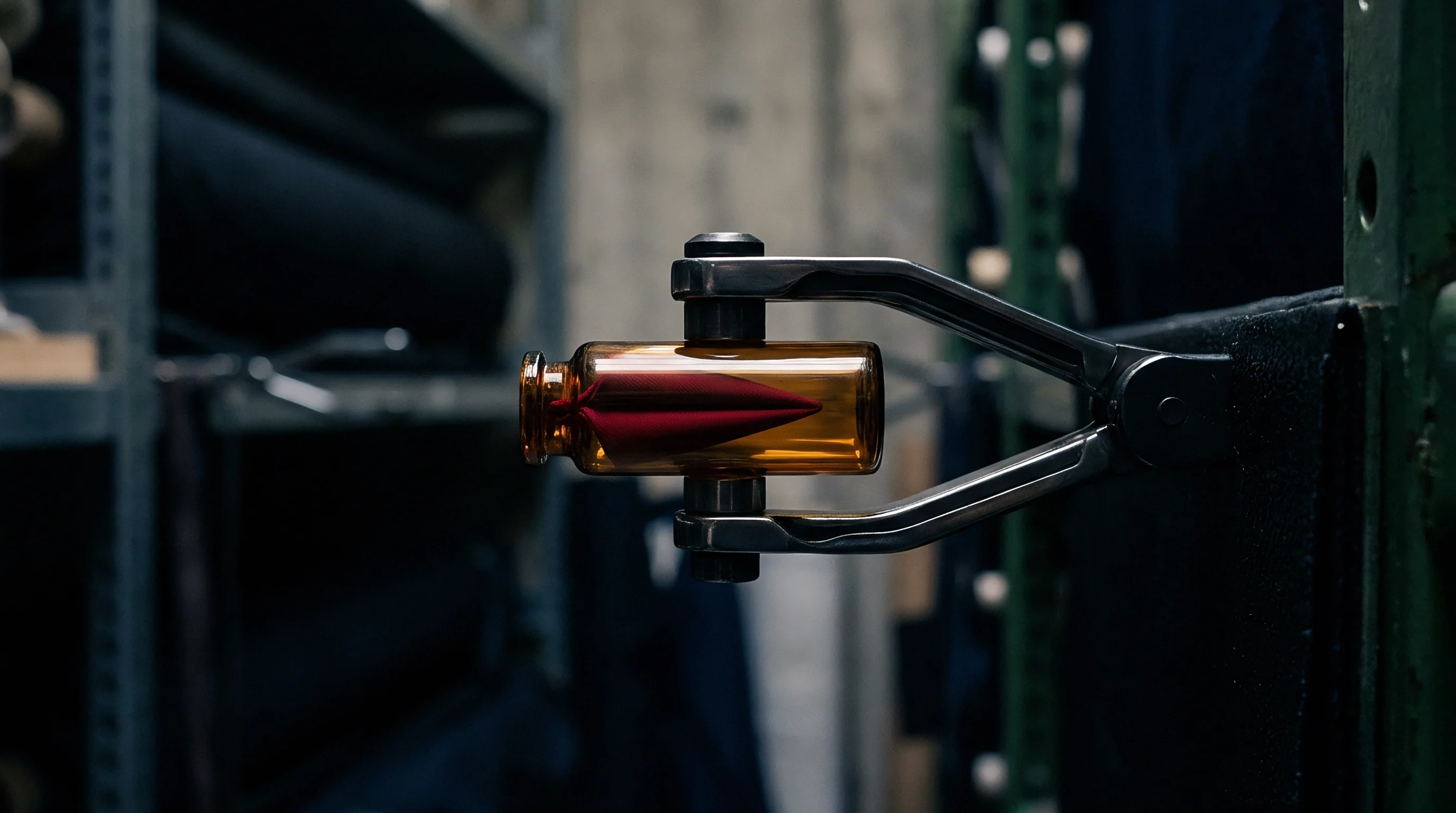
Freshly prepared Nash reagent stored in amber glass prevents photochemical oxidation from corrupting spectrophotometric baselines.
Absorbance of the working reagent blank against water must remain below 0.025 at four hundred twelve nanometres. When blank absorption drifts past this limit, the laboratory replaces the reagent batch immediately. Fresh batches demand twenty-four hours of dark maturation to stabilise baseline absorbance.
The reaction forms diacetyldihydrolutidine.
Does Acetylacetone React with Interfering Aldehydes?
Glyoxal and acrolein present in finishing resins form competing chromophores that absorb near the primary target band. Glyoxal condensations yield yellow reaction products absorbing between 400 and 430 nanometres, creating false-positive spikes in formaldehyde readings on cross-linked cottons. When treating cellulosic materials with dimethyloldihydroxyethyleneurea derivatives containing glyoxal impurities, analytical staff execute a confirmatory run using dimedone.
Dimedone reacts selectively with formaldehyde, forming an insoluble precipitate that strips free formaldehyde from the aqueous extract. The technician measures the eluate before and after dimedone treatment. True formaldehyde content equals the difference in absorbance values between the untreated and treated solutions.
Coloration remaining after dimedone precipitation belongs entirely to non-formaldehyde interference artifacts, which the final report subtracts from the gross reading.
Distinguishing Free Formaldehyde from Vapour Release
The second part of the international standard, designated 14184-2, hangs a dry swatch over water inside an incubator. Sealed glass jars maintain ninety percent relative humidity alongside forty-nine degrees Celsius over twenty hours. This mechanism captures releasable formaldehyde, quantifying molecules dislodging under storage heat rather than direct skin sweat contact.
Finished garments destined for warehouse storage undergo ISO 14184-2 evaluation to predict off-gassing inside maritime freight containers.
Enzymatic clearing cuts residual background.
Whether commercial enzyme washes can reliably cleave methylol bonds without degrading cellulose strength remains unresolved across bulk finishing trials.
Tolerance
Statutory thresholds diverge across export jurisdictions and garment categories. Customs authorities, trade ministries, and private brand consortia write enforceable ceiling figures directly into import codes. A batch compliant for adult outer layers in North America faces automatic seizure at customs gates in Japan or China if imported under babywear classifications.
Infant garments face twenty parts.
Purchase agreements referencing OEKO-TEX Standard 100 Class I enforce an uncorrectable rejection if extractable content reaches sixteen parts per million.
China applies mandatory standard GB 18401 across all imported and domestic apparel. Category A covers baby articles up to thirty-six months with a threshold of twenty milligrams per kilogram. Category B encompasses apparel in direct skin contact, enforcing seventy-five milligrams per kilogram.
Category C caps non-direct contact textiles at three hundred milligrams per kilogram. Garments entering Chinese ports undergo mandatory state testing, where test values exceeding these values halt entry and force re-export.
Adult apparel caps at seventy-five.

Regulatory Thresholds across Global Jurisdictions
European authorities enforce an entry under Annex XVII of the REACH regulation fixing the maximum concentration for direct wear at seventy-five parts per million. The restriction applies to clothing, footwear, and interior textiles across EU member states. In the United States, formaldehyde content in apparel remains unregulated by federal statutory concentration limits, though California Proposition 65 requires warnings for workplace exposures and consumer products causing significant dermal release.
| Standard / Regulation | Baby / Infant Tier | Direct Skin Contact | Non-Skin Contact |
|---|---|---|---|
| EU REACH Annex XVII Entry 72 | 75 mg/kg | 75 mg/kg | 300 mg/kg |
| China GB 18401 | 20 mg/kg | 75 mg/kg | 300 mg/kg |
| Japan Law 112 | Undetectable (<16 mg/kg) | 75 mg/kg | 300 mg/kg |
| OEKO-TEX Standard 100 | 16 mg/kg (Class I) | 75 mg/kg (Class II) | 150 mg/kg (Class III) |
| bluesign System Criteria | 16 mg/kg | 75 mg/kg | 300 mg/kg |
The standard exempts dry upholstery.

Private Ecolabel Tiering and Detection Limits
Independent standards split products into age brackets and dermal contact tiers. OEKO-TEX Standard 100 Class I defines limits below quantification thresholds, effectively imposing a sixteen milligram ceiling. Class II covers shirts, underwear, and bed linen at seventy-five milligrams.
Class III includes jackets and coats at one hundred fifty milligrams. Class IV regulates decorative furnishing articles at three hundred milligrams.
- Scope Certificates establish mill-level operational qualification, but they leave individual container lot chemistry unverified unless backed by lot-specific test reports.
- Transaction Certificates transfer legal title and trace volume movements through supply tiers without certifying current chemical concentrations on physical goods.
- Direct Laboratory Reports verify concentration on specific cut swatches, expiring twelve months from the analytical release date.
- Brand Restricted Lists frequently impose internal thirty milligram limits for direct skin apparel, over-riding sixty and seventy-five milligram statutory allowances.
The inclusion of mandatory supply-chain testing under REACH Annex XVII Entry 72 shifts financial risk directly to the importer of record when border agencies draw random audit samples.

Lot
Bulk rolls leaving a stenter frame carry uneven chemical distributions across their physical width. Edge-to-middle shading of curing resins occurs when drying nozzles deposit uneven air velocities across the tentered web. Formaldehyde-based cross-linking agents such as modified dimethyloldihydroxyethyleneurea (DMDHEU) require uniform thermal activation at 150 to 170 degrees Celsius.
Temperature drops of five degrees across the stenter width prevent complete curing, leaving unreacted methylol groups behind.
Moisture balance dictates dry mass.
Unwashed rolls wrapped in permeable polyfilm exchange ambient moisture and atmospheric acid catalysts during ocean transit.
Acid catalysts like magnesium chloride activate curing reactions inside the drying oven. Incomplete curing yields labile N-methylol structures that hydrolyse under ambient humidity. Ocean freight containers passing through tropical transit routes hit internal temperatures exceeding fifty degrees Celsius alongside eighty percent relative humidity.
These marine microclimates trigger reverse reactions, regenerating free formaldehyde from cured cellulose resins inside sealed polyethylene wrapping.
Sealed plastic stops off-gassing.
Sampling Discipline at the Stenter Frame
Technicians extract specimens five centimetres inward from the selvedge edge to avoid heat dissipation zones. Sampling protocols pull swatches from the head, middle, and tail of every finished dye lot. A single twenty-thousand-metre production run encompasses multiple drying cycles, requiring composited specimen batches to catch stenter burner variations.
- Stenter Air Flow Variations generate heat pockets that leave unreacted methylol resin pools near selvedges.
- Inadequate Post-Wash Neutralisation allows residual acid catalysts to continue hydrolysing cross-links during roll storage.
- Non-Uniform Chemical Paddiing deposits differing resin liquor pick-up percentages across the face and back of heavy woven twills.
- Premature Packaging traps hot steam inside rolled goods, driving hydrolytic cleavage of finished polymers.

Do Moisture Fluctuations Distort Final Calculations?
The dry weight of cellulose shifts under ambient relative humidity, altering the denominator of the extraction equation. Standard ISO 139 mandates twenty-four hours of specimen conditioning inside a controlled atmosphere. Cotton materials exhibit moisture regain values near eight percent, while viscose reaches twelve percent.
Weighing swatches straight from dry ovens yields inaccurate calculations that inflate reported parts-per-million metrics by ten to fifteen percent.
The dyehouse manager claimed that elevated warehouse humidity during monsoon storage caused the cross-linking resin to hydrolyse after inspection.
Recourse
Purchase orders require unequivocal allocation of financial liability for rejected shipments. When port authorities or brand verification programs flag formaldehyde concentrations breaching contractual ceilings, financial losses escalate rapidly beyond the raw fabric invoice value. Demurrage, secondary laboratory fees, container destruction tariffs, and retail delay penalties accumulate against the importing party unless master purchase agreements assign non-conformity costs upstream.
Secondary laboratories yield conflicting numbers.
Commercial contracts define actionable batch acceptance criteria by establishing an absolute threshold tolerance. Sourcing contracts designating ISO 14184-1 testing specify whether the test result governs acceptance as a raw number or accounts for measurement uncertainty. ISO/IEC 17025 accredited laboratories operate with expanded measurement uncertainties near twelve to fifteen percent for spectrophotometric formaldehyde determinations.
A test result of seventy-eight milligrams per kilogram falls within the measurement uncertainty margin of a seventy-five milligram regulatory limit, opening contentious contractual battles between buyers and textile mills.
Demurrage charges compound daily.
Arbitration Pathways for Conflicting Laboratory Certificates
Disputes arise when accredited testing facilities return divergent parts-per-million values for identical production batches. An importer holding a passing mill certificate of forty-two milligrams per kilogram faces sudden detention when import border screens yield eighty-four milligrams per kilogram. These discrepancies stem from inter-laboratory calibration differences, shipping-induced resin hydrolysis, or non-representative original sampling.
| Exposure Component | Routine Pre-Shipment Audit | Destination Port Rejection | Mitigation Mechanism |
|---|---|---|---|
| Testing Expenditure | $450 (Composite Lot Screen) | $2,400 (Multiple Dispute Runs) | Pre-designated reference facility |
| Port Storage and Demurrage | $0 | $7,500 (14-day hold) | Direct terminal guarantee clause |
| Remediation Laundry Washing | $0.35 per kilogram | $1.85 per finished garment | Local contract finishing agreement |
| Total Direct Landed Impact | $3,950 (Pre-wash + Test) | $32,000 (Freight + Detention) | Upstream chargeback indemnity |
Remediation Protocols for Off-Gassing Cargo
Washing garments in open-width continuous washers strips unreacted methylol groups before final packaging. An industrial wash using sodium carbonate at sixty degrees Celsius neutralises acidic catalysts and eliminates surface formaldehyde residues. The wash bath must maintain a pH of 8.0 to 8.5 to prevent alkaline hydrolysis of the underlying cellulose fibre.
After laundering, the goods require secondary testing under ISO 14184-1 to verify that residual extractable content dropped below thirty milligrams per kilogram before container release.
Failure to establish split-sample arbitration terms leaves the importer liable for full shipment value, port storage accumulation, and mandatory destruction costs at the destination border.