Gravimetric Bias from Oligomer Co-Extraction during Chlorinated Solvent Reflux Procedures
Chlorinated solvent reflux extracts structural polymer oligomers alongside spin finishes, distorting quantitative gravimetric composition analysis unless corrected.

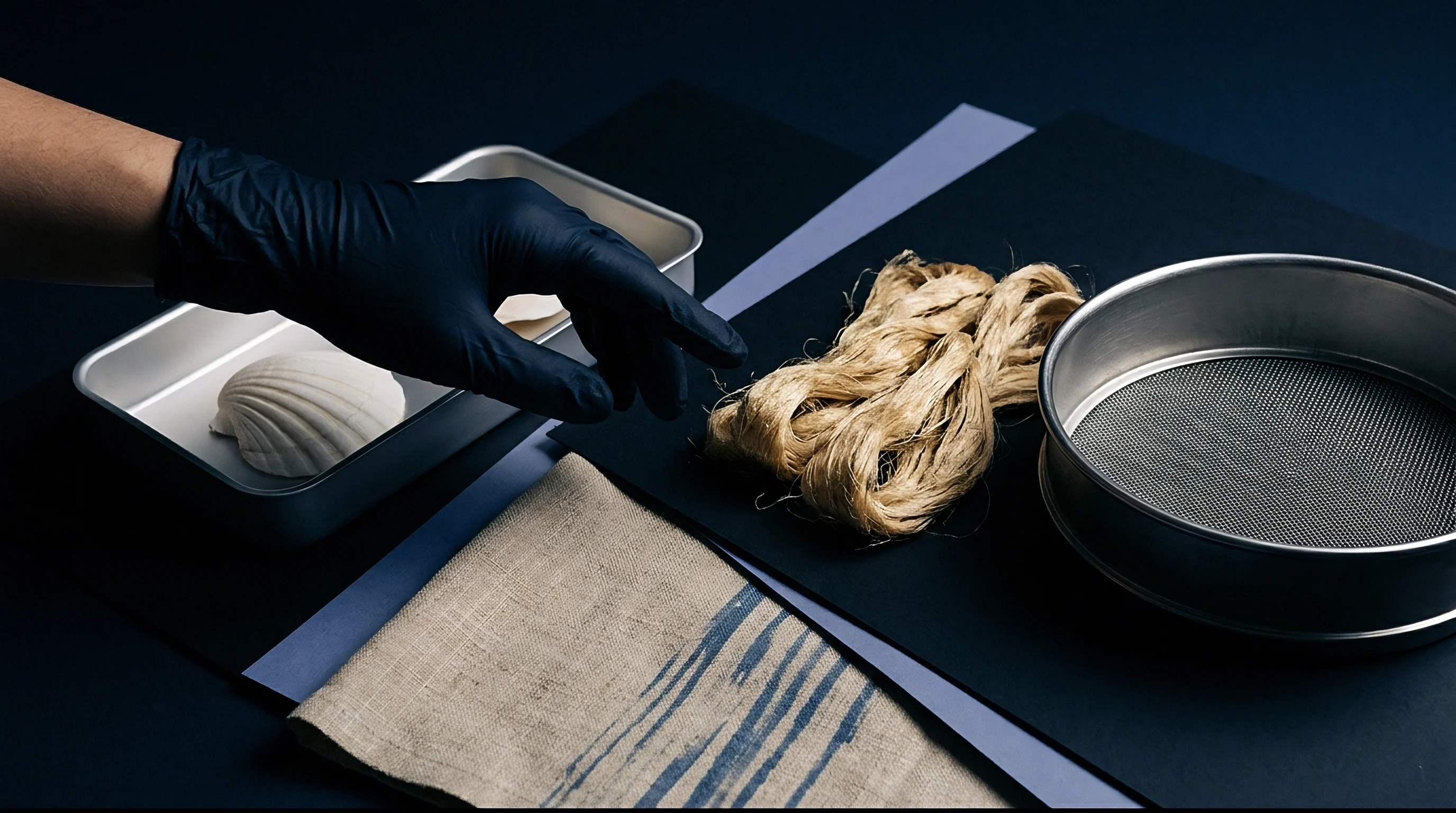
Reflux
Chlorinated solvents like dichloromethane and trichloroethylene serve as standard extraction agents during quantitative determination of spin finish, knitting oil, and sizing agents on synthetic yarns. Standard Soxhlet extraction procedures dictate boiling solvent exposure across multiple hours to isolate non-fibrous additive mass. During this continuous thermal Soxhlet extraction, chlorinated liquids penetrate past the filament surface into the amorphous regions of synthetic polymers.
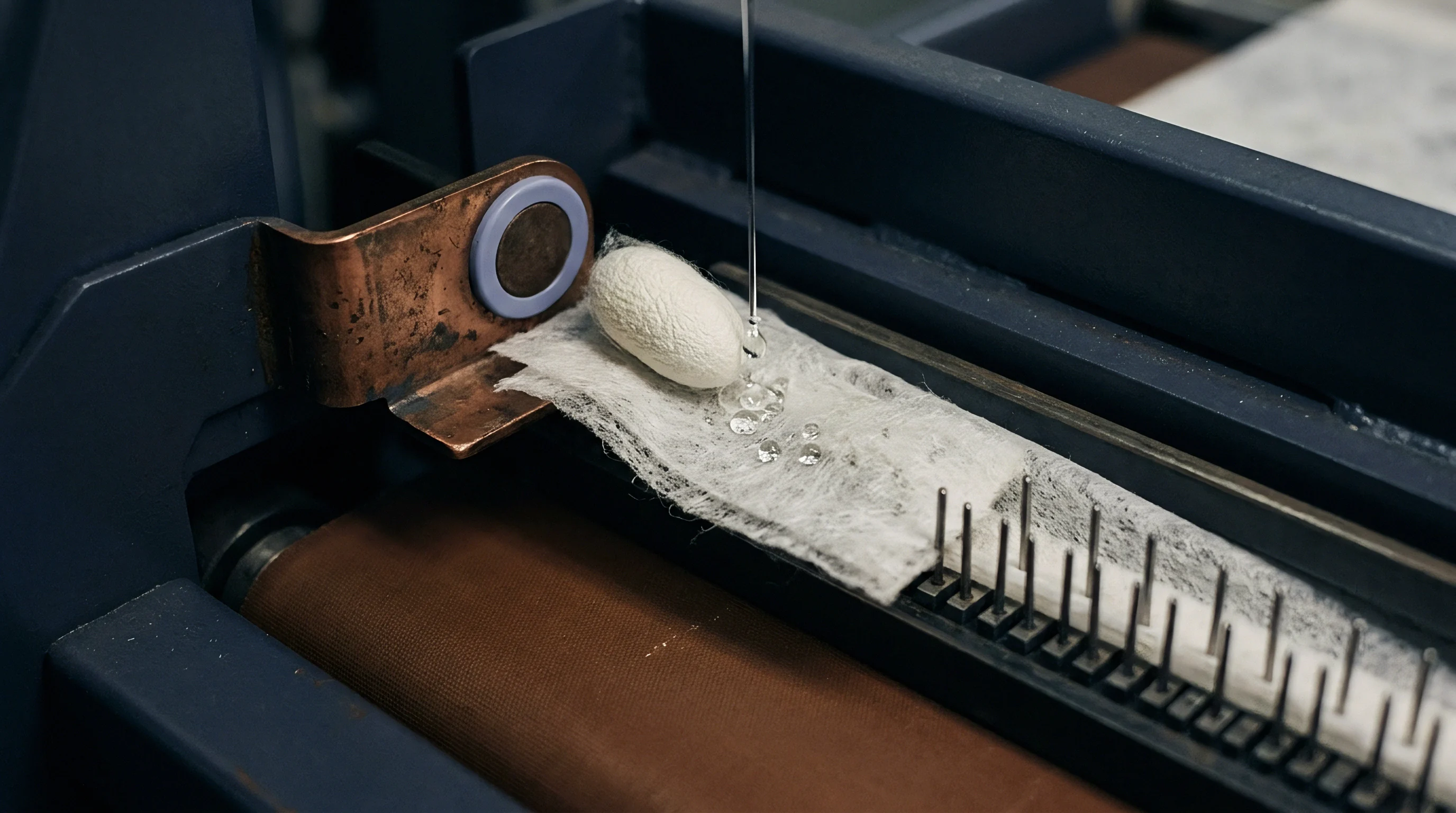
Solvent Extraction Dynamics in Synthetic Polymers
Standard Soxhlet procedures rely on repeated boiling liquid percolation through yarn or fabric swatches held inside a porous thimble. Dichloromethane operates at a boiling point of 39.6 degrees Celsius, whereas trichloroethylene boils at 86.7 degrees Celsius. These chlorinated hydrocarbons exhibit high polarity parameters and strong swell action on semi-crystalline synthetic matrices.
Chlorinated reflux dissolves surface oils rapidly. When boiling solvent enters the swollen polymer matrix, it solubilizes not only topical lubricants but also low molecular weight poly-condensate fractions held within the internal chain network.
Soxhlet extraction kinetic profiles reveal that topical spin finishes, paraffin coning oils, and anti-static esters dissolve within the first fifteen to thirty minutes of solvent contact. Continuous extraction beyond this initial threshold yields an additional mass fraction in the boiling flask. This secondary mass fraction consists of structural polymer fragments leached directly from the filament core.
Extended refluxing in chlorinated liquids creates a continuous gravimetric increase in total extractable residue, decoupling the analytical measurement from actual topical lubricant content.

Cyclic Oligomer Migration in Polyethylene Terephthalate
Polymerization of polyester generates a side-product distribution comprising ring-structured compounds, dominated by the cyclic trimer. Polyethylene terephthalate synthesis yields approximately 1.0 to 3.5 percent by weight of total cyclic oligomeric species, including cyclic trimers, tetramers, pentamers, and hexamers. Among these species, cyclotris-ethylene terephthalate represents roughly 80 percent of total oligomer mass.
Boiling solvent penetrates amorphous polymer domains.
Thermal yarn processing stages like texturing, drawing, and high-temperature heat setting between 180 and 215 degrees Celsius induce oligomer migration from the internal core toward the filament surface. When a yarn swatch undergoes chlorinated solvent refluxing, these migrated surface oligomers and swollen sub-surface cyclic trimers pass freely into the solvent phase. Upon solvent distillation and drying, these ring compounds precipitate as crystalline solid matter, artificially inflating the calculated mass fraction of extracted finish.
- Cyclic Trimers High-melting ring compounds that crystallize into white powder upon solvent evaporation, artificially elevating measured finish mass.
- Caprolactam Monomers Residual low molecular weight fragments in Nylon 6 extracted rapidly during refluxing, distorting clean yarn weight baseline calculations.
- Linear Oligomeric Esters Low-viscosity short polymer chains dissolved out of modified co-polyester matrix structures when exposed to chlorinated solvents above room temperature.
- Plasticizer Additives Non-bonded functional additives leaching into boiling extractant liquids alongside target lubricants, generating uncalibrated weight shifts.
Soaking synthetic filaments in boiling solvent beyond finish extraction thresholds strips structural oligomers directly from the amorphous regions.
In commercial negotiations over high extractable percentages, yarn suppliers frequently claim that elevated gravimetric residue values simply reflect heavy application of protective coning oils required for high-speed winding operations.
Residue
Gravimetric measurement after solvent evaporation isolates all non-volatile mass dissolved during refluxing. Laboratory procedures standardizing solvent extraction prescribe evaporating the solvent in a tared glass flask, followed by oven drying at 105 degrees Celsius until reaching constant mass. The dried residue mass is weighed to 0.1 milligram precision to calculate the mass fraction of non-fibrous extractables.

When Do Cyclic Oligomers Distort Solvent Extractable Measurement?
Standard test procedures like ISO 14419 or AATCC 97 quantify surface finishes by mass difference after evaporating the extract liquid. Distinguishing topical finish oils from co-extracted polymer oligomers requires evaluating extraction temperature and solvent contact time. Cold extraction conducted at 20 degrees Celsius isolates accessible surface lubricants while suppressing the dissolution kinetics of internal cyclic trimers.
Hot chlorinated refluxing at 40 to 87 degrees Celsius accelerates solvent diffusion into the polymer amorphous phase, causing progressive leaching of low molecular weight polymer fractions.
When continuous Soxhlet reflux exceeds two hours, co-extracted oligomer mass often equals or exceeds the actual topical spin finish content. Extraction duration alters measured residue mass. High-crystallinity yarns with thermal setting history yield significant cyclic trimer quantities under hot trichloroethylene extraction, generating false finish content readings above 2.0 percent by weight when actual spin finish application measures under 0.6 percent.
| Filament Chemistry | Boiling Solvent | Reflux Duration (Hours) | Finish Content (% w/w) | Co-Extracted Oligomer (% w/w) | Gravimetric Bias (% absolute) |
|---|---|---|---|---|---|
| Polyethylene Terephthalate | Dichloromethane | 4.0 | 0.55 | 1.25 | +1.25 |
| Polyethylene Terephthalate | Trichloroethylene | 2.0 | 0.55 | 1.80 | +1.80 |
| Polyamide 6 | Dichloromethane | 4.0 | 0.70 | 0.95 | +0.95 |
| Polyamide 6,6 | Dichloromethane | 4.0 | 0.65 | 0.20 | +0.20 |
| Polytrimethylene Terephthalate | Dichloromethane | 4.0 | 0.50 | 1.45 | +1.45 |
Analytical Separation of Topical Finishes from Polymer Fragments
Spectroscopic and chromatographic verification methods isolate individual species contained within dried extraction residues. Fourier Transform Infrared Spectroscopy (FTIR) analysis of gravimetric residue identifies functional group absorption bands. Spin finish components like polyoxyethylene fatty acid esters exhibit characteristic aliphatic ester carbonyl peaks at 1735 reciprocal centimeters and broad ether linkage bands around 1100 reciprocal centimeters.
Cyclic PET trimers display distinct aromatic ester ring stretching vibrations at 1715, 1410, and 725 reciprocal centimeters.
High-Performance Liquid Chromatography (HPLC) coupled with ultraviolet detection at 240 nanometers quantifies cyclic oligomers directly. Resolving dried residue dissolved in tetrahydrofuran through a reversed-phase C18 column separates individual cyclic trimers, tetramers, and pentamers from surfactant alkoxylates. Spectroscopy identifies aromatic ring structures cleanly.
Thermogravimetric Analysis (TGA) further differentiates species: topical oils decompose below 280 degrees Celsius, whereas cyclic PET trimers display thermal decomposition plateaus above 350 degrees Celsius.
Dichloromethane refluxing at 40 degrees Celsius for 4 hours extracts 1.42 percent cyclic trimers from high-crystallinity polyethylene terephthalate filaments.
Whether field laboratories can adopt low-temperature ultrasonic extraction methods fast enough to prevent false quality rejections remains an open question across international supply chains.


Calculus
Quantitative separation of fiber mixtures using chemical dissolution relies on accurate baseline corrections for mass lost during preliminary solvent washing. Standard quantitative analysis procedures require stripping non-fibrous materials before dissolving specific fiber components in selective chemical reagents. When calculating dry clean component masses, analytical procedures apply a correction factor, designated as d, to account for fiber mass loss incurred during pre-treatment.

Gravimetric Correction Mechanics in Fiber Mixture Quantitative Analysis
Standard test protocols like ISO 1833-11 for PET and cotton or wool combinations prescribe a pre-extraction stage to remove non-fibrous matter. The formula calculating clean dry fiber proportion relies on subtracting non-fibrous extractable mass from total initial dry mass. When chlorinated reflux extracts 1.85 percent mass from a synthetic yarn containing 0.60 percent topical finish and 1.25 percent co-extracted oligomer, the dry mass of synthetic fiber recorded after pre-treatment stands under-reported by 1.25 percent.
Applying an uncalibrated d-factor of 1.00 under-reports the synthetic polymer proportion in the final binary mix calculation. Because co-extracted oligomers represent structural polymer rather than removable topical finish, their removal artificially reduces the insoluble synthetic residue weight recorded after selective acid dissolution of the companion fiber. Dry mass figures determine tariff lines.
This systemic error inflates the calculated percentage of natural or cellulosic companion fiber in the quantitative test report.
- Sample Conditioning Dry the yarn swatch to constant mass at 105 degrees Celsius to establish initial moisture-free weight.
- Soxhlet Refluxing Extract the specimen with dichloromethane for 4 hours at 40 degrees Celsius to isolate total non-fibrous additives.
- Residue Evaporation Evaporate collected solvent in a tared glass flask and dry at 105 degrees Celsius for 1 hour to measure total extract mass.
- Oligomer Quantification Dissolve gravimetric residue in tetrahydrofuran and inject into liquid chromatography equipment to separate finish oil from cyclic trimer mass.
- Factor Calibration Adjust component mass balance calculations by subtracting co-extracted polymer mass from the solvent extraction tally.

Worked Mass-Balance Analysis for Polyester Cotton Combinations
Consider a declared 65 percent polyethylene terephthalate and 35 percent combed cotton woven fabric submitted for import clearance under customs tariff heading 5513. Assume a commercial production shipment of 10,000 kilograms of finished fabric priced at 4.20 US dollars per linear meter. The true physical composition of the fiber matrix measures 64.80 percent PET and 35.20 percent combed cotton, with a target topical spin finish application of 0.60 percent by weight.
During standard testing under ISO 1833-11 using 4-hour dichloromethane Soxhlet reflux pre-treatment, the solvent extracts 0.60 percent topical finish alongside 1.25 percent co-extracted cyclic trimers, producing a total solvent extractable residue yield of 1.85 percent. The specimen subsequently undergoes 75 percent sulfuric acid dissolution to dissolve the cotton component, leaving the insoluble PET component behind. Liquid chromatography confirms cyclic trimer presence.
Uncorrected gravimetric calculation yields the following figures: initial dry specimen mass equals 5.0000 grams; solvent pre-treatment removes 0.0925 grams (1.85 percent), leaving 4.9075 grams. Acid dissolution removes the cotton fraction, leaving an insoluble PET dry residue of 3.1775 grams. The uncorrected calculation divides 3.1775 grams insoluble PET by the initial specimen mass of 5.0000 grams, arriving at a measured synthetic proportion of 63.55 percent and an inferred cotton proportion of 36.45 percent.
Because the measured synthetic proportion falls below the 65 percent threshold required for chief weight synthetic classification under customs tariff heading 5513, customs authorities reclassify the shipment under tariff heading 5210 for cotton-predominant woven fabrics. Reclassification shifts the applicable import duty rate from 12.0 percent to 16.2 percent, generating an immediate duty penalty assessment of 17,640 US dollars on the shipment alongside customs administrative hold fees.
| Fiber Combination Matrix | True Synthetic Ratio (%) | Finish Mass (%) | Co-Extracted Oligomer (%) | Measured Synthetic Ratio (%) | Composition Error (% absolute) |
|---|---|---|---|---|---|
| PET / Combed Cotton | 65.00 | 0.60 | 1.25 | 63.75 | -1.25 |
| PET / Merino Wool | 55.00 | 0.50 | 1.40 | 53.60 | -1.40 |
| Nylon 6,6 / Viscose | 70.00 | 0.70 | 0.20 | 69.80 | -0.20 |
| PTT Co-polyester / Cotton | 50.00 | 0.45 | 1.50 | 48.50 | -1.50 |
Applying ISO 1833-11 solvent corrections without subtracting internal cyclic oligomer mass shifts declared polyester proportions past commercial tolerance limits.
Mislabeling fiber composition based on uncorrected solvent extractable figures exposes importers to customs reclassification penalties, origin certificate invalidation, and mandatory shipment re-testing fees at border checkpoints.

Trace
Laboratory testing personnel can suppress oligomer solubility without compromising finish removal efficiency by modifying solvent selection and extraction temperature. Selective solvent systems target hydrophobic hydrocarbon chains of spin finish surfactants while exhibiting negligible thermodynamic affinity for polar synthetic polymer chains. Regulating extraction temperature limits kinetic energy below the threshold required for oligomer diffusion through amorphous polymer domains.

Standardized Reflux Protocols Vs Solvent Dissolution Profiles
Alternative solvent systems like petroleum ether, aliphatic hexane, or cold diethyl ether remove surface spin finishes while leaving structural polymer rings intact. Petroleum ether and n-hexane dissolve non-polar lubricants, paraffin wax, and silicone coning oils efficiently at temperatures between 25 and 35 degrees Celsius. Aliphatic solvents exhibit zero solubility for cyclic PET trimers under cold extraction conditions, preventing oligomer leaching.
Hexane isolates lubricants without dissolving polymers.
Comparing standardized test methods illustrates substantial extraction variance across solvent choices. ISO 1833 Annex A permits petroleum ether pre-treatment, which yields clean finish separation with oligomer co-extraction below 0.05 percent. Conversely, ASTM D2257 procedures specifying dichloromethane refluxing extract total non-fibrous matter including internal polymer fragments.
Method selection directly governs whether gravimetric results reflect surface oils or structural matrix loss.
Pre-Extraction Conditioning and Wash Procedures
Implementing a short aqueous surfactant wash before organic solvent exposure isolates water-soluble lubricants without attacking the synthetic polymer matrix. Polyethylene glycol esters, anti-static phosphate salts, and ethoxylated surfactants dissolve readily in warm aqueous baths. Aqueous washing removes water soluble oils.
Performing a controlled aqueous wash at 45 degrees Celsius with non-ionic alcohol ethoxylate surfactant strips surface finishes without penetrating synthetic filament walls.
- Weigh a clean specimen of 2.0 grams to within 0.0001 gram precision after conditioning at standard ambient humidity.
- Submerge the swatch in 50 milliliters of n-hexane inside an ultrasonic bath maintained at 25 degrees Celsius for 15 minutes.
- Decant the solvent through a pre-weighed glass fiber filter to capture suspended insoluble matter.
- Repeat the ultrasonic immersion with a fresh 50 milliliter portion of n-hexane to ensure full lubricant removal.
- Combine decanted extracts in an evaporation dish, dry at 105 degrees Celsius, and weigh the residual finish mass.
Chlorinated reflux solvents dissolve low molecular weight polymers alongside topical lubricants without chemical distinction in gravimetric residues.
Standard purchase specifications incorporating ISO 1833 Annex A mandate that organic solvent pre-treatments exclude polymer-degrading solvents whenever quantitative fiber separation forms the basis of commercial billing.

Proof
Sourcing dossiers require clear test method references and explicitly stated correction factors to defend fiber composition claims against regulatory challenges. Contracting commercial fiber specifications demands defining exact laboratory procedures, extraction solvents, and acceptable mass tolerances. Eliminating analytical ambiguity protects buyers and spinning mills from false non-compliance claims caused by solvent extraction artifacts.

Drafting Purchase Specifications for Quantitative Compliance
Commercial contracts specifying yarn or fabric composition must state the exact testing standard and extraction solvent used to establish commercial mass. Specifying ISO 1833-11 with n-hexane pre-treatment establishes a clear testing baseline that prevents chlorinated solvent oligomer co-extraction. Contracts incorporating quantitative tolerance limits should reference ISO 2076 and ISO 1833 allowance bands, which accommodate typical commercial variation within a plus or minus 1.0 percent absolute boundary.
Ultrasonic baths accelerate surface oil detachment.
Procurement documents for synthetic filament yarns must decouple spin finish allowance thresholds from total solvent extractable limits. A robust raw yarn procurement specification establishes a maximum allowable surface finish content of 0.80 percent by mass when measured via 15-minute ambient temperature n-hexane extraction. Setting explicit analytical protocols prevents mills from masking poor scouring or heavy lubricant application behind uncalibrated chlorinated reflux test reports.
Cold solvents preserve polymer molecular structure.
Contractual Dispute Management for Mislabeled Synthetic Content
When independent laboratory reports disagree on fiber percentage, comparing the extraction residues via spectrophotometry resolves whether oligomer leaching biased the result. Dispute verification procedures require submitting dried extract residues to liquid chromatography or FTIR analysis. Demonstrating that cyclic trimers constitute over 30 percent of total extracted residue mass invalidates the initial test report, establishing grounds for re-testing under cold non-polar solvent conditions.
Chromatography separates oligomers from finish surfactants.
Commercial arbitration clauses should stipulate that third-party reference testing laboratories utilize chromatographic separation to quantify cyclic oligomers whenever solvent extraction yield exceeds 1.0 percent by weight. Commercial tolerances accommodate minor testing variance. Adjusting total extracted mass by subtracting identified oligomer peaks restores accurate dry component baselines, protecting contract declared composition ratios and securing landed duty calculations.
Specifying cold hexane extraction for surface finish verification while reserving hot chlorinated reflux solely for total polymer dissolution eliminates gravimetric bias across commercial compliance audits.