Refractometric and Gravimetric Monitoring of Cold Pad Batch Alkali Ratios
Refractometric and gravimetric tracking stabilizes cold pad batch alkali ratios, preventing reactive dye hydrolysis and securing shade repeatability.


Bench
Continuous pad-batch coloration demands precise alkaline activation to fix reactive dyestuffs without inducing premature hydrolysis inside delivery lines. In cold pad batch processing on cellulosic substrates, the reactive dye and concentrated alkali must stay isolated until seconds before application. A two-component metering pump pulls dye liquor from one tank and alkali fixative from another, combining them at a fixed volumetric ratio directly at a low-volume padding trough.

Dosing System Mechanics and Alkali Mix Architecture
Metering pumps merge concentrated dye liquor with fixative chemistry at set volumetric ratios just before trough entry. Standard production machinery operates at a four-to-one volumetric ratio, blending four parts dye solution with one part concentrated alkali liquor, though some configurations run a one-to-one dual-stream setup. The alkali stream typically uses sodium hydroxide (38 degrees Baumé) paired with sodium silicate (37 to 40 degrees Baumé), or liquid soda ash combinations tailored for silicate-free runs on soft knits.
When dosing pump displacement shifts from mechanical wear, fluid viscosity changes, or line pressure variations, the proportion of alkali to dye alters immediately. Excess alkali accelerates dye inactivation in the trough before the liquor can transfer to the cloth, whereas a deficiency lowers fixative strength, leaving unreacted dyestuff that washes out during subsequent soaping runs.

Physical Manifestations of Chemical Imbalance
Deviations from target caustic and silicate ratios disrupt the fixation kinetic window across cellulosic woven goods. The dyehouse floor sees these errors as immediate shade drift, structural fabric tendering, or poor wash-fastness.
- Under-dosed alkali delivery reduces dye-cellulose covalent bonding efficiency, generating pale shades, severe tailing, and poor wet-rub fastness across long production runs.
- Over-dosed caustic concentration accelerates dye hydrolysis within the pad trough, leading to chemical waste, heavy tailing, and reduced color yield.
- Silicate precipitation forms insoluble crusts on padding rollers, causing uneven nip pressure and mechanical marks on sensitive knit goods.
- Uncontrolled pH fluctuations alter reactivity rates between vinyl sulfone and triazine dyestuffs, destroying shade consistency from seam to seam.
Monitoring the alkali stream requires regular floor verification. While laboratory titration gives the exact molarity of sodium hydroxide and sodium carbonate, it cannot run continuously in an active production hall. Refractometric index tracking and gravimetric density checks serve as the primary physical indicators of batch consistency.
ISO 105-J03 shade variance limits of delta E below 0.8 enforce strict volumetric stability on pad trough feed lines.
Inadequate metering oversight converts prime combed cotton poplin into off-shade scrap, forcing costly stripping operations or unrecoverable markdown sales.
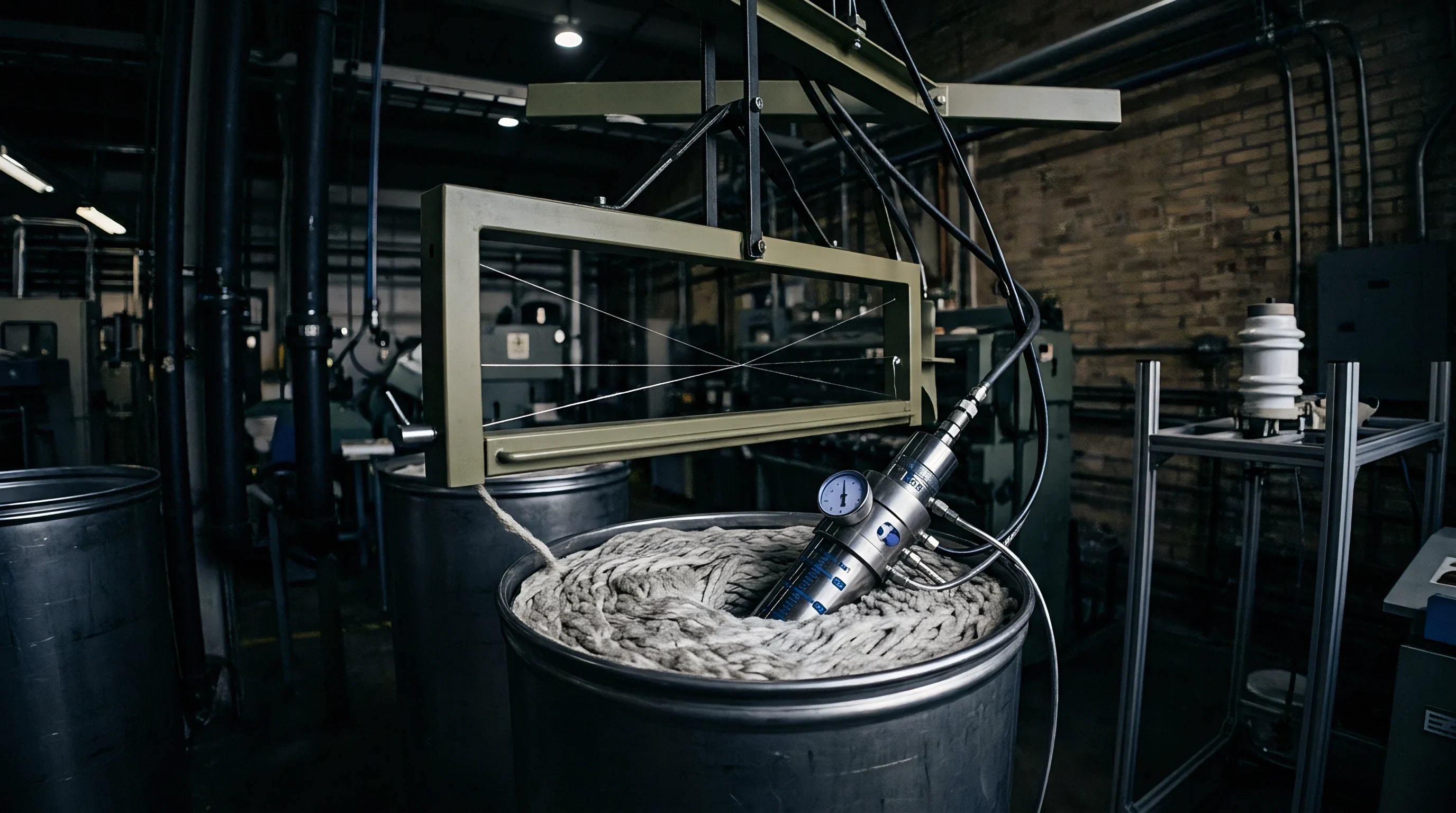

Refraction
Optical measurement of dissolved solids provides rapid floor-level checks on chemical strength in feed liquors. A digital refractometer measures the angle of total internal reflection as light passes through a liquid sample on a sapphire prism. Because dissolved sodium hydroxide and sodium silicate both raise the optical density of water, total Brix readings track chemical concentration in fresh, unmixed alkali stock.

Brix Value Calibration and Temperature Compensation
Handheld optical sensors calculate refractive angles across the sample boundary against a standard reference temperature of twenty degrees Celsius. Alkaline liquors carry a positive temperature coefficient, raising the observed refractive index as fluid temperatures climb in the mixing shop. Most digital meters rely on automatic temperature compensation curves developed for pure sucrose, introducing slight systematic errors when measuring dense ionic sodium hydroxide mixtures.
To correct for this, dyehouse laboratories develop empirical correlation tables that link specific Baumé hydrometer readings to target Brix values for each alkali recipe, establishing workable tolerance windows for operators on the floor.
| Alkali Recipe Formulation | NaOH Concentration (38 deg Bé) | Na2SiO3 Concentration (38 deg Bé) | Target Specific Gravity | Target Brix Value (deg Bx) | Brix Tolerance Window |
|---|---|---|---|---|---|
| Standard Silicate Ratio (4:1 Pump) | 100 g/L | 210 g/L | 1.225 | 28.4 | +/- 0.4 |
| High-Fixation Silicate (4:1 Pump) | 135 g/L | 210 g/L | 1.248 | 31.2 | +/- 0.5 |
| Silicate-Free Carbonate Blend (4:1 Pump) | 80 g/L NaOH + 120 g/L Na2CO3 | 0 g/L | 1.142 | 18.1 | +/- 0.3 |
| Low-Temperature Knit System (1:1 Pump) | 45 g/L | 100 g/L | 1.108 | 14.6 | +/- 0.3 |
Refractive Drift in Polymerized Silicate Matrixes
Sodium silicate solutions undergo structural polymerization over extended hold times, shifting optical density independently of chemical concentration. As concentrated silicate ages in bulk storage tanks, oligomers cross-link and alter light scattering at the prism interface without changing total dissolved mass. A room-temperature silicate tank held for three weeks will read higher on the Brix scale than a freshly mixed batch with identical gravimetric composition.
Refractometric Brix values drift upward by 0.15 degrees per five-degree Celsius rise when measuring sodium silicate mixes without automatic temperature compensation.
Testing mixed pad trough liquor with high dye concentrations introduces further optical interference. Reactive dyes contain chromophores and aromatic structures that absorb light across the visible spectrum, blurring the shadow line on optical prism sensors and lowering measurement accuracy.
- Prism face contamination distorts refractive index readings when dye residues or silicate films dry on the optical glass surface.
- Bubble entrapment within the sample well scatters light rays, producing blurry demarcation lines on optical scales.
- Concentration gradient zones form in static feed tanks, yielding unrepresentative Brix values if sampling occurs without mechanical agitation.
- Dyestuff optical absorbance obscures boundary lines in mixed liquor samples, rendering direct refractometric measurement impossible past the mixing block.
Relying solely on volumetric stroke counts without optical monitoring overlooks check-valve wear that develops during continuous shift operation.


Gravity
Mass-per-unit-volume measurements establish a baseline for alkali liquor strength without optical interference. Gravimetric analysis uses density to quantify total solute loading in clear alkali feeds. Because sodium hydroxide solution density rises linearly with concentration up to thirty percent by weight, direct mass measurement spots small dosing drifts before fabric enters the padding mangle.

Pycnometry and Hydrometer Monitoring Standards
Digital density meters determine specific mass from oscillating U-tube frequency shifts in temperature-regulated cells, while glass hydrometers remain the standard tool for quick floor checks. Hydrometers measure fluid displacement along scales marked in specific gravity or degrees Baumé, requiring steady sample temperatures because density shifts significantly with thermal changes.

Why Do Temperature Changes Distort Specific Gravity Measurements?
Thermal expansion increases solution volume while mass remains constant, lowering observed density readings on glass hydrometer scales. Liquid alkali in warm mixing rooms or heated bulk tanks registers a lower observed density than identical chemistry measured at the standard twenty-degree Celsius laboratory baseline. Failing to correct for thermal expansion leads dyers to over-concentrate alkali stock, wasting chemicals and risking fabric damage.
| Sample Temperature (deg C) | Observed Baumé (deg Bé) | Temperature Correction (deg Bé) | Corrected Baumé (20 deg C) | Active NaOH Molarity (mol/L) | Total Alkali Solids (g/L) |
|---|---|---|---|---|---|
| 15.0 | 29.2 | -0.3 | 28.9 | 2.48 | 308 |
| 20.0 | 28.9 | 0.0 | 28.9 | 2.48 | 308 |
| 25.0 | 28.5 | +0.4 | 28.9 | 2.48 | 308 |
| 30.0 | 28.1 | +0.8 | 28.9 | 2.48 | 308 |
| 35.0 | 27.6 | +1.3 | 28.9 | 2.48 | 308 |
| Method Note: Measurements conducted using standard DIN 12791 glass hydrometers calibrated against volumetric acid-base titration using 1.0 M Hydrochloric acid to methyl orange endpoints. | |||||
Hydrometer readings taken directly from warm mixing tanks consistently understate total alkali solids due to liquid thermal expansion.
Gravimetric checks must be validated periodically through acid-base volumetric titration to isolate active caustic alkali from sodium carbonate impurities formed through atmospheric carbon dioxide absorption.
- Draw a 250 millilitre sample of alkali liquor directly from the pump feed line into a clean borosilicate cylinder.
- Lower a calibrated glass hydrometer into the liquid while avoiding contact with cylinder sidewalls.
- Record the fluid temperature using an immersion thermometer alongside the float reading.
- Apply the thermal correction factor to convert observed Baumé degrees to standard twenty-degree Celsius values.
- Pipette ten millilitres of liquor into an analytical flask containing fifty millilitres of distilled water.
- Titrate against one-molar hydrochloric acid using phenolphthalein and methyl orange indicators to determine caustic and carbonate contents.
Whether digital inline density resonators can replace manual hydrometer verification across highly viscous silicate formulations remains subject to ongoing mill trial evaluation.


Control
Closed-loop systems combine dual analytical feeds to correct dosing pump displacement in real time. Comparing refractometric index values with gravimetric density readings isolates individual alkali components in mixed feeds. Because sodium hydroxide alters specific gravity faster than refractive index per mole of solute, evaluating optical and mass metrics together resolves two-part component ratios without requiring offline titrations.

Dual-Parameter Feed Stabilization Protocols
Cross-referencing Brix readings with hydrometer density separates silicate aging from caustic dilution. On a four-to-one dosing pump feeding a cold pad batch range at seventy meters per minute on combed cotton jersey, the target formulation calls for 100 grams per liter of sodium hydroxide (38 degrees Baumé) and 210 grams per liter of sodium silicate (38 degrees Baumé).
If a technician measures 26.2 degrees Brix alongside a hydrometer reading of 1.225 specific gravity, density matches specification while the optical reading sits 2.2 degrees Brix low. Standard volumetric stroke counts suggest normal pump action, but the dual-parameter discrepancy identifies a high-viscosity silicate delivery restriction that causes the pump to pull excess water through an unsealed secondary valve under backpressure changes.
| Dosing Volumetric Variance (%) | Trough pH Level | Brix Index Shift (deg Bx) | Fixation Rate after 16 Hours (%) | Color Yield Delta E (D65) | Fabric Handle Rating |
|---|---|---|---|---|---|
| -20.0 (Alkali Deficient) | 10.4 | -3.1 | 62.4 | 2.8 (Pale) | Soft |
| -10.0 (Alkali Deficient) | 11.1 | -1.5 | 81.2 | 1.2 (Slightly Pale) | Soft |
| 0.0 (Target Ratio) | 11.8 | 0.0 | 93.5 | 0.0 (Standard) | Standard |
| +10.0 (Alkali Excess) | 12.3 | +1.4 | 91.8 | 0.7 (Off-Shade) | Slightly Harsh |
| +20.0 (Alkali Excess) | 12.8 | +2.9 | 84.1 | 2.1 (Hydrolyzed) | Harsh / Stiff |

Trough Dynamics and Fixation Kinetics
Pad troughs require minimal volume relative to line speed to keep liquor residence times short. High-caustic liquor lingering in a large trough during line stops undergoes rapid hydrolysis, destroying reactive dye binding capacity. Keeping liquor volume low turns over the trough bath every ninety seconds, ensuring that measurements taken at the dosing feed match what hits the textile fiber.
Trough residence times exceeding five minutes promote premature dye reaction before fabric absorption occurs.
Excess caustic degrades final fabric handle, while sudden line pressure drops indicate upstream filter fouling.
- Inline refractometer cleaning cycles clear scale accumulation using automated water flush pulses every two hours.
- Dosing pump calibration logs record volumetric displacement checks performed before every color change.
- Alkali storage tank agitation prevents density stratification in concentrated caustic and silicate bulk holds.
- Differential pressure alarms signal filter clogging in chemical suction lines before dosing ratios drift off target.
Dyers who trust pump dial settings without verifying trough chemical concentration pay for their confidence on the inspection frame.


Ledger
Dyehouse cost tracking shows that dosing control directly dictates unit finishing costs. In cold pad batch operations, reactive dyes account for up to sixty percent of wet-processing chemical spend, whereas alkali salts represent under eight percent. Unmonitored alkali drift that causes uneven fixation or off-shade results wastes expensive dyestuffs and forces stripping and redyeing cycles that erode margins.

Rejection Risk and Claims Analysis
Off-shade fabric batches resulting from uncorrected alkali drift trigger commercial claims across supply contracts. A dosing shift on a ten-thousand-meter continuous dyeing run creates substantial financial liability. Stripping reactive dyes demands high-temperature oxidative treatments with sodium hydrosulfite and caustic soda, cutting cotton tensile strength by up to fifteen percent under ISO 13934 testing.
This loss in tensile strength leads to pilling and tearing failures during garment manufacturing. When entire fabric lots are rejected in the cutting room, the wet processor absorbs the cost of greige replacement, wasted process heat, freight surcharges, and contract delay penalties.

Quality Specifications for Commercial Dyehouse Audits
Supply contracts define clear testing parameters and operating limits for wet-processing compliance. Tier-one sourcing agreements require verified quality assurance records for all continuous and semi-continuous runs, rejecting mill production where chemical monitoring relies on operator estimation or uncalibrated hydrometers.
Inserting standard contract clause DIN EN ISO 105-B02 fastness verification paired with continuous alkali monitoring logs transfers liability for shade re-runs entirely onto the wet processor.