Calculating Spin Finish Residue Corrections for Chlorinated Solvent Scoured PET
Correcting PET spin finish extraction figures demands subtracting dissolved cyclic trimers to prevent overstating lubricant content in commercial mass calculations.
Finish
Dichloromethane and trichloroethylene strip surface lubricants while penetrating the amorphous regions of synthetic filament matrices. Drawing and spinning synthetic yarns generates enough frictional heat to melt untreated polymer surfaces, making topical processing aids essential for controlling friction, static electrification, and bundle cohesion during high-speed winding.
Filament Surface Additives and Solvent Penetration
Synthetic fiber production uses lubricant formulations to manage friction between yarn packages and ceramic guides. These topical coatings consist of mineral oils, ester lubricants, polyoxyethylene surfactants, and alkyl phosphate antistatic agents. Under ambient conditions, chlorinated solvents rapidly dissolve these non-polar and weakly polar components, with methylene chloride penetrating the outer polymer boundary within seconds of immersion.
Extended immersion allows the solvent to diffuses deeper into the inner amorphous domains of polyethylene terephthalate filaments.
While surface oils dissolve almost instantaneously on contact with the solvent, extended exposure swells the polymer matrix. As polyethylene terephthalate chains in lower-orientation regions yield under solvent plasticization, they release non-bonded chemical species trapped inside the matrix during melt spinning.
Cyclic Oligomer Co Extraction Interference
Melt polymerization of polyethylene terephthalate produces low molecular weight byproducts, primarily ring-structured cyclic ethylene terephthalate trimers. These remain dispersed throughout the amorphous phase of solid polyester filaments at concentration levels between 1.0 percent and 1.8 percent by mass. Because chlorinated solvents act as powerful swelling agents for ester linkages, scouring procedures dissolve these internal oligomers alongside surface lubricants.
Gravimetric analysis of evaporated solvent residues records both the topical lubricant package and the dissolved polymer trimers. Reporting the combined residue without mathematical correction overstates the spin finish application level by a significant margin, creating a risk that acceptable yarn shipments will be rejected based on uncorrected polymer leaching.
Chlorinated solvent extractions performed without temperature control strip internal polymer fractions alongside surface lubricants.
Failure modes arising from uncorrected gravimetric residue reporting include:
- Overstated Finish Calculations where solvent-dissolved polymer trimers inflate the mass of collected surface residues.
- Misadjusted Scouring Lines resulting from scouring line operators increasing chemical bath temperatures when false high extractables reports indicate stubborn oil deposits.
- Distorted Regain Determinations caused by subtracting oligomer mass losses from total dry fiber weight during commercial mass verification.
- Inaccurate Tariff Declarations where overstated surface treatment mass alters the chemical classification threshold of imported filament shipments.
Solvent extractable mass above target specifications often stems from polymer synthesis residues rather than excess spin finish application.


Sieve
Physical separation techniques isolate topical lubricants from dissolved synthetic polymer trimers. Gravimetric analysis relies on solubility differences between high molecular weight esters, surface surfactants, and ring-structured cyclic oligomers. Because chlorinated solvents dissolve both target lubricants and unwanted polymer fractions, the post-extraction residue requires distinct analytical treatment.
Fractional Dissolution and Solvent Temperature Controls
At ambient room temperature, methylene chloride strips ethoxylated esters rapidly without triggering immediate deep matrix swelling. Heating the solvent to its boiling point accelerates cyclic trimer diffusion out of partially oriented polyester filaments. Controlling bath temperature during extraction limits internal polymer leaching while recovering topical lubricants completely, whereas cold acetone washing selectively strips surface finish compounds while leaving cyclic trimers largely insoluble in the liquid phase.
Cooling extraction vessels during processing suppresses polymer matrix expansion and keeps oligomer leaching to minimal baseline figures when extraction temperatures remain below 18°C. Analyzing extracted residues using UV spectrophotometry at 240 nanometers quantifies the exact concentration of benzene ring structures characteristic of cyclic ethylene terephthalate trimers.
| Solvent System | Extraction Temp (°C) | Immersion Time (min) | Finish Recovery (%) | Trimer Leaching (% mass) |
|---|---|---|---|---|
| Dichloromethane | 20 | 15 | 99.2 | 0.14 |
| Dichloromethane | 40 | 30 | 99.8 | 0.68 |
| Trichloroethylene | 25 | 20 | 98.5 | 0.22 |
| Trichloroethylene | 87 | 15 | 99.9 | 1.15 |
| Anhydrous Acetone | 20 | 15 | 94.1 | 0.02 |
| Data represents mean extractable mass fractions determined on 50dtex/36f partially oriented PET yarn packages. | ||||
- Desiccate raw PET yarn samples inside sealed weighing bottles at 105°C for 90 minutes to remove moisture.
- Measure 20.0000 grams of dried fiber on an analytical balance reading to 0.1 milligrams accuracy.
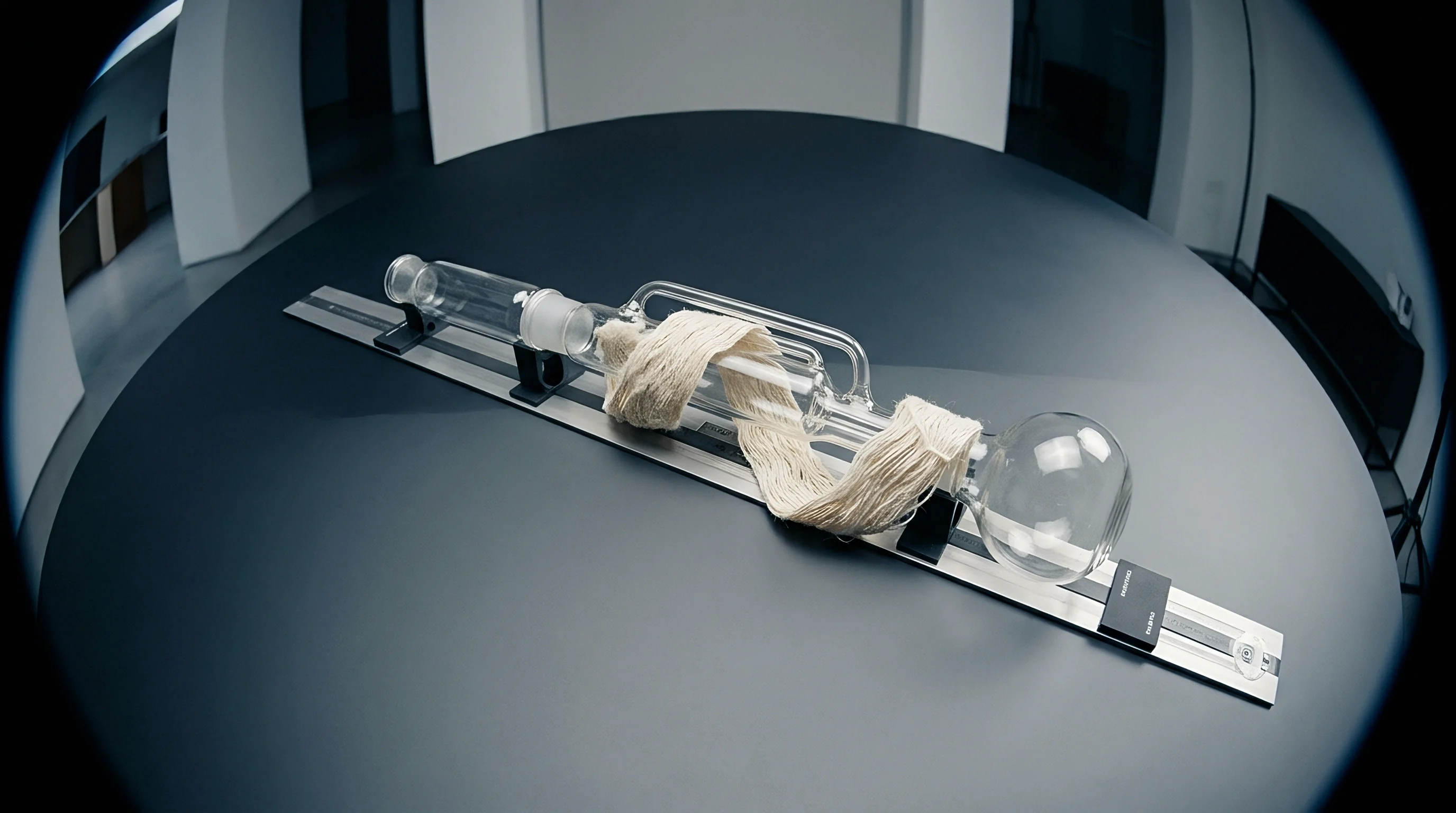
- Transfer fiber bundle into a glass Soxhlet extraction thimble fitted with a Teflon reflux ring.
- Charge the boiling flask with 150 milliliters of purified dichloromethane.
- Execute exactly six extraction cycles per hour over two hours, maintaining solvent bath temperature at 20°C using an external cooling jacket.
- Decant extract into a pre-tared aluminum evaporating dish and evaporate solvent under a fume hood air stream.
- Dry the residue container at 60°C under 50 kPa vacuum for 30 minutes before recording final dish mass.
Cold dichloromethane extraction at 15°C limits cyclic trimer solubility to 0.12 percent by mass of PET filament.
A clean evaporation dish indicates complete finish removal long before oligomer leaching reaches equilibrium.

Calculus
Determining net finish mass requires subtracting dissolved oligomer baseline values from total gravimetric residue mass. Laboratory technicians establish exact corrections by coupling gravimetric solvent extractions with spectrophotometric or chromatographic assay procedures. Calculating the true surface finish mass prevents inaccurate financial penalties during commercial yarn settlements.
What Alters the Cyclic Trimer Extraction Ratio?
Thermal history and orientation dictate how rapidly ester chains dissolve in chlorinated baths. Fully drawn yarn (FDY) exhibits high crystalline alignment, resisting solvent penetration more effectively than partially oriented yarn (POY). Heat-setting fiber bundles increases matrix density, slowing cyclic trimer diffusion rates during routine scouring.
Solvent residence time modifies final extraction mass, as extended Soxhlet refluxing continuously shifts chemical equilibrium and pulls deeply embedded trimers out of the core structure. Solvent purity plays an additional role: trace water content in dichloromethane increases solvent polarity, shifting extraction selectivity toward ethoxylated surfactant components while altering oligomer solubility limits.
Mathematical Derivation of Corrected Finish Mass
Iso-octane precipitation separates long-chain fatty esters from ring-structured trimers dissolved in chlorinated extracts. Adding excess iso-octane to concentrated dichloromethane extracts precipitates cyclic trimers selectively, allowing filtration through a 0.2-micrometer PTFE membrane prior to evaporating the solvent to isolate solid residues.
Mathematical isolation of net spin finish residue percentage follows a defined mass balance equation:
R_net = R_gross – (M_trimer / M_fiber) 100
Where R_net represents the true spin finish content percentage, R_gross equals the total gravimetric solvent extractable percentage, M_trimer defines the absolute mass of extracted cyclic trimers isolated via precipitation or spectroscopy, and M_fiber specifies the original dry mass of the extracted PET fiber sample.
A worked laboratory extraction illustrates the math. Take a 50.0000 gram sample of dry partially oriented PET filament scoured with boiling dichloromethane for 60 minutes. The gross evaporated residue mass measures 0.6200 grams, yielding a gross extractable content of 1.2400 percent.
Redissolving the residue in cold methanol followed by UV spectrophotometric assay at 240 nm reveals that cyclic ethylene terephthalate trimers account for exactly 0.2150 grams of the extracted residue.
Calculating the true surface finish proceeds as follows:
Gross Extractable Mass = 0.6200 g
Isolated Trimer Mass = 0.2150 g
Net Finish Mass = 0.6200 g – 0.2150 g = 0.4050 g
R_net = (0.4050 g / 50.0000 g) 100 = 0.8100 %
The uncorrected gross extractable figure overstated true surface finish by 0.4300 percentage points. Because temperature alters extraction yields, subtracting the trimer interference brings the true application level into alignment with the targeted yarn specification of 0.80 percent.
Rejection clauses specifying maximum solvent extractable matter without oligomer deduction clauses force suppliers to absorb natural resin leaching penalties.
Steps for analytical baseline adjustment include:
- Establishing Blank Corrections by running identical solvent volumes through extraction apparatus without fiber samples to account for non-volatile solvent impurities.
- Determining Matrix Baselines through extract analyses of un-finished virgin polymer chips to measure intrinsic oligomer leaching rates under fixed solvent conditions.
- Calibrating Spectrophotometers using pure cyclic ethylene terephthalate trimer standards dissolved in spectro-grade chloroform.
- Applying Time Corrections when extraction cycle times deviate from reference standards due to Soxhlet siphon fluctuations.
Technologists continue to debate whether online supercritical fluid extraction can eliminate chlorinated solvent hazards while completely excluding cyclic trimer dissolution.
Audit
Commercial weight determinations and customs tariff statements depend on precise dry fiber mass calculations after solvent extraction procedures. Spinning mills sell synthetic yarn packages by conditioned commercial mass, incorporating allowed moisture regain and official finish allowances. Overstating extractable matter by including polymer oligomers reduces the dry mass baseline, inflating financial claims against yarn producers unfairly.

Commercial Regain and Duty Classification Impacts
Harmonized tariff schedules classify synthetic yarns based on chemical composition, linear density, and processing state. Customs authorities verify yarn declarations by scouring samples to check dry polymer content versus topical chemical finishes. Misidentifying dissolved polymer trimers as topical finish lowers the apparent polyester content percentage, risking tariff re-classification under technical audit regimes.
Invoicing operations adjust net billed mass using standard allowance equations. If an auditor incorrectly includes 0.43 percent extracted oligomer mass as spin finish, a 100,000-kilogram container shipment experiences a false commercial mass reduction of 430 kilograms of deliverable fiber material.
| Standard Designation | Solvent Specified | Allowed Tolerance (%) | Oligomer Deduction Directive |
|---|---|---|---|
| ISO 1833-1 | Dichloromethane | +/- 0.10 | Mandates separation or spectroscopic correction |
| ASTM D2257 | Trichlorotrifluoroethane / Ether | +/- 0.15 | Permits selective precipitation corrections |
| ISO 6741-1 | Dichloromethane | +/- 0.05 | Directs deduction of internal polymer extractables |
| AATCC 20A | Cyclohexane / Methylene Chloride | +/- 0.20 | Requires explicit reporting of uncorrected residues |
Laboratory test reports missing solvent blank corrections produce billing disputes between spinners and fabric weavers.
ISO 6741-1 Annex B specifies that solvent extractable matter corrections shall deduct dissolved oligomeric material prior to calculating invoice mass.