Quantitative Solvent Extraction Adjustments for Chemical Separation Commercial Mass Verification
Solvent extraction adjustments correct non-fibrous loss and moisture regain to convert raw dry residual weights into accurate commercial mass for tariff settlement.
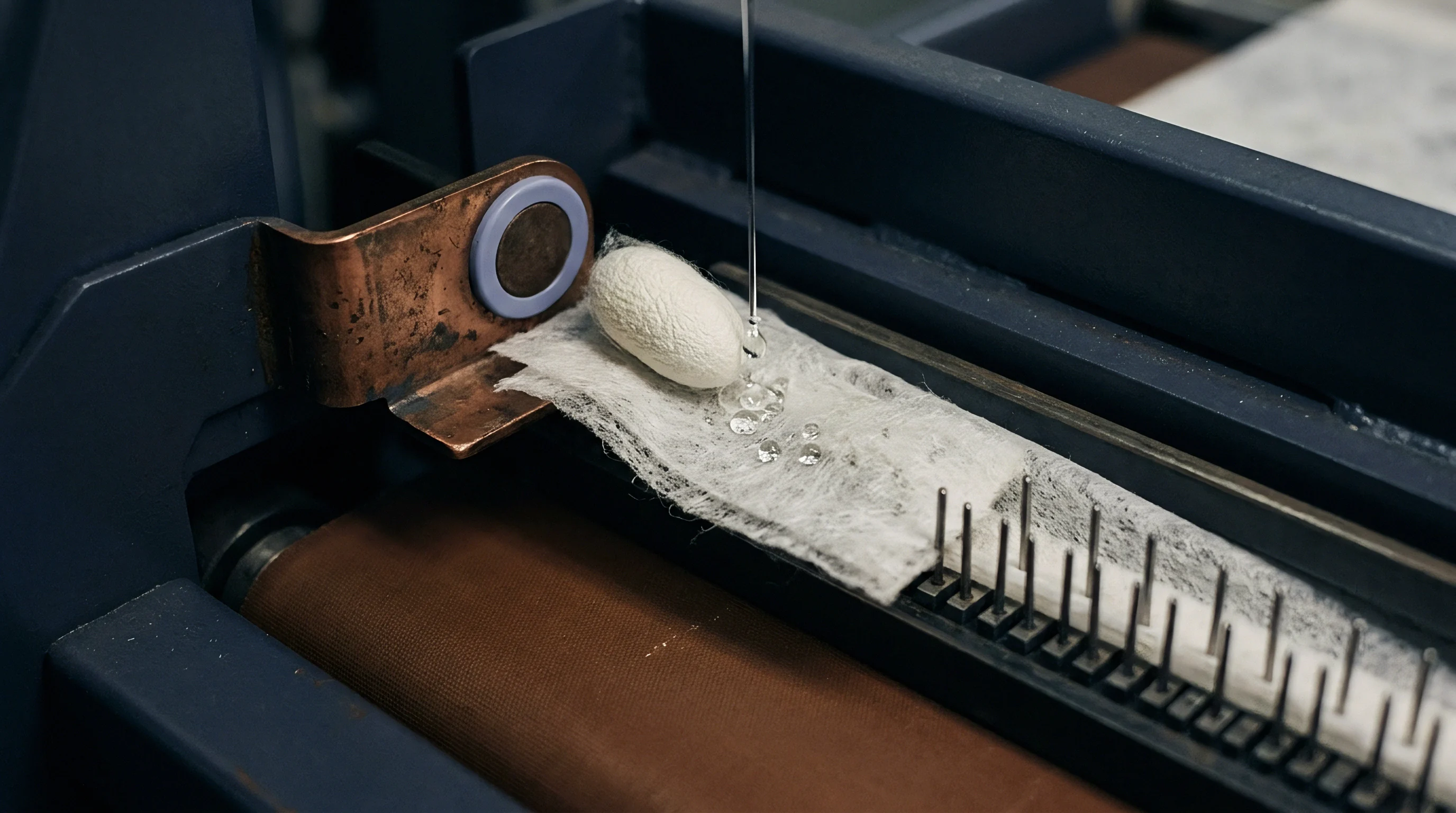

Pretreatment
Technicians pressed for immediate blend certificates often skip the initial Soxhlet wash. Skipping this solvent extraction, however, introduces systematic errors into quantitative chemical analysis. Loom-state yarns and finished fabrics carry substantial non-fibrous additives ~ paraffin waxes, synthetic spin finishes, lubricating oils, warp sizes, and residual dye auxiliaries ~ coating the filament surface.
These additives artificially inflate the baseline dry mass of the specimen before chemical dissolution even starts.
Unwashed specimens skew quantitative results through two opposing mechanisms. Lipophilic finishes that resist aqueous reagents remain on the insoluble residue, artificially inflating the mass fraction of the resistant fibre. Conversely, water-soluble sizes and emulsified oils dissolve into the solvent alongside the target polymer, causing excess mass loss that inflates the calculated percentage of soluble fibre.
Standard analytical protocols like ISO 1833-1 and AATCC Method 20A mandate extracting non-fibrous matter using petroleum ether or tertiary solvents before applying selective reagents.
The degree of distortion depends on yarn construction and processing. Continuous synthetic filaments carry spin finishes between 0.5 percent and 1.5 percent by mass. Heavy warp sizing on ring-spun cotton yarns can deposit starch, polyvinyl alcohol, or synthetic waxes exceeding 8 percent of total dry weight.
Scoured wool tops retain residual grease and carding oils between 0.8 percent and 2.2 percent. On a nominal 60/40 polyester/cotton woven fabric with 6 percent warp size, skipping extraction shifts the apparent blend ratio by over two percentage points ~ enough to push the material outside trade contract tolerances.
Measuring extractable matter directly requires a closed-loop Soxhlet apparatus run through a set cycle count. Petroleum ether boiling between 40 degrees Celsius and 60 degrees Celsius extracts neutral fats, waxes, and mineral oils without attacking natural or synthetic polymers. A secondary wash with cold water removes water-soluble sizes, finishing agents, and inorganic salts.
The mass loss across both stages establishes the non-fibrous extractable value, recorded as parameter S in formal equations.
| Substrate Blend | Target Non-Fibrous Contaminant | Extraction Solvent | Soxhlet Cycle Rate | Reflux Duration | Typical Extraction Yield Range |
|---|---|---|---|---|---|
| Cotton and Polyester Woven | Starch, PVA, paraffin wax size | Petroleum ether followed by water | 12 to 15 cycles per hour | 4 hours ether, 1 hour water | 3.5% to 8.2% dry mass |
| Wool and Polyamide Top | Carding lubricant, residual suint | Dichloromethane or petroleum ether | 10 to 12 cycles per hour | 3 hours continuous | 0.8% to 2.4% dry mass |
| Viscose and Elastane Knit | Silicone oil, needle lubricant | Light petroleum distillate | 15 cycles per hour | 2.5 hours continuous | 1.2% to 3.1% dry mass |
| Acrylic and Cellulosic Blends | Spinning finish, antistatic agents | Methanol or petroleum ether | 12 cycles per hour | 3 hours continuous | 0.6% to 1.8% dry mass |
Determining the precise dry mass of the cleaned specimen requires controlled drying. Residual petroleum ether evaporates quickly at room temperature, but water-washed specimens retain moisture deep within hydrophilic amorphous regions. Samples must be dried in a ventilated oven at 105 degrees Celsius plus or minus 2 degrees Celsius to constant mass ~ defined as consecutive weighings twenty minutes apart differing by less than 0.1 percent of specimen mass.
This step grounds all subsequent calculations on the clean dry fibre weight.
In high-throughput commercial testing, open-beaker agitation is often substituted for Soxhlet refluxing. Swirling specimens in warm solvent fails to reach equilibrium saturation inside dense yarns. High-twist ring-spun yarns and tight industrial weaves retain up to forty percent of their spin finish after rapid beaker washes.
That residual finish persists into the selective dissolution phase, leaving unextracted mass on the filter crucible and overestimating the insoluble fibre component. This analytical defect frequently appears when reviewing supplier laboratory certificates submitted for customs origin audits.
- Dry the loose sample lot in a weighing bottle at 105 degrees Celsius for one hour to drive off free surface moisture.
- Place the dried sample into a Soxhlet extraction thimble and fit the thimble into the extraction chamber above a boiling flask containing petroleum ether.
- Reflux the solvent for a minimum of sixteen cycles over two hours, verifying that the solvent dripping from the thimble runs clear and leaves no oily residue upon evaporation on a watch glass.
- Remove the specimen from the thimble, rinse thoroughly with distilled water at 50 degrees Celsius for ten minutes to dissolve water-soluble sizes, and squeeze out excess moisture.
- Oven-dry the extracted specimen at 105 degrees Celsius until reaching constant mass, then cool inside a glass desiccator over fresh silica gel before recording the pretreated dry mass.
Calculating clean dry mass relies on establishing an accurate pre-dissolution baseline. If m0 is the initial dry mass before pretreatment and m1 is the dry mass after extraction and washing, the non-fibrous content percentage S is calculated as (m0 – m1) / m0 multiplied by 100. All subsequent dissolution steps use m1 as the reference denominator so that non-polymeric impurities do not distort the structural blend ratio.
High-molecular-weight silicone lubricants do not vaporize during oven drying; at 105 degrees Celsius, they decompose into non-volatile siloxane residues that remain in the specimen, altering chemical dissolution measurements.
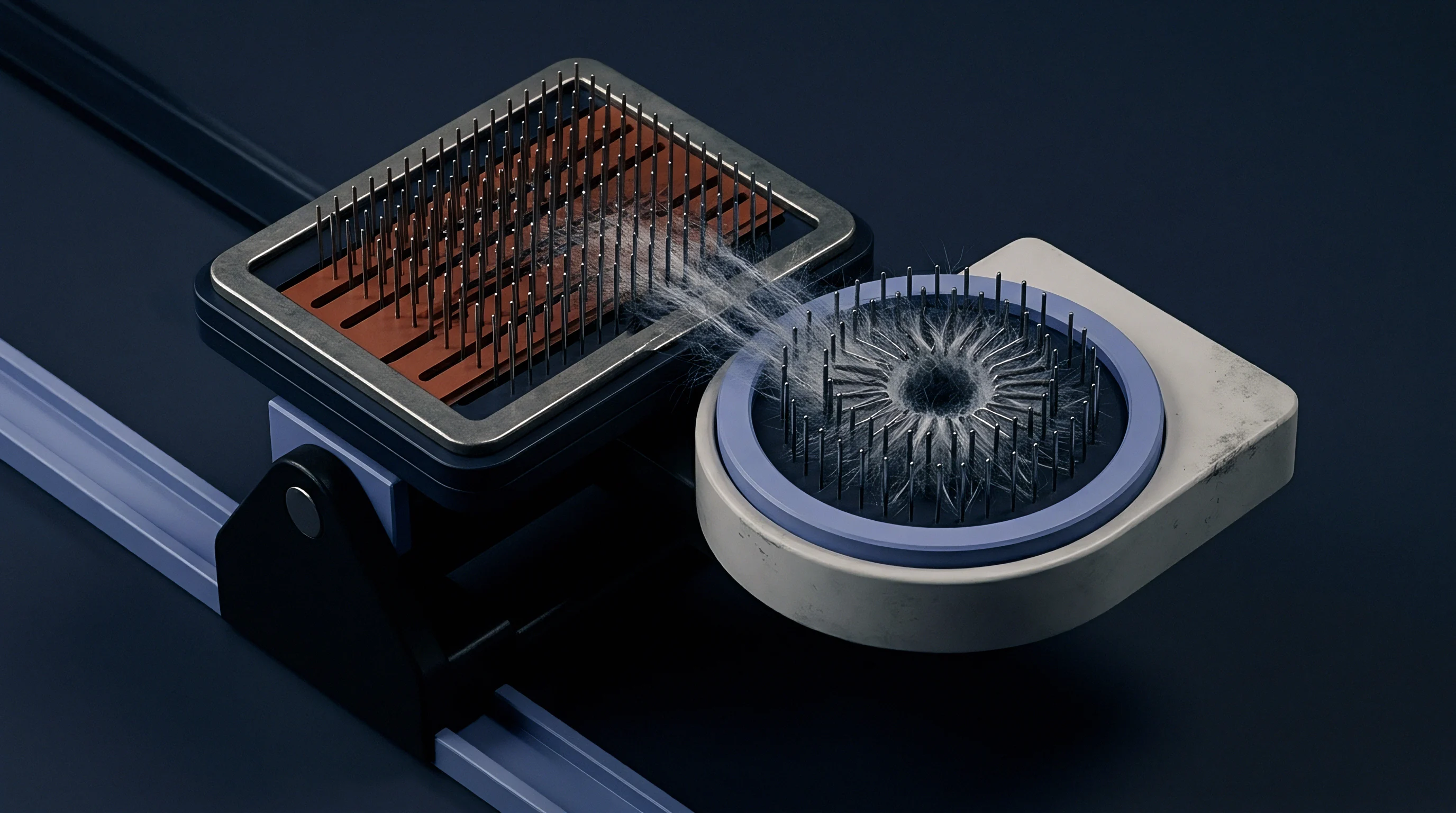
Flask
Reagent purity and vessel mechanics govern the precision of quantitative fibre separation. When adding a pretreated binary blend to a reaction vessel, selectivity depends on maintaining tight control over reagent concentration, temperature, and liquor ratio. Standard methods assume reagents dissolve one component completely while leaving the other untouched.
In practice, chemical selectivity is rarely absolute; slight attack on the resistant fibre or incomplete dissolution of the soluble one is an inherent constraint of wet quantitative analysis.
The selective dissolution of cellulosics from synthetic blends shows how narrow this margin is. Method 3 of ISO 1833 uses seventy-five percent concentrated sulfuric acid to dissolve cotton, viscose, or cupro from polyester, polyamide, or polypropylene. The specimen is shaken in a stoppered conical flask with one hundred millilitres of acid per gram of fibre at room temperature for thirty minutes.
Concentrated acid cleaves glycosidic bonds in cellulose, converting insoluble microfibrils into soluble low-molecular-weight glucose derivatives. If ambient moisture dilutes the acid below seventy-three percent, cellulose dissolution slows and leaves microscopic residues on the crucible. If concentration exceeds seventy-seven percent, the acid degrades polyamide or polyester surfaces, causing artificial loss of insoluble mass.
To adjust for reagent attack on the insoluble component, analysts use the solubility correction factor, or d-factor. This factor represents the mass ratio of the resistant fibre before and after reagent exposure under identical test conditions. A d-factor of 1.00 reflects no mass loss.
A factor of 1.02 indicates that the insoluble fibre loses two percent of its dry mass, requiring the residual crucible mass to be multiplied by 1.02. Standardized d-factors are derived empirically by exposing pure reference fibres to target reagents.
| Dissolved Fibre Class | Residue Fibre Class | Reagent and Concentration | Reaction Temp | Agitation Time | Standard d-Factor |
|---|---|---|---|---|---|
| Viscose or Cupro | Cotton | Zinc chloride and formic acid | 40 degrees C | 45 minutes | 1.02 for Cotton |
| Polyamide 6 or 6.6 | Polyester or Acrylic | 80% Formic acid solution | 20 degrees C | 15 minutes | 1.00 for Polyester |
| Acetate | Cellulosic or Synthetic | Acetone reagent grade | 20 degrees C | 30 minutes | 1.00 for Cotton |
| Natural Silk | Wool or Hair Fibres | 75% Alkaline copper ethylenediamine | 25 degrees C | 30 minutes | 1.01 for Wool |
| Cotton or Cellulosic | Polyester or Polyolefin | 75% Sulfuric acid solution | 50 degrees C | 60 minutes | 1.01 for Polyester |
Applying the d-factor requires tracking mass precisely across each analytical step. Take a pretreated dry 2.0000-gram specimen of a polyester/cotton blend. The cotton dissolves in seventy-five percent sulfuric acid, leaving the polyester as a porous mat on a grade 2 sintered glass crucible.
Following vacuum filtration, neutralization with dilute ammonia, water rinsing, and oven drying at 105 degrees Celsius, the dry residual polyester weighs 0.8000 grams. Uncorrected, the apparent blend ratio is 0.8000 divided by 2.0000, or 40.00 percent polyester and 60.00 percent cotton.
Applying the standard 1.01 d-factor for polyester exposed to seventy-five percent sulfuric acid adjusts the mass. Multiplied by 1.01, the true dry polyester mass becomes 0.8080 grams, bringing the corrected clean dry polyester fraction to 40.40 percent and cotton to 59.60 percent. A shift of 0.40 percent seems minor in laboratory settings, but it can alter commercial classifications when bulk shipments clear tariff borders.
Standard test methods mandate applying specific solubility correction factors to raw residual dry masses before calculating clean component proportions.
Temperature control during dissolution is another critical variable. Acrylic fibres dissolve readily in dimethylformamide at 60 degrees Celsius, but exceeding 65 degrees Celsius causes rapid degradation of co-blended wool or silk. Wool proteins hydrolyze in hot polar organic solvents, breaking disulfide bonds and releasing soluble peptides into the reagent.
The resulting residue weighs less than it should, underreporting wool content. Precise temperature regulation using circulating water baths accurate to plus or minus 0.5 degrees Celsius protects the insoluble fraction.
Post-consumer textile waste introduces structural variations that test standard d-factors. Mechanically recycled polyester often exhibits surface damage and lower intrinsic viscosity, making it more vulnerable to acid attack during cellulosic dissolution. Using virgin polyester d-factors for recycled blends underestimates polymer mass loss.
Testing facilities must calibrate baseline d-factors on pure samples of recycled polymer before certifying blend compositions.
Relying on an uncalibrated d-factor for mechanically recycled cotton blended with virgin nylon risks severe commercial penalties. When degraded recycled cotton loses four percent of its mass in cold formic acid, the laboratory reports an inflated nylon content, which can trigger customs misdeclaration claims.
Moisture
Clean dry mass fractions derived from solvent extraction do not equal commercial trading weights. Fibres absorb water vapor from ambient air based on polymer structure and relative humidity. Cellulosic and protein fibres contain abundant hydroxyl and amino groups within amorphous regions, giving them high hygroscopicity.
Non-polar synthetics like polyester and polypropylene absorb negligible moisture under standard conditions. Commercial contracts, customs classifications, and invoice weight settlements depend on commercial mass rather than absolute dry mass.
Under ISO 6741, commercial mass is defined as clean dry mass plus officially agreed moisture allowances, known as commercial regains. Standard regains are established by regulatory bodies and trade organizations such as the International Wool Textile Organisation and BISFA to standardize trading across different climates and prevent weight disputes after ocean transit. In wool trade transactions, payment covers clean dry mass plus an official 18.25 percent regain for combed wool top, regardless of whether physical moisture at arrival measures 12 percent or 15 percent.
Converting clean dry mass percentages into commercial mass percentages requires applying official regains to component dry weights. Standard regain rates vary widely: cotton carries an official allowance of 8.50 percent, viscose staple 13.00 percent, regular polyester staple 1.50 percent, polyamide 6.6 staple 6.25 percent, wool top 18.25 percent, and acrylic staple 2.00 percent. These differences shift relative mass proportions when transitioning from dry test figures to commercial trading weights.
| Fibre Classification | Commercial Moisture Regain Rate | Clean Dry Mass Multiplier | Commercial Mass of 100kg Dry Fibre | Governing Standard Body |
|---|---|---|---|---|
| Combed Wool Top | 18.25% | 1.1825 | 118.25 kg | IWTO Regulations |
| Viscose Staple Fibre | 13.00% | 1.1300 | 113.00 kg | BISFA Standards |
| Cotton Carded or Combed | 8.50% | 1.0850 | 108.50 kg | ISO 6741-1 |
| Polyamide 6 or 6.6 Staple | 6.25% | 1.0625 | 106.25 kg | BISFA Standards |
| Polyester Staple Fibre | 1.50% | 1.0150 | 101.50 kg | ISO 6741-2 |
| Acrylic Staple Fibre | 2.00% | 1.0200 | 102.00 kg | BISFA Standards |
The formula for calculating the commercial mass percentage of component A in a binary blend combines clean dry masses mA and mB with regain rates rA and rB. Commercial mass MA equals mA multiplied by (1 + rA/100), and MB equals mB multiplied by (1 + rB/100). The commercial mass percentage of component A is MA divided by (MA + MB), multiplied by 100.
Omitting this calculation leaves the buyer with clean dry proportions that misstate commercial material value.
Consider a binary yarn of viscose and polyester. Extraction and d-factor adjustments yield a clean dry mass of 50.00 grams viscose and 50.00 grams polyester in a 100.00-gram dry sample ~ a 50.00/50.00 dry split. Applying commercial regains alters these figures: viscose (13.00 percent regain) has a commercial mass MA of 50.00 multiplied by 1.1300, or 56.50 grams; polyester (1.50 percent regain) yields an MB of 50.00 multiplied by 1.0150, or 50.75 grams.
Total commercial mass equals 56.50 plus 50.75, or 107.25 grams. Viscose commercial mass percentage calculates to 56.50 divided by 107.25 multiplied by 100, yielding 52.68 percent, while polyester calculates to 47.32 percent. The regain calculation moves the declared composition 2.68 percentage points away from the clean dry baseline.
On a ten-ton order, that adjustment reallocates 268 kilograms of material between cellulosic and synthetic accounting lines.
Contractual composition specifications without an explicitly cited mass basis default to commercial mass incorporating official international regain rates.
Atmospheric conditioning in testing rooms must comply with ISO 139 to prevent moisture drift during weighing. Standard testing conditions require 20.0 degrees Celsius plus or minus 2.0 degrees Celsius and 65.0 percent relative humidity plus or minus 4.0 percent. Where climate control fluctuates, dry crucibles containing hygroscopic residues like viscose or wool absorb ambient moisture rapidly between the desiccator and the balance.
Gaining 5 milligrams of water in thirty seconds distorts analytical results.
Weighing hygroscopic natural fibres requires ground-glass stoppered weighing bottles during tare and residue weighings, alongside balances with 0.1 milligram resolution. In blended fabrics, high-regain fibres pull commercial mass toward their category, reducing the relative weight share of non-hygroscopic synthetics.
Commercial price adjustments depend on commercial mass calculations rather than scale-weight arrivals recorded in humid port warehouses.

Variance
Solvent extraction test results carry statistical uncertainty caused by sampling variations, chemical measurement limits, and operator execution. Understanding this variance helps procurement teams distinguish routine laboratory scatter from actual supplier misrepresentation. Standard test protocols like ISO 1833 define confidence limits for repeatability and reproducibility.
Repeatability measures the maximum acceptable difference between two single test results on the same material by one operator using identical equipment in one lab. Reproducibility measures the maximum expected difference between single results from different laboratories testing the same batch.
Under ISO 1833, the ninety-five percent confidence limit for repeatability r generally spans 0.5 to 1.2 percentage points, depending on the fibre blend and reagent. Reproducibility R ranges between 1.0 and 2.0 percentage points. If Laboratory A tests a polyester/cotton fabric and reports 65.4 percent polyester, while Laboratory B reports 63.8 percent polyester on a duplicate swatch, the 1.6 percentage point difference falls within expected inter-laboratory variance rather than indicating testing error.
Commercial specifications manage analytical spread through defined tolerance limits. European Union Regulation 1007/2011 allows a 3.0 percentage point manufacturing tolerance between declared and tested blend ratios for binary mixtures. United States Federal Trade Commission regulations permit a matching 3.0 percent tolerance band.
This allowance accounts for fiber distribution shifts during carding and spinning alongside laboratory measurement variance. Private supply contracts frequently specify tighter tolerances of 1.0 or 1.5 percentage points for technical fabrics or high-grade yarns.
Sampling introduces more variance than analytical bench work. A swatch taken from the outer wrap of a fabric roll rarely reflects an entire multi-bale shipment. Fiber distribution in carded webs varies locally, and differences in staple length or denier cause radial segregation during spinning.
Obtaining a representative sample requires taking composite swatches across multiple rolls, discarding at least the outer three meters to avoid edge contamination.
Residual solvent mass can alter invoice tariff lines when non-fibrous extraction is incomplete.
Systematic sampling prevents location bias when taking specimens from bulk shipments. Swatches should be cut across the full usable fabric width, excluding five centimeters of selvedge on each side, and collected diagonally along the roll to capture variations in warp ends and filling runs. Combining these cuts into a 10-gram composite specimen averages local yarn fluctuations to establish a solid baseline mass.
When laboratories produce conflicting results on high-value lots, formal dispute resolution relies on referee testing. Both parties select an accredited neutral laboratory to test archived referee samples sealed in airtight moisture-barrier bags at initial sampling. The reference facility runs six parallel replicates following standardized pretreatment, d-factor, and commercial regain protocols, using the mean of these runs as the binding settlement value.
Statistical variance increases in ternary and quaternary blends. Analyzing a three-component blend of wool, polyamide, and viscose requires two sequential dissolutions with different reagents. The residue from the first dissolution forms the starting mass for the second, compounding errors from extraction, primary d-factors, crucible transfers, and secondary d-factors.
Repeatability limits expand to 2.5 percentage points for ternary blends, necessitating larger replicate sets.
Whether unextracted sizing agents in complex ternary blends cause systematic laboratory biases large enough to alter customs tariff classifications remains a subject of ongoing study among trade compliance committees.

Classification
Customs authorities classify textiles under the Harmonized System using strict weight-based rules. Chapter 52 covers cotton, Chapter 54 filament synthetics, Chapter 55 staple synthetic fibers, and Chapter 51 wool. Heading assignment depends on which fiber predominates by weight, where a shift of one-tenth of a percent across a 50 percent threshold can reclassify a shipment into a different tariff line, altering duty rates, trade preference eligibility, and quota constraints.
Take a woven fabric made from spun cotton and polyester staple yarn. Under Harmonized System rules, if cotton accounts for 50 percent or more of total fiber weight, the fabric classifies under HS 5210 or 5211. If polyester exceeds 50 percent, classification shifts to HS 5513 or 5514.
In many jurisdictions, the duty difference between cotton-chief and polyester-chief fabrics exceeds six ad valorem percentage points, and trade sanctions or anti-dumping duties often target synthetic lines while sparing natural fibres.
| Nominal Trade Description | Laboratory Composition Result | Correct Customs HS Code | Base Duty Rate Band | Commercial Financial Consequence |
|---|---|---|---|---|
| Cotton Predominant 51/49 Poly | 49.2% Cotton / 50.8% Poly (Dry) | HS 5514.11 (Polyester Chief Wt) | 12.0% ad valorem | Higher duty rate applied to total shipment landed cost |
| Cotton Predominant 51/49 Poly | 51.4% Cotton / 48.6% Poly (Comm) | HS 5210.11 (Cotton Chief Wt) | 7.5% ad valorem | Lower duty rate applied following commercial regain adjustment |
| Wool Predominant 52/48 Nylon | 48.5% Wool / 51.5% Nylon (Unwashed) | HS 5407.52 (Synthetic Chief Wt) | 14.9% ad valorem | Misdeclaration claim plus duty difference assessment |
| Wool Predominant 52/48 Nylon | 52.1% Wool / 47.9% Nylon (Clean) | HS 5111.11 (Wool Chief Wt) | 6.0% ad valorem | Duty rate validated after non-fibrous size removal |
Discrepancies between clean dry test figures and commercial mass calculations create compliance risks during customs audits. Test reports that omit commercial regain adjustments reflect dry mass proportions. For a 51/49 cotton/polyester blend, dry testing may yield 49.8 percent cotton and 50.2 percent polyester, as cotton loses moisture in oven drying while polyester holds almost none.
Filing entry under HS Chapter 55 based on that unadjusted dry report misclassifies the goods as polyester chief weight, resulting in higher duty payments.
Recalculating the same lab data using official commercial moisture regains reverses the chief weight determination. Applying 8.5 percent regain to cotton and 1.5 percent to polyester adjusts the ratio to 51.5 percent cotton and 48.5 percent polyester on a commercial basis, placing the fabric under HS Chapter 52 as cotton chief weight. Enforcing commercial mass adjustments in the analytical record legally secures the lower duty rate across containerized shipments.
Customs authorities impose penalties, back duties, or shipment seizures when lab audits invalidate declared fiber content. Customs laboratories use thorough solvent extractions and standard d-factors. If an importer submits a certificate based on unwashed samples, customs testing will show higher synthetic contents due to unextracted spin finish, triggering misdeclaration claims and invalidating trade preference benefits under agreements like USMCA or the EU-Vietnam FTA.
- Unextracted finish inflation occurs when supplier test certificates omit petroleum ether pretreatment, causing spin finishes to act as false synthetic mass during classification reviews.
- Unadjusted dry mass submission happens when importers file customs entries using raw dry lab percentages without applying mandatory ISO 6741 commercial moisture regain additions.
- Omitted d-factor application arises when testing technicians fail to apply standard solubility correction factors, artificially understating the mass of acid-exposed resistant polymers.
- Invalid sample size Selection occurs when custom entries rely on single-roll swatches that fail to reflect average production lot variation across containerized shipments.
Rules of Origin enforce regional value content and tariff shift rules tied to fiber weight thresholds. Under many preference agreements, a fabric containing over 7 percent non-originating elastomeric yarn by weight fails origin criteria unless specific tolerance rules apply. Quantitative chemical extraction ~ dissolving elastane in dimethylacetamide at 70 degrees Celsius ~ determines whether non-originating content remains below statutory de minimis limits.
Customs Entry Standard Operating Procedures state: All textile fiber composition declarations must specify whether percentages reflect clean dry mass or commercial mass incorporating official international regain rates under ISO 6741-1.

Dossier
Validating commercial mass in bulk transactions requires a clear reconciliation ledger connecting raw scale weights to adjusted billing totals. A practical example shows how pretreatment, d-factor adjustments, and commercial moisture regains work together. Consider a contract for 10,000 kilograms of tri-blend yarn specified as 50 percent wool, 30 percent viscose, and 20 percent polyamide 6.6.
Receiving warehouse scales record a landed weight of 10,150 kilograms under ambient conditions.
Technicians draw a 500-gram composite sample across twenty yarn packages and prepare duplicate 10.000-gram test specimens for analysis under ISO 1833. Initial specimen mass m0 is 10.000 grams. Petroleum ether Soxhlet extraction and hot water washing yield a non-fibrous extractable content S of 2.50 percent from carding oils and lubricants, leaving a clean dry pretreated mass m1 of 9.750 grams.
Sequential dissolution begins with Method 1, using 80 percent formic acid to dissolve the polyamide. The remaining dry residue of wool and viscose weighs 7.820 grams. Applying standard d-factors of 1.00 for both wool and viscose in cold formic acid, the dry polyamide mass mPA is 9.750 minus 7.820, or 1.930 grams, representing 19.79 percent of the pretreated dry mass.
Secondary dissolution of the 7.820-gram residue with cold zinc chloride and formic acid removes the viscose, leaving 4.780 grams of dry wool residue mWool. Applying the 1.02 d-factor for wool exposed to zinc chloride and formic acid adjusts the dry wool mass mWool,corr to 4.780 multiplied by 1.02, or 4.876 grams. Clean dry viscose mass mViscose is 7.820 minus 4.876, yielding 2.944 grams.
Combining corrected dry weights gives 4.876 grams wool, 2.944 grams viscose, and 1.930 grams polyamide, totaling 9.750 grams clean dry mass m1. On a dry percentage basis, the blend measures 50.01 percent wool, 30.19 percent viscose, and 19.80 percent polyamide ~ matching nominal specifications closely. Final settlement, however, requires converting these figures using official commercial moisture regains.
| Fiber Component | Clean Dry Mass (Specimen) | Clean Dry Proportion | ISO Commercial Regain Rate | Commercial Mass Factor | Commercial Mass Proportion |
|---|---|---|---|---|---|
| Combed Wool | 4.876 g | 50.01% | 18.25% | 5.766 g | 52.79% |
| Viscose Staple | 2.944 g | 30.19% | 13.00% | 3.327 g | 30.46% |
| Polyamide 6.6 | 1.930 g | 19.80% | 1.025 g (6.25%) | 2.051 g | 18.75% |
| Total Blend Lot | 9.750 g | 100.00% | Weighted: 12.03% | 10.944 g | 100.00% |
Applying ISO 6741 regains to clean dry specimen masses determines commercial mass values. Wool (18.25 percent regain) yields a commercial mass of 4.876 multiplied by 1.1825, or 5.766 grams. Viscose (13.00 percent regain) yields 2.944 multiplied by 1.1300, or 3.327 grams.
Polyamide (6.25 percent regain) yields 1.930 multiplied by 1.0625, or 2.051 grams. Total specimen commercial mass equals 5.766 + 3.327 + 2.051 = 10.944 grams.
Dividing component commercial masses by the 10.944-gram total yields final commercial proportions: Commercial Wool is 5.766 divided by 10.944, or 52.79 percent; Commercial Viscose is 3.327 divided by 10.944, or 30.46 percent; Commercial Polyamide is 2.051 divided by 10.944, or 18.75 percent. Wool’s high moisture capacity increases its commercial share by 2.78 percentage points over its dry mass baseline, while polyamide drops by 1.05 percentage points.
Reconciling invoice weights starts with total clean dry mass for the 10,150-kilogram shipment. Deducting 2.50 percent non-fibrous content leaves 9,896.25 kilograms of clean moist fiber. Oven drying lot samples establishes physical moisture at 11.20 percent, giving a net clean dry lot weight of 9,896.25 divided by 1.1120, or 8,899.50 kilograms.
Multiplying 8,899.50 kilograms clean dry mass by commercial composition percentages yields billing weights: Commercial Wool weight is 8,899.50 multiplied by 52.79 percent, or 4,698.05 kilograms; Commercial Viscose weight is 8,899.50 multiplied by 30.46 percent, or 2,710.79 kilograms; Commercial Polyamide weight is 8,899.50 multiplied by 18.75 percent, or 1,668.66 kilograms. Adding non-fibrous allowances brings total official billing weight to 9,970.20 kilograms.
Comparing warehouse scale weight (10,150.00 kg) against commercial billing weight (9,970.20 kg) exposes a short-weight difference of 179.80 kilograms. Scale weight reflected transit moisture absorption and excess spinning oil beyond contract limits. The buyer issues a debit note adjusting the invoice from 10,150 kilograms to 9,970.20 kilograms.
A complete audit dossier incorporating solvent extraction corrections, d-factors, and ISO regains protects capital and supports legal commercial settlement.
Commercial contracts enforcing these mathematical adjustments prevent suppliers from billing water as high-value fiber mass.