Modeling Hydrolyzed Reactive Dye Diffusion Resistance in High Cover Factor Cotton Twills
High cover factor twills restrict intra-yarn mass transport, requiring wash-off temperatures above 85 degrees Celsius to desorb trapped hydrolyzed reactive dye.
Grid
Twill architecture sets physical boundaries for fluid movement and solute transport during wet processing. In high cover factor cotton twills, where total fabric cover exceeds 0.88 under Peirce’s geometric model, warp and weft yarns are packed tightly together. This packing squeezes the spaces between adjacent yarns, turning what would be open capillary channels in low-density plain weaves into narrow, tortuous micro-passages.
For a 3/1 Z-twill woven from 30s Ne combed cotton warp and 20s Ne ring-spun weft, fractional cover factor and geometric packing density directly dictate the channel diameters available for dye liquor and dissolved chemicals to move through.
As crimp redistributes during weaving, individual fiber bundles compress at crossover points, flattening yarn cross-sections from circular into elliptical profiles. This reduces the inter-yarn void fraction while raising the yarn core’s internal packing factor to between 0.65 and 0.72. Void volume for free liquor flow collapses accordingly.
Fluid can no longer move freely through the fabric matrix by bulk flow; transport shifts entirely to diffusion through constricted inter-yarn channels and the dense fiber network inside the yarn itself.
Yarn Packing and Hydraulic Permeability Metrics
Analyzing liquid transit through dense twills requires accounting for yarn sett, linear density, and float length. Long warp floats in a 3/1 twill allow higher pick insertion rates than a 1/1 plain weave of the same yarn count. That higher picking density creates a dense fabric face with asymmetric pore dimensions between the warp-dominated face and weft-dominated back.
Hydraulic permeability in the greige fabric scales with effective pore radius and decreases with higher tortuosity in the inter-yarn voids.
| Fabric Construction Specification | Ends x Picks per cm (Finished) | Fractional Cover Factor (K_c) | Inter-Yarn Void Fraction (ε_inter) | Calculated Tortuosity Factor (τ) | Greige Air Permeability (mm/s at 100 Pa) |
|---|---|---|---|---|---|
| 3/1 Z-Twill 30/1 Ne x 20/1 Ne | 42.0 x 24.0 | 0.895 | 0.182 | 1.84 | 145 ± 6 |
| 3/1 Z-Twill 20/1 Ne x 16/1 Ne | 38.0 x 21.0 | 0.922 | 0.145 | 2.15 | 92 ± 4 |
| 2/2 S-Twill 24/2 Ne x 24/2 Ne | 34.0 x 28.0 | 0.881 | 0.198 | 1.68 | 180 ± 8 |
| 2/1 Z-Twill 40/2 Ne x 30/1 Ne | 48.0 x 28.0 | 0.941 | 0.121 | 2.48 | 68 ± 3 |
Cover factor and pore geometry share a non-linear relationship. Once total cover factor exceeds 0.90, small increases in thread count cause exponential rises in fluid resistance. In ultra-dense 2/1 twills, the inter-yarn void fraction falls below 0.15, forcing liquid through micro-capillaries barely wider than individual cotton fiber convolutions.
At that point, fabric geometry sets a hard physical limit on how fast chemical reagents can enter or exit the yarn core during batch or continuous processing.
In heavy cotton 3/1 twills with a cover factor exceeding 0.92, inter-yarn void volume falls below 15 percent of total fabric volume, elevating structural flow tortuosity above 2.1.
Hydraulic flow through this constricted pore network follows modified Darcy kinetics with an anisotropic permeability tensor. Long warp floats offer a path of lower resistance across the face of the fabric, whereas flow through the fabric thickness meets heavy resistance at yarn crossovers. This anisotropy drives liquor along warp floats instead of pushing it evenly through the fabric thickness.
Adding swelling agents or alkaline buffers compounds the issue, as swollen fibers narrow the hydraulic radius of both inter-yarn and intra-yarn capillaries further.

Capillary Constriction Mechanics in High-Density Weaves
Cotton fibers swell significantly in water, altering pore structure throughout the dyeing cycle. Raw cell wall cellulose absorbs water and expands up to 14 percent laterally, while axial length increases by less than 2 percent. In a high cover twill where adjacent threads physically restrict yarn movement, this lateral expansion directly consumes what remains of the inter-fiber void space inside the yarn bundle.
This loss of internal void volume changes how mass transfer occurs. In unswollen fabric, circulation pressure drives solute through wider inter-fiber gaps via convection. Under alkaline conditions, however, fiber swelling narrows those gaps below 100 nanometers.
Bulk fluid movement stops at that scale, leaving solute transport entirely dependent on diffusion through a swollen, gel-like cellulosic matrix bounded by tightly locked yarn crossovers.
- Warp Float Length sets how long individual yarn segments sit in open contact with bulk liquor before crossing a perpendicular yarn.
- Yarn Twist Multiplier dictates internal fiber packing density and initial capillary suction before alkaline swelling begins.
- Crimp Balance Ratio controls relative warp and weft undulation amplitude, altering trans-planar flow resistance across fabric sides.
- Effective Thread Jamming marks the point where yarn systems enter lateral mechanical compression during wet relaxation.
These geometric parameters set the baseline for evaluating mass transfer kinetics. High cover twills create a physical barrier to uniform liquor penetration well before dye reactivity or fastness properties come into play. Ultimately, fabric construction defines the spatial geometry in which all wetting, diffusion, and extraction take place.

Hydrolysis
Reactive dyeing relies on covalent bond formation between nucleophilic cellulate anions and electrophilic dye groups. In baths containing sodium carbonate or sodium hydroxide, hydroxyl ions (OH-) compete directly with cellulate anions (Cell-O-) for active electrophilic sites. This competing reaction yields hydrolyzed dye ~ a derivative that cannot covalently bond to cellulose, even though it retains its original chromophore and solubilizing sulfonic acid groups.
At constant temperature and alkali concentration, reactive dye hydrolysis follows pseudo-first-order kinetics relative to dye concentration. Monochlorotriazine (MCT) dyes undergo nucleophilic aromatic substitution: hydroxyl ions attack the electron-deficient triazine ring, displacing chloride to form a hydroxytriazine derivative. Vinyl sulfone (VS) dyes undergo nucleophilic addition instead; the active vinyl sulfone group ~ formed in situ from beta-sulfatoethylsulfone via alkali elimination ~ reacts with water to produce 2-hydroxyethylsulfone.

Chemical Structure and Hydrolysis Kinetics
Molecular structure dictates both hydrolysis rate and the final equilibrium ratio between fixed and hydrolyzed dye. Heterobifunctional dyes containing both monochlorotriazine and vinyl sulfone groups show distinct, multi-stage hydrolysis behavior. The vinyl sulfone group activates at lower temperatures (50 to 60 degrees Celsius) and moderate pH (10.8 to 11.2), while the monochlorotriazine group requires higher temperatures (75 to 80 degrees Celsius) or higher pH (11.5 to 12.2) to react efficiently.
| Dye Reactive Class | Dominant Reaction Mechanism | Fixation Temp (°C) | Hydrolysis Rate Constant k_h (min^-1) | Primary Hydrolyzed By-Product | Substantivity Index (S) Hydrolyzed Form |
|---|---|---|---|---|---|
| Dichlorotriazine (DCT) | Bimolecular Substitution (S_N2) | 40 – 50 | 0.045 – 0.082 | Dihydroxy- / Monohydroxy-triazine | High (0.65 – 0.75) |
| Monochlorotriazine (MCT) | Bimolecular Substitution (S_N2) | 80 – 85 | 0.012 – 0.028 | Monohydroxytriazine | Moderate (0.45 – 0.55) |
| Vinyl Sulfone (VS) | Nucleophilic Addition (Ad_N) | 60 – 65 | 0.025 – 0.050 | 2-Hydroxyethylsulfone | Moderate-Low (0.35 – 0.48) |
| MCT / VS Heterobifunctional | Mixed S_N2 and Ad_N | 60 – 70 | 0.018 – 0.035 | Mixed Hydroxy Derivatives | High (0.58 – 0.70) |
Hydrolyzed dyes present persistent operational challenges because they retain substantive affinity for cotton cellulose. Hydrolysis removes reactivity without altering the planar aromatic structure, hydrogen bonding sites, or Van der Waals forces that cause affinity. Hydrolyzed dye molecules therefore adsorb onto fiber surfaces and enter internal pores alongside active dye, competing for volume within the swollen matrix.
Specific fastness failures are governed by ISO 105-E04 for perspiration and ISO 105-C06 for domestic laundering, where unextracted hydrolyzed reactive dye drives shade change and staining.
The substantivity of hydrolyzed dye (Sh) determines its distribution between fiber and dyebath at equilibrium. High Sh values mean hydrolyzed dye binds tightly to internal pore walls through non-covalent forces, creating a significant desorption barrier during rinsing. The dye will not rinse out easily; it must be thermally and thermodynamically desorbed from the cellulose before bulk wash-off can take place.

Substantivity and Partition Dynamics of Hydrolyzed Species
The partition coefficient (Kp) quantifies how hydrolyzed dye distributes between bulk solution and the swollen fiber interior. This value reflects electrostatic repulsion, hydrophobic interactions, and hydrogen bonding inside the capillary network. Because cotton cellulose develops a negative zeta potential in water, anionic sulfonic acid groups on hydrolyzed dye molecules face an electrostatic barrier at the fiber surface.
Adding electrolyte (sodium sulfate or sodium chloride) screens this surface charge and compresses the electrical double layer, allowing hydrolyzed dye molecules to come close enough for Van der Waals forces to take hold. In high cover factor twills, the electrolyte levels needed for fixation drive high substantivity inside tight inter-fiber spaces. Once fixation finishes and alkali is neutralized, this substantive portion stays trapped inside dense yarn cores.
- Sulfonic Acid Load sets aqueous solubility and the electrostatic barrier opposing adsorption onto fiber walls.
- Planar Chromophore Area determines dispersion force strength, driving non-covalent affinity for cellulose.
- Bath Electrolyte Strength screens surface repulsion, raising the partition coefficient of hydrolyzed dye in dense fiber zones.
- Liquor pH Stability governs vinyl sulfone regeneration rates relative to hydrolysis during high-temperature hold cycles.
Mill managers often assume cold water rinsing clears hydrolyzed dye effectively, but high-substantivity species cannot be removed by dilution alone. Switching from linear to exponential alkali dosing does not eliminate hydrolyzed dye in heavy twills, as that assumption ignores basic thermodynamics. Exponential dosing controls fixation kinetics to prevent surface unlevelness; it does not change the underlying ratio of hydrolysis to fixation.

Transport
Mass transport in dense cotton twills occurs across two distinct domains: convective bulk flow through channels between yarns, and hindered diffusion inside yarn bundles and swollen cell walls. Modeling hydrolyzed dye movement requires combining Darcy’s law for inter-yarn flow with a modified Fick’s second law for hindered diffusion in constrained pores. Within the saturated fiber matrix, a hydrolyzed dye molecule’s effective diffusion coefficient (Deff) drops far below its free diffusion coefficient (D0) in water.
At 80 degrees Celsius, free diffusion coefficients (D0) for reactive chromophores typically run between 2.5 × 10⁻⁶ and 5.0 × 10⁻⁶ cm2/s. Inside the swollen pore matrix of a compressed 3/1 twill, effective diffusion (Deff) falls by one to two orders of magnitude, down to 1.2 × 10⁻⁸ to 4.5 × 10⁻⁷ cm2/s. Tortuous flow paths, viscous friction along pore walls, and steric hindrance as dye molecular dimensions approach pore diameters combine to cause this drop.

Fickian and Hindered Pore Diffusion Modeling
Modeling transport through dense twills uses a modified Fickian equation incorporating fabric structural parameters. The one-dimensional transient mass transport of hydrolyzed dye along the thickness coordinate (z) of a saturated fabric sheet is expressed by:
fracpartial Cpartial t = fracD0 · varεintτ · Kp fracpartial2 Cpartial z2 – fracuzKp fracpartial Cpartial z
Here, C is hydrolyzed dye concentration in pore fluid, D0 is the bulk free diffusion coefficient, varεint is internal fiber porosity, τ is tortuosity, Kp is the fiber partition coefficient, and uz is the trans-planar fluid velocity driven by circulation pressure. In ultra-dense twills where uz approaches zero inside yarn cores, transport reduces to pure hindered diffusion governed by the ratio of solute molecular radius (rs) to pore radius (rp).
When Does Hydrolyzed Dye Diffusion Transition to Hindered Transport?
Transport shifts from open pore diffusion to sterically hindered diffusion when the radius ratio λ = rs / rp exceeds 0.10. In solution, hydrolyzed reactive dyes form hydrated species or aggregates with hydrodynamic radii (rs) of 1.2 to 2.8 nanometers. Unswollen cotton fibers contain micro-pores measuring 1 to 5 nanometers in radius, along with macro-pores between 10 and 50 nanometers.
Alkaline wet processing swells fiber walls, closing micro-pores while shifting macro-pore distributions toward smaller effective dimensions under mechanical compression inside tight twills. When λ exceeds 0.20, Renkin wall friction forces and steric exclusion effects reduce internal mobility rapidly. Transport transitions from standard pore diffusion into anomalous or hindered diffusion, where the effective diffusion coefficient decreases according to the hydrodynamic friction equation:
Deff = D0 left(1 – λright)2 left
- Measure the baseline free diffusion coefficient (D0) of the hydrolyzed chromophore via diaphragm cell or dynamic light scattering at target wash temperatures (60 to 95 degrees Celsius).
- Determine fabric cover factor (Kc) and measure inter-yarn void volume (varεinter) under wet compression using liquid displacement pycnometry.
- Calculate tortuosity (τ) from 3D micro-CT data or estimate it with geometric models for 3/1 and 2/1 twill float structures.
- Measure internal fiber matrix porosity (varεfiber) and fiber swelling factors in the target alkaline wash bath.
- Derive effective diffusion coefficients (Deff) by fitting experimental desorption curves from thin-film fiber assemblies to analytical solutions of Fick’s second law for cylindrical geometry.
- Extract the wall friction factor and steric restriction index by comparing Deff to theoretical unhindered diffusion limits across different packing densities.
| Hydrolyzed Reactive Dye Species | Molecular Weight (g/mol) | Fabric Cover Factor (K_c) | Temp 60°C D_app (cm^2/s) | Temp 80°C D_app (cm^2/s) | Temp 95°C D_app (cm^2/s) |
|---|---|---|---|---|---|
| Hydrolyzed Reactive Blue 19 (VS) | 626.5 | 0.880 | 3.2 x 10^-8 | 8.5 x 10^-8 | 1.8 x 10^-7 |
| Hydrolyzed Reactive Blue 19 (VS) | 626.5 | 0.935 | 8.4 x 10^-9 | 2.6 x 10^-8 | 6.2 x 10^-8 |
| Hydrolyzed Reactive Red 120 (MCT/MCT) | 1338.1 | 0.880 | 1.1 x 10^-8 | 3.8 x 10^-8 | 9.1 x 10^-8 |
| Hydrolyzed Reactive Red 120 (MCT/MCT) | 1338.1 | 0.935 | 2.1 x 10^-9 | 8.2 x 10^-9 | 2.4 x 10^-8 |
| Hydrolyzed Reactive Black 5 (VS/VS) | 991.8 | 0.880 | 1.8 x 10^-8 | 5.2 x 10^-8 | 1.2 x 10^-7 |
| Hydrolyzed Reactive Black 5 (VS/VS) | 991.8 | 0.935 | 4.5 x 10^-9 | 1.4 x 10^-8 | 3.9 x 10^-8 |
Increasing cover factor from 0.880 to 0.935 cuts the apparent diffusion coefficient of large bi-reactive dyes by roughly 75 percent. Temperature is the primary tool to offset this resistance: raising wash temperature from 60 to 95 degrees Celsius accelerates diffusion by three to four times, overcoming steric hindrance inside swollen yarns.
Dense yarn crossovers create stagnant liquid pockets where hydrolyzed dye accumulates during rinsing. The tight yarn network shields these pockets from bulk liquor shear, making dye removal dependent entirely on diffusion across stagnant boundary layers. This creates persistent extraction bottlenecks when scaling up production.
Whether models calibrated on open plain weaves can accurately predict diffusion kinetics in mercerized high-density twills remains an open question in process simulation. Mercerization rounds out cell wall cross-sections from kidney bean shapes into circles, dramatically reducing inter-fiber space inside compressed yarns. Current transport equations treat tortuosity as a static spatial average, missing localized channel collapse as fibers swell during mercerization.
Clearance
Clearing hydrolyzed reactive dye requires overcoming both physical entrapment inside yarn bundles and thermodynamic adsorption onto cellulose. Clearance follows a two-step mechanism: thermodynamic desorption from fiber surfaces into internal pore water, followed by diffusion and convection out of intra-yarn voids into the wash bath. High cover cotton twills restrict fluid flow at both steps, creating severe extraction bottlenecks on the finishing floor.
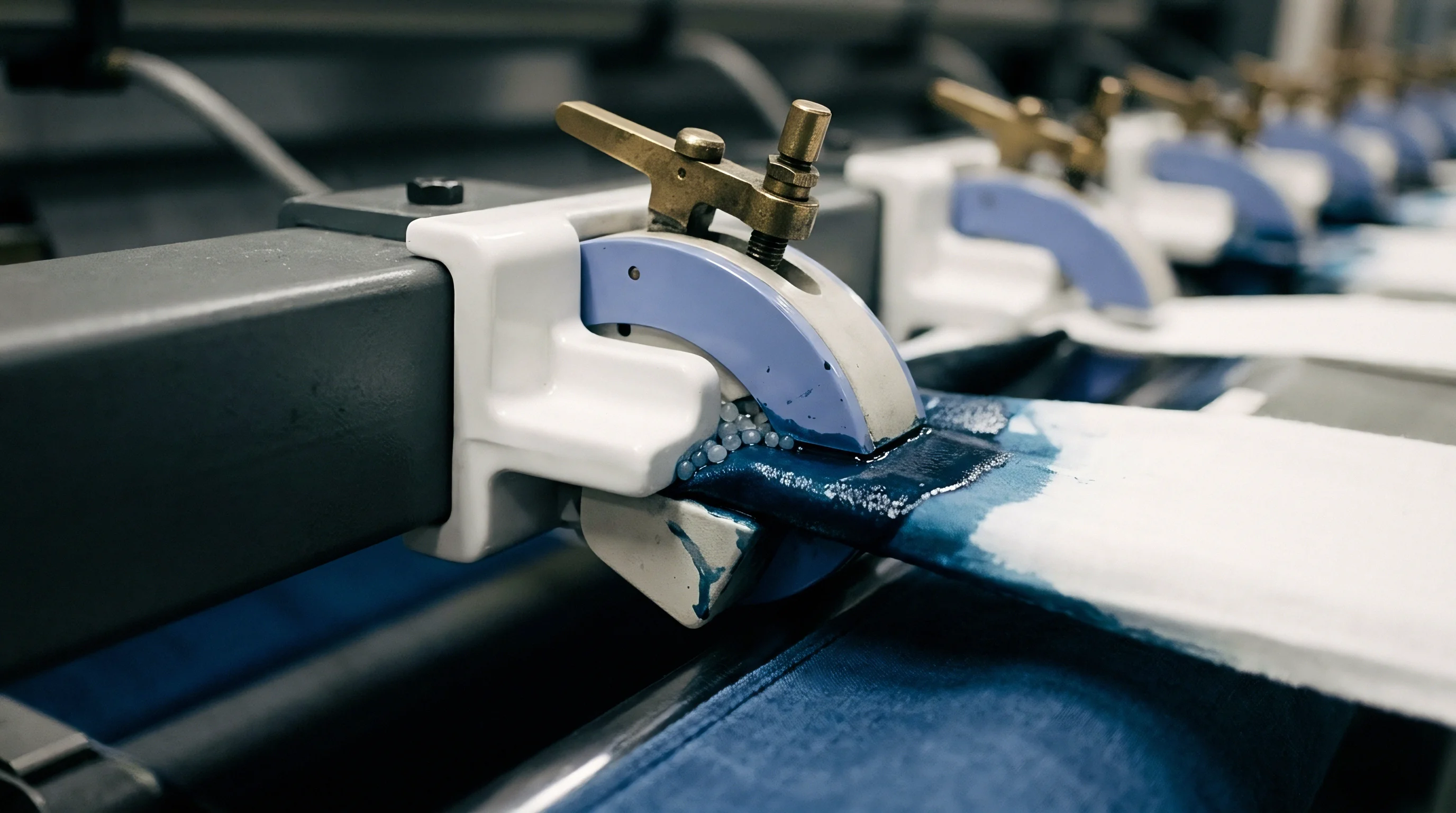
External hydrodynamic boundary layers around tightly woven fabrics slow mass transfer. As fabric moves through wash boxes or jet nozzles, relative liquor velocity creates a stagnant boundary layer (δ) at the surface, across which transport occurs strictly by molecular diffusion. Because liquid cannot readily flow through high cover factor twills, thick boundary layers build up along warp floats, flattening the concentration gradient (partial C / partial z) that drives dye out of the fabric matrix.
Boundary Layer Hydraulics and Mass Extraction Kinetics
The rate of hydrolyzed dye extraction (J) from fabric to bulk wash liquor is governed by the boundary mass transfer coefficient (kL) and the driving concentration difference between internal pore liquid (Cp) and wash bath liquor (Cb):
J = kL left(Cp – Cbright) = fracD0δ left(Cp – Cbright)
Increasing liquor turbulence or nozzle pressure thins the boundary layer (δ), raising the mass transfer flux J. Inside the dense yarn core of a heavy 3/1 twill, however, mechanical liquor impact cannot induce convective flow. Intra-yarn clearance remains bound by internal diffusion, no matter how fast the external bath is agitated.
Rinsing efficiency in heavy twills depends on maintaining wash temperatures above 90 degrees Celsius to drop dye substantivity near zero while maximizing internal diffusion rates.
Effective wash-off sequences use thermal profiling to optimize extraction. Initial rinses reduce electrolyte concentration without prematurely lowering bath temperature. Rinsing with cold water while salt remains inside dense twills strips electrolyte from outer spaces while leaving it locked in yarn cores.
That setup creates ionic gradients that hold hydrolyzed dye tightly to inner fiber walls, halting desorption completely.
Thorough clearance requires bringing bath electrolyte below 1.0 g/L while keeping liquor temperatures above 85 degrees Celsius. High thermal energy breaks down hydrogen bonds and hydrophobic interactions between hydrolyzed chromophores and cellulose, shifting partition equilibrium into the bath phase, raising Cp, and driving diffusion out of dense yarn zones.
Mechanical Action and Micro-Convective Washing
Continuous washing efficiency relies on forcing fluid through the fabric web. Because heavy twills resist trans-planar flow, washers must rely on bending forces and surface shear to pull trapped liquor from yarn crossovers. When fabric flexes over guide rollers or passes through nip rolls under load, compressed yarns act like tiny pumps, squeezing entrained pore fluid out into the surrounding bath.
Nip efficiency depends on fabric recovery mechanics. Tightly packed high cover twills show low wet compressibility; squeeze rollers remove surface liquor effectively on light goods, but express only a small fraction of internal pore volume in dense fabrics. Multiple short immersions coupled with high-impact jet manifolds therefore deliver much better wash-off than long dwell times in static boxes.
A reliable rule of thumb for heavy twills is to double the bath turnover rate while keeping liquor ratios short, preserving steep concentration gradients between pore fluid and bulk wash liquor.
Fabric structure dictates how easily hydrolyzed dye can be cleared. Designers specifying ultra-dense twills for workwear or military uses often choose high molecular weight bi-reactive dyes to meet strict fastness targets. But those large molecules pair high affinity with wide hydrodynamic radii, maximizing diffusion resistance in tight pore networks and creating clearance bottlenecks during wash-off.
Defect
Failing to clear hydrolyzed reactive dye from high cover twills leads to distinct, costly defects in finished fabric. Hydrolyzed dye left inside dense yarn cores remains unbonded. When the fabric hits the stenter or calender, evaporating water carries this mobile dye to the surface, causing blotchy shade variation, poor rub fastness, and severe wet crocking failures.
Cross-sections of defective twill yarns show a distinct ring-dyeing pattern of hydrolyzed dye. While active dye fixed covalently near fiber surfaces during alkali treatment, hydrolyzed dye stayed trapped deeper in yarn crossovers. High stenter drying temperatures drive those mobile molecules outward, concentrating unfixed chromophore on exposed warp floats.
That surface buildup directly causes poor rub fastness in ISO 105-X12 testing.
Cross-Sectional Penetration Failure and Ring Dyeing
Uneven distribution of fixed and unfixed chromophore through the fabric thickness causes metamerism and face-to-back shade differences. Heavy 3/1 twills have asymmetric float structures, giving the face and back different surface properties. Hydrolyzed dye trapped in long warp floats migrates face-ward during hot-air drying, altering surface spectral reflectance and pushing face-to-back delta E values beyond acceptable buyer tolerances.
Pinpointing defect origins requires cross-sectional microtomy and spectrophotometry across the yarn depth. Embedding yarns in acrylic resin and slicing 5-micrometer sections allows measurement of chromophore gradients from sheath to core. A high concentration of core-trapped hydrolyzed dye relative to surface-fixed active dye points directly to poor mass transfer during post-fixation washing.
- Low Wet Crocking Fastness stems from unbonded hydrolyzed dye accumulating on surface warp floats as moisture evaporates during drying.
- Face-to-Back Shade Variance indicates asymmetric mass transfer where directional moisture flow carries mobile chromophores toward one face.
- Streaky Wash Unlevelness arises from local variations in inter-yarn tortuosity that cause uneven extraction in continuous wash ranges.
- Tailing Along Bulk Runs points to a gradual buildup of desorbed dye in the wash bath caused by insufficient counter-current replenishment.
- Perspiration Fastness Failure under ISO 105-E04 occurs when residual hydrolyzed dye bleeds from internal yarn voids during wear.
A simple diagnostic test isolates whether unlevelness stems from uneven active dye fixation or residual hydrolyzed dye. Extracting fabric samples in 50 percent aqueous dimethylformamide (DMF) at 80 degrees Celsius strips unfixed hydrolyzed dye while leaving covalently bound dye intact. Comparing reflectance curves before and after extraction isolates the exact shade error caused by residual hydrolyzed dye.
Fastness failures lead straight to commercial chargebacks. A dyehouse took a nine thousand dollar re-handling penalty on a forty thousand metre lot of high cover twill when residual hydrolyzed dye pulled wet crocking down to Grade 2 under ISO 105-X12. The fabric looked level coming off the jet, but rapid stenter drying drove trapped internal hydrolyzed dye out to the warp floats, ruining the face.
Microscopic Fastness Failure Diagnostics
Resolving fastness issues requires matching visual defects to their microscopic physical causes. Surface crocking is often a thermal migration problem rather than a basic washing failure: as moisture evaporates during drying, capillary flow moves toward the outer fibers, carrying dissolved hydrolyzed dye and leaving concentrated deposits on the surface once the water is gone.
Chemical wash-off agents engineered to encapsulate hydrolyzed dye must reach deep into yarn cores to work. High molecular weight polymers struggle to enter tight inter-fiber spaces in ultra-dense twills due to steric exclusion. They stay in the bulk liquor, unable to reach dye trapped inside the yarn core.
Effective formulations rely on lower molecular weight dispersants that can penetrate narrow pore networks, complex with hydrolyzed chromophores, and keep them soluble in circulating rinse bath liquor.
Engineers frequently mistake residual hydrolyzed dye failures for poor reactive dye fixation. Adding more alkali to push fixation backfires ~ it elevates dyebath pH, accelerates hydrolysis, and leaves even more unbonded dye trapped inside dense yarn structures.

Ledger
Managing diffusion resistance in high cover twills directly impacts finishing economics, utility use, and plant capacity. Longer wash sequences needed to extract trapped hydrolyzed dye raise water, energy, and machine time demands per kilogram of fabric. Sourcing teams need to evaluate true landed costs by factoring in the processing penalties imposed by dense weave constructions.
Standard open-weave cottons need 40 to 60 liters of wash water per kilogram of cloth to meet fastness specs. High cover twills (Kc > 0.92) routinely demand 90 to 140 liters per kilogram across multi-stage wash sequences. That extra water requires more energy to heat incoming fresh water to target wash temperatures (85 to 95 degrees Celsius), inflating thermal energy costs per finished metre.
Resource Economics and Industrial Wash-Off Calculations
The financial impact of diffusion-limited washing scales directly with line speed and utility rates. On continuous ranges, running speeds must drop from standard rates of 80 metres per minute down to 35 or 45 metres per minute to give intra-yarn diffusion enough dwell time. In jet batch dyeing, wash cycles expand from 4 steps to 8 or 10 separate hot-wash and rinse stages, adding up to 120 minutes to total cycle time.
| Fabric Construction Class | Fractional Cover Factor (K_c) | Required Wash-Off Stages | Water Consumption (L/kg fabric) | Thermal Energy (MJ/kg fabric) | Added Finishing Cost ($/finished metre) |
|---|---|---|---|---|---|
| Plain Weave Light (Poplin) | 0.720 | 4 Stages | 42 ± 3 | 5.8 ± 0.4 | 0.08 |
| 2/1 Medium Twill | 0.840 | 6 Stages | 68 ± 5 | 9.2 ± 0.6 | 0.16 |
| 3/1 Heavy Twill Standard | 0.895 | 8 Stages | 95 ± 7 | 13.4 ± 0.9 | 0.28 |
| 3/1 Ultra-Dense Workwear Twill | 0.942 | 11 Stages | 138 ± 10 | 19.8 ± 1.2 | 0.47 |
Purchase orders must account for these processing cost differences. Quotes based on standard fabric profiles fail during bulk scale-up, leading to mill surcharges or compromised fastness when dyehouses trim wash cycles to keep up with production schedules.

Commercial Verification Protocols for Bulk Twill Sourcing
Mitigating commercial risk on high cover twills requires embedding clear technical parameters in procurement specifications. Technical dossiers should define maximum allowable cover factors alongside fastness requirements linked to specific test methods. Relying solely on fabric weight (GSM) without controlling thread count and yarn packing leaves buyers vulnerable to wide fastness variations between production lots.
Quality assurance contracts need explicit wash-off validation steps before approving bulk production runs. Buyers should require mills to provide extraction curves showing residual hydrolyzed dye levels remain below target thresholds before stenter drying. Testing incoming lots with solvent extraction assays stops fastness failures before fabric hits the cutting tables.
Procurement contracts should include a strict fastness clause requiring ISO 105-X12 wet crocking performance of Grade 3.5 or higher on deep shades, backed by mandatory 80 degree Celsius DMF extraction testing to confirm complete removal of hydrolyzed dye from dense yarn cores.