Yarn Numbering Conversion Formulas for Fabric Cover Factor Analysis
Cover factor analysis requires direct conversion to Tex linear density and adjustment for fiber packing density before computing fractional surface area.


Systems
Linear density and length-per-unit-mass scales categorize textile yarns into direct and indirect measurement standards. Direct systems quantify mass per defined length, meaning larger numbers signify heavier, thicker yarns. Indirect systems calculate length per defined mass, meaning larger numbers indicate finer, thinner strands.
Evaluating structural density across global supply chains requires precise mathematical translation between these competing paradigms.
Tex serves as the primary standard unit under International Organization for Standardization standards, defined as grams per 1000 meters of strand. Continuous synthetic filaments frequently utilize Denier, representing grams per 9000 meters, or Decitex, measuring grams per 10000 meters. Mass remains constant across systems.
Converting Denier to Tex requires dividing by nine, while converting Decitex to Tex requires dividing by ten.
Indirect systems dominate regional natural-fiber production formats. English Cotton Count expresses the quantity of 840-yard hanks that weigh exactly one pound at standard moisture regain. Metric Count measures kilometers of yarn per kilogram.
Worsted Count relies on 560-yard hanks per pound, Woolen Run uses 1600-yard hanks per pound, and Linen Lea counts 300-yard hanks per pound. Direct counts scale with mass.
Calculating structural properties across differing systems requires exact conversion constants derived from base mass and distance metrics. The fundamental relation between Tex and English Cotton Count relies on the mass of one pound in grams divided by the length of one 840-yard hank in kilometers. At standard atmospheric testing conditions, this constant evaluates to 590.541.
Tex cover factor equals 0.957 times the English cotton cover factor when warp and weft counts are measured at standard moisture regain of 8.5 percent.
When working with spun combed cotton, moisture regain introduces variability into weight measurements. Commercial standards assume an 8.5 percent moisture regain for cotton, 11.0 percent for worsted wool, and 0.4 percent for continuous filament polyester. Failing to condition yarn packages prior to mass measurement alters the calculated count by several percentage points.
A weight taken on dry cotton yarn understates linear density, distorting downstream density models.
Direct system formulas maintain simple proportional scaling. In contrast, indirect formulas require inverse division where the conversion constant sits in the numerator. Table 1 lists the primary conversion equations required to harmonize raw yarn specifications prior to structural cover factor calculations.
| Starting Unit | Target Unit | Conversion Formula | Standard Regain Baseline |
|---|---|---|---|
| English Cotton Count (Ne) | Tex | Tex = 590.541 / Ne | 8.5 percent moisture regain |
| Metric Count (Nm) | Tex | Tex = 1000 / Nm | 6.5 percent moisture regain |
| Denier (den) | Tex | Tex = den / 9 | 0.4 percent moisture regain |
| Decitex (dtex) | Tex | Tex = dtex / 10 | 0.4 percent moisture regain |
| Worsted Count (Ne_w) | Tex | Tex = 885.8 / Ne_w | 11.0 percent moisture regain |
| Linen Lea (Ne_L) | Tex | Tex = 1653.5 / Ne_L | 12.0 percent moisture regain |
Spinning mills occasionally express single-ply equivalents for folded yarns using variable nomenclature. A 2/40 Ne ring-spun thread contains two strands of 40 Ne twisted together, yielding a combined linear density equivalent to a 20 Ne single yarn. In Tex, a 15 tex double yarn is written as 15 x 2 tex, representing a total linear density of 30 tex.
Converting multi-ply yarns into direct Tex values before conducting open-space analysis prevents systemic counting errors on weaving spec sheets.
Yarn suppliers occasionally claim that direct conversions between filament Denier and spun Cotton Count carry inherent rounding margins that justify off-spec weight arrivals. Technical managers reject this explanation because physical mass-to-length constants are fixed by international weights and measures standards, leaving blend variability and uneven conditioning as the true root causes of off-count deliveries.


Algebra
Calculating the projected visual opacity or mechanical tightness of a woven web depends directly on yarn cross-sectional geometry. Assuming an ideal circular cross-section, physical strand diameter calculates from linear density and volumetric packing density. Thread spacing interacts with this calculated diameter to define open space within the interlaced grid.
Peirce established the classic diameter formula for ring-spun cotton yarns in 1937, operating on English Cotton Count. The classic relation fixes yarn diameter in inches as one divided by twenty-eight times the square root of the Cotton Count. In metric units, this equation translates to strand diameter in millimeters equal to 0.907 divided by the square root of the Cotton Count.
Yarn diameter governs cover.
Modern engineering demands universal equations valid for synthetic filaments, high-density bast fibers, and low-density polyolefins. The universal diameter equation calculates physical width in millimeters from Tex and bulk fiber density. Dividing Tex by fiber density in grams per cubic centimeter, taking the square root, and multiplying by 0.0357 yields the theoretical strand diameter in millimeters.
Twist shifts effective diameter.
Yarns never pack into solid cylinder shapes without internal air pockets. The bulk yarn density reflects raw fiber density multiplied by an internal structural packing factor. Ring-spun cotton strands typically exhibit a packing factor between 0.55 and 0.65.
Open-end rotor yarns achieve lower core density, ranging from 0.50 to 0.58, while continuous filament synthetic yarns achieve packing factors between 0.70 and 0.85 depending on filament count and texturizing crimp.
Substituting unadjusted solid polymer density into geometric diameter equations understates physical strand width. Lower bulk density increases physical strand diameter for a given mass per unit length. When a 150 denier continuous filament polyester strand carries a packing factor of 0.75, its effective bulk density drops from 1.38 grams per cubic centimeter to 1.035 grams per cubic centimeter, widening its projected surface width on the loom.
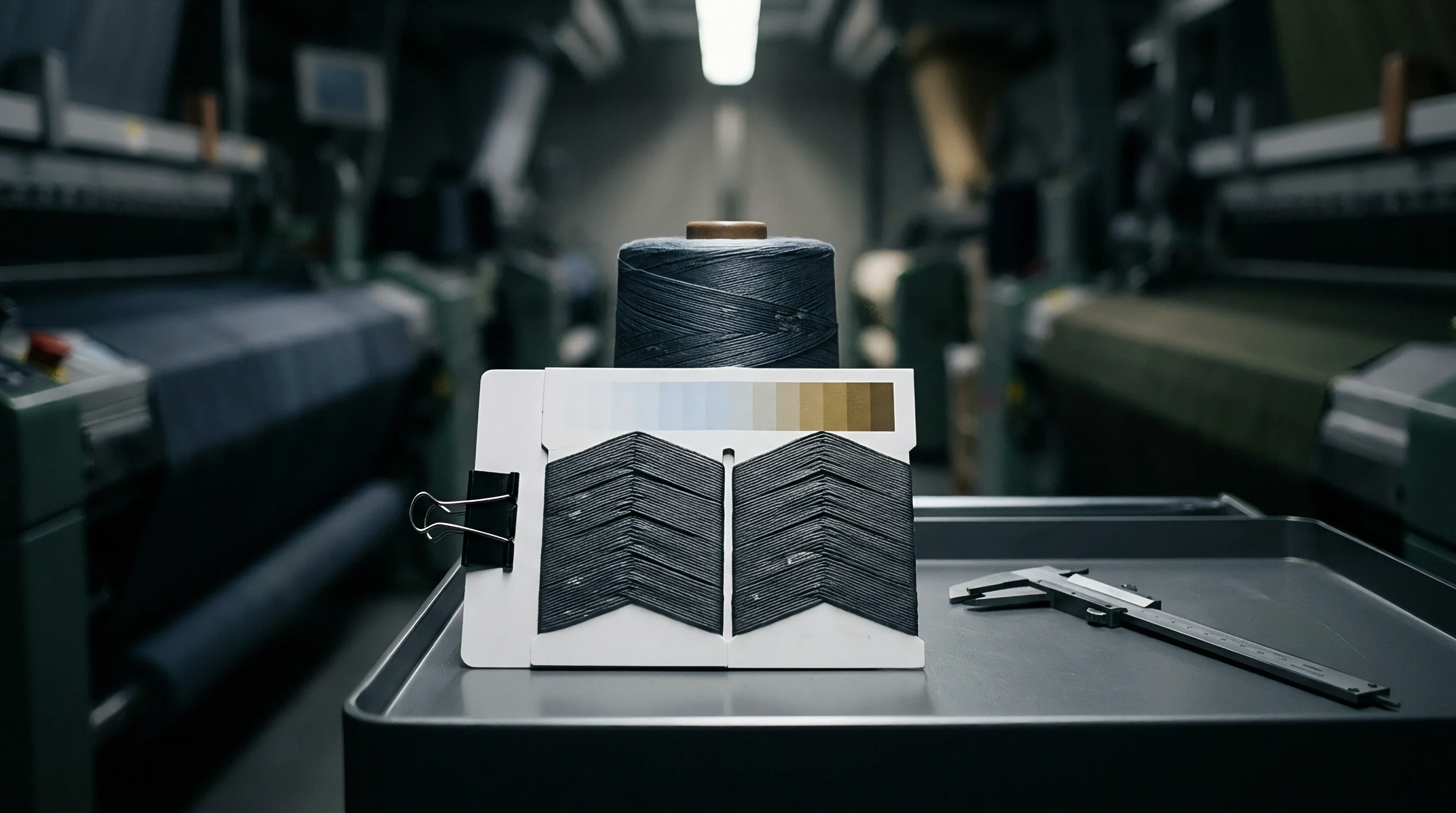
Why Does Yarn Diameter Calculation Fail for Texturized Continuous Filament Synthetic Tow?
False-twist texturizing imparts helical crimp and bulk to smooth synthetic filaments. Crimp forces individual filaments outward, creating air voids that reduce effective yarn density while expanding physical diameter. Standard diameter formulas assume a static cylindrical cross-section, whereas texturized filaments flatten against adjacent strands under weaving tension inside the reed shed.
Measuring strand width under varying tension reveals that textured yarn diameter drops linearly as warp tension rises. At minimal tension, bulk density approaches 0.40 grams per cubic centimeter, but shed insertion forces compress the strand toward 0.85 grams per cubic centimeter. Diameter models for textured filament substrates must incorporate a tension-dependent compression factor to predict actual grey goods dimensions.
Single-strand twist insertion modifies strand geometry by tightening outer fibers around the core. Higher twist multipliers increase yarn density, driving the packing factor closer to maximum theoretical limits. A low-twist knitting yarn carries a wider physical diameter than a hard-twisted voile warp yarn of identical Tex linear density.
High twist compresses strand volume.
Calculating yarn volume without accounting for twist-induced shortening distorts linear density calculations. Twist take-up increases the mass per unit length of the final twisted strand relative to its untwisted single components. Standard adjustments increase theoretical linear density by one to three percent for medium twist levels, rising to seven percent for high-twist crepe yarns.
Twist factor equations link yarn turn density directly to linear density. In English units, the twist factor equals turns per inch divided by the square root of English Cotton Count. In metric Tex units, twist level evaluates as turns per meter multiplied by the square root of Tex, divided by one hundred.
Harder twist packages yield slimmer physical diameters, creating more open space within a given thread sett.
Higher twist levels systematically reduce physical yarn diameter for a given linear density.

Reed
Thread density combined with strand diameter defines the total surface area covered by yarn strands inside a woven web. Traditional terminology references English cover factors based on Cotton Count and thread densities recorded in ends and picks per inch. Modern technical specifications rely on SI Tex cover factors based on thread densities measured per centimeter.
Peirce cover factor isolates warp and weft contributions independently. Warp cover factor equals ends per inch divided by the square root of English Cotton Count. Weft cover factor equals picks per inch divided by the square root of English Cotton Count.
Fractional cover represents the actual proportion of surface area hidden by threads, calculated by dividing the English cover factor by twenty-eight.
Total woven cover factor does not equal the simple arithmetic sum of warp and weft cover values. Simple addition double-counts the rectangular intersection zones where warp ends overlap weft picks. Correct total cover calculation subtracts the product of warp fractional cover and weft fractional cover from their sum.
Crimp modifies thread spacing.
SI Tex cover factor calculates from thread density per centimeter multiplied by the square root of Tex, divided by ten. Converting an English cover factor directly to an SI Tex cover factor requires multiplication by 0.957. Metric cover factor uses threads per centimeter divided by the square root of Metric Count.
Table 2 contrasts these cover metrics across three representative woven constructions.
| Construction Type | Threads Per Unit | Yarn Numbering | English Cover (K_c) | SI Tex Cover (K_tex) | Total Fractional Cover |
|---|---|---|---|---|---|
| Cotton Poplin Greige | 100 ends/in x 60 picks/in | 40/1 Ne warp x 40/1 Ne weft | 15.81 warp / 9.49 weft | 15.13 warp / 9.08 weft | 0.723 combined fraction |
| Polyester Plain Weave | 38 ends/cm x 28 picks/cm | 167 dtex warp x 167 dtex weft | 16.82 warp / 12.39 weft | 16.09 warp / 11.86 weft | 0.771 combined fraction |
| Heavy Cotton Canvas | 48 ends/in x 36 picks/in | 10/1 Ne warp x 10/1 Ne weft | 15.18 warp / 11.38 weft | 14.53 warp / 10.89 weft | 0.729 combined fraction |
Loom setting calculations require adjusting reed density for off-loom relaxation. Warp ends crowd closer together as off-loom tension drops, while weft picks compress under take-up motion. Loomstate sett differs from reed width calculations due to structural crimp contraction.
Sett determines open space.
Converting yarn numbering systems without reviewing physical thread density unit baselines generates catastrophic weaving failures during loom setup. Substituting values into cover formulas without aligning linear density scales creates structural miscalculations that compromise finished specifications.
- Direct System Inversion occurs when an operator inserts Denier directly into an indirect Cotton Count cover formula, causing heavy yarns to register as ultra-sheer structures on production calculation sheets.
- Linear Unit Mismatch happens when thread densities counted in ends per inch combine with Tex linear densities without applying the required 0.957 system conversion factor.
- Intersection Omission develops when total fabric cover is calculated by summing warp and weft cover factors directly, ignoring the structural overlap area at yarn crossing points.
- Crimp Disregard arises when grey goods cover factor calculations assume reed width equals finished cloth width, understating actual finished thread density by five to twelve percent.
Ignoring crimp contraction during preliminary grey goods design alters finished warp density, causing air permeability to exceed maximum client threshold limits on protective workwear orders.
When reed spacing is miscalculated, the weaving floor produces off-spec goods that fail physical opacity benchmarks, triggering immediate mill rejections and costly warp re-drawing cycles.

Swell
Finishing operations transform grey goods geometry through mechanical tension, chemical cleaning, thermal shrinkage, and wet fiber expansion. Desizing and scouring remove processing oils and warp sizing chemicals, allowing yarns to relax and un-crimp. Mercerization expands cellulosic fiber cross-sections, changing flat ribbon shapes into circular profiles.
Cellulosic fibers absorb substantial water volumes during aqueous dyeing, causing lateral fiber swelling. Cotton fibers expand in diameter by 14 to 20 percent when wet, while rayon filaments swell up to 35 percent. Fiber swelling forces yarn diameters outward, closing inter-strand air spaces and increasing finished cover factor.
Mercerization increases fiber circularity.
Thermal processing on stenter frames stabilizes synthetic substrates through controlled heat setting. Thermoplastic yarns relax, untwist slightly, and shrink in length under elevated temperatures. Warp and weft contraction increases thread counts per unit centimeter, compensating for any heat-induced strand thinning.
Off-loom contraction tightens the sett.
Evaluating finished goods cover factor requires post-finishing physical measurement rather than calculation from grey loomstate values. ISO 3801 defines mass per unit area testing, while ISO 7211-2 governs thread count determination per unit distance. Wet swell alters thread geometry.
Technicians verify finished cover factor using a standardized laboratory analysis sequence on conditioned finished rolls.
- Cut five square test specimens measuring 100 square centimeters each across the full usable width of the finished roll, avoiding selvedges by at least 10 centimeters.
- Condition specimens at 20 degrees Celsius plus or minus 2 degrees and 65 percent relative humidity plus or minus 4 percent for 24 hours per ISO 139 standards.
- Count warp ends and weft picks across each specimen using a traveling thread counter over a 50 millimeter distance, recording averages in threads per centimeter.
- Extract twenty warp and twenty weft strands, measure their crimped versus straightened lengths according to ISO 7211-3, and calculate warp and weft crimp percentages.
- Weigh extracted strands on a calibrated analytical balance to determine actual finished yarn linear density in Tex, accounting for finish add-on weights.
Finish chemicals alter calculated yarn linear density without increasing load-bearing fiber mass. Durable water repellents, flame retardants, and polyurethane coatings add mass to the web, increasing measured Tex values. Calculating cover factor using chemical-laden yarn weight distorts structural geometric models.
Yield drops when crimp rises.
Air permeability drops under tension.
Coating weight must be chemically stripped or mathematically deducted prior to running yarn linear density analysis for structural cover factor verification. Failing to subtract chemical add-on overstates structural yarn cover, producing false theoretical performance readings.
Whether wet-processing shrinkage and fiber swelling can be modeled mathematically across multi-component blend yarns with sufficient accuracy to bypass laboratory swatch testing remains an open industrial debate.

Tolerance
Blend yarns containing fibers with differing volumetric densities require composite density calculations before accurate diameter and cover formulas can be executed. Polyester blended with cotton alters average fiber density based on blend ratio. Equation parameters must reflect the true specific gravity of the fiber mixture.
Calculating composite fiber density for a blend uses a weighted harmonic mean rather than a simple linear average. The reciprocal of average blend density equals the mass fraction of fiber one divided by its specific gravity, plus the mass fraction of fiber two divided by its specific gravity. Density varies across fiber types.
A 65/35 polyester/cotton blend yarn combines polyester with a specific gravity of 1.38 and combed cotton with a specific gravity of 1.54. Evaluating the harmonic mean yields a composite fiber density of 1.431 grams per cubic centimeter. Using the raw fiber average of 1.46 overstates strand density, understating calculated yarn diameter.
Table 3 collects physical constants for primary commercial textile fibers.
| Fiber Polymer Type | Fiber Density (g/cm³) | Standard Moisture Regain (%) | Typical Ring Packing Factor | Filament Packing Factor |
|---|---|---|---|---|
| Combed Cotton | 1.54 | 8.5 | 0.60 | Not applicable |
| Viscose Rayon | 1.52 | 11.0 | 0.58 | 0.75 |
| Polyester (PET) | 1.38 | 0.4 | 0.62 | 0.80 |
| Polyamide (Nylon 6,6) | 1.14 | 4.5 | 0.60 | 0.78 |
| Polypropylene | 0.91 | 0.0 | 0.55 | 0.72 |
| Wool (Merino) | 1.31 | 13.6 | 0.50 | Not applicable |
Commercial yarn delivery contracts enforce strict manufacturing tolerances around linear density. ISO 2060 specifies sampling procedures for yarn count determination. Standard trade contracts allow a plus or minus 2.5 percent variance on single spun cotton yarns, while continuous synthetic filaments permit a tighter plus or minus 1.5 percent tolerance window.
Count variations ripple directly into finished cover metrics. A negative 2.5 percent variation in warp Tex reduces warp cover factor by 1.26 percent. When warp and weft counts both drift to the lower tolerance boundary, total cover drops sufficiently to cause fluid leakage in coated barrier fabrics.
Reed width fixes warp ends.
ISO 7211-2 specifies that thread density counts must be conducted on unskewed material after 24 hours of standard conditioning at 20 degrees Celsius and 65 percent relative humidity.
Technical managers executing cross-border yarn sourcing apply a structured qualification checklist to verify conversion integrity before committing bulk yarn purchasing orders.
- Regain Alignment Verification requires confirming whether quoted spun yarn counts reflect dry mass or standard conditioned mass, preventing weight disputes upon container arrival.
- Blend Density Calculation demands evaluating harmonic mean specific gravity for intimate blend yarns to feed correct physical parameters into strand diameter equations.
- Twist Multiplier Check mandates comparing twist factors between original and substitute yarn packages to ensure equivalent compressed strand diameters inside the reed shed.
- Finished Sett Tolerance establishes explicit upper and lower thread density bounds on incoming grey goods inspection sheets to guarantee target cover factor attainment.
Standard procurement agreements include explicit language stating that count conversions between direct and indirect systems must use ISO 1144 standards, and any supplier delivery drifting beyond plus or minus 2.0 percent of target converted Tex will be rejected at the port of entry.

Contract
Specifying yarn substitutions across international weaving mills introduces financial risk when conversion formulas omit fiber density adjustments. Substituting a 150 denier continuous filament nylon yarn for a 150 denier polyester yarn creates unexpected structural changes. Nylon carries a density of 1.14 grams per cubic centimeter, compared to polyester at 1.38 grams per cubic centimeter.
Equal linear density means equal mass per unit length, but lower material density increases strand volume. The nylon yarn strand measures 10 percent wider in physical diameter than the polyester strand of identical Denier. Weaving the nylon strand at the original polyester ends and picks per centimeter increases total surface cover factor, making the final web stiffer and heavier than intended.
Converting a cotton plain weave specification to a synthetic filament equivalent requires adjusting thread density to match visual opacity without creating excessive stiffness. A 30/1 Ne cotton warp at 30 ends per centimeter provides a specific warp cover factor. Matching that cover factor with textured polyester requires calculating equivalent Tex, adjusting for fiber packing factor, and recalculating reed denting plans.
Converting yarn numbering systems without adjusting for fiber specific gravity overstates structural opacity in low-density synthetic yarns.
Cost calculations depend on yield metrics derived from yarn linear density and cover factor target parameters. Woven web yield expressed in linear meters per kilogram relates directly to total Tex and finished thread counts. Higher crimp levels require greater yarn length per meter of cloth, increasing raw material consumption per finished linear unit.
Converting yarn counts accurately protects mill profit margins during bulk raw material purchasing. A one-count error on a 40/1 Ne cotton order miscalculates yarn weight requirements by 2.5 percent. Across a 50,000-meter weaving contract, that error represents over 200 kilograms of unbudgeted yarn, eroding mill converter margins and generating severe delivery delays.
Mastering yarn numbering conversion equations enables buyers to write precise technical dossiers that bind suppliers to exact physical construction targets. Enforcing systematic laboratory verification across raw yarn arrivals, loomstate grey goods, and wet-processed finished rolls eliminates structural discrepancies, ensuring imported substrates deliver promised performance, hand feel, and opacity across bulk production runs.