Pre-Treatment Protocols for Removing Spin Finish in Quantitative Fiber Analysis
Pre-treatment solvent extraction eliminates spin finish mass errors, ensuring precise quantitative fiber analysis and valid tariff classification.


Soak
Spin finish compounds applied during extrusion and yarn preparation alter the gravimetric baseline of every quantitative fibre analysis test report. Synthetic filaments receive hydrophobic lubricants, emulsifiers, and antistatic agents at levels ranging from 0.4 percent to 3.5 percent by weight to lower friction during drawing and texturing. Natural staple processing introduces batching oils and processing lubricants that adhere tightly to fibre walls.
When quantitative separation protocols run without removing these surface additions, every subsequent weighing step carries an uncorrected systematic error. Standard chemical dissolution methods specified in ISO 1833-1 depend on direct contact between clean polymer substrates and selective reagents. Surface finishes mask this interface, retarding solvent penetration and distorting mass loss readings.
Selecting an extraction solvent demands precise alignment between finish composition and polymer chemical tolerance. Petroleum ether with a boiling range of 40 °C to 60 °C dissolves nonpolar mineral oils, paraffin waxes, and long-chain fatty esters without swelling synthetic polymer matrices. Water-soluble antistatic additives, such as polyoxyethylene alkylamines or quaternary ammonium salts, resist aliphatic hydrocarbon solvents and demand a secondary warm water rinse at 40 °C. Chlorinated solvents like dichloromethane strip silicone-based finishes efficiently, yet they swell elastomeric fibres and alter the crystalline domain accessibility of triacetate.
Extraction solvents must match finish polarity while leaving the polymer backbone completely unswollen.
Temperature control during solvent extraction governs both extraction kinetics and substrate integrity. High extraction temperatures speed up finish removal, but solvent temperature exceeding the glass transition threshold of amorphous fibers promotes structural compacting. Acetone effectively strips processing auxiliaries from cellulosic structures, but it dissolves acetate and partial acrylic blends entirely.
Methanol removes highly polar lubricants, yet it leaches low-molecular-weight oligomers from polyamide 6 filaments, creating artificial mass loss attributed to spin finish extraction.
- Petroleum ether extractions target neutral mineral oils and paraffinic lubricants through low-temperature refluxing without altering polyester or polyolefin crystallite dimensions.
- Deionized water rinses remove hygroscopic antistatic agents and polyglycol emulsifiers that resist aliphatic hydrocarbon dissolution at room temperature.
- Cyclohexane solvent baths clean polyolefin and structural synthetic yarns when low-boiling petroleum fractions leave heavy wax residues on filament bundles.
- Diethyl ether washes remove fatty acid esters and vegetable-based lubricants from natural fibre blends while preserving moisture-sensitive protein structures.
Laboratory technicians often encounter finish formulas containing cross-linked silicone polymers applied during high-speed texturing. These synthetic compounds form insoluble surface networks that resist standard aliphatic hydrocarbon baths. Chemical suppliers explain that finishing oils simply evaporate during yarn conditioning cycles, assuming standard laboratory drying procedures eliminate surface additives before chemical separation begins.


Residue
Residual lubricants on filament surfaces create dual mechanisms of analytical interference during quantitative dissolution. First, unremoved finish mass directly inflates the recorded dry weight of the initial specimen. When a selective solvent dissolves one fibre component, the weight loss includes both the target polymer and the surface finish coating.
Second, hydrophobic lubricant layers create physical barriers against polar dissolving agents. In a polyester and cotton blend subjected to 75 percent sulfuric acid, a continuous silicone coating impedes acid diffusion into the cotton core, leaving undissolved cellulosic fragments in the filter crucible.

Why Do Residual Lubricants Distort Blend Ratios?
The severity of compositional distortion correlates directly with finish concentration and the specific dissolution pathway selected. In binary blends where the minor fibre component comprises less than 10 percent of total mass, a 2 percent spin finish payload completely invalidates the chemical analysis. Dissolving polyamide from a polyamide and wool blend using 80 percent formic acid leaves fatty ester finish residues on the wool fiber.
The insoluble wool fraction collects these hydrophobic residues, yielding an artificially elevated wool percentage on the final certificate of analysis.
| Fibre Blend System | Standard Dissolution Reagent | Target Fibre Dissolved | Typical Finish Payload (%) | Uncorrected Composition Error (%) |
|---|---|---|---|---|
| Polyester / Cotton | 75% Sulfuric Acid | Cotton | 1.2 to 2.8 | +1.1 to +2.5 Polyester |
| Polyamide 6.6 / Wool | 80% Formic Acid | Polyamide | 0.8 to 1.8 | +0.7 to +1.6 Wool |
| Acrylic / Viscose | Dimethylformamide | Acrylic | 1.5 to 3.2 | +1.4 to +2.9 Viscose |
| Elastane / Polyester | Dimethylacetamide | Elastane | 3.0 to 6.5 | +2.8 to +6.1 Polyester |
Spin finish distributions vary across package builds and fabric structures. Outer yarn layers on a package lose volatile finish components through room-temperature aging, while inner package layers retain full oil loadings. Fabric scouring removes varying amounts of finish depending on water temperature, detergent concentration, and dwell time.
Sampling unwashed greige fabric alongside finished goods creates systematic discrepancies between mill production records and port-of-entry verification testing.
Finish migration creates localized composition spikes within single fabric rolls. Elastomeric yarns require high silicone oil application rates to prevent thread breaks during circular knitting. Solvent pre-treatment isolates these surface agents completely, ensuring chemical dissolution reagents interact exclusively with the core polymer backbone.
Complete extraction turns on matching the solvent extraction duration to the physical density of the yarn package.
Apparatus
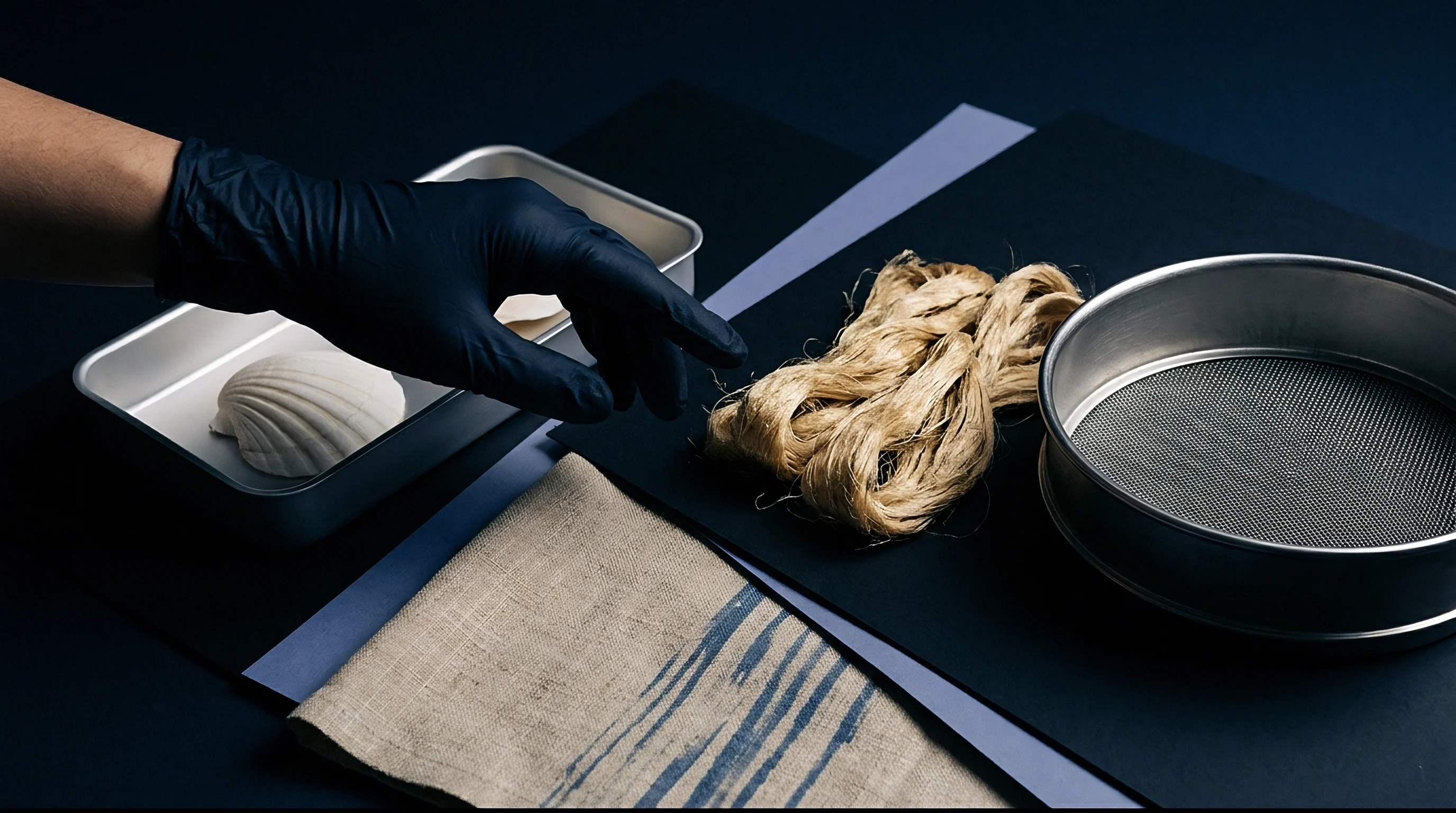
Executing accurate finish extraction relies on Soxhlet or automated Soxtec apparatus setups configured for precise thermal cycling. The classic Soxhlet system operates via continuous solvent vaporization, condensation, and siphoning through a porous cellulose thimble holding the test specimen. Siphon frequency controls extraction efficiency.
A minimum of six siphon cycles per hour across a two-hour extraction window guarantees complete removal of nonpolar surface oils from dense yarn structures.
Automated Soxtec systems accelerate pre-treatment by immersing the specimen directly in boiling solvent before the rinsing and recovery phases. Direct boiling accelerates matrix swelling and speeds oil dispersion into the solvent phase. Solvent purity dictates baseline gravimetric precision.
Distilled technical-grade solvents containing non-volatile residues leave solid artifacts on test samples upon drying, directly corrupting the dry mass baseline.
Specimen drying following solvent extraction requires strictly regulated thermal environments. Ventilated drying ovens set at 105 °C ± 3 °C remove residual solvent and moisture down to constant mass. Constant mass is achieved when consecutive weighings at 15-minute intervals, taken after cooling in a desiccator over active silica gel, differ by less than 0.1 percent of the initial sample weight.
Excess heat exposure oxidizes functional groups on sensitive fibres like polypropylene or elastane, inducing thermal mass changes that distort raw fiber weighings.
- Weigh approximately 5.000 g of air-equilibrated fiber specimen on an analytical balance to 0.0001 g precision.
- Enclose the weighed specimen inside an open-structure glass thimble or pre-extracted cellulose extraction thimble.
- Place the thimble into the Soxhlet extraction chamber and attach the reflux condenser and receiving flask filled with 150 mL of petroleum ether.
- Heat the solvent flask to achieve a steady condensation rate yielding 6 to 8 siphon cycles per hour for 120 minutes.
- Remove the specimen thimble, allow solvent residual vapors to flash off under a fume hood, and submerge the specimen in 200 mL of deionized water at 40 °C for 30 minutes.
- Filter the fiber mass through a tared sintered glass crucible of porosity grade P16.
- Dry the crucible and fiber specimen in an oven at 105 °C to constant mass, cool inside a desiccator for 45 minutes, and record the dry clean fiber mass.
Consider a 10.0000 g specimen taken from a high-speed textured polyester and combed cotton yarn lot declared at 65.0 percent polyester and 35.0 percent cotton by mass. The specimen undergoes Soxhlet extraction with petroleum ether followed by warm water washing. The dry specimen mass before pre-treatment measures 9.8200 g under oven-dry conditions, reflecting initial moisture content.
After solvent extraction and drying to constant mass, the oven-dry cleaned specimen weighs 9.6450 g, revealing a spin finish mass loss of 0.1750 g, corresponding to 1.78 percent surface finish payload.
Extraction protocols operating at six siphon cycles per hour remove nonpolar finishing oils down to a residual mass threshold below 0.02 percent.
The cleaned, dry specimen undergoes chemical dissolution in 75 percent sulfuric acid according to ISO 1833-11 protocols to dissolve the cotton component. The insoluble polyester residue, collected on a grade P16 crucible, washed, dried, and weighed, yields an oven-dry mass of 6.2886 g. Applying the standard mass correction factor d = 1.01 for polyester exposure to sulfuric acid adjusts the final polyester dry mass to 6.3515 g.
Calculating composition without correcting for the 1.78 percent spin finish mass yields a misleading blend ratio. The uncorrected calculation divides the raw insoluble mass by total dry specimen weight, producing 64.04 percent polyester and 35.96 percent cotton. Correcting for the extracted spin finish mass allocates the 9.6450 g clean dry matrix exclusively between the two structural polymers.
The true corrected dry composition yields 65.85 percent polyester and 34.15 percent cotton. Failing to execute spin finish pre-treatment shifts the reported composition past standard commercial tolerance bands, causing false lot rejections at customs boundaries.
Improper drying parameters create hidden gravimetric errors that cascade through subsequent chemical calculations. Overheating cellulosic blends during post-extraction drying degrades structural hemicellulose, driving volatile mass off before chemical separation occurs. Insufficient cooling inside desiccators permits atmospheric moisture absorption on hot fiber surfaces, inflating clean sample dry weights and altering baseline composition calculations.

Tolerance
Quantifying fiber blend proportions requires applying official moisture regain figures to oven-dry clean masses. ISO 6741 defines standard moisture regain values used to convert dry clean fibre masses into official commercial masses. Polyester carries an official regain value of 1.50 percent, whereas combed cotton carries an official regain value of 8.50 percent.
When surface finishes remain on fibers during initial dry weighing, the calculated commercial mass incorporates finish mass as structural fibre weight, distorting final billable weights.
Inter-laboratory verification testing reveals consistent variance patterns when labs omit finish pre-treatment protocols. A lab using direct solvent extraction reports clean dry fiber masses that align within ±0.2 percent across identical lot samples. Conversely, laboratories skipping pre-treatment exhibit inter-lab variations exceeding ±1.8 percent on identical yarn lots.
This scatter stems directly from non-uniform spin finish distribution across package layers and variations in local ambient relative humidity during direct room-weighing procedures.
| Fibre Type | Official Regain ISO 6741 (%) | Commercial Allowance (%) | Pre-treatment Finish Correction Range (%) |
|---|---|---|---|
| Polyester (PET Filament) | 1.50 | 1.50 | 0.30 to 1.20 |
| Cotton (Combed Staple) | 8.50 | 8.50 | 0.10 to 0.50 |
| Polyamide 6.6 (Nylon) | 5.75 | 6.25 | 0.50 to 2.20 |
| Viscose Rayon | 13.00 | 13.00 | 0.20 to 0.80 |
| Wool (Scoured Staple) | 17.00 | 18.25 | 0.50 to 1.50 |
Contractual specifications in international trade dictate strict tolerance boundaries for fiber blend declarations. Standard commercial contracts permit an absolute composition variation tolerance of ±1.0 percent to ±2.0 percent between declared and tested fiber content. An uncorrected spin finish payload of 1.5 percent consumes the entire allowable contractual tolerance window before inherent fiber blending variability enters the calculation.
Contractual composition tolerances absorb finish extraction errors only at the direct expense of manufacturing allowance windows.
- Sampling depth errors arise when technicians cut test swatches exclusively from outer fabric roll wraps containing evaporated finish profiles.
- Solvent contamination faults occur when reused extraction solvents transfer dissolved heavy paraffin waxes back onto clean fiber matrices.
- Desiccator exhaustion failures allow atmospheric ambient moisture ingress during cooling cycles, inflating baseline clean fiber mass readings.
- Incomplete wash steps leave water-soluble antistatic salts on fiber surfaces, artificially increasing calculated insoluble residue mass.
Commercial purchase contracts frequently include standard compliance clauses covering analytical testing methodology. A representative contract clause states that all quantitative composition assertions must reference oven-dry mass stripped of non-fibrous materials according to ISO 1833 pre-treatment standards. Incorporating this clause empowers buyers to reject shipments based on lab certificates that omit finish extraction protocols.

Deduction
Customs agencies enforce Harmonized System tariff classifications based strictly on predominant fiber mass thresholds. Crossing an 85 percent single-fiber content threshold alters duty rates significantly across major trading regions. A technical textile fabric declared at 85.5 percent polyester and 14.5 percent elastane qualifies for reduced duty categories under specific regional trade agreements.
If an unextracted 2.1 percent silicone finish on the elastane yarn inflates the elastane weight percentage during testing, the recorded polyester content drops to 83.7 percent.
This single analytical discrepancy triggers administrative reclassification into high-duty basket categories. Duty rates jump from 6.5 percent up to 12.0 percent ad valorem upon reclassification. On a 20-tonne shipment of technical woven fabric valued at 14.00 USD per kilogram, this duty shift increases landed costs by 15,400 USD.
Port authorities also levy misdeclaration penalties when laboratory re-testing reveals discrepancies exceeding established statutory limits.
Importers manage financial exposure by establishing standardized laboratory audit dossiers prior to customs filings. Validated test dossiers contain raw Soxhlet extraction mass loss sheets, solvent purity certificates, and pre-treatment correction factor logs. When customs laboratories return conflicting composition figures, presenting complete pre-treatment extraction logs proves whether the authority’s laboratory removed non-fibrous spin finishes before running dissolution testing.
Pre-treatment mass correction sheets serve as the primary legal defense against customs composition reclassification penalties.
Commercial margins depend on resolving test methodology discrepancies before goods cross customs frontiers. Mills often resist running mandatory pre-treatment steps to reduce testing turnaround times and lower laboratory chemical consumption costs. Importers who enforce strict pre-treatment compliance protect landed cost calculations, maintain tariff classification integrity, and eliminate composition claims across supply chains.
Whether regional customs authorities will universally standardize automated Soxtec extraction protocols over traditional Soxhlet methods remains an open question across international trade committees.