Cotton Fabric Moisture Regain Control in Continuous Dyeing
Continuous cotton dyeing demands precise moisture regain control at intermediate drying to halt dye migration below thirty percent moisture content and prevent shade defects.
Swell
Moisture Regain Physics in Cellulosic Fibres
Native cotton fibres absorb water vapour directly into their amorphous regions, expanding transverse lumen cross-sections by up to fourteen percent. Because the crystalline regions of the cellulose polymer remain impermeable to liquid water, all hydrogen bonding is confined to non-crystalline zones. Standard moisture regain for scoured cotton sits at 8.5 percent under standard atmospheric conditions of 20 degrees Celsius and 65 percent relative humidity.
Wet processing continuously shifts this baseline; greige or prepared fabric enters the range carrying an absolute moisture content governed by warehouse humidity, air movement, and prior thermal history.
At lower relative humidity, water molecules bind to accessible hydroxyl groups through primary adsorption. As ambient humidity climbs, secondary layers build up through capillary condensation within internal pore channels. This internal accumulation lowers the glass transition temperature of the cellulose matrix, which directly alters dyestuff diffusion kinetics during thermal fixation.
When greige fabric arrives at the pad mangle with uneven internal regain, incoming dyestuff liquor fails to penetrate the fibre bundle uniformly.
Equilibrium Moisture Content under Atmospheric Variance
Continuous dye ranges regularly face ambient relative humidity swings between thirty percent in dry winters and ninety percent in tropical summers. Running unconditioned greige storage introduces a three percent variance in fabric regain before the goods ever touch the pad trough. Cellulosic material equilibrated at eighty percent relative humidity holds eleven percent bound moisture, whereas fabric held at forty percent relative humidity contains only five percent.
That spread fundamentally alters the expression ratio achieved at the pad mangle bowl.
| Ambient Relative Humidity (%) | Equilibrium Moisture Regain (%) | Fiber Diameter Change (%) | Amorphous Hydroxyl Availability (mol/kg) |
|---|---|---|---|
| 30.0 | 4.2 | +2.1 | 1.12 |
| 50.0 | 6.5 | +4.8 | 1.74 |
| 65.0 | 8.5 | +7.5 | 2.28 |
| 80.0 | 11.2 | +11.4 | 3.01 |
| 90.0 | 14.8 | +14.2 | 3.95 |
Fabric entering the pad bath dry pulls dyestuff liquor in rapidly through bare capillary draw, creating localized liquor depletion at the fibre surface and driving tailing down the lot. Conversely, fabric entering with elevated baseline moisture impedes dyestuff diffusion toward the fibre core; the excess bound water acts as an internal diluent, lowering the effective concentration of reactive or disperse dye molecules at cellulose binding sites.
What remaining thermodynamic interactions between bound pore water and unfixed particulate dye determine the absolute limit of shade migration before entry to the intermediate dryer?
Padding
Wet Pick-Up Mechanics and Liquor Retention
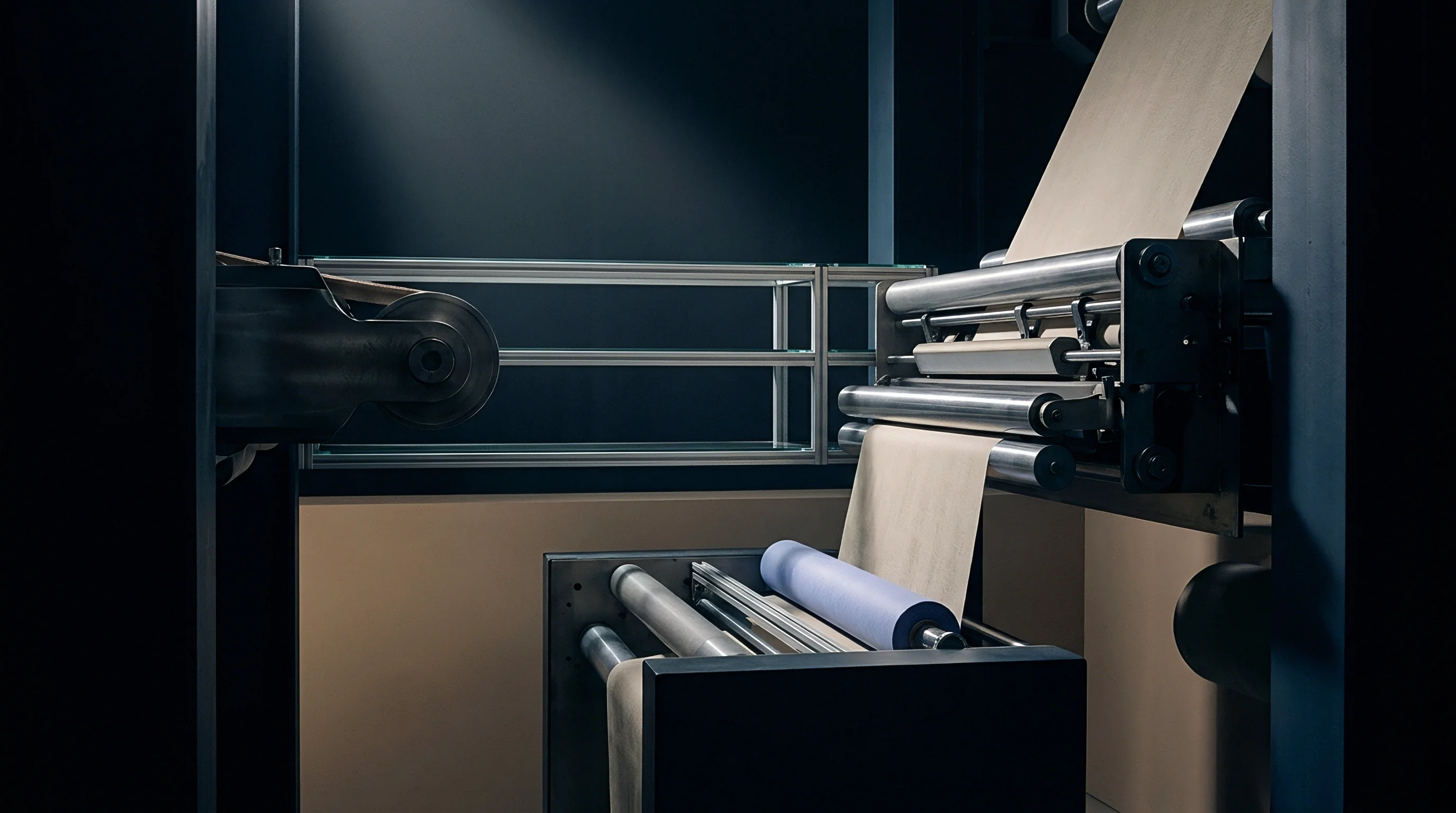
The wet process begins when dry woven fabric enters a liquor trough under controlled mechanical tension. The web then passes through a flexible roll nip under pneumatic load, squeezing off excess surface liquid while leaving a targeted volume within the yarn interstices. Wet pick-up expresses this retained liquor weight as a percentage of the dry conditioned fabric mass.
Medium-weight woven cotton twill typically targets 55 percent to 65 percent wet pick-up on high-expression bowls, since lower liquor volumes reduce the thermal load needed for evaporation and curb dyestuff migration.
Liquor retention reflects yarn geometry: warp sett, weft density, twist factor, and hairiness. A hard-twist ring-spun warp holds less interstitial water than an open-end rotor yarn of identical count. If mechanical bowl pressure drops across the roll face, local pick-up climbs immediately, leaving excess free water in the fabric body.
- Density gradient variance occurs when variable warp yarn tension across the loom beam alters local interstitial pore volume, causing non-uniform liquor pickup under uniform nip pressure.
- Bow bowl deflection develops under high pneumatic loading, lifting the middle section of the roll face and leaving elevated liquid fractions down the fabric centre.
- Substrate hydrophobic boundary persists when incomplete scouring leaves residual natural waxes above 0.2 percent by weight, suppressing instantaneous capillary absorption in the pad trough.
- Temperature-induced viscosity shift takes place when dye bath cooling alters chemical liquor surface tension, altering the total liquor volume drawn through the nip zone.
Expression Uniformity across the Bowl Nip
Pad-dry-thermosol ranges require strict side-to-centre-to-side expression consistency. A two percent pick-up variance across the fabric width translates to colorimetric shifts beyond 0.8 CIELAB Delta E on medium navy shades. Modern pad mangles rely on crown-compensating pneumatic rolls or swimming rolls with internal hydraulic zones to keep the pressure profile flat across wide working widths.
| Fabric Construction | Greige Weight (g/m²) | Target Wet Pick-Up (%) | Free Interstitial Water (%) | Bound Fiber Moisture (%) |
|---|---|---|---|---|
| 1/1 Plain Weave Poplin | 115 | 52.0 | 43.5 | 8.5 |
| 2/1 Warp Face Twill | 195 | 58.0 | 49.5 | 8.5 |
| 3/1 Heavy Workwear Twill | 280 | 63.0 | 54.5 | 8.5 |
| Canvas Duck Construction | 360 | 68.0 | 59.5 | 8.5 |
Immediately past the pad nip, retained liquid divides into bound water inside the amorphous cell wall and free water filling inter-yarn voids. This free capillary water transports unfixed particulate dye. Controlling its movement during initial drying dictates shade levelness across the yardage.
When the pad mangle expression stays flat, the downstream drying process holds total authority over shade levelness.

Duct

Intermediate Drying Profiles and Particulate Dye Migration
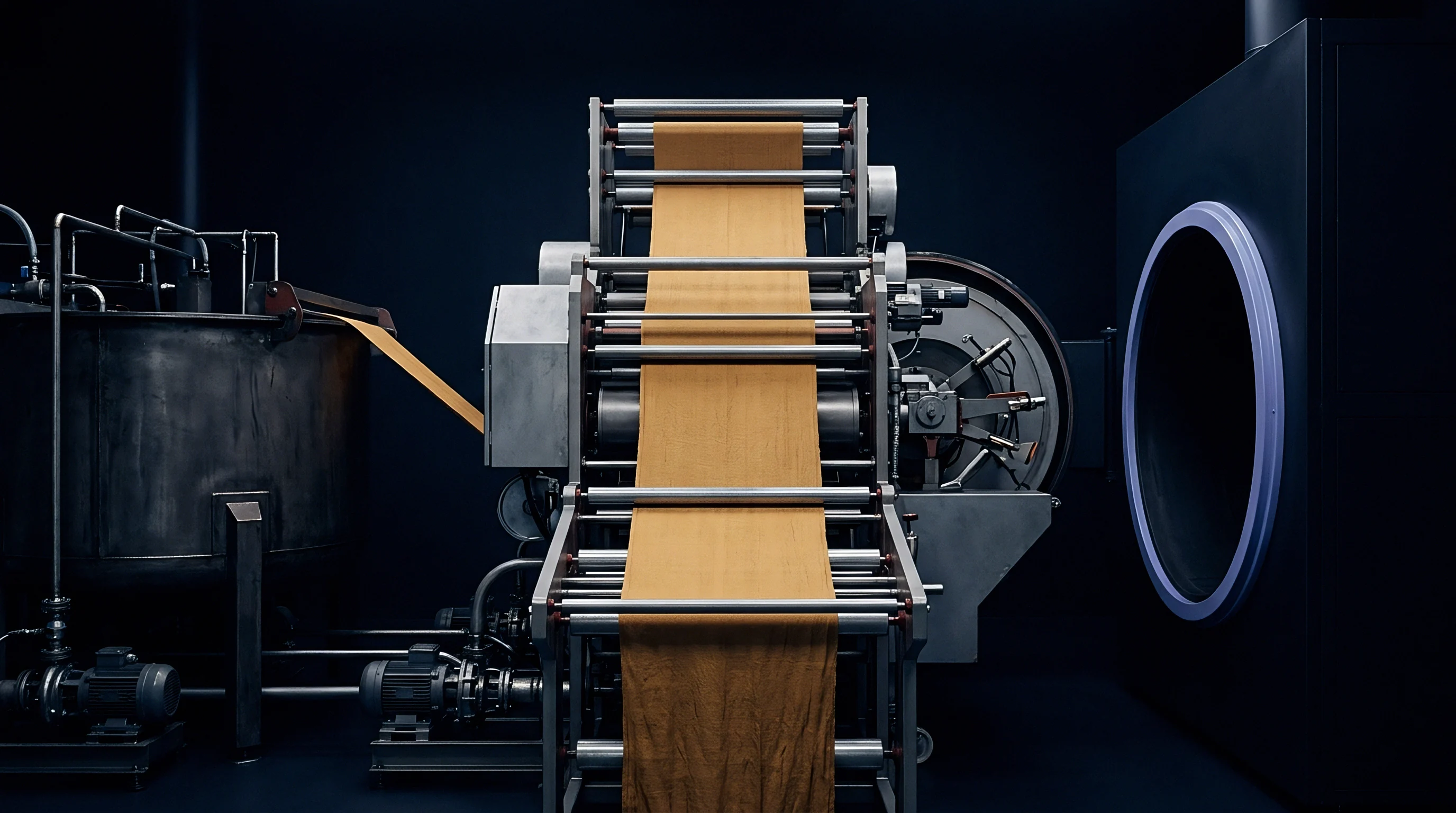
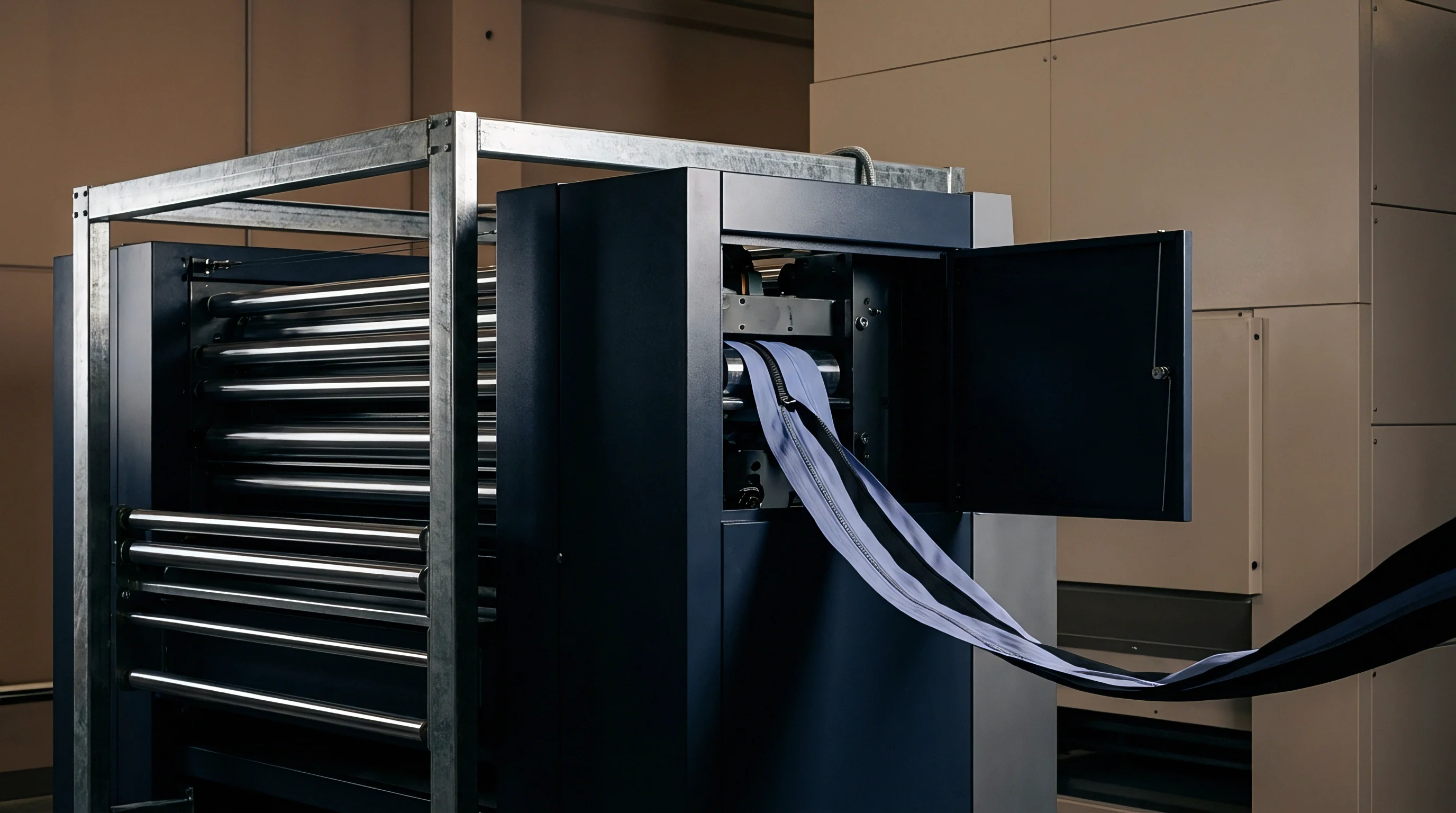
Hot-air flues evaporate moisture from the wet web via opposed air nozzles spaced along a vertical travel path. Continuous pad lines require an intermediate drying phase between dye application and fixation. During early drying, evaporation proceeds at a constant rate; water moves outward from the yarn core toward the surface, carrying dissolved reactive dyes or dispersed pigment particles along capillary channels.
Surface evaporation sets up hydraulic suction that continuously draws liquid and suspended color out to the fabric faces.
A wet fabric pick-up rate above sixty-five percent initiates severe particulate dyestuff migration whenever air velocity across the intermediate dryer nozzles fluctuates by more than five percent.
Particulate migration continues until fabric moisture reaches the critical moisture content, where continuous capillary channels break down, liquid flow stops, and further drying occurs solely by vapour diffusion. For continuous woven cotton, this threshold sits between 28 percent and 32 percent regain. Managing the evaporation rate through these early heating zones determines whether dye concentration remains balanced across the fabric cross-section.
Hot-Flue Thermodynamic Balancing
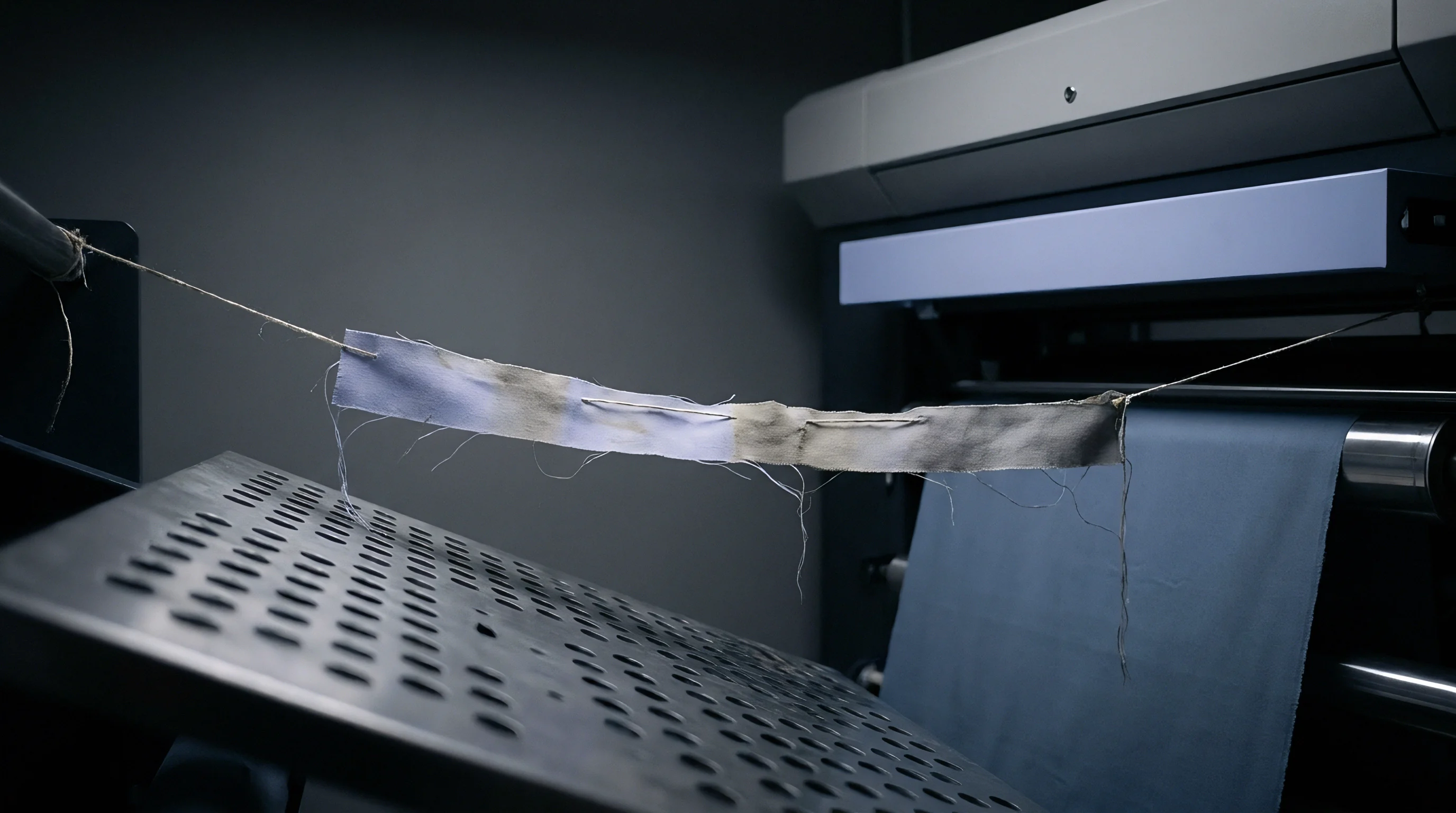
Infrared pre-dryers placed ahead of the hot-flue entry shed moisture without physical contact. Medium-wave infrared radiation (2.0 to 3.5 micrometres) targets liquid water absorption bands. Bringing fabric temperature to 70 degrees Celsius in an infrared zone drops regain from 60 percent to 35 percent in seconds, setting dye positions before convective air jets strike the wet face.
Consider a continuous dyeing line running a 240 g/m² 2/1 cotton twill at a speed of 45 metres per minute with an incoming wet pick-up of 62 percent. The line processes 648 kilograms of dry fabric per hour, carrying 401.76 kilograms of liquor. Reducing moisture regain down to the critical threshold of 30 percent requires evaporating 207.36 kilograms of water per hour within the infrared pre-dryer and first hot-flue zone.
Assuming the infrared unit operates at 55 percent thermal efficiency with an installed electrical capacity of 180 kilowatts, evaporating that moisture volume requires 152 kilowatt-hours of thermal input. If upper hot-flue circulation fans drift and create a 12 percent nozzle velocity mismatch between faces, drying rates unbalance; the face exposed to higher air velocity dries faster, pulling liquor and dye toward that side. The resulting listing defect leaves one side noticeably darker than the reverse, forcing lot rejection at final inspection.
Failure to maintain strict nozzle velocity symmetry in the first hot-flue chamber leads directly to unrecoverable shade two-toning across the entire bulk production run.

Measurement
Online Sensor Calibration and Surface Reflection Distortions
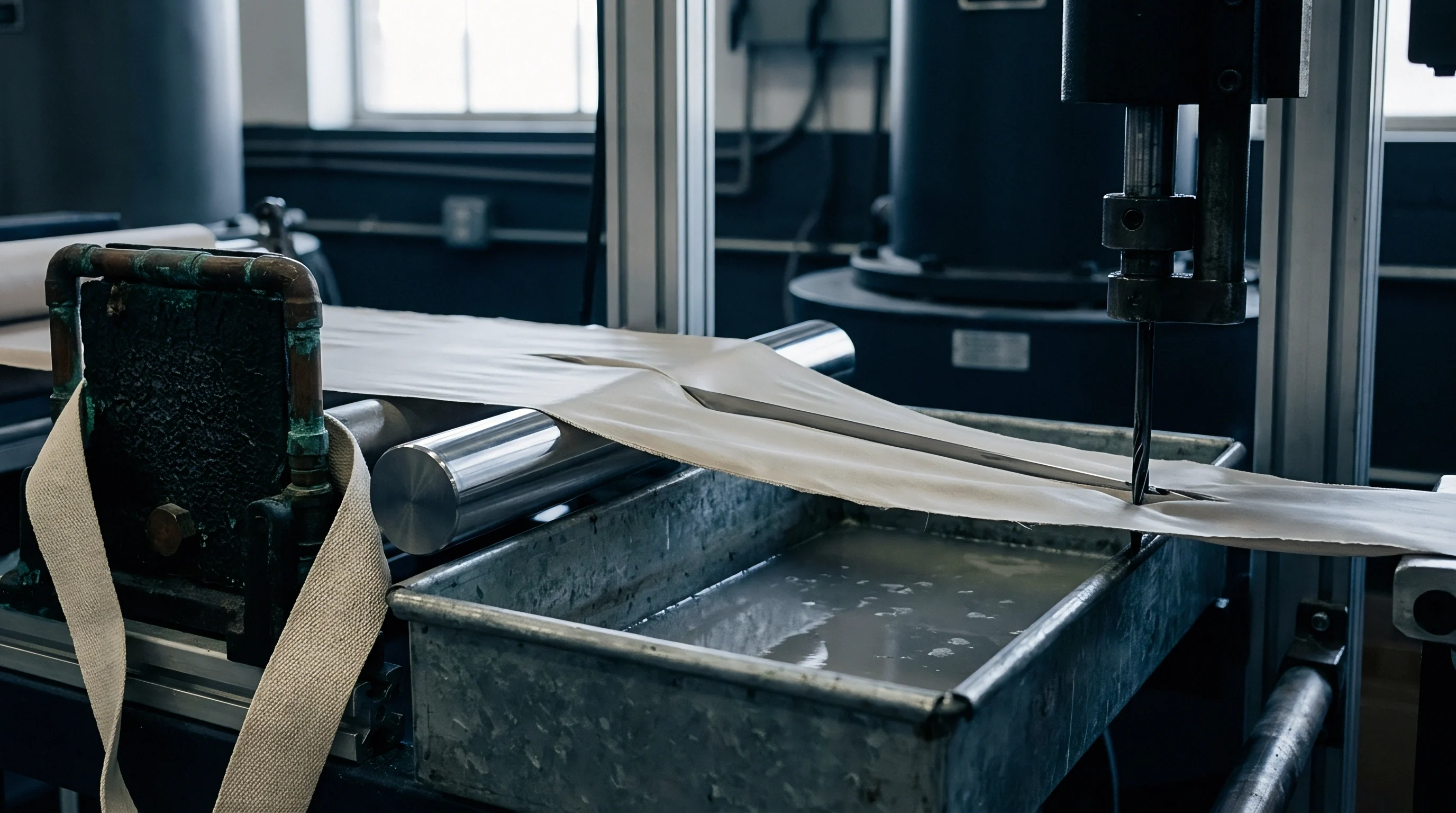
Tracking moisture levels on a running range requires non-contact instrumentation positioned right after the drying zone. Mills rely mostly on microwave resonance absorption or near-infrared reflection (NIR) spectroscopy. Microwave units gauge the phase shift and attenuation of a high-frequency wave sent through the running web.
Because water has a high dielectric loss relative to dry cellulose, signal attenuation scales directly with total water mass per unit area.
The ISO 6330 conditioning protocol mandates dry sample equilibration at twenty degrees Celsius and sixty-five percent relative humidity for four hours to validate online optical sensor baseline calibration.
Near-infrared sensors measure light absorption at wavelengths matching the vibrational overtones of oxygen-hydrogen bonds in water. NIR units inspect only the outer surface of the cloth, whereas microwave sensors integrate moisture across the full web thickness. On heavier constructions, internal moisture gradients confuse surface-reading optical sensors, under-reporting moisture while the core remains damp.
| Technology Type | Measurement Depth | Accuracy Range (%) | Sensitivity to Web Speed | Primary Failure Cause |
|---|---|---|---|---|
| High-Frequency Microwave | Full Core Penetration | ± 0.3 | Low | Variable Fabric Density |
| Near-Infrared (NIR) | Surface Layer (150 µm) | ± 0.2 | Negligible | Dye Color Interference |
| High-Frequency Conductance | Contact Roller Depth | ± 0.8 | Moderate | Static Charge Accumulation |
| Radio-Frequency Capacitive | Full Web Cross-Section | ± 0.5 | High | Salt Concentration Drift |
When Does High-Frequency Microwave Regain Sensing Fail on Heavy Fabrics?
Microwave regain sensors misread water mass on fabrics above 400 grams per square metre when residual conductive salts are present. Direct dye recipes loaded with electrolytes like sodium sulphate or sodium chloride change the dielectric loss factor of the liquid phase. The sensor mistakes this ionic conductivity for moisture, reports inflated regain figures, and triggers burners to over-dry and degrade the cotton fibres.
Temperature variations in the moving web also shift dielectric readings: a ten-degree Celsius rise in exit temperature lowers the dielectric constant of bound water, so microwave sensors under-report regain unless dynamic pyrometer compensation is running in the control loop.
Optical sensors are promoted as self-calibrating across shade changes, yet dark navy and carbon black shades absorb near-infrared light entirely, blinding the instrument.

Control

Closed-Loop Line Speed and Burner Modulation
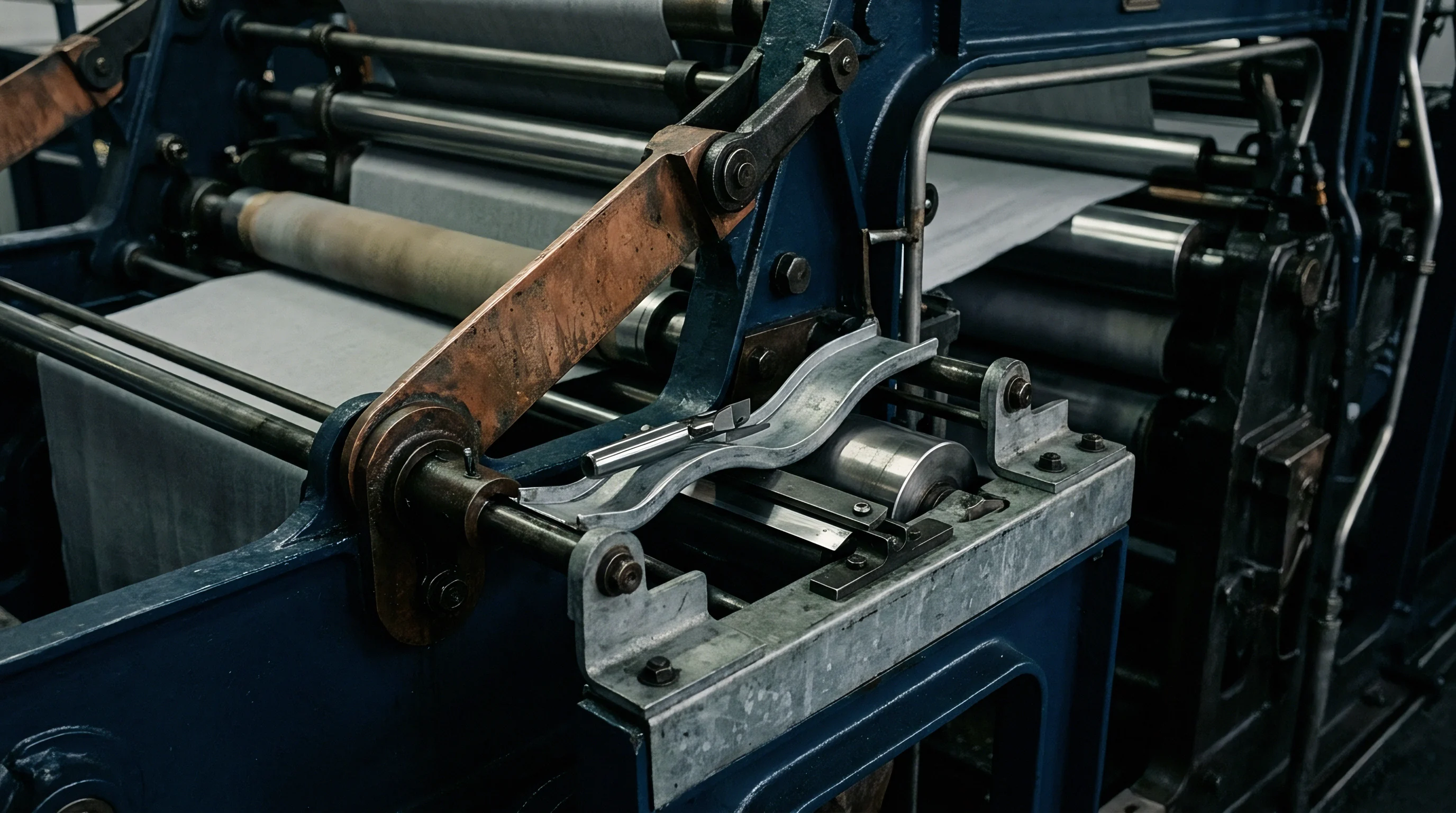
Automated loops adjust burner firing rates and stenter drive speeds from live sensor feedback. When dryer exit regain registers above setpoint, the system modulates proportional gas valves to raise chamber heat, or trims line speed to extend residence time in the flue. Exposing cotton to sustained heat beyond the dry point drops the degree of polymerization, costing up to fifteen percent in tensile strength.
Operating a stenter line at three percent below target regain increases thermal gas consumption by eighteen percent per finished linear metre.
Precise closed-loop control keeps delivery moisture inside a tight band around standard equilibrium, typically 6.0 percent to 7.0 percent for cotton entering thermal fixation. Carrying that residual moisture into the thermosol cabinet prevents thermal shock and limits warp shrinkage.
- The online microwave sensor measures residual web moisture mass at the hot-flue exit.
- The central processor compares measured regain against the target setpoint for the specified fabric mass per unit area.
- An error signal calculates the required correction using a proportional-integral-derivative control algorithm.
- Proportional control valves adjust gas burner firing rates across active heating zones within three seconds.
- Line speed drives alter stenter chain velocity to maintain exact thermal exposure timing if burner adjustments reach capacity limits.
- Downstream exit moisture sensors verify target regain compliance before fabric wind-up.
Moisture Management at the Thermosol Entry
Continuous thermosol fixation requires strict moisture uniformity across the web prior to entering the high-temperature zone (190 to 210 degrees Celsius). Residual moisture entering the thermosol cabinet flashes off instantly as superheated steam. If regain varies across the width, steam generation rates vary locally, altering local fixation temperatures and causing shade banding down the roll.
The standard sales contract for continuous wet processing requires that finished delivery rolls contain between six and eight percent moisture regain, measured instantly upon delivery per ISO 6330 test standards, with rejection rights triggered below five percent.
Defects
Quantifying Bulk Shade Deviation Caused by Moisture Asymmetry
Non-uniform drying across the fabric width causes shade listing, double-face variance, and localized tendering during continuous thermosol fixation. Moisture asymmetry alters the local swelling capacity of the cellulose structure, directly shifting the chemical yield of reactive dyes. A moisture deviation of two percent across the web during intermediate drying produces measurable CIELAB color differences.
The affected areas fail visual shade matching under D65, TL84, and CWF illuminants inside standard light boxes.
| Exit Moisture Regain (%) | Tensile Strength Loss (%) | Warp Shrinkage (%) | Delta E (CIELAB) Color Drift | Process Pass/Fail Status |
|---|---|---|---|---|
| 2.5 (Severe Over-dry) | -16.5 | +4.2 | 1.85 | Rejected |
| 4.5 (Moderate Over-dry) | -8.0 | +2.8 | 0.95 | Margin Out of Spec |
| 6.5 (Optimal Target) | 0.0 | +1.1 | 0.12 | Approved |
| 9.0 (Under-dried) | 0.0 | -0.5 | 1.45 | Rejected (Dye Migration) |
| 12.0 (Wet Core) | 0.0 | -1.8 | 2.80 | Rejected (Water Spotting) |

Financial Implications of Over-Drying and Fiber Degradation
Running continuous lines with excessive burner output to ensure full dryness drives up natural gas expenses while destroying commercial fabric weight. Fabric sold on a mass basis loses billable weight when delivered below standard moisture regain. A 50,000-metre production run of 250 g/m² cotton fabric delivered at four percent regain instead of the standard 8.5 percent regain represents a net loss of 562.5 kilograms of billable material.
At a fabric value of 4.50 USD per kilogram, this single moisture discrepancy costs the dyehouse 2,531.25 USD in unrecovered bulk weight, alongside elevated energy expenditures.
Before issuing a bulk dyehouse production release, technical buyers demand verification of moisture control protocols within the mill qualification dossier.
- Target regain windows must be specified per fabric construction in the technical manufacturing instruction sheet.
- Dual-stage sensor positioning must include non-contact sensors at both intermediate drying exit and stenter delivery frames.
- Thermal calibration records must prove monthly validation of burner modulation hardware against certified moisture standard rolls.
- Width-wise regain profile reports must demonstrate moisture variation below 0.5 percent across the full usable width.
Controlling moisture regain in continuous dyeing requires balancing physical fibre properties, chemical liquor application, heat transfer dynamics, and automated sensing hardware across every meter of processing line. Mill managers who manage moisture parameters reduce shade rejections, protect yarn tensile integrity, optimize line speeds, and maintain stable energy budgets across large-volume continuous dyeing operations.