Predictive Dynamic Mass Balance Modeling for Differential Fibre Extraction in High Speed Carding
Calibrate differential carding waste extraction through dynamic mass balances to protect staple length distribution and minimize yarn cost per kilogram.

Chute
Continuous pneumatic distribution trunks deliver raw tuft columns across modern high-production spinning card installations. Carding isolates individual fibres. Modern carding setups running above one hundred kilograms per hour rely on uniform pneumatic feed towers to maintain consistent mass flow per unit of time.
Density variations within the feed batt propagate through the carding zones, producing sliver count deviations and erratic trash extraction behavior. When tuft volume fluctuates at the intake, mechanical combing elements experience uneven loading, which shifts the ratio of removed waste to preserved spinnable lint. Tuft density determines opening resistance.
Feed systems regulate mass through optical sensors and pressure switches that monitor pneumatic column compression. A card consuming saw-ginned upland cotton with a base staple length of 28.5 millimeters and a micronaire of 4.2 requires steady volumetric delivery to prevent cylinder overloading. High-speed carding kinematics do not tolerate batt unevenness exceeding three percent coefficient of variation.
When feed mass surges, the feed roller pinches an oversized web against the feed plate, blunting wire teeth and fracturing raw seed hulls into microscopic fragments.
- Bale Plucker Traversal Uniformity determines feed chute density by depositing balanced tuft layers directly into automated opening lines.
- Pneumatic Trunk Static Pressure Calibration governs lap compression through pressure differential transducers along lower feed passages.
- Feed Plate Radial Setting Verification prevents premature web tearing during high-volume batt compression before lickerin entry.
- Chute Exit Optical Density Scanning triggers feed motor adjustments to eliminate web thickness variations across card widths.
Pneumatic Feed Trunk Regulation
Pressure transducers positioned along lower distribution ducts regulate feed roll motors. The air velocity inside the transport duct must decouple from tuft compaction dynamics to avoid turbulent eddy currents that cause fiber entanglement. Air speeds between twelve and fifteen meters per second transport individual tufts without rolling them into tight neps.
Once stock arrives at the reserve chamber, perforated partition walls allow transport air to escape while retaining the fiber mass.
Static air pressure in the lower trunk establishes the batt density presented to the feed roller. Variations in relative humidity alter inter-fiber friction, modifying tuft packing behavior within the column. Processing cotton at fifty-five percent relative humidity produces different packing densities than processing at sixty-five percent relative humidity.
Unopened tufts produce visible slubs. Mechanical cards fitted with integrated autolevellers measure feed roll displacement to counteract residual density variations, adjusting the feed roll rotational speed to hold cross-sectional mass constant.
Tuft Mass Uniformity Metrics
Laboratory checks measure cross-machine web density through acoustic gauges or infrared reflectance arrays. Production managers assess batt uniformity by cutting and weighing one-meter segments of consolidated web delivered by the chute exit rollers. The mass per unit area must remain within a tolerance of plus or minus two percent across the working width of 1.28 meters.
Variations beyond this threshold alter the point-to-point contact frequency of wire clothing teeth against fibrous tufts.
Machine builders commonly claim that pneumatic feed towers self-correct for raw stock density swings without external automated intervention.


Lickerin
Opening rollers fitted with reverse-rake wire saw teeth receive compacted fibrous laps directly from feed plates. Lickerin teeth strip the batt. Rotating at speeds between seven hundred and twelve hundred revolutions per minute, the initial taker-in roller combs through the presented fiber fringe, plucking tufts and accelerating them along an arc bounded by adjustable moteknives and carding segments.
The mechanical force applied during this transition separates heavy vegetable trash, motes, and mineral soil from spinning fiber.
Differential extraction relies on the distinct inertia of high-density impurities versus low-density cellulosic fibers. When accelerated to peripheral speeds exceeding thirty meters per second, foreign matter possessing high specific gravity overcomes local aerodynamic drag and exits through extraction apertures beneath the roller. Fine cotton fibers remain held by boundary layer suction and the mechanical grab of forward-facing wire teeth.
Centrifugal forces eject dense particles.
A card running at 180 kilograms per hour extracts 1.8 percent lickerin droppings when processing saw-ginned upland stock at 750 revolutions per minute taker-in velocity.
Aerodynamic Opening Mechanics
Rotating toothed cylinders strike the feed batt while knife bars strip mineral matter. Modern high-production cards utilize triple lickerin configurations, employing three sequential rollers with progressive wire densities and speeds. The first roller features coarse saw-tooth wire with ten to twelve teeth per square inch to initiate opening.
The secondary and tertiary rollers carry twenty to thirty teeth per square inch, increasing peripheral velocity to accelerate individual fibers toward main cylinder speed.
Air guide vanes beneath the extraction zone establish a controlled boundary layer separation that pulls trash away from fiber hooks. Knife angles set between twenty-eight and thirty-two degrees relative to the cylinder circumference generate an aerodynamic pressure crest that discharges brittle bark and leaf remnants into vacuum waste collection ducts. Short staples drop through screens.
If the knife angle is too steep, excessive amounts of spinnable long fiber peel away into the undercard waste chamber.
Does Cylinder Speed Shift Lickerin Extraction Efficiency?
Taker-in peripheral velocity governs kinetic energy imparted to particulate contaminants. Elevated rotational velocities amplify centrifugal acceleration, which scales with the square of peripheral speed divided by roller radius. Increasing taker-in speed from six hundred to nine hundred revolutions per minute increases the centrifugal force exerted on a five-milligram seed particle by a factor of 2.25.
Trash particles resist aerodynamic capture.
Higher velocity concurrently increases the incidence of mechanical fiber rupture. Fragile upland cottons with low maturity ratios exhibit pronounced staple length degradation when subjected to excessive taker-in tooth impacts. The balance between trash extraction efficiency and fiber length retention requires strict setting management based on fiber micronaire and strength ratings.
| Carding Element | Rotational Velocity (rpm) | Fibre Loss 160 kg/h (%) | Trash Rejection 160 kg/h (%) | Fibre Loss 220 kg/h (%) | Trash Rejection 220 kg/h (%) |
|---|---|---|---|---|---|
| Primary Lickerin | 850 | 0.85 | 68.5 | 1.12 | 62.4 |
| Secondary Lickerin | 1050 | 0.45 | 18.2 | 0.58 | 15.1 |
| Stationary Flats (Inlet) | Static | 0.28 | 6.4 | 0.34 | 7.2 |
| Revolving Flats | 0.28 m/min | 1.35 | 4.8 | 1.48 | 8.6 |
| Stationary Flats (Outlet) | Static | 0.12 | 1.2 | 0.15 | 1.5 |
| Filter Box Under-Suction | Continuous | 0.35 | 0.9 | 0.42 | 5.2 |
Incorrect knife bar pitch leads directly to short-staple accumulation in rotor spinning grooves and elevates yarn breakage rates across downstream winding.

Flat
Main cylinders rotating at peripheral speeds above thirty-five meters per second transport individual fibrous strands past flexible top bars. Cylinder clothing retains long filaments. The point-to-point action between revolving flats and cylinder wire produces true single-fiber separation, releasing entangled clusters and scraping minute seed coat remnants from individual cotton ribbons.
Revolving flat assemblies move slowly along an elliptical track, either counter to or concurrent with cylinder rotation, systematically loading their card clothing with nep formations and short non-spinnable fragments.
The gap separating flat clothing from cylinder wire ranges from 0.15 to 0.25 millimeters on precision machinery. Maintaining this microscopic clearance across a 1.28-meter working width requires strict thermal stabilization of the carding chassis. Carding action generates friction that heats the cylinder rim, causing radial metal expansion of up to 0.08 millimeters during continuous high-production operations.
Seed coat fragments shatter easily. If chassis cooling systems falter, the cylinder wire risks direct contact with the flat points, destroying clothing investments.
Heavier flat strips yield cleaner sliver at the expense of combed staple loss.

Revolving Top Bar Clearance Dynamics
Cast-iron assemblies riding polished flexible bends maintain ten-thousandth-of-an-inch tolerances across seventy-four active working elements. The heel-to-toe design of the card flat bar creates an entry angle that wedges incoming fiber layers progressively deeper into opposing wire fields. Fiber orientation aligns along the direction of main cylinder rotation.
Entangled clusters and neps lack linear tensile continuity, remaining trapped on flat wires while straight, mature fibers follow cylinder clothing.
Flat speed governs the extraction rate of revolving flat strips. Accelerating the flat traversal velocity from 0.18 meters per minute to 0.35 meters per minute exposes fresh clothing surfaces to the cylinder continuously, elevating total flat waste removal from 1.1 percent to 1.8 percent of aggregate machine throughput. Static flats catch coarse impurities.
- Heel-to-Toe Gauge Misalignment causes uneven flat strip deposition across the card width.
- Excessive Boundary Layer Air Turbulence blows good staple into the under-screen suction trunks.
- Worn Stationary Carding Segment Wire leaves seed coat neps intact inside the sliver web.
- Inadequate Revolving Flat Stripping Blade Contact allows loaded flats to recirculate uncombed trash.
What Controls Stationary Flat Waste Generation?
Fixed carding plates positioned over the lickerin and doffer zones strip seed hulls through localized boundary layer skimming. Stationary flat segments feature precision aluminum profiles carrying hardened wire clothing strips. Because these bars do not circulate along a mechanical track, trash accumulation deposits between wire teeth until aerodynamic drag from the spinning cylinder dislodges loaded matter toward continuous extraction knives.
A precision knife blade positioned between stationary flat clusters peels the outer boundary layer away from the cylinder perimeter. Air currents moving at forty meters per second carry dislodged motes directly into exhaust ducts. The mass of fiber extracted at these static stations consists primarily of immature, dead fibers containing minimal secondary cell wall thickening.
These low-micronaire fractions exhibit insufficient bending stiffness to withstand centrifugal forces, projecting outward into the suction zone.
Whether mechanical flat cleaning brushes extract trash through true differential velocity or purely through passive surface drag remains unsettled across continuous mill trials.

Transfer
Main drum clothing intermeshes with the wire points of slower delivery condensing drums across narrow radial gaps. Doffer speed dictates production rate. The cylinder-to-doffer interface represents the point where opened fibers transfer from high-speed processing drums onto condensing surfaces to form a cohesive sliver web.
The transfer ratio defines the probability that a single fiber on the main cylinder transfers to the doffer wire during a single transit pass.
Centrifugal acceleration on the main cylinder exceeds three hundred times gravity, holding individual fibers at the tips of forward-angled clothing teeth. The doffer cylinder rotates at a fraction of main cylinder speed, presenting hook-faced wire teeth angled in opposition to incoming fiber paths. The relative velocity difference between cylinder and doffer strips fiber layers, condensing them into a continuous web.
Fibre transfer ratios govern loading.
Cylinder clothing loading reaches equilibrium within sixty seconds of continuous sliver delivery.

Cylinder to Doffer Centrifugal Fractionation
Centrifugal acceleration exceeding three hundred gravities propels untangled strands toward outer clothing tips. Boundary layer separation around rotating card cylinders mirrors fluid-phase centrifugal sorting seen in heavy mineral processing cyclones. Mineral beneficiation plants calibrate splitters by slurry density, whereas textile engineers govern air currents through precision under-casings.
This hydrodynamic environment subjects loose, unanchored short fibers to instantaneous aerodynamic discharge before mechanical doffing occurs.
A transfer factor of 0.12 to 0.18 indicates that a typical fiber circles the main cylinder five to eight times before successfully embedding in doffer wire clothing. During these recirculating passes, the fiber repeatedly interfaces with revolving flats and fixed carding segments, experiencing additional cleaning cycles. Excessive recirculating passes increase mechanical stress on individual cotton strands, generating fiber breakage and secondary nep formation.

Card Clothing Loading Equilibria
Surface wire teeth accumulate trapped lint during initial run-in periods. Wire clothing points possess microscopic surface striations that grip cotton waxes and fine micro-dust. Over the first twenty minutes of carding, clothing teeth establish an equilibrium mass of embedded fibers that remains stable throughout continuous production.
Dynamic modeling tracks this loading state through continuous differential differential balances.
Heavier sliver increases drawing draft. When the transfer factor drops due to wire wear or inappropriate settings, the cylinder retains excessive fiber mass. Cylinder loading elevates radial pressure against opposing flat bars, narrowing operating clearances and elevating thermal generation across carding arches.
In severe cases, cylinder loading forces raw stock into under-screens, generating uncontrolled fiber extraction and uneven sliver deliveries.
Clean wire transfer hinges on uniform tooth sharpness across interacting drums.
Partition
Mass conservation dictates that total raw stock introduced into high-production machinery equals sliver output plus accumulated waste streams. Waste extraction reduces saleable mass. Predictive differential mass balance modeling establishes mass flow equations that partition raw input fiber into discrete mechanical outputs based on fiber length, maturity, trash contamination, and moisture content.
Dynamic differential tracking accounts for time-dependent mass retention within the clothing layers of high-speed cylinders.
Mathematical formulations divide total input mass into four primary discrete extraction zones: lickerin droppings, revolving flat strips, stationary flat waste, and pneumatic suction losses. Let total intake mass flow be denoted as input mass flow. Differential extraction efficiency parameters characterize the proportional extraction of foreign matter and short fiber fractions across each mechanical boundary.
Excessive extraction destroys spinning margin.
Differential Staple Length Extraction Profiles
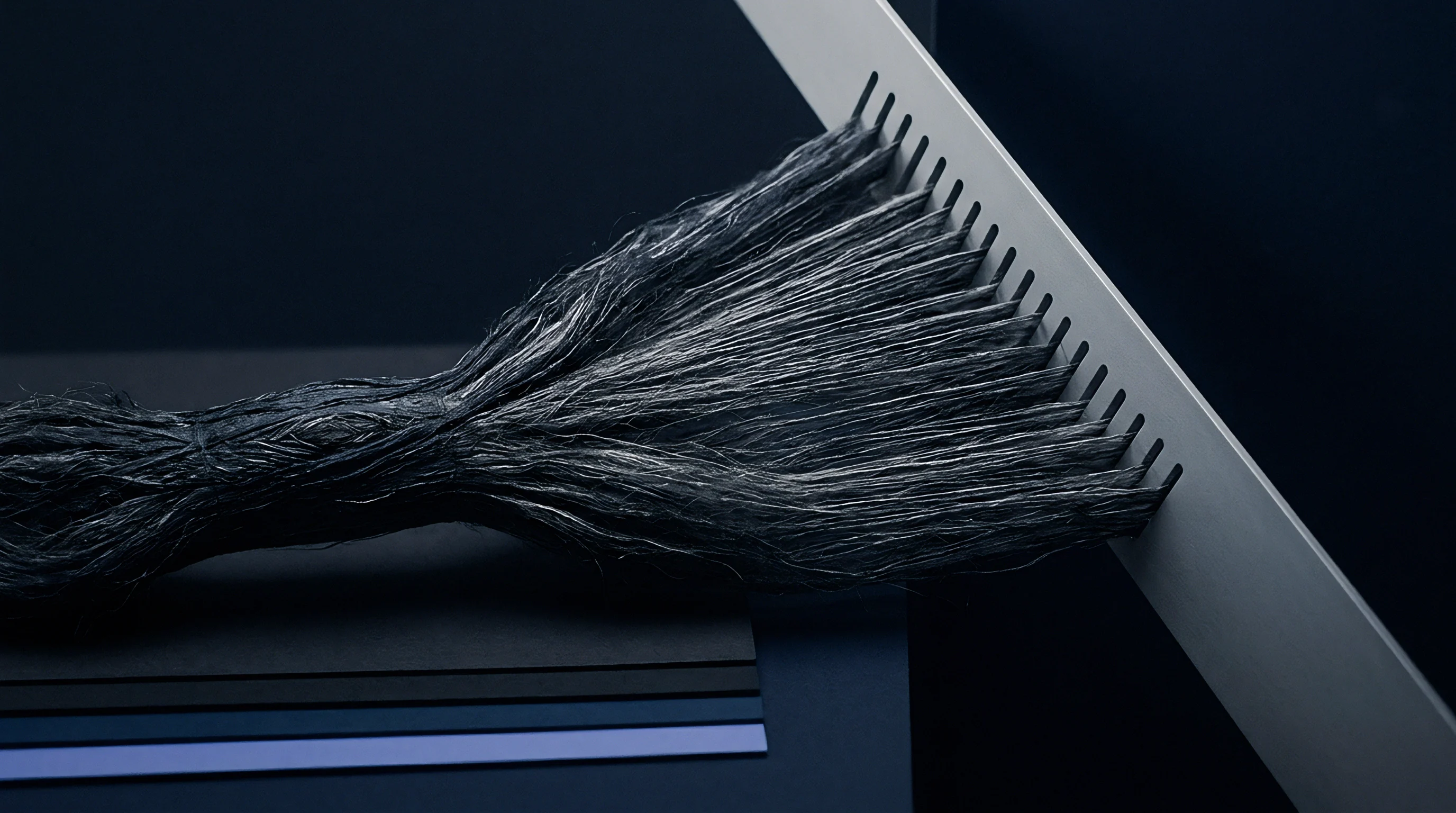
High-volume instrument testing demonstrates that extraction knives systematically fractionate raw stock by physical dimensions. Shorter fibers display reduced mechanical contact with clothing teeth, increasing their probability of falling into extraction ducts under centrifugal forces. The Upper Half Mean Length of delivered card sliver increases relative to raw bale laydown stock, accompanied by a reduction in short fiber content by weight.
A sample lot of raw cotton possessing a short fiber index of 9.2 percent by weight produces sliver with a short fiber index of 6.8 percent when operating with a total card extraction rate of 4.2 percent. The extracted waste streams display elevated concentrations of short fibers: lickerin droppings measure 22.4 percent short fiber content, while revolving flat strips contain 34.6 percent short fiber content. Real yields determine final cost.
- High Volume Instrument Length Verification quantifies the lower quartile length shift between incoming bale stock and final sliver.
- Advanced Fibre Information System Analysis measures exact short fibre content by weight and nep count per gram in all dropping streams.
- Gravimetric Suction Waste Isolation captures discrete filter box deposits from individual extraction points over continuous thirty-minute runs.
- Moisture Regain Equilibrium Testing conditions all collected waste fractions under standard laboratory atmosphere prior to final analytical weighing.
Empirical Mass Balance Conservation Equations
Mathematical models track input flows across discrete extraction vectors through differential material balances. Consider a card operating at a delivery speed of 180 kilograms per hour processing a 500-kilogram test lot of raw cotton stock. Intake material contains 3.2 percent non-lint content measured by Shirley Analyzer testing, alongside a base moisture regain of 7.5 percent.
Target sliver delivery is 481 kilograms of clean, conditioned sliver at identical regain levels.
The carding cycle partitions the remaining nineteen kilograms of mass across mechanical waste streams. Lickerin droppings account for 8.5 kilograms, consisting of 6.2 kilograms non-lint trash and 2.3 kilograms extracted fiber. Revolving flat strips account for 7.0 kilograms, consisting of 1.4 kilograms trash and 5.6 kilograms short fibers.
Stationary flat knives extract 2.0 kilograms, containing 0.8 kilograms trash and 1.2 kilograms fiber. Under-card pneumatic suction captures 1.5 kilograms of dust and fragmented fibrils. Summing all fractions confirms exact mass conservation across the 500-kilogram intake volume.
| Stream Identifier | Mass Flow Rate (kg/h) | Mean Fibre Length (mm) | Short Fibre Content (% wt) | Non-Lint Trash Content (%) |
|---|---|---|---|---|
| Intake Raw Stock | 187.50 | 28.45 | 8.95 | 3.15 |
| Delivered Sliver Web | 180.00 | 29.20 | 6.40 | 0.12 |
| Lickerin Droppings | 3.18 | 14.20 | 24.50 | 72.80 |
| Revolving Flat Strips | 2.62 | 18.80 | 36.20 | 18.40 |
| Stationary Flat Waste | 0.75 | 16.50 | 31.10 | 38.50 |
| Continuous Filter Box Suction | 0.95 | 11.40 | 48.20 | 54.20 |
| Testing conducted under ISO 12027 and ASTM D5866 standard atmospheric conditions: 20 ± 2 °C, 65 ± 4 % relative humidity on AFIS PRO instrument arrays. | ||||
The dynamic balance closes when every extracted gram aligns with its corresponding fraction in the primary sliver stream.

Settlement
Spinning mill accounting ledgers record the fiscal penalty of unrecovered droppings directly in cost per net kilogram of combed sliver. Commercial yarn manufacturing requires precise calibration between trash removal efficiency and raw material fiber loss. Extracting an unnecessary 0.5 percent of spinnable lint across a spinning mill producing twenty thousand kilograms of carded sliver daily wastes one hundred kilograms of prime fiber every twenty-four hours.
Calculated at a base lint price of 2.10 US dollars per kilogram, this loss imposes an unrecovered cost penalty of 210 dollars per day, translating to over 75,000 dollars annually on a single production line.
Mill management must monitor the clean lint content of flat strips and lickerin droppings to prevent excessive raw material write-downs. Chemical extraction or gravimetric cleaning tests establish the ratio of spinnable fiber present inside waste collection bins. If lickerin waste contains greater than thirty percent spinnable lint with lengths exceeding twenty-two millimeters, technician intervention is warranted to close extraction knives or reduce taker-in peripheral speeds.
Incorporating ASTM D2812 non-lint content tolerances into the purchasing specification prevents spinning mills from billing unrecovered droppings back to yarn buyers.

Commercial Lint Yield Loss Mechanics
Raw material purchasing contracts specify baseline trash allowances according to standard international rules. When raw cotton arrives with higher foreign matter percentages than contractual descriptions stipulate, carding lines increase extraction intensity to protect downstream yarn quality. Elevating flat speeds and widening knife apertures purges additional trash particles but inevitably pulls spinnable long fiber along with the extracted waste.
The financial impact surfaces directly in combed yarn cost formulas. Unrecovered waste streams possess low salvage value when sold to secondary spinning or non-woven manufacturing sectors. Lickerin droppings recover only fifteen to twenty percent of virgin cotton purchase price, while revolving flat strips command thirty-five to forty-five percent.
The economic differential between raw stock purchase price and waste salvage value represents a permanent loss to the spinner.

Customs Valuation and Clean Mass Adjustment
Harmonized tariff schedules assess duty rates on net conditioned weight rather than gross intake volume. International trade disputes frequently emerge when customs laboratories evaluate imported raw cotton using standardized desiccation oven techniques under ISO 6741, while spinning mills calculate invoiced mass from automated bale plucker load cells. Discrepancies between physical mass balances and official customs declarations trigger financial penalties and delayed cargo clearances.
A cross-border delivery of 100,000 kilograms of raw cotton declared at 7.5 percent commercial moisture regain carries significant customs exposure if moisture evaporation during transit drops arrival weight to 98,200 kilograms. Mill-side predictive models identify whether weight losses represent evaporated moisture regain or structural mass loss from premature bale opening and handling damage. Accurate verification protects purchasing margins against arbitrary customs reclassifications.
Standard arbitral contracts under International Cotton Association Rule 231 reallocate moisture and tare penalties directly to the invoice recipient upon certified test submission.