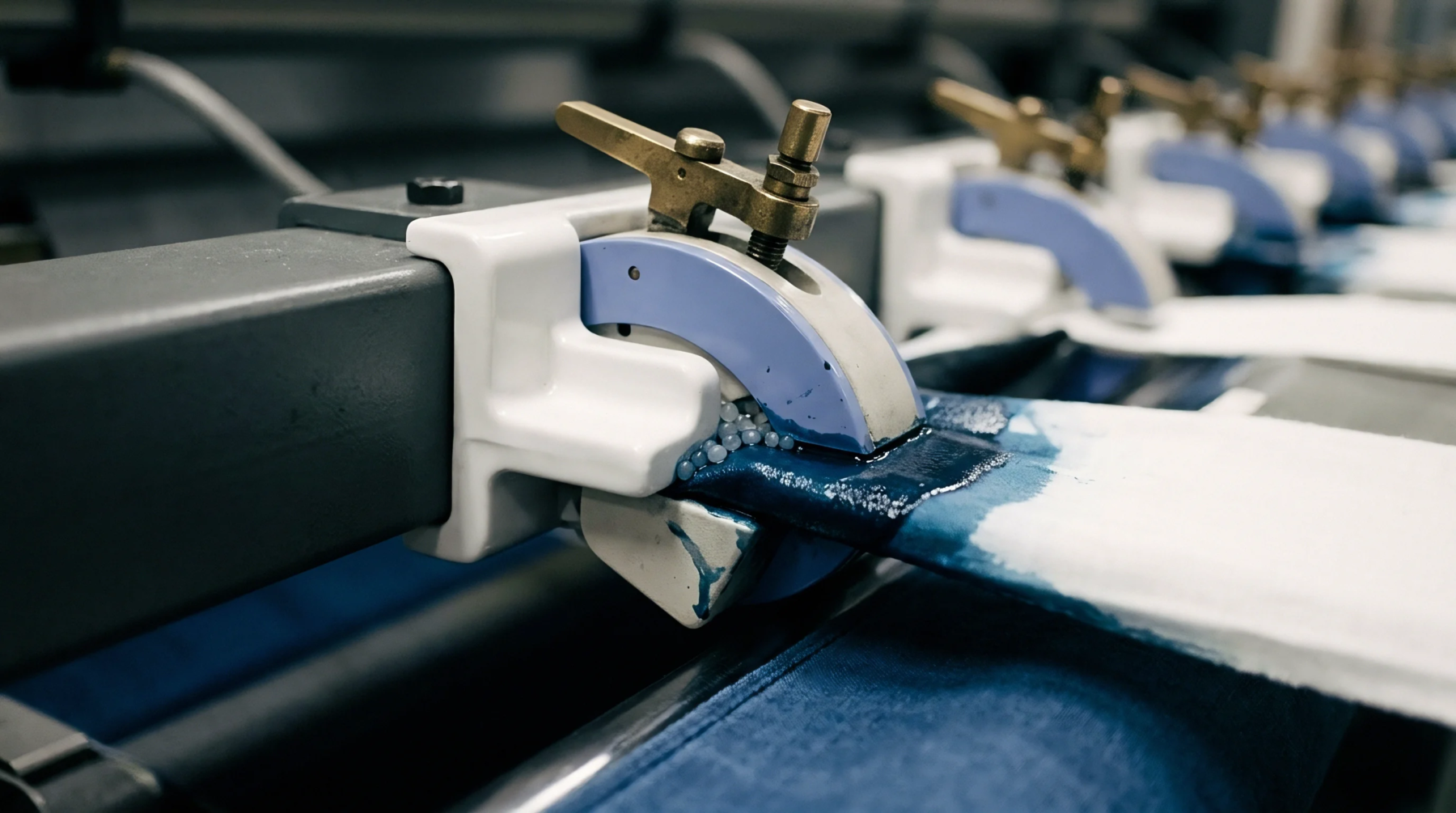
Hydrolyzed Reactive Dye Extraction Kinetics during High Cover Factor Fabric Washing
Dense fabric wash-off requires electrolyte removal below 1 g/L before 95°C soaping to extract residual hydrolyzed dye without fastness failures.
Synthetic additives with long molecular chains keep insoluble dye particles or solid contaminants uniformly distributed throughout a liquid bath to prevent agglomeration or spotting. A polymeric dispersant governs the physical stability of pigment dispersions and vat dyes during the immersion stages of fabric coloration and finishing. It defines the commercial threshold for shade uniformity by stopping small particles from clumping together into larger masses that would cause uneven dark specks on the textile surface.
The effectiveness of the agent stops when the concentration of solids exceeds the capacity of the polymer to provide adequate steric or electrical separation. Industrial dyers rely on these chemicals to achieve consistent results in high speed continuous operations.
Each polymer molecule contains both hydrophobic segments that anchor to the dye particle and hydrophilic segments that extend into the surrounding water. This creates a protective shield that keeps particles spaced apart through mutual repulsion as they move through the high speed pumps of the dyeing machine. The polymeric dispersant acts as a bridge between the solid and the liquid, lowering the overall energy of the mixture to favor a fine, mist like state.
Without this protection, the dye would rapidly settle at the bottom of the tank or get stuck in the tight bends of the fabric folds. The mechanism is particularly useful in polyester dyeing where high temperatures tend to force particles together. Heat stable versions ensure that the dispersion remains intact even as temperatures rise to one hundred and thirty degrees.
Using these stabilizers requires careful adjustment of the bath pH to ensure that the functional groups on the polymer remain fully active. If the chemical environment becomes too acidic or alkaline, the polymeric dispersant may undergo a conformation change that reduces its ability to grip the dye. Its performance is also linked to the shear forces present in the machinery where high turbulence can sometimes strip the polymers from the surface of the solids.
Boundary conditions are defined by the specific compatibility between the polymer chemistry and the dye type used in the batch. Correct dosing ensures that the total surface area of all solids in the bath is adequately covered. If the dose is too low, localized clustering is observed within the fabric fibers, appearing as unlevel dyeing.
Assessing the success of the stabilizer involves a filter test where the liquor is passed through a fine paper to see if any visible particles are left behind. A clean filter indicates that the polymeric dispersant has successfully maintained the required particle size for penetration into the fiber. Finished fabrics are also inspected under strong light for signs of pigment spotting which marks a failure of the chemical package.
Standard reports log the relationship between chemical dose and the final visual clarity of the roll. These tools allow mills to troubleshoot problems in their mixing rooms before expensive fabric batches are started. Success is confirmed when thousands of meters display identical color values from start to finish.
Dense fabric wash-off requires electrolyte removal below 1 g/L before 95°C soaping to extract residual hydrolyzed dye without fastness failures.
Expertise is a utility, not a secret. sentiention™ publishes its working knowledge as open reference: intelligence layer covering the materials it sources, the markets it enters, and the reference that serves both.