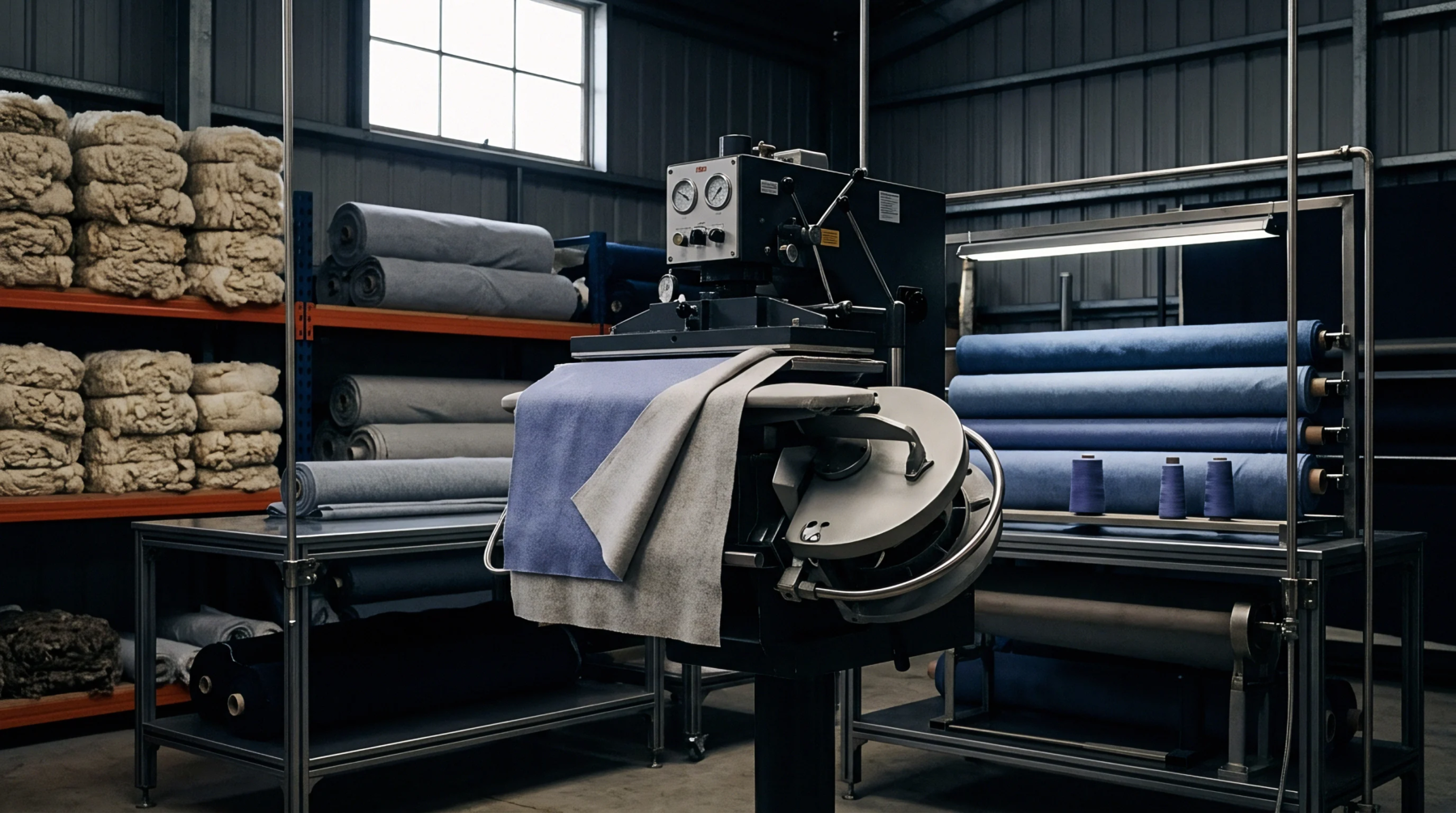
Movement Protocol
Continuous wet processing relies on slack handling to prevent dimensional distortion during transition between stages. Tensionless festooning allows substrate to settle into hanging loops on a conveyor or belt without mechanical pulling. High-speed rollers drive the material forward while sensors maintain the exact speed required to avoid drag.
Gravity governs the fold formation to ensure each layer stays uniform. This avoids the internal stress that causes irreversible elongation in synthetic knits or elasticised fabrics.
Gravity Benefit
Gravity remains the primary force acting upon the material during transport through drying or chemical saturation chambers. By letting the fabric hang in loops, internal fibres avoid the lengthwise load found in driven nip rollers. Reduced load prevents the narrowing effect known as widthwise contraction.
Folding Mechanic
Sensors detect the precise volume of fabric arriving from the upstream machine and adjust the conveyor speed to maintain a constant loop depth. Each pleat rests against the previous fold to create a stable pile. Uniformity in the loop structure prevents the entanglement of long strands within the processing vat.
Process Consequence
Elimination of longitudinal drag protects the latent elastic properties of the textile from premature modification. Fabrics arrive at the final packaging stage with dimensions that match the design specifications established during the knitting or weaving phase. Final product geometry depends on this preservation of the relaxation state throughout the entire finishing sequence.