Viscoelastic Stress Relaxation Profiles in Heat Set Polyurethane Stretch Wovens
Controlled stenter dwell at 185-195°C stabilizes polyurethane hard segments to minimize viscoelastic force decay and garment bagging in stretch wovens.
Domain
Segmented polyurethane filaments rely on a biphasic morphology to generate elastic recovery under tensile strain. Hard segments, composed of diisocyanate units reacted with low-molecular-weight diols, organize into semi-crystalline or glassy microdomains through strong intermolecular hydrogen bonding. Soft segments, comprising high-molecular-weight polyether or polyester diols, remain amorphous at ambient temperatures and coil randomly between the rigid domains.
Uniaxial extension uncoils the soft segments, transferring tensile stress across the macromolecular network to the hard domain anchor points. Constant strain application initiates rapid conformational rearrangement within the amorphous polyol chains, accompanied by progressive hydrogen bond dissociation within the hard domains.
Stress relaxation proceeds as a time-dependent decay of restoring force under fixed elongation. The initial instantaneous drop reflects entropic rearrangement of soft segment chains between physical crosslinks. Slower, long-term decay stems from viscous slippage of hard segments, mechanical pull-out of chain ends from domains, and molecular plasticization.
When the hard segment domains fail to resist viscous flow, the polyurethane filament retains unrecoverable plastic deformation. Woven stretch constructions magnify this relaxation behavior through yarn-on-yarn friction, crimp balance displacement, and localized contact stresses at crossover points.
Tensile force under thirty percent extension drops twenty-two percent within six hundred seconds when measured at twenty degrees Celsius.
Polyether-based polyurethanes demonstrate superior hydrolytic stability and dynamic flex fatigue resistance compared to polyester variants. Polyester-based types offer higher initial tensile strength and thermal stability, yet suffer rapid chain scission in warm, humid processing conditions. Selecting polyether versus polyester chemistry fixes the baseline viscoelastic relaxation rate before any thermal processing or weaving begins.
The molecular weight distribution of the polyol directly dictates soft segment mobility. Polydisperse soft segments exhibit broader relaxation spectra, producing erratic force decay profiles across extended load cycles. Narrow polydispersity indices concentrate relaxation into predictable time constants, allowing precise calculation of dimensional recovery in the finished woven structure.
Heat
Thermal Reorganization within Continuous Stenter Frames
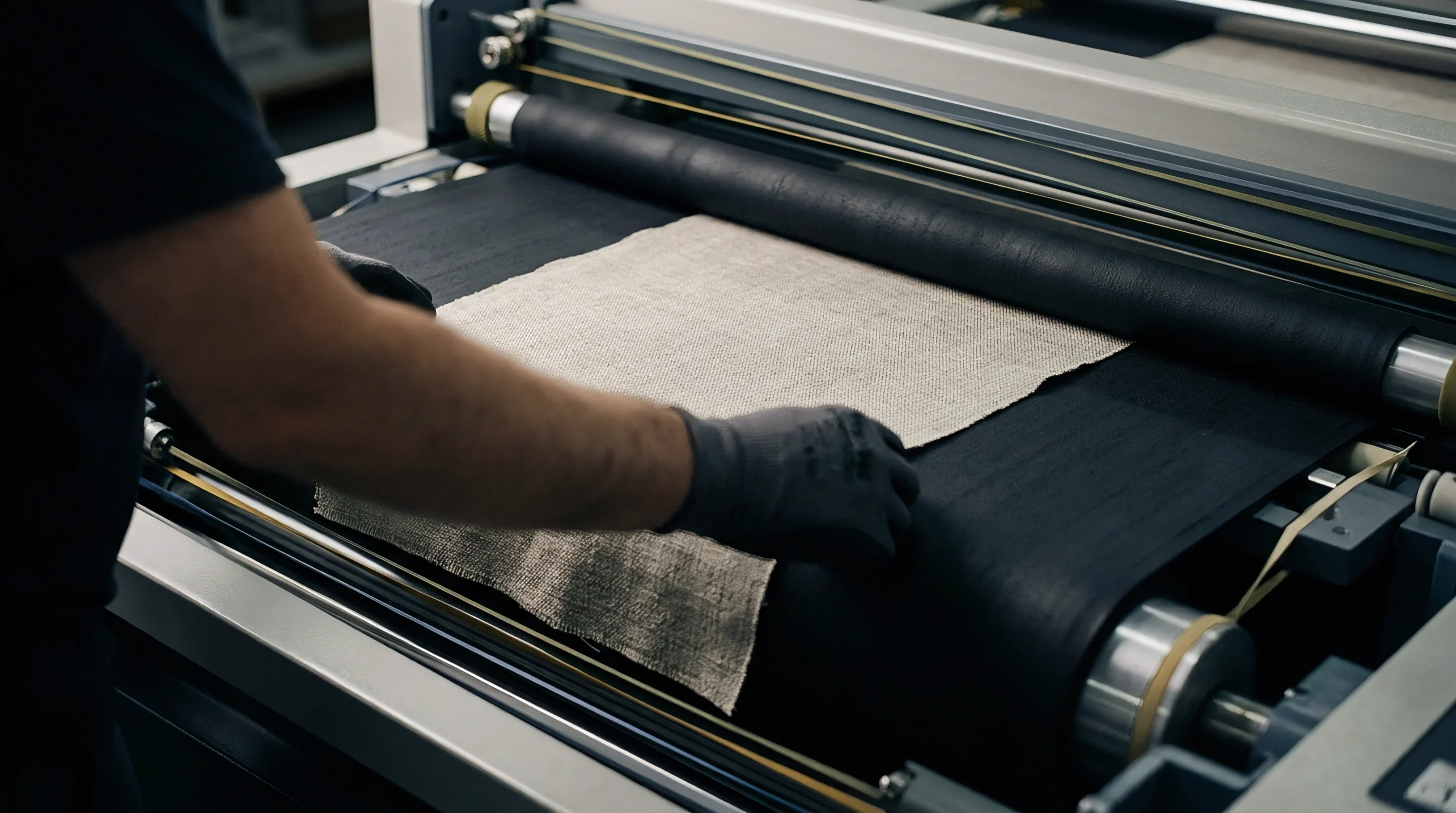
Thermal processing on a stenter frame reconfigures the polyurethane phase morphology while stabilizing the companion rigid yarns. Fabric passes through heated chambers under controlled warp overfeed and cross-machine pin tension. Elevated thermal energy disrupts the secondary bonding within the polyurethane hard segments, allowing polymer chains to slip into lower-energy spatial configurations without applied external load.
As the cloth exits the cooling zone, hydrogen bonds reform around the newly imposed dimensions, establishing the finished width and sett.
Operating temperatures balance thermal stabilization against irreversible thermal degradation. Pure polyurethane filaments experience soft segment melting between 180 degrees Celsius and 200 degrees Celsius, depending on the polyol chemistry and diisocyanate selection. Companion synthetic fibers dictate the processing window.
Polyester-blend stretch wovens require stenter zone temperatures between 185 degrees Celsius and 195 degrees Celsius to achieve adequate dye fixation and polyester dimensional stability. Polyamide 6,6 blends run between 175 degrees Celsius and 185 degrees Celsius. Exceeding these windows triggers thermal oxidation, urethane linkage dissociation, and loss of elastic recovery.
| Fiber Blend Composition | Stenter Chamber Temperature | Dwell Time Target | Applied Overfeed Range | Residual Elastic Recovery |
|---|---|---|---|---|
| 92% Polyester / 8% Polyurethane | 192 degrees Celsius | 42 seconds | +12% to +16% | 89.4% after 30 min |
| 88% Polyamide 6,6 / 12% Polyurethane | 182 degrees Celsius | 35 seconds | +14% to +18% | 93.1% after 30 min |
| 96% Cotton / 4% Polyurethane | 175 degrees Celsius | 45 seconds | +8% to +10% | 86.2% after 30 min |
| 65% Polyester / 30% Rayon / 5% Polyurethane | 180 degrees Celsius | 38 seconds | +10% to +14% | 84.7% after 30 min |
Dwell time dictates the depth of molecular reorganization. Insufficient time inside the stenter chamber prevents complete hard segment rearrangement, leaving residual internal stresses from the weaving loom. Excessive dwell time accelerates thermo-oxidative chain scission along the soft segment backbone, permanently softening the elastomer and elevating long-term creep.
Morphological Consequences of Temperature Variations
Cross-machine temperature variation generates immediate performance rejection in bulk apparel manufacturing. A temperature differential of four degrees Celsius between the stenter center and the drive-side pins creates marked variance in finished width, weight, and viscoelastic relaxation across the roll width. Edge panels cut from under-heated zones exhibit rapid stress decay and garment bagging, while center panels maintain target recovery profiles.
Finishing mills frequently run stenters above optimal processing speeds to increase hourly yardage output. Compensating for shortened dwell times by raising chamber air temperatures degrades the surface polyurethane filaments without stabilizing the core structure. The outer elastomer sheath degrades while the inner yarn core retains high residual tension.
Spinning mills attribute fabric recovery failure to aggressive garment wash cycles rather than stenter temperature overshoot during initial greige stabilization.
Decay
Which Test Conditions Isolate Pure Viscoelastic Decay?
Standardized tensile testing methods capture different phases of stress decay. ISO 20932-1 establishes cycles of constant rate extension to measure immediate elastic recovery, delayed recovery, and residual unrecoverable deformation. ASTM D3107 isolates stretch and growth in woven fabrics through static load application over extended durations.
Distinguishing viscoelastic stress relaxation from pure yarn slippage requires continuous load tracking under constant strain on a universal testing machine fitted with pneumatic non-slip clamps.
A thirty-minute static dwell under fifteen percent elongation according to ASTM D3107 generates permanent fabric growth exceeding four percent when stenter heat setting runs below target dwell times.
Stress relaxation data curves conform to modified Kohlrausch-Williams-Watts stretched exponential functions or Maxwell-Wiechert multi-element mechanical models. The initial rapid force drop represents Maxwell elements with low relaxation time constants, dominated by soft segment uncoiling. The secondary plateau decay represents high-time-constant elements, controlled by hard domain slippage and frictional rearrangement among neighboring warp and weft yarns.
| Elapsed Time Interval | Residual Force: 180°C Set | Residual Force: 190°C Set | Residual Force: 198°C Set | Decay Rate Coefficient |
|---|---|---|---|---|
| 0 seconds (Initial Peak) | 14.80 N | 12.40 N | 9.10 N | 0.000 |
| 30 seconds | 12.10 N | 10.90 N | 7.30 N | 0.182 |
| 300 seconds (5 min) | 10.40 N | 9.80 N | 6.10 N | 0.088 |
| 1800 seconds (30 min) | 9.20 N | 9.10 N | 5.20 N | 0.041 |
| 7200 seconds (2 hours) | 8.60 N | 8.70 N | 4.60 N | 0.022 |
Evaluating the decay rate coefficient demonstrates the stabilization achieved at 190 degrees Celsius. The specimen set at 180 degrees Celsius exhibits massive short-term decay due to unrelaxed greige stress. The specimen set at 198 degrees Celsius exhibits low initial peak force and high cumulative degradation from thermal over-exposure.
The 190 degrees Celsius setting achieves the balance between elastic modulus retention and minimal time-dependent force loss.
Laboratory conditioning before testing determines measurement validity. Specimens tested without forty-eight hours of relaxation at twenty degrees Celsius and sixty-five percent relative humidity yield artificially high recovery values. Residual static charges and dry yarn friction distort the load cells.
A purchase contract clause specifying ISO 20932-1 Method A with a five-cycle dynamic pre-load and a ten-minute static dwell holds the converter liable for all growth rejections exceeding three point five percent on finished goods.
Modulus
Will Core Spun Geometry Suppress Creep?
Yarn architecture governs how external mechanical load divides between the elastomeric core and the inelastic sheath. In ring core-spun yarns, staple fibers such as cotton, modal, or polyester wrap helically around a central polyurethane filament. Under tensile elongation, the outer staple sheath tightens radially around the core, generating internal lateral compression.
This transverse pressure restricts the polyurethane filament from undergoing unrestricted axial relaxation, shifting a portion of the time-dependent decay into the frictional contact points of the sheath.
Air-covered and double-covered filament yarns distribute loads differently across their cross-sections. Air-covered structures feature random interlacing nips that allow local micro-slippage of the polyurethane core, resulting in faster initial stress relaxation under moderate strain. Double-covered yarns enclose the core in balanced opposing filament helices, creating uniform radial constraint that dampens viscoelastic decay across repeated cyclic extensions.
In plain weave and twill constructions, this yarn-level constraint dictates the overall fabric hysteresis loop.
Staple sheath packing density directly controls the lateral clamping force exerted on the elastomeric core during tensile extension.
Weave architecture establishes the geometric boundary conditions for yarn deformation. Plain weave structures introduce high crimp frequency and dense yarn crossover points, maximizing inter-yarn friction. This friction arrests immediate recovery, lengthening the delayed recovery phase.
Satin and loose twill constructions reduce crossover frequency, allowing yarns to slide easily and contract rapidly after stress removal.
Finishing operations alter the structural crimp balance through wet contraction. Scouring, relaxing, and open-width washing allow the warp and weft yarns to bulk and interchange crimp amplitudes. If the weft shrinks thirty percent during wet relaxation, warp crimp amplitude increases, altering the angle of load application on the stretch yarns.
The structural interaction leaves an active industry dispute regarding whether higher pick density stabilizes the stretch profile or simply accelerates sheath abrasion over extended garment wear cycles.
Settlement
Uncontrolled stress relaxation transforms directly into commercial loss when stretch woven goods reach the cutting room and retail distribution. Fabric rolls wound under excessive winding tension on inspection frames undergo continuous creep while stored horizontally in warehouse racking. When spread on automated cutting tables, the fabric slowly relaxes, contracting longitudinally over several hours.
Cutting panels immediately after spreading causes severe dimensional discrepancy between upper and lower plies, producing mismatched seam lengths and ill-fitting garments.
Manufacturing facilities prevent cutting-room shrinkage by enforcing documented relaxation protocols before spreading. Operators unroll stretch wovens onto flat tables or transfer them into tensionless festooning cradles for twenty-four hours prior to cutting. This holding period dissipates residual rolling tension, allowing the viscoelastic recovery curve to flatten before mechanical knives engage the cloth.
Bulk production costs depend heavily on the stenter line throughput required to hit exact thermal stabilization windows. Running an eight-chamber stenter at twenty meters per minute to ensure forty-two seconds of dwell time at 190 degrees Celsius costs significantly more per finished meter than operating at thirty-five meters per minute. When mills cut dwell times to lower processing charges, the finished cloth fails retail growth and bagging specifications, triggering garment rejections, chargebacks, and full production lot write-downs.
Garment panels cut without tensionless table relaxation undergo differential contraction that invalidates graded pattern tolerances across bulk sewing assemblies.
Supply chain contracts establish strict parameters to manage these operational risks across converter networks:
- Fabric Spreading Dwell Protocol dictates a mandatory twenty-four-hour tensionless rest period on cutting tables before automated knife engagement to normalize residual winding strain.
- Maximum Allowable Fabric Growth Threshold limits finished parcel growth to a maximum of three point zero percent after thirty minutes of continuous thirty-percent strain testing.
- Stenter Thermal Verification Logging requires real-time thermocouple data capture across all heating chambers to verify dwell time and temperature uniformity within plus or minus one point five degrees Celsius.
Failing to verify stenter dwell parameters and relaxation profiles during initial mill qualification leads directly to high consumer return rates driven by permanently bagged knees and elbows in finished stretch apparel.