
Stenter Dwell Profiles and Hard Segment Ordering in Stretch Textiles
Stenter heat setting requires precise fabric surface temperature tracking to optimize hard segment re-ordering without causing thermal polymer scission.
Stenter heat setting requires precise fabric surface temperature tracking to optimize hard segment re-ordering without causing thermal polymer scission.

Stenter heat setting at precise glass transition temperatures eliminates residual elastic stress while locking dimensional stability and fabric weight.

Biaxial viscoelastic modeling prevents garment bagging by replacing uniaxial stretch tests with planar strain energy functions calibrated across finish thermal cycles.

Predict elastane core decay by testing tension retention under dynamic cyclic strain after heat setting, establishing core slip thresholds before weaving.

Core retraction in stretch yarn is controlled through calibrated draft ratios, uniform spinning triangle tension, and precise stenter heat setting.

Hydrolytic chain scission in elastane follows temperature and pH-dependent Eyring kinetics, destroying core filament recovery unless bath conditions match polymer chemistry.

Pressurized jet dyeing degrades polyurethane via hydrothermal cleavage; capping bath temperatures at 125°C and maintaining pH 5.0 preserves elasticity.
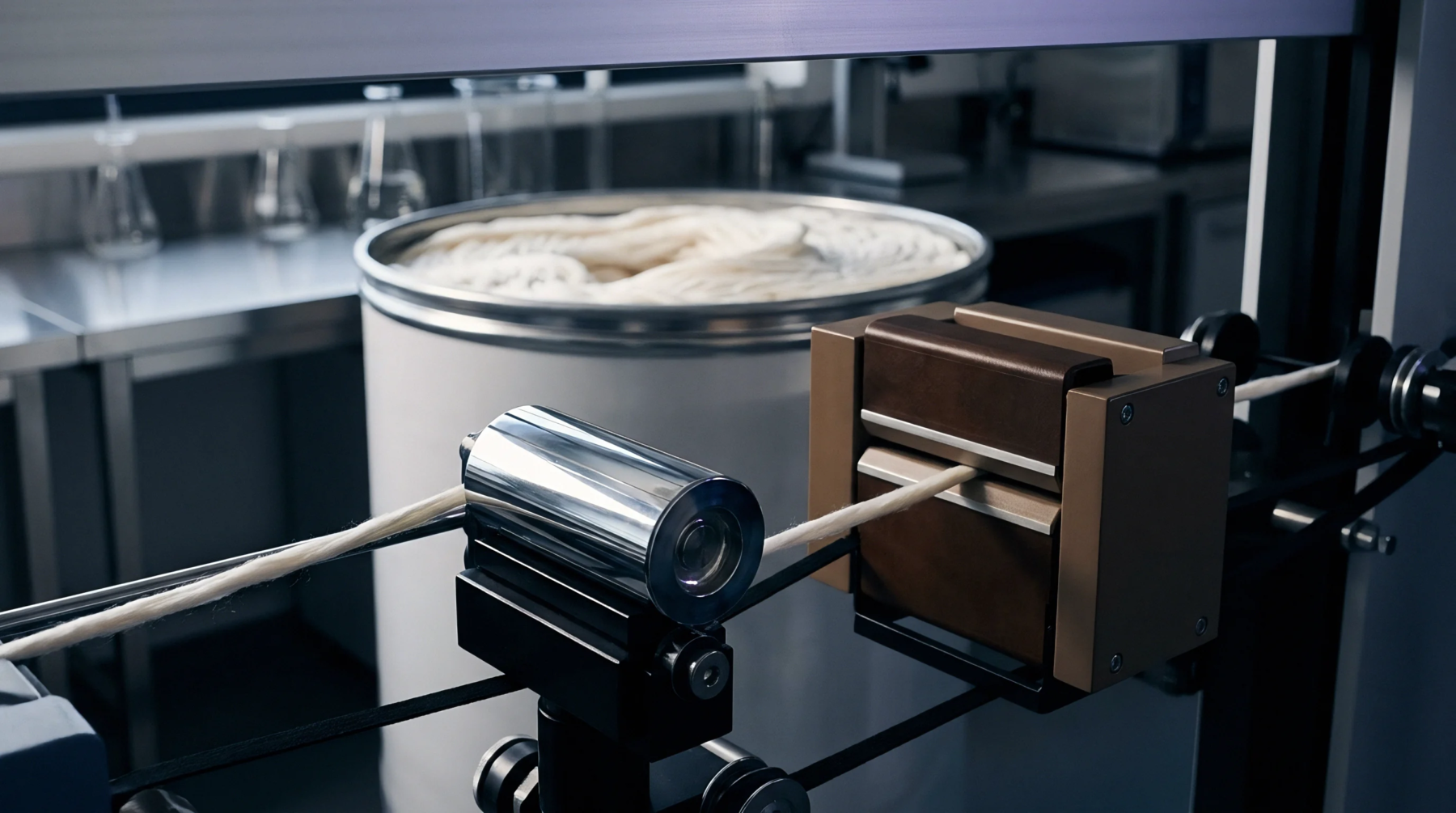
Core elastane degradation stems from hydrodynamic drag overextending thermal-softened polyurethanes, mitigated by synchronizing reel overfeed and soft nozzles.

Controlled stenter dwell at 185-195°C stabilizes polyurethane hard segments to minimize viscoelastic force decay and garment bagging in stretch wovens.

Optimize air-jet polyurethane wovens by setting stenters to 190°C with +24% overfeed, holding heat setting efficiency above 88% and growth below 2.5%.

Modeling long-term stress relaxation thresholds in core-spun jet processed elastic fabrics requires balancing spinning core draft with stenter heat setting to prevent interfacial shear slip and retractive decay.
Expertise is a utility, not a secret. sentiention™ publishes its working knowledge as open reference: intelligence layer covering the materials it sources, the markets it enters, and the reference that serves both.