Statistical Skip Lot Switching Rules under ISO 2859 Standard
ISO 2859-3 skip-lot sampling cuts inspection cadence only after ten clean normal lots, shifting consumer risk unless backed by strict chemical dock controls.


Eligibility
Suppliers qualify for skip-lot sampling under ISO 2859-3 only after establishing an unbroken record of product conformance under ISO 2859-1 normal inspection at lot-by-lot frequency. A fabric mill or finished apparel manufacturer cannot buy their way into skip-lot status through commercial tenure or self-declared quality management credentials. The standard establishes strict entry gates to prevent uninspected lots from concealing latent defects or restricted chemical substances.
The operational baseline demands that the manufacturer maintains a stable production process across a continuous series of lots. ISO 2859-3 specifies that the product must be of continuous production, without interruptions exceeding specified operational durations, and the design must remain frozen. When a mill alters the yarn count, changes a dyestuff formulation, or shifts finishing stenter parameters, the qualification cycle resets to the initial stage.
Acceptance of ten consecutive lots under normal inspection at acceptance number zero permits initial screening for skip-lot qualification.
Entering skip-lot status requires meeting three statistical prerequisites simultaneously under standard inspection conditions:
- Consecutive acceptance history records at least ten consecutive production lots accepted under ISO 2859-1 normal inspection at the agreed acceptance quality limit without a single lot rejection.
- Process capability index demonstrates a demonstrated Cpk value equal to or exceeding 1.33 across thirty production days for critical physical and dimensional parameters.
- Chemical inventory validation confirms third-party analytical test reports for restricted substances have matched incoming yarn and greige fabric lots over six consecutive months.
The mathematical hurdle is intentionally severe. If the contract defines an Acceptance Quality Limit of 1.0 percent for major fabric defects under General Inspection Level II, every sample drawn from the qualifying sequence must pass the acceptance criterion without invoking reduced inspection allowances. Reduced inspection under ISO 2859-1 operates under different statistical mechanics and cannot serve as the stepping stone to skip-lot execution.
The qualification phase builds empirical confidence in the manufacturer’s internal process control. When a supplier operates multiple production lines for identical garment styles, qualification belongs to the specific line rather than the enterprise. A sewing unit operating twenty lines may achieve skip-lot status on lines one through four while lines five through twenty remain on lot-by-lot normal inspection.
ISO 2859-3 Clause 5.1.2 defines the precise lot count criteria, establishing that any single nonconformance during the initial qualification sequence automatically mandates an immediate restart of the qualification count from the subsequent lot.

Cadence
Inspection schedules in ISO 2859-3 divide lot progression into discrete states with decreasing inspection frequencies. State 1 represents the qualification phase where every submitted lot undergoes normal attribute sampling. Once the qualification score reaches the threshold determined by the standard’s lot tables, the supplier advances to State 2, known as the skip-lot operational state.
Inside State 2, inspection frequency drops to predetermined statistical intervals: one lot in two, one lot in three, one lot in four, or one lot in five. The specific ratio depends on the cumulative qualification score, the historical defect rate, and the buyer’s tolerance for consumer risk. High-volume synthetic knitwear with stable automated knitting and dyeing parameters qualifies for a one-in-four cadence faster than woven shirting involving complex yarn-dyed patterns.
| Operational State | Inspection Cadence | Qualification Minimum | Lot Selection Mechanism | Lot Disposition Mode |
|---|---|---|---|---|
| State 1 (Qualification) | 1 in 1 (100 percent of lots) | 10 consecutive lots | Sequential receipt order | Lot-by-lot attribute gate |
| State 2 (Skip Level 1) | 1 in 2 (50 percent of lots) | 10 lots plus capability proof | Central pseudo-random generator | Immediate release for unselected |
| State 2 (Skip Level 2) | 1 in 3 (33 percent of lots) | 15 consecutive accepted lots | Buyer third-party algorithm | Immediate release for unselected |
| State 2 (Skip Level 3) | 1 in 4 (25 percent of lots) | 20 consecutive accepted lots | Dock arrival timestamp hash | Immediate release for unselected |
| State 2 (Skip Level 4) | 1 in 5 (20 percent of lots) | 25 consecutive accepted lots | Cryptographic seed generation | Immediate release for unselected |
Selection of inspected lots cannot follow a predictable sequence. When an inspection agency inspects every third lot predictably, factory managers divert marginal roll goods into the uninspected intervals. The standard demands a random selection mechanism that assigns an identical probability of inspection to every lot presenting at the loading dock.
A skip-lot program without cryptographic randomization degrades into an invitation for strategic batch dumping.
Lot disposition operates independently for inspected and skipped lots. When the algorithm selects a lot, inspectors pull physical swatches and inspect garments according to the normal sampling plan. When the algorithm bypasses a lot, the system releases that lot for packaging and export documentation without physical verification.
The supplier certifies compliance based on internal production logs and continuous chemical dosing verification.
Continuous surveillance runs parallel to random lot selection. The manufacturer must maintain ongoing statistical process control charts for fabric weight, tear strength, and colour fastness to water and perspiration. Randomization shields the buyer only when internal manufacturing discipline remains constant between inspection intervals.
The statistical sample size within an inspected skip-lot remains identical to the sample size dictated by ISO 2859-1 for that lot size. Skip-lot sampling reduces the number of inspected lots; it never reduces the sample size drawn from an inspected lot.
Statistical confidence shifts downward as the inspection frequency drops across successive skip-lot tiers.


Dock
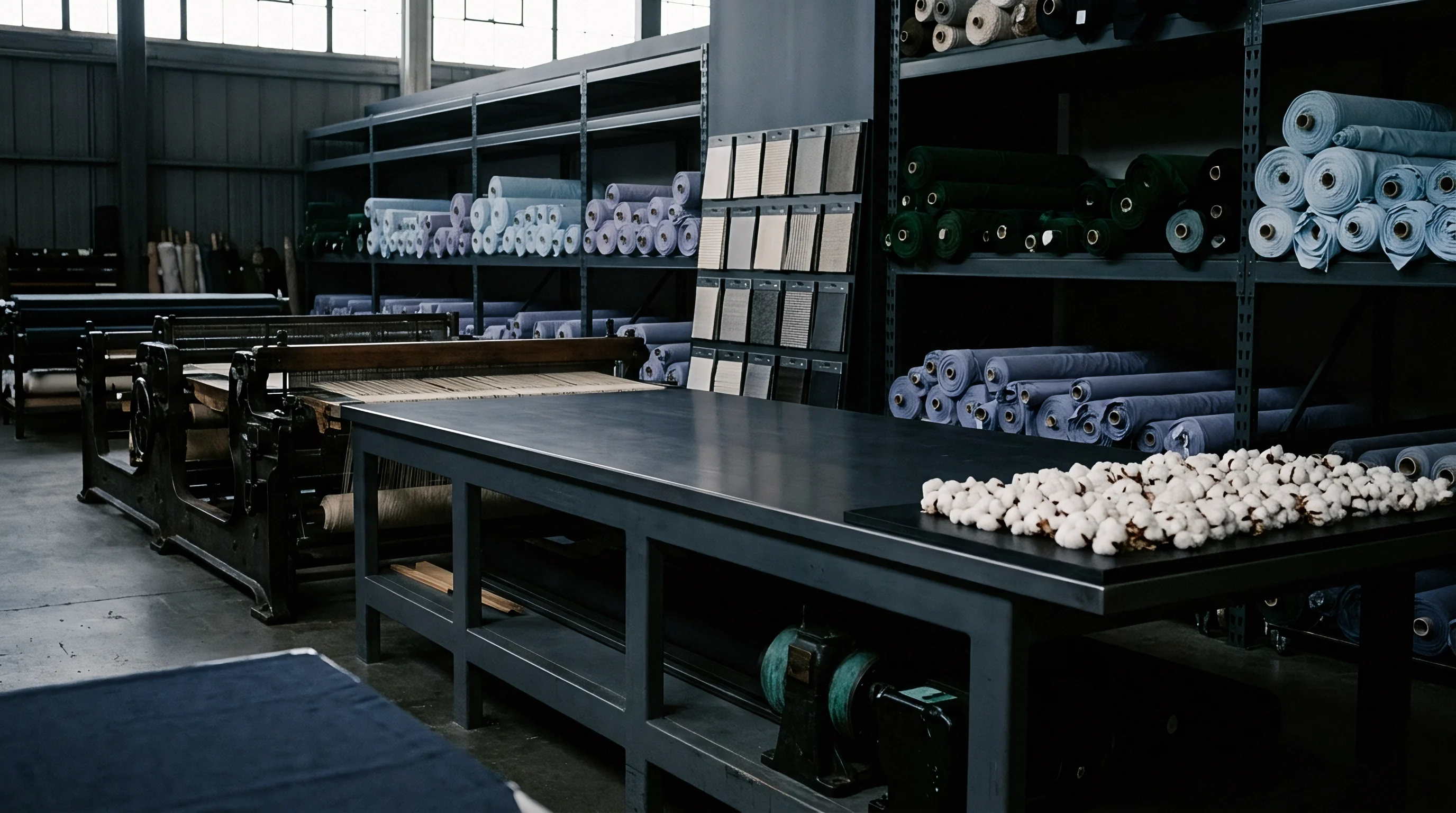
Receiving bays and export loading terminals expose the practical boundary between documentary sampling plans and physical roll stock. An inspector arriving at a textile warehouse with a random selection sheet faces rows of densely packed bales and export cartons. Verification begins with lot integrity, carton counts, and container seal numbers before any fabric swatch meets a balance or spectrophotometer.
How Does Receiving Segregation Prevent Mixed Dye Batches?
Physical isolation of production lots prevents cross-contamination between approved greige batches and unverified processing lots. When a mill finishes twenty thousand meters of poplin, the rolls must bear tamper-evident labels displaying yarn spinning batch, dye vat designation, and heat-setting machine assignment. The receiving dock operates quarantine lanes where trucks unload onto marked floor positions rather than merging inventory into active staging lanes.
Inspectors follow a systematic physical intake sequence to maintain sampling integrity across multi-container shipments:
- Carton integrity validation checks external export shipping marks against the commercial invoice, packing list, and mill piece-goods ticket.
- Random roll extraction draws parent rolls from top, middle, and bottom tiers of the pallet configuration using a predetermined random number table.
- Swatch cut protocol removes three full-width textile swatches measuring one running meter each, discarding the outer three wraps of fabric to avoid transit abrasion.
- Moisture equilibration verification holds swatches at standard atmosphere for twenty-four hours under ISO 139 parameters before executing weight and dimensional stability testing.
Physical roll auditing frequently exposes inconsistencies that paper test reports hide. A dyehouse operating three jigger dyeing machines may deliver a single commercial lot compiled from six separate dye cycles. While the composite laboratory report indicates an acceptable average Delta E colour variance under 0.8, individual rolls drawn from the lower container tier exhibit roll-to-roll shading exceeding 1.8 Delta E under D65 illumination.
ISO 2859-3 Clause 6.2 prohibits the inclusion of multiple disparate dye lots inside a single skip-lot inspection presentation.
Chemical testing introduces a severe timeline challenge at the receiving dock. High-performance liquid chromatography testing for banned aromatic amines under EN 14362-1 and formaldehyde extraction under ISO 14184-1 requires four to five working days in an accredited laboratory. Skipped lots cannot sit at export terminals awaiting third-party chemical certification without incurring detention and demurrage costs.
The vendor argued that since the previous five lots passed analytical tests, testing this fabric would cause port congestion.


Reversion
The skip-lot mechanism contains automatic circuit breakers designed to terminate State 2 privileges the moment product quality drifts. A supplier operating at an inspection frequency of one in five lots does not receive infinite tolerance for manufacturing variance. Any lot failure on an inspected skip-lot triggers immediate reversion to ISO 2859-1 normal inspection at a one-in-one cadence.

When Do Operating Characteristic Curves Mask Contamination?
Operating characteristic curves calculate the probability of lot acceptance across varying levels of incoming defective material. In skip-lot arrangements, the composite OC curve shifts to the left, showing that consumer risk rises sharply for uninspected lots carrying localized or sporadic defects. When an uninspected lot contains chemical nonconformances such as banned perfluorinated compounds from water-repellent finishing, the skip-lot mechanism permits entry into distribution channels without physical interception.
| Incoming Defect Rate | ISO 2859-1 Normal (AQL 1.0) | Skip-Lot (1 in 2 Cadence) | Skip-Lot (1 in 5 Cadence) | Consumer Risk Index |
|---|---|---|---|---|
| 0.5 percent | 0.985 detection threshold | 0.492 composite escape risk | 0.197 composite escape risk | Negligible boundary shift |
| 1.0 percent (at AQL) | 0.910 detection threshold | 0.455 composite escape risk | 0.182 composite escape risk | Moderate inventory exposure |
| 2.5 percent | 0.620 detection threshold | 0.310 composite escape risk | 0.124 composite escape risk | Severe commercial vulnerability |
| 5.0 percent | 0.180 detection threshold | 0.090 composite escape risk | 0.036 composite escape risk | Critical recall probability |
The mathematical reality of skip-lot sampling means that detection capability falls proportionally with inspection frequency. If a lot containing five percent defective items arrives during a one-in-five cadence, the probability that the lot gets selected for inspection is only twenty percent. Even when the attribute sampling plan has an eighty-two percent probability of rejecting that five-percent defective lot upon inspection, the total system probability of intercepting that bad lot drops below seventeen percent.
Reversion triggers extend beyond physical nonconformities discovered at the inspection bench. ISO 2859-3 establishes non-statistical reversion events that strip skip-lot privileges immediately:
- Production interruption occurrence records an unscheduled shutdown or schedule gap exceeding thirty consecutive calendar days between fabric runs.
- Facility infrastructure modification documents replacement of primary wet-processing machinery, relocation of sewing lines, or substitution of dyestuff suppliers.
- Customer complaint escalation registers a verified market surveillance failure or regulatory recall regarding restricted substances or safety parameters.
- Traceability documentation gap reveals incomplete transaction certificates or broken custody records for certified organic or recycled fibre blends.
When reversion strikes, the supplier returns to State 1 qualification. The manufacturer must complete a fresh sequence of ten consecutive conforming lots under lot-by-lot normal inspection before skip-lot consideration resumes. Suppliers often request credit for lots shipped during the skip-lot phase to shorten the requalification run.
The standard denies that request. Requalification demands a clean sequence of ten newly manufactured, fully inspected lots.
How an inspection system can mathematically separate sporadic human error from systemic machinery degradation remains open.

Recourse
The financial aftermath of an escaped defect under skip-lot inspection falls entirely on commercial terms negotiated in purchase contracts. A standard purchase order stating inspection under ISO 2859-3 without liability allocation clauses leaves the brand holding the commercial loss. Importers of record maintain legal accountability for safety and restricted chemical limits regardless of whether an overseas factory operated under an approved skip-lot agreement.
Customs authorities and market surveillance inspectors do not recognize skip-lot inspection agreements as legal defenses. When border surveillance extracts swatches from an imported container of cotton fleece and detects lead levels exceeding ninety milligrams per kilogram under consumer safety regulations, the entire consignment faces seizure. The border agency penalizes the importer of record rather than the offshore textile mill.
Direct costs escalate rapidly when an uninspected lot carrying defects enters domestic logistics networks. A buyer must cover reverse logistics, national distribution centre quarantine, roll sorting, and destructive testing fees. Defective garments that reached retail shelves generate consumer returns, brand equity impairment, and administrative fines from consumer safety commissions.
Purchase contracts must reallocate inspection savings to indemnity reserves. Skip-lot agreements reduce third-party inspection fees by sixty to eighty percent over a production year. Prudent sourcing organizations direct thirty percent of these inspection fee savings into an escrow account dedicated to secondary analytical verification and border compliance insurance.
When an offshore vendor delivers a defective shipment through a skip-lot bypass, the financial loss without strict contract indemnity clauses includes unpaid demurrage, unsalvageable inventory write-offs, and complete forfeiture of retail shelf margins.