Predicting Long Term Dynamic Elastic Degradation in Polyurethane Core Vortex Spun Woven Structures
Predict elastane core decay by testing tension retention under dynamic cyclic strain after heat setting, establishing core slip thresholds before weaving.

Morphology
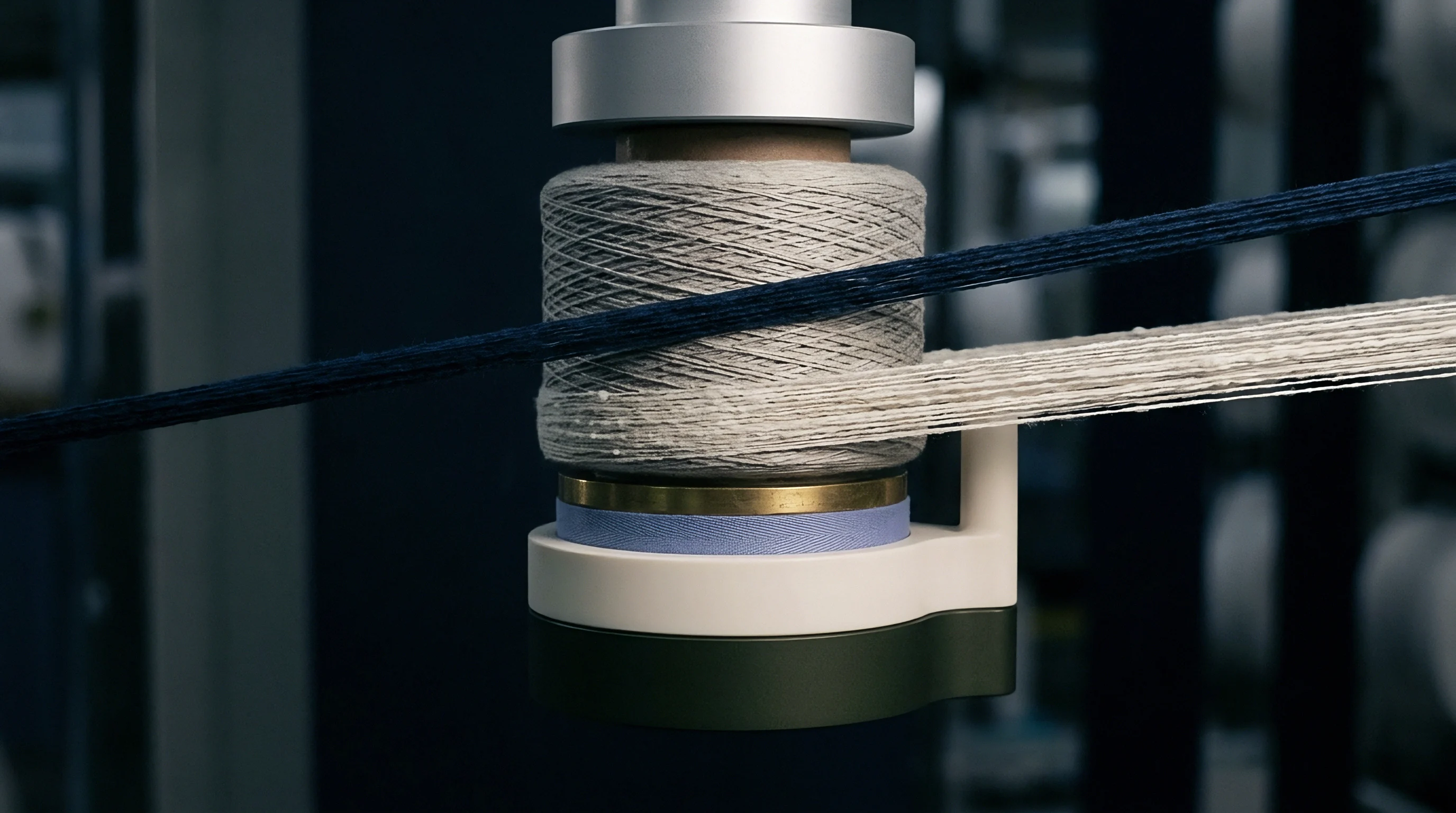
Vortex-spun yarns differ structurally from ring-spun and open-end elastomeric hybrids. In a Muratec Vortex System (MVS), a continuous polyurethane elastane core feeds directly into the air nozzle alongside drawn staple fibres. The primary vortex airflow wraps outer staple fibres around a parallel central core at speeds exceeding 400 metres per minute.
This produces a two-zone morphology: an untwisted axial core of elastane filament and straight staple fibres, enclosed by a tight outer sheath of fasciated wrapper fibres. Elastic performance in the finished woven fabric depends on the mechanical friction generated between that fasciated sheath and the central elastane filament.
Under dynamic loading, the core filament begins to slip past the surrounding sheath fibers.
When vortex core-spun woven fabric undergoes repeated extension and recovery cycles, internal micromechanical degradation starts well before the polyurethane filament shows chemical cleavage. In ring-spun elastic yarns, helically twisted sheath fibers exert continuous radial pressure along the core, locking it in place with uniform normal force. Vortex yarns rely instead on localized pneumatic fasciation: outer wrapper fibers form discrete anchoring nodes rather than a continuous helical lock.
Under extension, the smooth polyurethane filament stretches inside the axial channel and slides past untwisted core fibers between those wrapper nodes.
| Yarn Architecture | Spinning Mechanism | Core Restraint Geometry | Initial Elastic Recovery (%) | Core Slip Resistance Index |
|---|---|---|---|---|
| Ring Core-Spun | Mechanical Ring Twist | Continuous Helical Wrap | 94.2 to 96.5 | High (0.85 to 0.92) |
| Siro Core-Spun | Double Strand Ring Twist | Dual Helical Interlock | 95.8 to 97.8 | Very High (0.90 to 0.96) |
| Vortex Core-Spun (MVS) | Pneumatic Swirling Air | Fasciated Node Wrapping | 91.0 to 93.5 | Moderate (0.62 to 0.74) |
| Open-End Rotor Core | Centrifugal Rotor Twist | Disordered Fiber Belt | 86.5 to 89.0 | Low (0.45 to 0.58) |
This arrangement concentrates stress along the polyurethane filament. When the fabric cycles between five percent and thirty percent strain, the elastane core pulls back through sheath gaps during contraction. Because core staple fibers lack helical orientation, they offer little frictional resistance to this axial travel.
Over thousands of cycles, rubbing at node points smooths the filament surface, reducing the friction coefficient between the polyurethane core and the cellulosic or synthetic sheath. This loss of interfacial grip eventually causes core retraction from cut yarn ends in the weave, showing up as localized bagging, grin-through, and permanent fabric growth.
- Interfacial Sheath Friction Breakdown occurs when cyclic strain shifts wrapper nodes, reducing radial pressure on the polyurethane filament.
- Axial Filament Migration allows the stretched elastane core to pull back within the staple sheath during fabric contraction.
- Localized Stress Peaks concentrate elastic work at un-wrapped sheath zones, accelerating localized polymer fatigue.
- Fasciated Wrapper Displacement alters yarn cross-sectional geometry under continuous cross-directional fabric tension.
Structural decay accelerates when woven density restricts yarn mobility. High picks-per-inch constructions lock yarn intersections in place, forcing the elastane core to take up all extension without yarn-to-yarn sliding. That constraint focuses elongation forces directly onto the polyurethane filament, driving it past its viscoelastic yield point during normal movement.
Clamp
Isolating physical core slip from chemical polymer decay requires cyclic strain testing rather than standard tensile pulls. While tests such as ISO 13934-1 capture breaking strength and elongation at break, they miss progressive elastic fatigue. Dynamic polyurethane testing relies instead on multi-cycle hysteresis profiling using pneumatic clamps on a constant-rate-of-extension frame.
Under ISO 20932-1 Method A, fabric strips are cycled to a set elongation ~ typically twenty percent or thirty percent ~ for several thousand cycles at 0.5 Hertz to 2.0 Hertz.
Repeated extension progressively shifts the internal yarn geometry.
During the first ten loading cycles, stretch wovens show a sharp drop in retractive force known as initial stress relaxation. This drop comes from amorphous hard segments realigning within the polyurethane chains while weave intersections settle. Past that initial phase, degradation settles into a steady decline in both un-load force at low strain and total elastic recovery.
The difference between loading and unloading curves at fifty percent of peak strain gives the hysteresis energy loss in millijoules.
The elastic recovery percentage of a vortex core-spun fabric drops by four to eight percentage points after 5,000 extension cycles under ISO 20932-1 conditions due to progressive internal filament slip.
To distinguish core decay from fabric structural set, technicians run a standardized fatigue protocol on finished swatches:
- Cut test specimens to 50 millimetre width by 250 millimetre length in both warp and weft directions, conditioning them at 20 degrees Celsius and 65 percent relative humidity for 24 hours per ISO 139.
- Mount the specimen in pneumatic action grips set to a 100 millimetre gauge length, applying a pre-tension force of 0.05 Newtons per centimetre of fabric width.
- Cycle the specimen between zero strain and twenty-five percent elongation at a frequency of 1.0 Hertz for 5,000 continuous cycles.
- Record peak load on cycle 1, cycle 100, cycle 1,000, and cycle 5,000 to track force decay across extended cycling.
- Measure permanent set after a 30-minute recovery window, calculating un-recovered strain against original gauge length.
Force decay stabilizes only when core draft ratios stay within narrow limits during spinning. Above a 3.8 draft ratio, the pre-strained filament operates close to its elastic limit. Dynamic clamp cycling then accelerates microfibrillar rupture within the soft segments, pushing permanent set past six percent.
Draft ratios between 2.8 and 3.2 preserve chain mobility, cutting force loss over extended cycles.
Excessive warp or weft pre-tension during weaving impairs elastic recovery far more rapidly than common spinning defects.
Thermal
Wet processing provides the thermal and chemical conditions that trigger premature polyurethane breakdown. The core is an alternating block copolymer: flexible polyether or polyester soft segments supply stretch, while rigid aromatic or aliphatic hard segments provide thermal stability and mechanical strength. Heat-setting on a stenter reorganizes these phase domains.
Once temperatures cross the melting point of the soft segment or approach hard segment dissociation, retractive power is lost permanently.
Elevated processing temperatures hasten chain degradation in the elastomer.
Stenter heat-setting fixes fabric width and controls shrinkage. For vortex-spun fabrics with polyether-based cores, the effective processing window sits strictly between 185 degrees Celsius and 192 degrees Celsius, with dwell time held under 45 seconds. Running below 185 degrees Celsius fails to relieve spinning stress, resulting in excessive wash shrinkage.
Exceeding 195 degrees Celsius triggers thermo-oxidative cleavage at urethane linkages, cleaving polymer chains into short fragments.
| Temperature (°C) | Polymer State | Retractive Force Retained (%) | Fabric Permanent Set (%) | Yellowing Index (Delta E) |
|---|---|---|---|---|
| 175 | Under-set (Internal Stress Intact) | 98.5 | 8.4 | 0.3 |
| 185 | Optimum Heat Set Window | 95.2 | 2.1 | 0.6 |
| 190 | Optimum Heat Set Window | 91.8 | 1.8 | 1.1 |
| 198 | Thermal Softening / Hard Segment Shift | 72.4 | 5.9 | 2.8 |
| 205 | Thermo-Oxidative Urethane Cleavage | 41.0 | 14.2 | 6.4 |
Subsequent chemical finishing compounds this thermal stress. Alkaline scouring above pH 11.5 hydrolyzes polyester-type polyurethanes. Polyether cores resist hydrolysis better, but remain vulnerable to oxidative attack during peroxide bleaching.
In jet dyeing above 98 degrees Celsius, trace iron or copper ions in the liquor catalyze free-radical attack on polyether soft blocks.
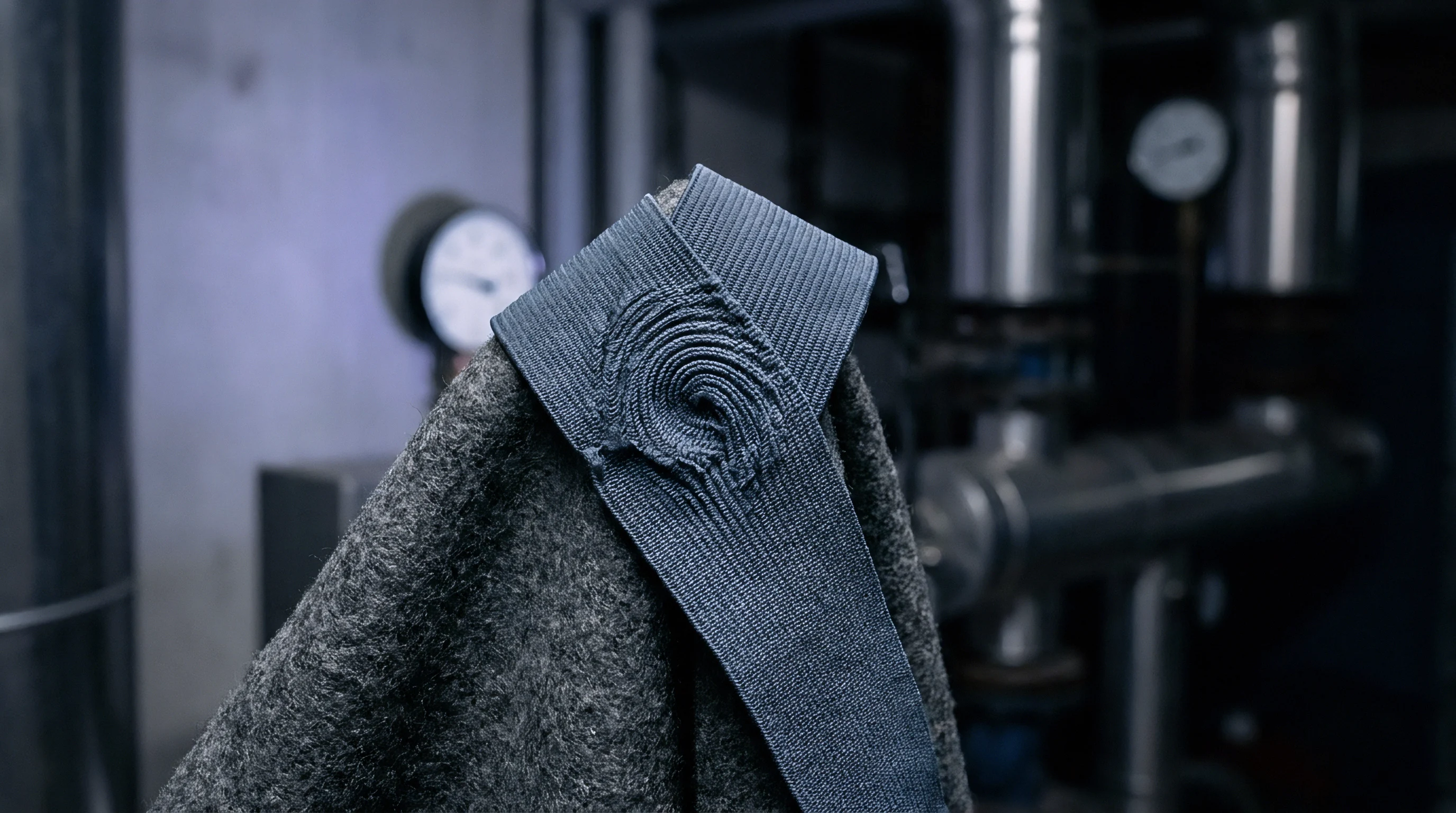
Can Solvent Scouring Prevent Core Elastane Degradation?
Solvent preparation scours spinning lubricants without exposing the core to aqueous oxidation, but solvent choice is critical. Perchloroethylene and related chlorinated chemistries swell the polyurethane core and leach out low-molecular-weight plasticizers. That extraction stiffens the filament and reduces ultimate elongation by up to twenty-five percent.
Scouring in water with non-ionic ethoxylated fatty alcohols at neutral pH leaves plasticizers intact, preserving long-term flex life.
Finishing lines lacking exhaust monitoring run the risk of under-drying or over-baking fabric rolls. When stenter overfeed does not accommodate natural yarn shrinkage, the core traverses the heating zones under high axial tension. Heat-setting under tension locks polyurethane chains in an extended conformation, wiping out recovery power and producing a flat, dead cloth that fails finished garment stretch requirements.
Running a stenter just five degrees above critical threshold destroys thirty percent of core retractive force before the roll reaches the batcher.
Kinetics
Forecasting elastomeric decay over garment service lifetimes relies on kinetic models built on time-temperature superposition. Arrhenius acceleration protocols hold mechanical strain constant under elevated heat, allowing technicians to project ambient degradation rates. The primary variable tracked is stress relaxation: the loss of retractive tension over time at constant extension.
Sustained strain steadily reduces fabric elastic recovery.
Polyurethane stress relaxation follows a two-stage exponential decay curve. In the first phase, stretched chains slide into lower-energy conformations within minutes or hours. The second phase is chemical: slow, continuous scission along the urethane backbone.
By measuring load loss at 40, 60, and 80 degrees Celsius across 168 hours, engineers calculate activation energy for the breakdown using the Arrhenius equation.
According to ISO 20932-1 dynamic testing, polyurethane core stress relaxation rates double for every ten-degree Celsius rise in ambient storage temperature when relative humidity exceeds 75 percent.
A worked calculation illustrates the model for a 200 gram per square metre cotton-polyurethane vortex fabric. Assuming an activation energy of 85 kilojoules per mole for thermal-hydrolytic breakdown of the polyether core, bench data gives a tension loss rate constant of 0.0012 per hour at 60 degrees Celsius (333.15 Kelvin). Applying the Arrhenius relationship:
k2 = k1 exp( (Ea / R) (1/T1 – 1/T2) )
Here, R is the universal gas constant (8.314 Joules per mole-Kelvin), T1 is 333.15 Kelvin, and T2 is an ambient storage temperature of 23 degrees Celsius (296.15 Kelvin). Calculating the temperature exponent gives a rate constant k2 of 0.000034 per hour at 23 degrees Celsius. That difference means 100 hours of accelerated exposure at 60 degrees Celsius corresponds to roughly 3,500 hours (nearly 146 days) of static strain at room temperature.
Kinetic decay accelerates sharply when moisture accompanies cyclic fatigue. Water molecules plasticize the matrix, lowering the soft segment glass transition temperature. Under humid conditions (30 degrees Celsius, 85 percent relative humidity), absorbed water speeds hydrolytic ester scission.
Combined degradation under mechanical strain and humidity outpaces the simple sum of individual stress vectors.
Standard kinetic acceleration models rarely account for synergistic damage from ozone exposure during container transit across ocean routes.
Draft
Applying elastomeric degradation models to commercial production requires tight control over spinning draft, crimp geometry, and grey-to-finished density calculations. Total core draft is the ratio of front roller delivery speed to elastane feed speed. In vortex spinning, that draft fixes both the linear density (dtex) of the core filament in the finished yarn and its residual elongation capacity.
Draft ratios directly determine internal yarn tension and finished fabric stability.
Specifying stretch wovens involves balancing power against yarn stability. Higher draft cuts material costs by lowering polyurethane mass per metre, but leaves the filament under elevated internal tension. On the loom, excessive core tension drives heavy weft contraction, pulling the fabric narrow off the reed and priming the elastane for rapid dynamic fatigue in use.
| Core Draft Ratio | Finished Weft Sett (picks/cm) | Greige to Finished Width Loss (%) | Dynamic Elastic Recovery after 5k Cycles (%) | Estimated Core Longevity Index |
|---|---|---|---|---|
| 2.5 : 1 | 28.0 | 8.5 | 95.1 | 1.45 |
| 3.0 : 1 | 31.5 | 12.0 | 93.4 | 1.20 |
| 3.5 : 1 | 34.0 | 16.5 | 88.2 | 0.85 |
| 4.0 : 1 | 38.0 | 21.0 | 79.6 | 0.50 |
Weave structure interacts directly with core tension. In plain weaves, frequent yarn crossovers pinch the vortex sheath wrapper fibers, pinning the core at short intervals; this restricts total fabric elongation but checks filament migration. In 3/1 twills or satins, longer floats provide fewer grip points.
The core slips across longer distances during stretch, accelerating recovery decay over thousands of cycles.
A core draft setting above 3.5 creates internal filament strain that accelerates dynamic elasticity loss by more than fifteen percent over 5,000 extension cycles.
Preventing mill-to-mill variation requires enforceable draft tolerances in greige yarn contracts.
Procurement specifications set lot-wide elastane draft variance at no more than plus or minus 1.5 percent per ISO 2060, requiring concentricity checks via cross-sectional microscopy across 50 random yarn samples per 1,000 kilogram lot.
Audit
Qualifying bulk production for dynamic performance requires oversight across spinning, wet processing, and garment assembly. Relying on mill test certificates creates substantial risk, as suppliers routinely test greige goods or benign lab samples that hide thermal damage sustained on the stenter line.
Overfeed adjustments on the stenter often conceal core damage until goods are laundered.
A thorough qualification dossier tracks mechanical properties through each production stage. Auditors log machine parameters on site: raw material lots, nozzle air pressures, stenter zone calibrations, and chemical recipes. A priority during finishing audits is verifying that plants do not mask thermal core degradation with silicone softeners.
Topical silicones give a temporary boost to hand and perceived stretch, but wash out after three domestic cycles, leaving the deadened elastane bare.
Incoming roll verification runs on an ANSI/ASQ Z1.4 single sampling plan, general inspection level II, normal severity:
- Greige Core Concentricity Sampling evaluates 10 cross-sectional cuts per yarn package microscopically to confirm filament centering within the fasciated sheath.
- Thermal History Differential Scanning measures residual crystallinity in finished fabric via Differential Scanning Calorimetry (DSC) per ISO 11357-3 to catch over-baked lots.
- Post-Wash Dynamic Fatigue Qualification subjects finished goods to 5 wash cycles under ISO 6330 Procedure 4N (40 degrees Celsius, tumble dry) before ISO 20932-1 cycling.
- Chemical Residue Analysis screens fabric for residual solvent, strong acids, and heavy metals via GC-MS to rule out hydrolytic risks in storage.
When dynamic recovery falls outside contract limits, failure modes isolate the processing flaw. High permanent set accompanied by breaking strength loss points to thermal over-exposure on the stenter. High set without strength loss signals inadequate nozzle wrapping or an off-spec core draft.
Grin-through ~ where bare filament shows through the surface ~ indicates low sheath cover or unbalanced weft crimp during weaving.
Establishing explicit quantitative criteria in purchase orders avoids delivery disputes. Standard requirements specify maximum permanent set below 4.0 percent after 3,000 cycles at 20 percent extension, unload force of at least 0.8 Newtons at 10 percent elongation, and post-wash dimensional stability within plus or minus 3.0 percent. Auditing mills to these mechanical thresholds ensures delivered yardage maintains recovery across its intended garment life.