Predictive Elastic Contraction Modeling for High Density Greige Setts under Continuous Wet Processing Stress
Dense greige setts contract predictably under wet processing when modeled using yarn jamming thresholds, hydrodynamic bath drag, and swelling crimp interchange.


Jam
Off-loom fabrics with warp cover factors above twenty-two show severe mechanical resistance to transverse compaction. Through continuous wet ranges, greige goods face constant longitudinal tension during aqueous immersion, enzyme desizing, and hot alkaline scouring. Under these combined forces, tightly packed warp and weft systems contract non-linearly according to their threadline geometry.
Once warp yarns fill over eighty-eight percent of the horizontal reed space, lateral movement halts as the threads lock against neighboring crossover points ~ reaching the structural jamming limit where any further width contraction drives yarns out of plane instead of sliding sideways.
Predictive modeling starts with yarn packing factors and structural crimp ratios measured under standard ISO 139 atmospheric conditions. Tension narrows greige yarn diameters while aqueous chemicals swell them; whether the fabric necks down sharply in the washer or retains its width depends on how longitudinal draft balances transverse chemical swelling.
Under a continuous processing tension of 1.8 Newtons per end at 95 degrees Celsius, a 60/1 cotton high-density poplin exhibits an immediate 4.2 percent warp elongation paired with a 6.8 percent weft width loss.
Calculating the actual mechanical response requires separating immediate elastic deflection from delayed viscoelastic flow. Machine rollers, squeeze nips, and guide bars trigger instantaneous elastic shifts, while the liquid drag inside an open-width saturator exerts distributed hydraulic resistance along the web, elevating longitudinal warp tension on high-density goods.
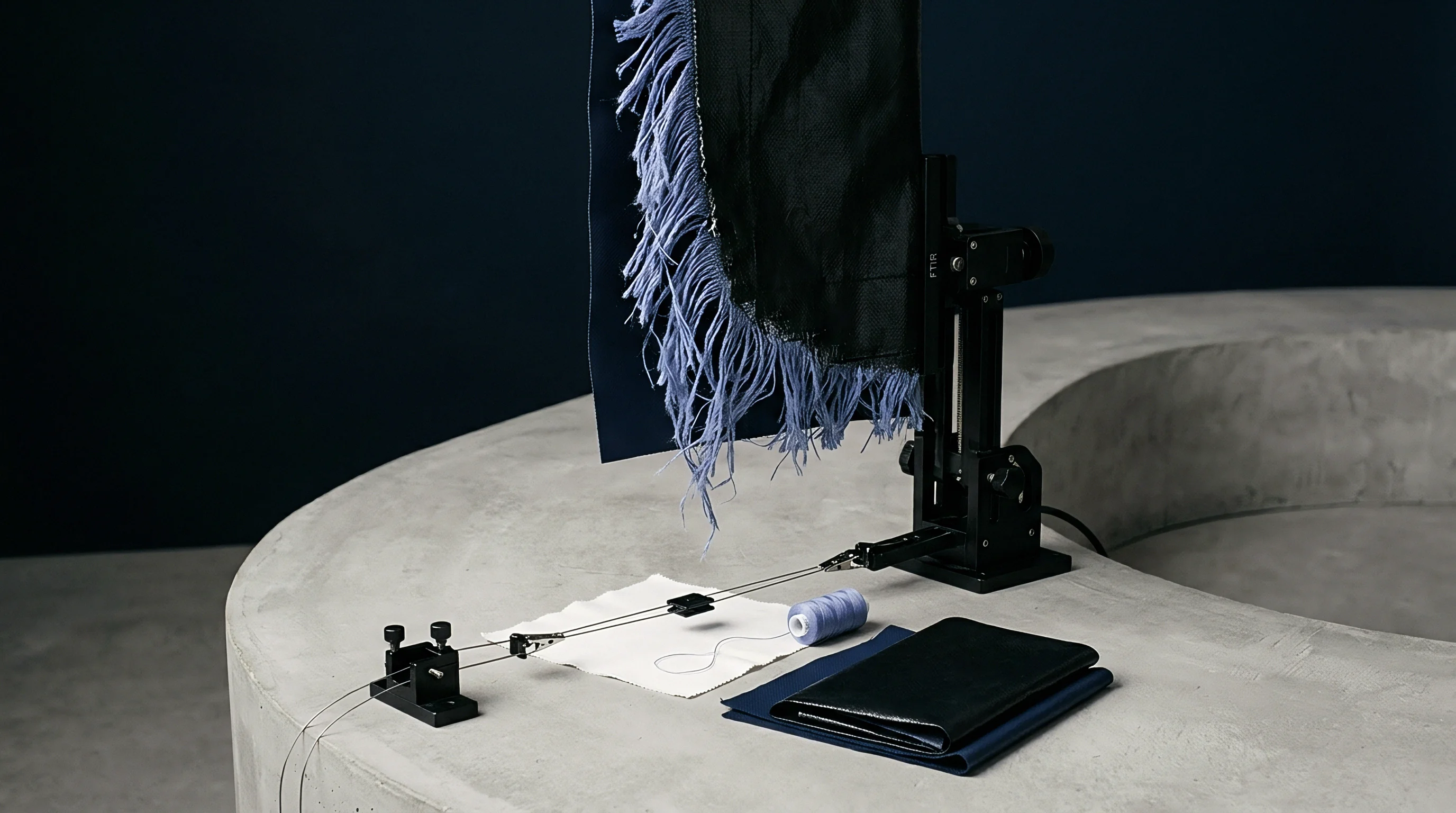
Structural Limits in Dense Interlacings
Threadline interference restricts yarn movement in the initial wash chambers. Because plain weaves max out theoretical intersection frequency with every warp yarn alternating over and under each pick, pulling the warp flat under longitudinal tension pushes that crimp straight into the weft. This interchange bends the crosswise yarns into steep waves.
When those adjacent picks are already touching, the weft cannot absorb extra amplitude without compressing neighboring threads, inducing local buckling across the web.
High-density twills and satins lower their intersection frequency through longer floats, letting warp yarns cross several picks before interweaving. This reduced crossover density delays lateral jamming, allowing the web to undergo greater width contraction under continuous processing tension than a balanced plain weave of the same weight.
| Construction Type | Yarn Count Warp and Weft | Greige Sett Ends and Picks per cm | Warp Cover Factor | Jamming Ratio | Predicted Lateral Contraction Percent |
|---|---|---|---|---|---|
| Plain Poplin | 14.7 tex / 14.7 tex | 52.0 / 28.0 | 23.2 | 0.94 | 5.8 |
| High-Density Plain | 11.8 tex / 11.8 tex | 58.0 / 34.0 | 22.8 | 0.91 | 6.4 |
| Four-End Warp Satin | 9.8 tex / 9.8 tex | 68.0 / 42.0 | 24.3 | 0.86 | 9.2 |
| Three-by-One Twill | 20.0 tex / 20.0 tex | 46.0 / 26.0 | 23.5 | 0.88 | 8.5 |
| Ripstop Technical Poplin | 15.0 tex / 15.0 tex | 48.0 / 30.0 | 21.4 | 0.82 | 7.1 |
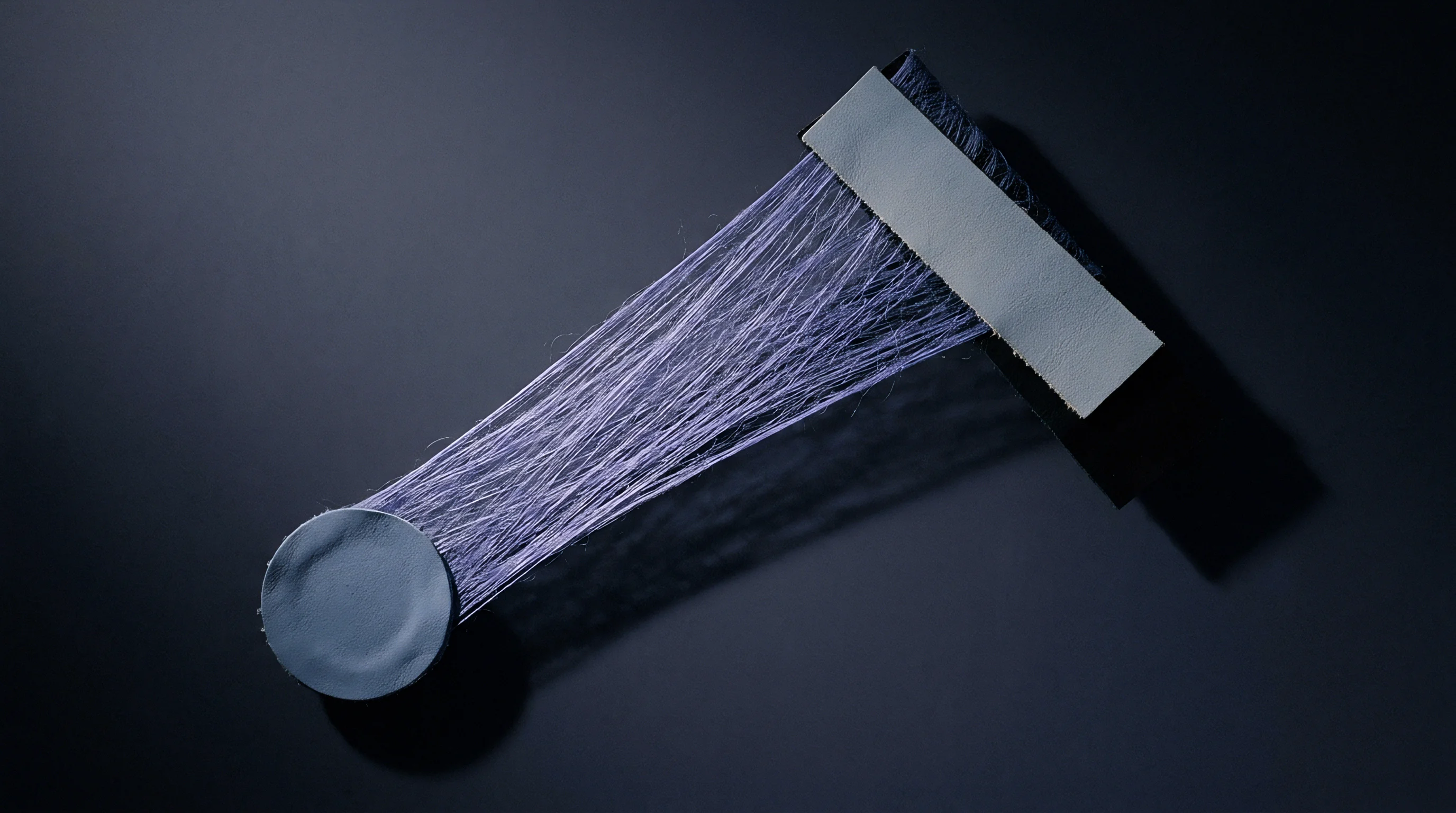
Predictive Geometry for Compact Packing
Threadline geometry calculations define the contraction threshold prior to structural distortion. Spacing between adjacent warp centers narrows until hitting the compressed horizontal yarn diameter; past this limit, the weave jams completely and transmits lateral force across the full width of the roll.
Line draft accentuates this effect. Speed mismatches between washer drive boxes introduce positive draft that elongates warp ends, forcing weft picks into deeper undulations with every increment of stretch. In dense constructions, the transition from smooth sliding to jammed compaction happens within a narrow tension window: stepping up line tension from 1.2 to 2.4 Newtons per end on a 60 ends/cm combed cotton poplin shifts behavior from uniform width loss to edge scalloping and centerline ribbing as excess compaction turns into surface corrugation.


Nip
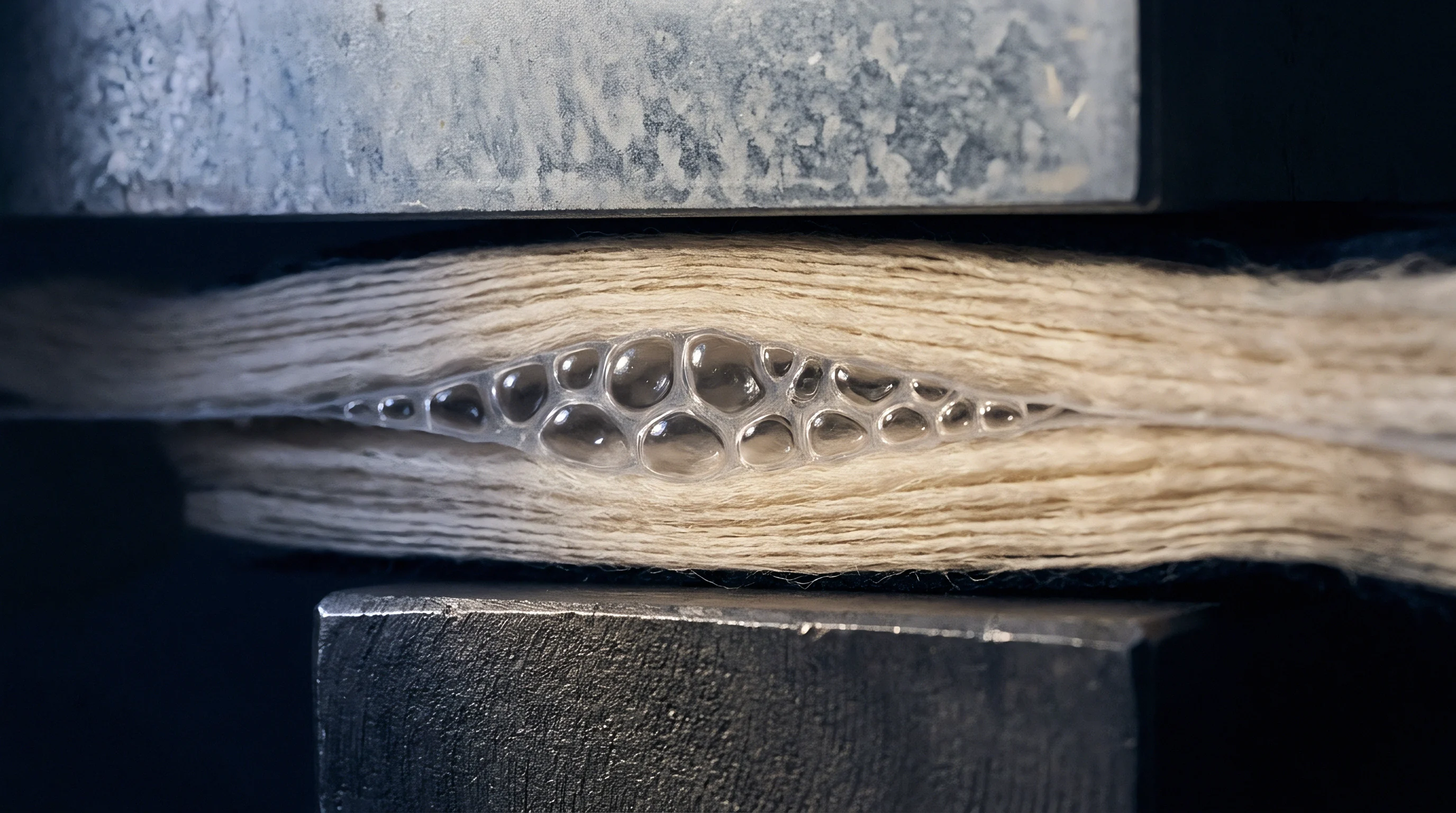
Continuous pad troughs subject saturated fabric to intense nip pressure. Squeezing the web between elastomeric and steel rolls under loads of sixty to one hundred kilonewtons per linear meter strips excess liquor while imposing sharp localized shear. Because trapped interstitial water cannot compress, its sudden deceleration in dense greige constructions builds a hydraulic wave right in front of the nip.
While open fabrics allow fluid to bleed backward through structural voids, high-density setts lack sufficient open area between yarn barrels. The retarding hydraulic wave instead forces trapped liquor outward toward the selvedges, sweeping transverse yarns into bowed profiles.
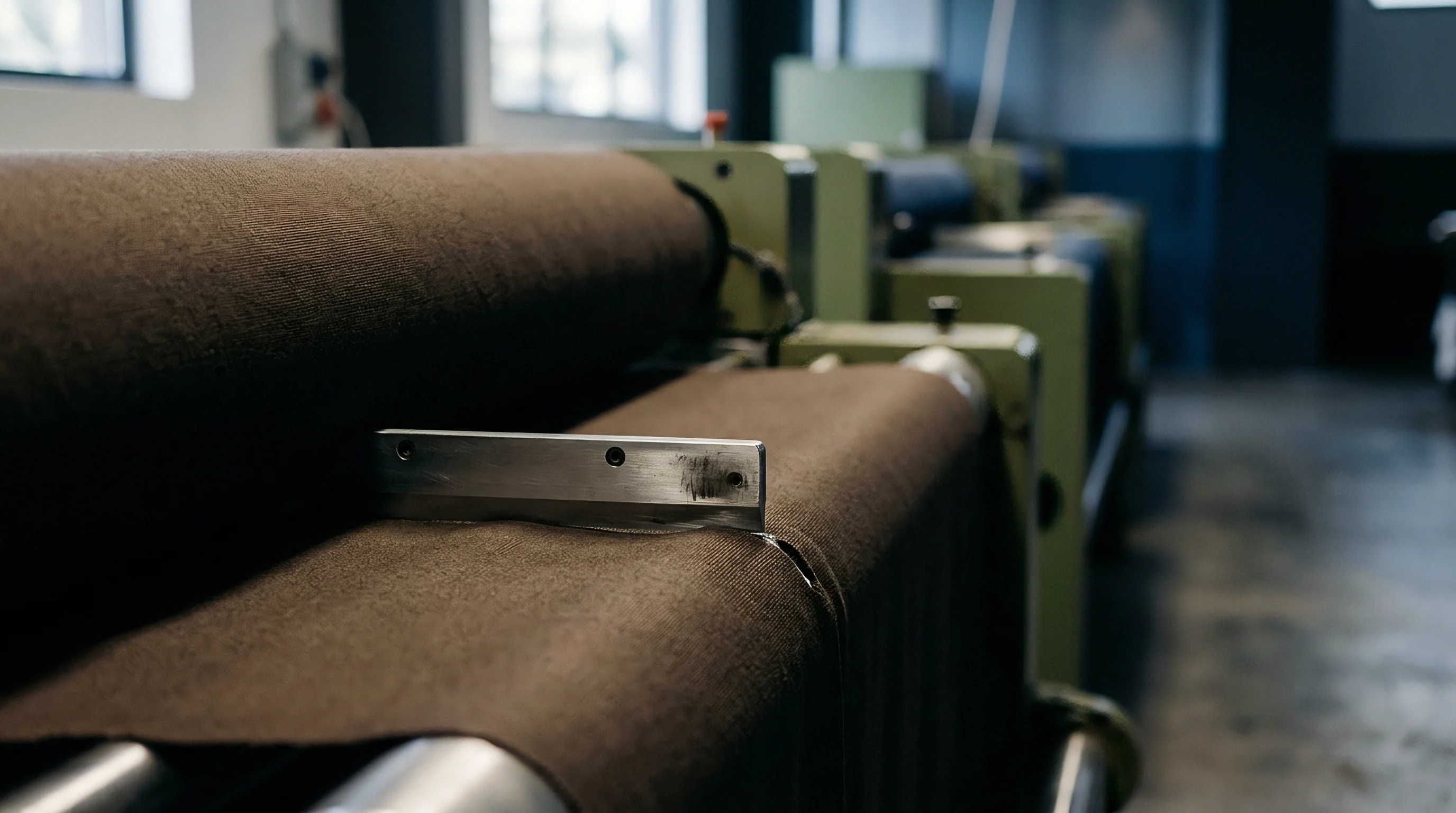
Where Do Inter-Yarn Friction Thresholds Break Down?
Surfactant-heavy scouring liquors diminish boundary lubrication between wet filaments, with alkali baths and wetting agents cutting inter-yarn friction by thirty to fifty percent relative to dry greige fabric. Yarns slide past crossovers under lower tension, accelerating slippage until barrels make contact in the jammed plane. Standard guide-roll load cells register only gross longitudinal tension across the full width, leaving localized tension spikes at the squeeze rolls undetected until distorted fabric leaves the nip.
Four primary continuous line stress vectors act upon dense goods during continuous open-width transport:
- Longitudinal machine draft stretches warp threadlines between driven rollers and increases weft crimp amplitude.
- Hydrodynamic drag forces resist planar transit through chemical immersion boxes and elevate line tension before extraction.
- Transverse squeeze expansion flattens yarn cross-sections under elastomeric roller deflection and forces lateral elongation.
- Surface shear differentials arise from velocity mismatches between rubber roller jackets and steel cores under high load.
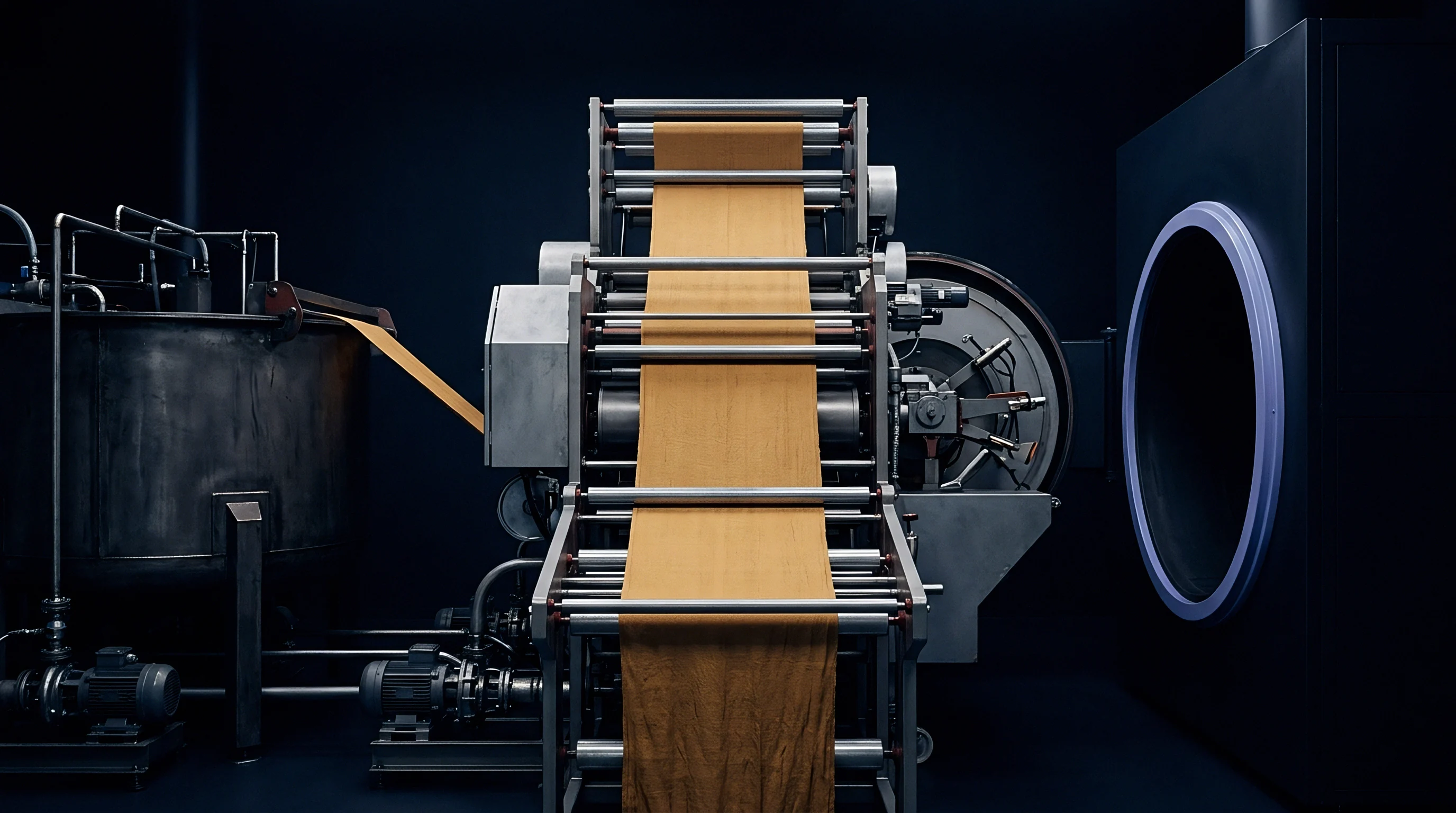
Roll Deflection and Tension Concentration
Crowned squeeze cylinders generate uneven pressure profiles across wide goods. Mechanical loading causes standard rolls to deflect slightly at their center, concentrating extraction pressure at the outer quarters and selvedges. In high-density fabrics, this variation induces differential longitudinal strain across the web ~ edges stretch more than the core, so as fabric leaves the nip, the outer quarters snap back elastically while the center lags, creating immediate troughing and weight variations.
A mill specification permitting a two-percent roll crown tolerance produces an eight-gram-per-square-meter weight disparity across a 160-centimeter dense twill.
Adjusting pneumatic cylinder pressure on padding mangles fails to compensate for crown mismatches. Reducing pressure leaves excess liquor in the web, overburdening downstream drying cylinders, while increasing pressure heightens shear at the roll face. Uneven beam tension from the loom shed makes continuous level extraction impossible across the run.
Hysteresis
Running saturated yardage through multi-drive continuous wet lines at differential speeds induces both instant elastic deformation and delayed recovery in warp threadlines. Submerged in hot baths, fiber polymers undergo viscoelastic relaxation; in cellulosics, water molecules disrupt hydrogen bonding in amorphous zones, letting microfibrils slide past each other at lower stress levels.
When tension relaxes between a driven nip and dancer roll, structural recovery lags. The load-unload strain curve traces an energy dissipation loop that defines mechanical hysteresis, and in dense fabrics this hysteresis governs actual running width through successive processing units.
| Polymer Composition | Dry Modulus Centinewtons per tex | Wet Modulus Centinewtons per tex | Modulus Loss Percent | Plastic Strain Ratio at 2 N Tension | Elastic Recovery Half-Life Seconds |
|---|---|---|---|---|---|
| Ring-Spun Combed Cotton | 450 | 310 | 31.1 | 0.42 | 4.8 |
| Viscose Rayon Staple | 520 | 180 | 65.4 | 0.68 | 12.4 |
| Polyethylene Terephthalate | 850 | 780 | 8.2 | 0.12 | 0.6 |
| Polyamide 6,6 Filament | 620 | 410 | 33.9 | 0.29 | 2.1 |
| Lyocell Staple | 680 | 390 | 42.6 | 0.38 | 3.5 |

Viscoelastic Energy Dissipation Mechanics
Submerged polymer chains absorb mechanical work via molecular displacement. In synthetics such as polyamide, 95 degree Celsius scouring baths drop the secondary glass transition temperature, accelerating plastic flow even under modest line tensions of one to two Newtons per end.
Elongated warp yarns maintain their extended state throughout passage through the wash box, allowing weft contraction to peak during this dwell window. If fabric reaches hot drying units before delayed elastic recovery occurs, the stretched geometry heat-sets directly into the polymer network, causing residual warp shrinkage to spike during laundering.
Kinetic Strain Equations for In-Line Draw
Kinematic models calculate warp elongation through sequential immersion tanks by summing Hookean elasticity, delayed Kelvin-Voigt viscoelasticity, and permanent plastic flow. Dwell times of twenty to sixty seconds per box during desizing and scouring closely match the relaxation half-life of wet cellulosic fibers.
Predictive width models must incorporate time dependency. Assuming static equilibrium between warp tension and weft crimp understates width loss on high-speed lines, where fabric exits the final squeeze nip before delayed elastic recovery can counteract structural jamming. Which specific molecular cross-links dictate the boundary between reversible viscoelastic contraction and permanent fiber draw under commercial line speeds remains an open question.


Swell
Hydrophilic fibers alter their physical dimensions within seconds of immersion. Water expands cotton radially by fourteen to twenty percent ~ against less than two percent longitudinally ~ while regenerated celluloses like viscose expand radially by thirty-five to forty percent, all confined within the tight geometry of a high-density greige sett.
Swelling yarn barrels eliminate free volume inside the interlacing. While unjammed structures absorb this lateral expansion through surface compaction, high-density fabrics woven near their jamming limit offer no horizontal clearance. Swelling forces vertical displacement instead, triggering severe crimp interchange between warp and weft.

Fiber Volumetric Expansion and Crimp Interchange
Radial filament expansion leaves axial chain length unchanged. As weft yarn diameters enlarge while axial length stays constant, the weft path must lengthen to traverse swollen warp barrels; however, running line tension holds the warp taut and flat, preventing it from yielding crimp length.
Crimp accommodation falls entirely on the weft. To navigate around swollen, flattened warp threads, the weft pulls its selvedges inward toward the centerline, narrowing the web by eight to twelve percent within the first ten meters of the wet range.
Dimensional testing per ISO 5077 confirms that dense poplins processed with excessive warp tension retain up to nine percent latent warp shrinkage.
Will Warp Tension Overrides Prevent Trough Formation?
Increasing longitudinal draft flattens transverse wrinkles over guide bars, leading operators to boost dancer roll pressures whenever diagonal troughs show up. While this hides visible surface wrinkling, it locks substantial mechanical stress into the fabric: warp ends straighten, weft crimp amplitude spikes, and the jamming boundary migrates toward the center of the web.
Relying on machine draft to suppress transverse instability causes predictable processing defects:
- Heavy selvedge edge build-up develops as weft crimp concentrates along outer pins and clips, causing downstream winding tension bands.
- Center-to-selvedge pick density variances manifest as picks crowd more densely in the center than along the margins.
- Severe warpway tear strength loss occurs under ISO 13937-2 testing because over-straightened yarns break sequentially rather than sharing load.
- Persistent bow and skew distortions lock into the construction when unequal roll extraction meets high longitudinal draw.
Uncorrected swelling-induced crimp interchange creates dimensional instability that stenter frames cannot rectify. Attempting to pull jammed, narrow fabric out to width on stenter clips exerts force against jammed yarn crossovers, tearing threads or pulling selvedges off pins and producing scrap at the cutting table.
Allowance
Loom reed planning governs final performance in continuous wet processing. Setting greige counts requires working backward from conditioned finished targets through the processing train to the reed plan; a dense twill targeted at 150 centimeters finished width cannot be woven at 158 centimeters greige if scouring and pad-dyeing cause an eight percent width contraction.
Consider a 15.0 tex combed cotton plain weave designed for 142 centimeters finished width at 54 ends/cm and 30 picks/cm. Running under a typical continuous line tension of 2.0 Newtons per end through desizing, scouring, and washing, fiber swelling reduces available interlacing space by sixteen percent, causing lateral jamming at 144 centimeters.

Loom Specification Derivation from Wet Contraction
Weaving calculations convert predicted wet contraction into target ends per dent. Accounting for an eight percent elastic-plastic wet line contraction and a two percent margin for stenter pinning yields a required off-loom greige width of 157.8 centimeters across 7,668 total warp ends. The reed width must accommodate both off-loom dimensions and contraction allowances.
Denting four ends per dent in a metric number 120 reed yields a drawn-in reed width of 159.8 centimeters. Trimming greige costs by weaving on a narrower 154-centimeter reed at higher warp cover causes line tension to pull the jammed weave past its limit, producing goods that either fail width inspection or arrive at target width laden with residual warp shrinkage.
| Processing Parameter | Standard Continuous Line | Low-Tension Under-Liquor Drive | Over-Tensioned Narrow Reed Route |
|---|---|---|---|
| Greige Reed Width (cm) | 164.5 | 161.0 | 155.0 |
| Warp Line Tension (N/end) | 2.1 | 0.8 | 3.2 |
| Wet Line Width Contraction (%) | 8.8 | 6.8 | 3.2 (Forced) |
| Finished Width (cm) | 150.2 | 150.1 | 150.0 |
| Residual Warp Shrinkage (%) | 3.2 | 1.8 | 7.4 |
| Stenter Speed (m/min) | 45 | 50 | 32 |
| Finished Yield (meters/greige ton) | 4,120 | 4,210 | 3,980 |
| Landed Cost per Finished Meter (USD) | 2.48 | 2.42 | 2.74 |
Commercial Toller Specification Rules
Supply contracts hold converters to tight dimensional tolerances, with standard agreements citing ISO 6330 wash protocols to cap warp shrinkage at three percent and weft shrinkage at two percent. If technical specifications omit greige reed allowances and line tension limits, mills often run orders on narrow looms to lower yarn consumption and weight per square meter, stretching fabric on the stenter later to hit invoice width.
For greige densities with cover factors above twenty-two, continuous wet line tension must stay under 1.2 Newtons per end to prevent permanent crimp interchange. Procurement specifications can enforce this by capping stenter overfeed at four percent and requiring ISO 5077 wash stability verification over three laundering cycles before bill of lading release.