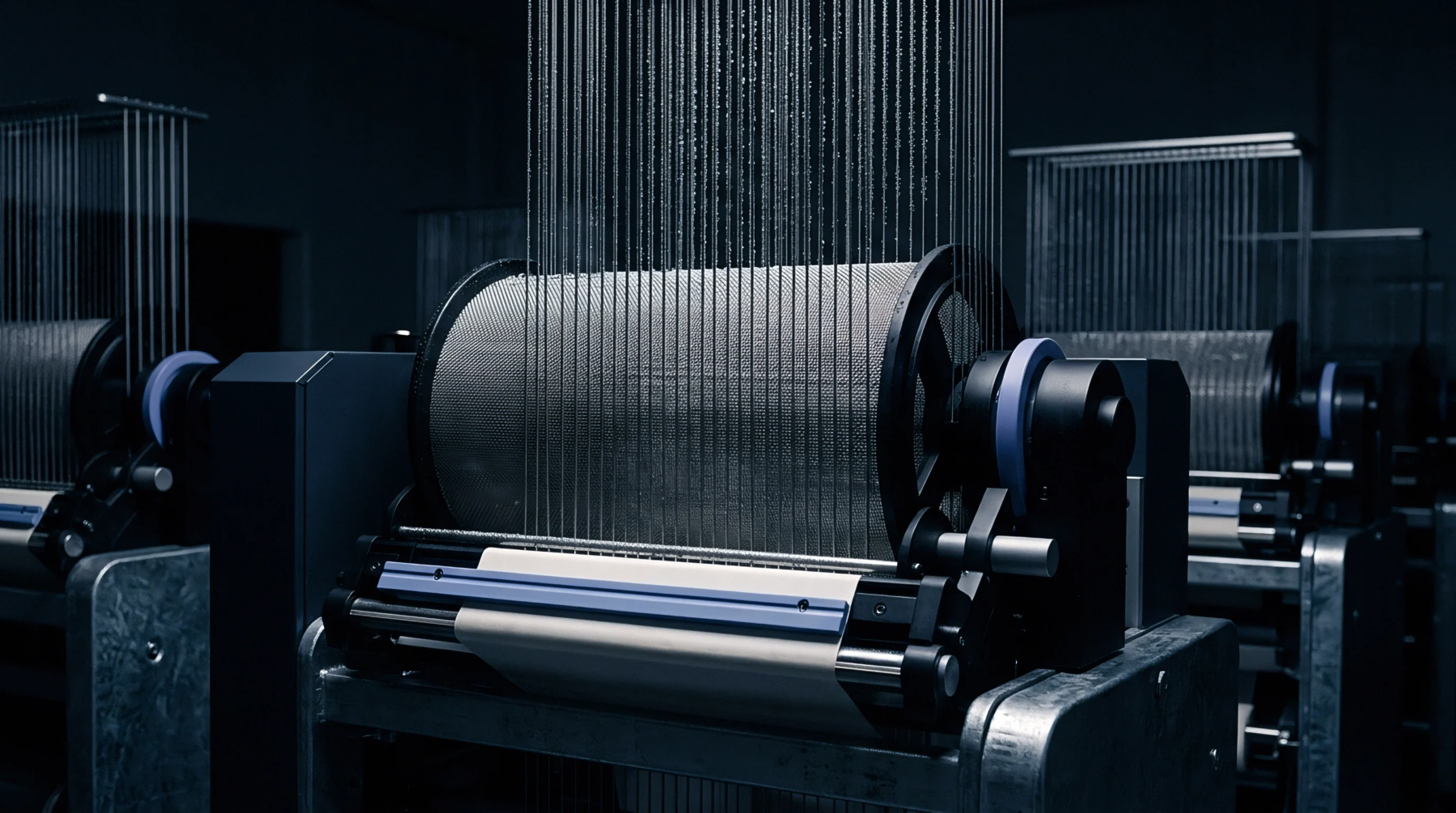
Extrusion Mechanics
Continuous cellulose regeneration defines viscose filament within commercial wet spinning operations, transforming alkaline xanthate dope into endless multi-filament yarn through acid coagulation baths. Dissolved wood pulp reacts with sodium hydroxide and carbon disulfide, producing a soluble intermediate that passes through noble metal spinnerets into a bath containing sulfuric acid, zinc sulfate, and sodium sulfate. Precipitating ions neutralize the alkaline solution simultaneously, regenerating cellulose molecules into solid filaments before mechanical drawing stretches the newly formed structure to orient internal molecular chains.
Spinneret hole geometry dictates linear mass density, while metering pump speeds govern throughput rates verified through denier determination testing in mill laboratories.
Spinning Tension
Regulating hydrodynamic drag inside coagulating baths prevents premature filament breakage during high-speed take-up sequences. Fluid dynamics across the spinneret face require precise balance between extrusion velocity and Godet roller rotational speed, avoiding excessive orientation that generates internal stress fractures along individual strands. Extrusion stretching ratios remain tightly controlled because over-stretching reduces transverse tensile strength in downstream weaving operations.
Solution viscosity variations demand continuous thermal monitoring across filtration units, maintaining uniform cross-sectional profiles through every commercial winding package produced.
Twist Geometry
Inserting angular displacement along continuous filament bundles stabilizes cohesion during subsequent warping and weaving procedures. Un-twisted multi-filament yarns lack structural integrity, causing individual filaments to fray or snag upon passing through metallic reed wires and heddle eyes on mechanical looms. Twist multipliers correlate directly with linear density, establishing torque balance that prevents looping or snarling during high-speed quill winding.
Certified yarn testing facilities measure turns per meter against established commercial tolerances to verify twist permanence prior to fabric formation.
Dye Uptake
Supramolecular crystalline ordering influences direct dye penetration rates across uniform yarn lots during wet processing treatments. Amorphous regions absorb aqueous dye molecules rapidly, whereas highly oriented crystalline domains restrict dye diffusion, requiring precise temperature control to achieve level coloration without streakiness. Swelling behavior in hot aqueous dye baths dictates final dimensional stability, affecting shrinkage rates during high-temperature finishing operations.
Spectrophotometric analysis of dyed skeins confirms batch-to-batch color consistency against agreed commercial shade standards before garment manufacturers commit fabric to cutting tables.