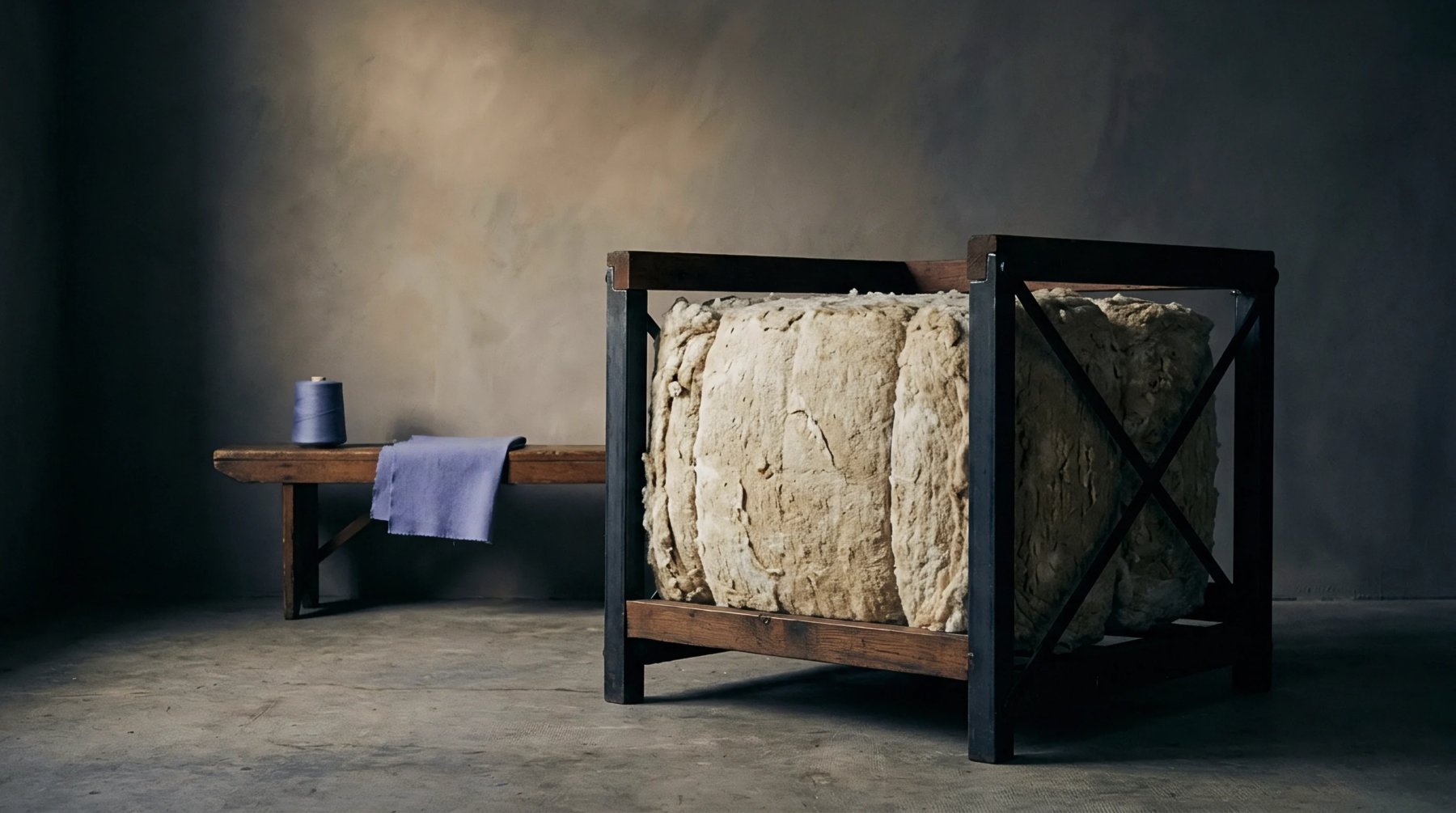
Determining Raw Cashmere Micron Profiles and Dehairing Yields
Determining raw cashmere value requires combined OFDA micron profiling and oven-dry yield mass balance testing to calculate true clean dehaired cost.
Laboratory testing of wool and animal hair lots determines the proportion of follicles exceeding a specified diameter threshold to establish grade consistency. Coarse hair percentage measures the volume of unwanted thick fibres relative to the total mass of the sample. This metric identifies contamination levels within a raw lot before processing begins.
It operates on the principle that excessive diameter variation compromises yarn uniformity and end-use performance. Spinning equipment adjustments depend on these values to prevent breakage during drafting and twisting.
Mill operators monitor raw stock quality through this specific count because coarse fibres create surface defects in finished fabrics. These rigid structures protrude from the yarn body when tension applied during weaving causes smaller fibres to migrate toward the core. Such anomalies result in uneven dyeing where thicker sections absorb different quantities of pigment compared to the surrounding structure.
Quality control teams perform microscopic analysis on representative segments of incoming bales to verify supplier documentation. High counts trigger additional combing steps to remove thicker material at the expense of total yield. Production runs proceed only if the batch meets threshold requirements for the intended spinning count.
Machine settings shift automatically based on the density of these impurities to maintain consistent output speed.
Procurement departments use established laboratory protocols to quantify diameter distribution for contract enforcement. Measurements require the extraction of individual fibres from a representative portion of the bale to ensure accuracy. Technicians mount segments on glass slides for projection through a microscope equipped with an ocular micrometer.
They count every fibre captured within the field of view until the target number reaches the statistical limit. Errors in selection produce bias that distorts the final calculation and misrepresents the batch quality. Proper sampling techniques dictate that technicians pull material from multiple depths of the container to minimize selection bias.
Software tools aggregate these counts to output a single value representing the total fraction of material falling outside the permitted range. This numerical output binds the transaction between the seller and the purchaser.
Measurement precision falls when operators fail to account for the variability between individual animals or regional climatic conditions. Variations in feed and environment influence the distribution of hair diameters and skew the results of standard tests. Testing equipment detects changes in fibre width but remains blind to the specific cause of such shifts.
Future advances in automated digital scanning may replace manual counts to increase throughput during large volume inspections. Machines capable of analyzing thousands of fibres per second improve confidence in the data while reducing human error during calculation. Reliable data points depend on the integrity of the initial sample collection protocol at the point of origin.
Accurate assessment of this attribute governs the financial value of the lot throughout the entire manufacturing supply chain.
Determining raw cashmere value requires combined OFDA micron profiling and oven-dry yield mass balance testing to calculate true clean dehaired cost.
Expertise is a utility, not a secret. sentiention™ publishes its working knowledge as open reference: intelligence layer covering the materials it sources, the markets it enters, and the reference that serves both.