Proteomic Identification Principles for Animal Hair Fibre Mixes
Proteomic LC-MS/MS quantifies animal hair blend percentages by measuring species-specific keratin peptide markers against isotope-labeled internal standards.
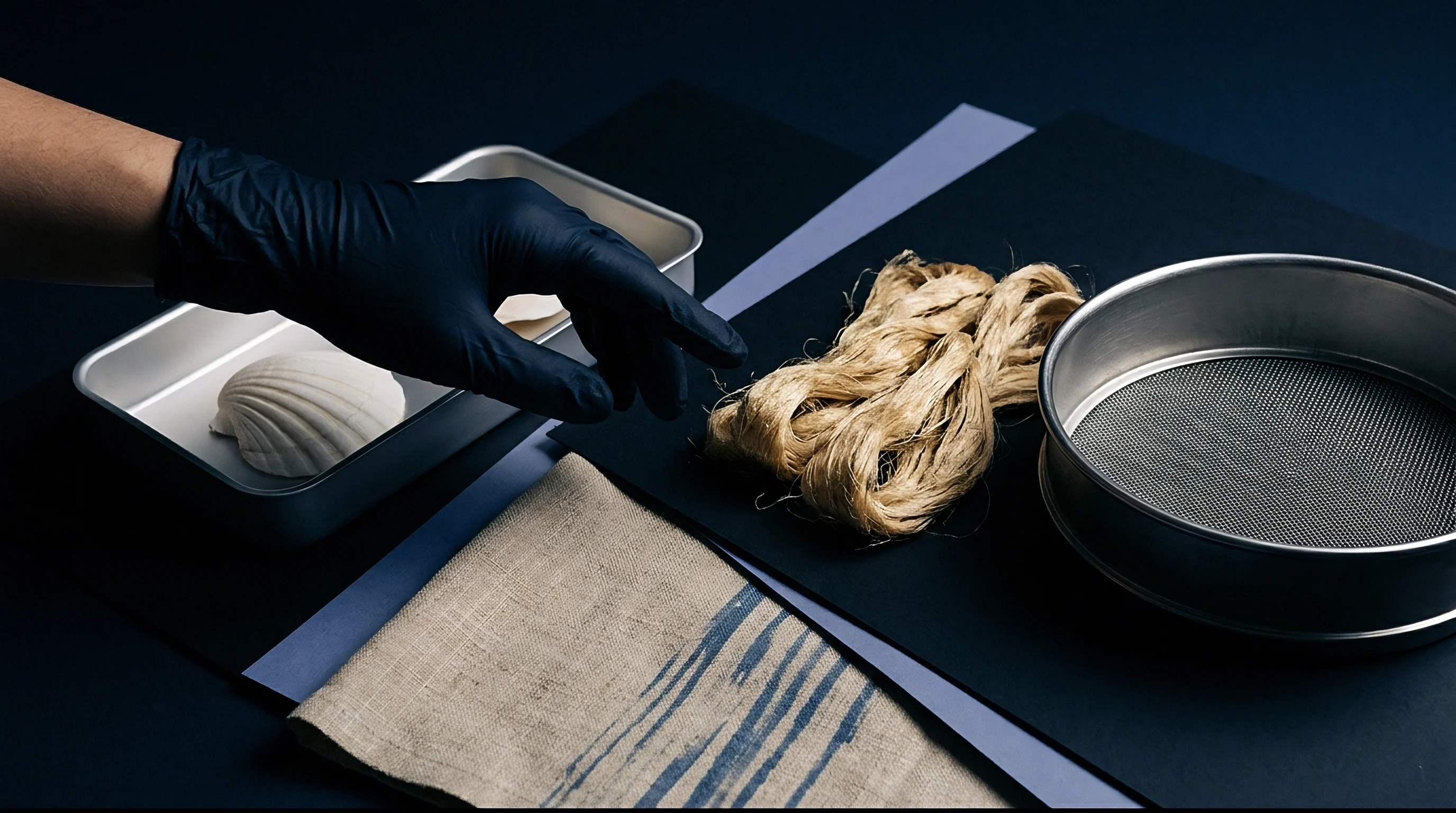
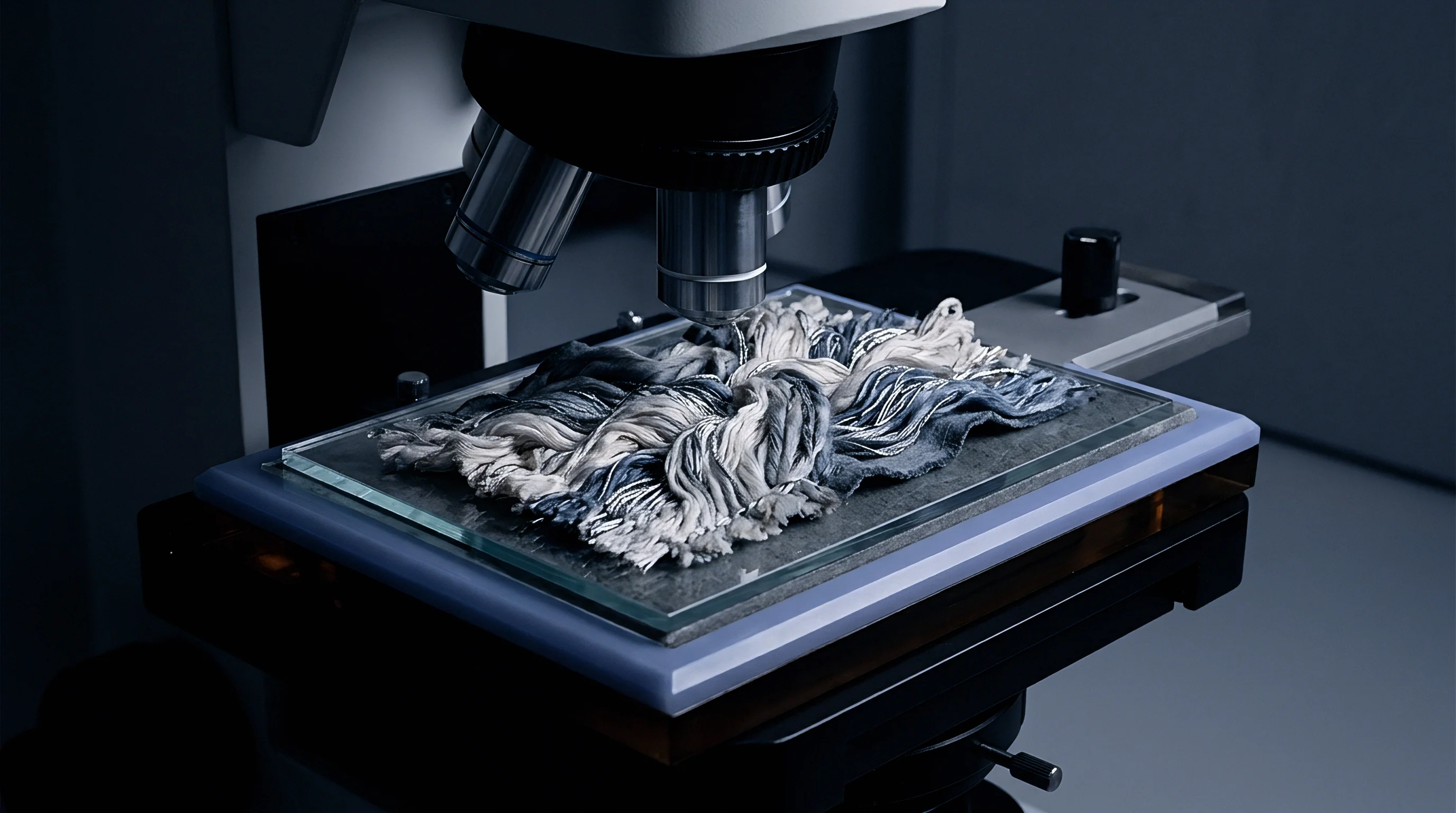
Lysis
Hair fiber proteins form an insoluble structural matrix stabilized by extensive disulfide cross-linking between cysteine residues. Disulfide bonds hold hair fibers tight. Keratin proteins resist simple water dissolution.
Quantitative proteomic analysis requires complete solubilization of the filament structure without destroying primary peptide sequences. Chemical reduction breaks these covalent bonds to convert rigid hair proteins into soluble, denatured polypeptide chains suitable for downstream processing.
Reductive Solubilization of Fiber Keratin
Denaturing reagents such as eight-molar urea open the tightly folded intermediate filament structures. Dithiothreitol breaks interchain cysteine bridges. Adding dithiothreitol or tris(2-carboxyethyl)phosphine at concentrations between fifty and one hundred millimolar reduces disulfide linkages within two to four hours at fifty-six degrees Celsius.
The buffer solution maintains a pH of 8.0 to 8.5 using 100 millimolar ammonium bicarbonate or Tris-HCl, preventing protein precipitation while maintaining optimal reduction kinetics. Complete denaturation unfolds alpha-helical domains in keratin intermediate filament proteins 31 through 40 and keratin-associated proteins, exposing hidden cysteinyl residues to alkylating agents.
- Mill raw hair mix into uniform fragments measuring under one millimeter in length.
- Suspend fifty milligrams of milled fiber in two milliliters of eight-molar urea containing fifty millimolar dithiothreitol.
- Incubate the suspension at fifty-six degrees Celsius for one hundred twenty minutes under constant agitation.
- Cool the extract to room temperature before introducing alkylating reagents.

Alkylation and Disulfide Bond Cleavage
Free sulfhydryl groups undergo irreversible modification when treated with iodoacetamide in dark conditions at room temperature. Iodoacetamide prevents disulfide bond re-formation. Introducing a two-fold molar excess of iodoacetamide over total thiol concentration yields carbamidomethylated cysteine residues within forty-five minutes.
This irreversible capping blocks random oxidation during subsequent enzymatic treatments. Excess alkylating agent is quenched by adding additional dithiothreitol, protecting downstream proteases from alkylation-induced inactivation.
A sample ground into fine powder yields consistent extraction recovery across mixed fiber diameters.
Fibers subjected to aggressive industrial processing, such as heavy hydrogen peroxide bleaching or stripping treatments, exhibit pre-existing cysteic acid modifications that alter reduction yields. Suppliers frequently argue that low peptide recovery stems from aggressive dyeing treatments rather than fraudulent substitution of yak hair for cashmere.

Enzyme
Specific proteolysis transforms complex animal hair proteins into predictable mixtures of soluble peptide fragments suitable for mass analysis. Proteotypic markers identify specific animal species. Trypsin cleaves at lysine and arginine.
Converting insoluble intermediate filament proteins into discrete, identifiable peptide fragments allows discrimination between closely related animal species whose physical fiber dimensions overlap entirely.

Tryptic Digestion and Peptide Cleavage Kinetics
Proteases targeting carboxyl-terminal sides of lysine and arginine residues generate distinct fragments from intermediate filament proteins. Trypsin digestion proceeds at thirty-seven degrees Celsius in fifty millimolar ammonium bicarbonate buffer at pH 8.2. Maintaining an enzyme-to-protein ratio between 1:50 and 1:20 by weight yields reproducible cleavage profiles within sixteen hours.
Quenching the reaction with one percent formic acid or trifluoroacetic acid drops the solution pH below 3.0, halting enzymatic activity and protonating basic side chains for subsequent mass spectrometry.
Marker Specificity across Keratinous Species
Sequence variations within type I and type II cytokeratins reflect genomic divergence between sheep, goats, yaks, and camels. A single amino acid substitution within a conserved keratin domain creates a species-specific proteotypic peptide. Yak hair mimics cashmere surface scales.
Mass spectrometry distinguishes Capra hircus (cashmere goat) from Bos grunniens (yak) and Ovis aries (sheep) based on exact precursor mass and characteristic product ion spectra. Amino acid substitutions changing leucine to isoleucine or valine to alanine generate unique mass signatures that persist through industrial spinning and weaving.
- Thermal degradation of biomarkers occurs when digestion temperatures exceed forty-two degrees Celsius, causing enzyme autolysis and incomplete peptide cleavage.
- Incomplete alkylation artifacts produce dual peak signals for single peptide sequences due to partial carbamidomethylation of cysteine residues.
- Cross-species sequence homology leads to false positive identification when shared keratin peptides are selected as species-exclusive quantifiers.
- Matrix suppression from spin finishes suppresses peptide ionization efficiencies when scouring surfactants remain on commercial yarn samples.
| Target Species | Protein Family | Peptide Sequence | Precursor m/z (z=2) | Product Ion m/z |
|---|---|---|---|---|
| Capra hircus (Cashmere) | KRT31 | LAENDFLNK | 539.29 | 647.35 (y5) |
| Bos grunniens (Yak) | KRT31 | LAENDFLSK | 528.27 | 625.32 (y5) |
| Ovis aries (Wool) | KRT33A | LCEACESPVR | 589.25 | 718.32 (y6) |
| Camelus dromedarius (Camel) | KRT85 | TIQALEEANR | 572.31 | 702.35 (y6) |
Tryptic digestion at thirty-seven degrees Celsius for sixteen hours converts ninety-two percent of reduced keratin into soluble peptides.
Whether industrial bleaching processes destroy conserved proteotypic peptides beyond the sensitivity threshold of modern triple quadrupole instruments remains under active investigation.


Ionization
Liquid chromatography separates complex peptide mixtures on reverse-phase C18 columns before sample aerosol entry into the mass spectrometer chamber. Electrospray sources generate multiply charged ions. Mass spectrometers measure mass-to-charge ratios.
Peptides fragment in high-energy collision cells. Reverse-phase separation using a water-acetonitrile gradient with 0.1 percent formic acid resolves hydrophobic peptide species over a thirty-minute run time, directing narrow chromatographic peaks into the ion source.
Liquid Chromatography Tandem Mass Spectrometry Configuration
Electrospray sources produce multiply charged gas-phase molecules that travel through triple quadrupole filters toward collision cells. Triple quadrupole systems operating in multiple reaction monitoring mode select predetermined precursor ion mass-to-charge ratios in the first quadrupole, induce collision-activated dissociation with argon gas in the second quadrupole, and monitor species-specific product ions in the third quadrupole. Dwell times between fifteen and fifty milliseconds per transition yield sufficient data points across three-second chromatographic peak widths, maintaining precise quantitative peak area integration.
Why Does Matrix Suppression Shift Intensity Ratios?
Co-eluting non-target compounds consume electrical charge inside electrospray droplets and alter target analyte signal strength. Matrix effects alter electrospray response factors. Non-keratin impurities, residual dye molecules, and wool grease residues alter droplet surface tension during evaporative charge transfer.
Co-eluting peptides compete for available surface charge on desorbing droplets, suppressing signal intensities for targeted species markers. High-resolution Orbitrap mass analyzers operating at 60,000 resolving power isolate target mass peaks within a two-parts-per-million window, eliminating isobaric interferences that skew low-resolution triple quadrupole signal ratios.
High-resolution mass spectrometry resolves isobaric peptide overlap that confounds low-resolution triple quadrupole systems.
Relying on a single peptide transition for commercial origin determination invites misclassification when processing chemicals modify amino acid side chains.
Calibration
Quantitative proteomic analysis relies on stable isotope-labeled synthetic molecules added at known concentrations prior to chromatographic separation. Heavy peptide standards correct signal drift. Calibration curves demand pure reference standards.
Synthetic peptides containing heavy isotopes replicate target sequence behavior exactly while generating distinct mass shifts that enable absolute quantification of species ratios in mixed textile samples.

Isotope-Labeled Synthetic Peptide Internal Standards
Heavy amino acids incorporating carbon-13 and nitrogen-15 isotopes match chemical properties of natural target sequences while shifting mass values. Substituting C13-labeled and N15-labeled arginine or lysine at the C-terminus yields a mass increase of six to ten Daltons. Internal AQUA (Absolute Quantification) peptides added at identical concentrations across calibration standards and unknown fiber extracts normalize for extraction efficiency loss, digestion variability, and electrospray signal ion suppression.
Ratio calculations compare native target peptide peak areas directly against isotopic standard peak areas.
Consider a 100-kilogram lot of high-grade yarn declared as 100 percent pure cashmere. Quantitative proteomic testing extracts total protein and spikes the digest with 10 picomoles of heavy cashmere-specific marker LAENDFLNK (C13, N15) and 10 picomoles of heavy yak-specific marker LAENDFLSK (C13, N15). Mass spectrometry returns a native-to-heavy peak area ratio of 0.815 for the cashmere marker and 0.185 for the yak marker.
Accounting for species-specific protein yield response factors (1.02 for cashmere keratin, 0.98 for yak keratin), the mathematical derivation yields:
Cashmere Fraction = (0.815 / 1.02) / = 0.7990 / (0.7990 + 0.1888) = 0.8088 (80.88%)
Yak Fraction = (0.1888) / (0.7990 + 0.1888) = 0.1912 (19.12%)
The 100-kilogram yarn lot contains 19.12 kilograms of undeclared yak hair, exposing the importer to mislabeling penalties and tariff reclassification.
Linearity and Peak Area Ratios
Construction of multi-point response curves from physical reference blends ensures accurate measurement across commercial target bands. Preparing calibration standards from pure cashmere and pure yak fibers across 1:99, 5:95, 10:90, 20:80, and 50:50 ratio points establishes linearity across three orders of magnitude. The linear regression coefficient R-squared must exceed 0.995 to validate the calibration curve prior to running commercial fabric extracts.
- Select species-exclusive proteotypic markers showing no sequence overlap with secondary animal hair constituents.
- Incorporate isotopically labeled AQUA standards at concentration levels matching anticipated target peptide abundances.
- Validate extraction linearity using physical reference fiber blends across zero to one hundred percent composition ranges.
- Verify peak retention time alignment within a two-second window between isotopic standards and native target analytes.
| Analytical Parameter | LC-MS/MS (MRM Mode) | MALDI-TOF MS |
|---|---|---|
| Limit of Detection (LOD) | 0.1% protein mass fraction | 1.5% protein mass fraction |
| Limit of Quantification (LOQ) | 0.5% protein mass fraction | 3.0% protein mass fraction |
| Sample Analysis Time | 35 minutes per sample | 2 minutes per sample |
| Mass Accuracy | < 5 parts per million | < 50 parts per million |
| Dynamic Range | 10 to the power of 4 | 10 to the power of 2 |
Under standard testing conditions, synthetic peptide internal standards correct for electrospray response drift across extended analytical runs.
Failing to construct matrix-matched calibration curves leads to miscalculation of yak content in cashmere yarns, causing downstream regulatory rejections and batch destructions.
Tolerance
Inter-laboratory round-robin trials establish measurement uncertainty parameters that govern legal composition enforcement under international standards. Laboratory variance influences custom audits. Method accuracy dictates commercial compliance thresholds.
Statistical evaluation of inter-laboratory testing under ISO 20418-1 demonstrates that proteomic mass spectrometry achieves vastly superior precision compared to classical optical microscopy methods when quantifying dehaired fine animal hair blends.
Inter-Laboratory Variance and Standard Deviation
Comparative optical microscopy under standard test methods fails to distinguish cashmere from fine yak hair when fiber scales possess identical profiles. Scanning electron microscopy and optical projection methods according to ISO 17751 yield subjective errors exceeding ten percent when analyzing dehaired cashmere-yak mixes. Liquid chromatography mass spectrometry methods according to ISO 20418-1 reduce inter-laboratory standard deviation to less than 1.2 percent for binary hair mixes.
Repeatability limits within the same laboratory remain under 0.5 percent across multiple extraction batches.
| Declared Cashmere Ratio | Actual Yak Content | ISO 17751 Microscopy Std Dev | ISO 20418-1 Proteomic Std Dev | Commercial Tolerance |
|---|---|---|---|---|
| 100% Cashmere | 0.0% Yak | +/- 4.5% | +/- 0.3% | 0.0% (Zero Tolerance) |
| 90% Cashmere | 10.0% Yak | +/- 5.2% | +/- 0.7% | +/- 1.5% |
| 70% Cashmere | 30.0% Yak | +/- 6.8% | +/- 1.1% | +/- 2.0% |
| 50% Cashmere | 50.0% Yak | +/- 7.4% | +/- 1.2% | +/- 2.5% |
Method Boundaries under International Standards
International standard ISO 20418-1 specifies sample preparation protocols and liquid chromatography parameters for binary animal hair mixtures. ISO 20418-2 details parallel procedures using MALDI-TOF mass spectrometry for rapid screening. While MALDI-TOF offers high sample throughput, LC-MS/MS triple quadrupole systems serve as the definitive reference method for legal customs disputes and commercial arbitration cases involving low-percentage adulteration.
- Raw mass spectra data files containing full chromatographic peak integrations for target native and isotopic peptide transitions.
- Calibration curve parameters including slope, intercept, R-squared values, and blank measurement baseline noise calculations.
- Digestion efficiency controls verifying full carbamidomethylation and complete conversion of target keratin proteins.
- Chain of custody documents establishing physical sample integrity from bale sampling through laboratory extraction.
ISO 20418-1 Clause 8.2 dictates that blend declarations exceeding a three percent deviation from test results require mandatory re-testing across three independent laboratory samples before custom clearance reclassification.
Clearance
Customs authorities classify imported yarn lots according to Harmonized System headings that carry divergent tariff schedules. Fine animal hair enters duty-free. Wool blends incur higher tariff rates.
Customs inspectors reclassify suspicious yarn lots. Commercial value drops when animal hair blend ratios deviate from customs entry declarations, exposing importers to duty rate adjustments and retroactive penalty assessments.
Customs Tariff Classification Impact
Dehairing processes separate coarse guard hair from soft undercoat fleece, altering commercial valuation and tariff line assignment under customs codes. Pure cashmere hair falls under Harmonized System code 5102.11, entering major import markets under favorable preferential tariff rates or zero customs duty. Fine yak hair and camel hair enter under code 5102.19, carrying distinct trade agreement quotas.
Introduce sheep wool into the blend, and the product falls under heading 5101 or 5103, triggering higher general duty rates and regional safeguard tariffs.
Consider an import shipment containing 10,000 kilograms of fine carded yarn declared as 100 percent Kashmir goat down (HS 5102.11) with an invoice valuation of 120 US dollars per kilogram, establishing a total declared cargo value of 1,200,000 US dollars. At a preferential duty rate of zero percent, the importer pays zero base customs duty. A random port customs inspection draws sample hanks and submits them for ISO 20418-1 proteomic analysis.
The LC-MS/MS test report reveals 15 percent coarse sheep wool protein markers and 10 percent fine yak hair markers.
Customs reclassifies the entire 10,000-kilogram lot under HS 5102.19 / HS 5101.99 as mixed animal hair yarn. The general non-preferential tariff rate of 6.5 percent applies immediately to the total shipment value, creating an instant base duty liability of 78,000 US dollars. Regulatory authorities assess misdeclaration penalties ranging from two to five times the evaded duty amount, adding 156,000 to 390,000 US dollars in punitive fines.
The landed cost per kilogram rises from 120.00 US dollars to 166.80 US dollars before accounting for accrued port demurrage and delayed delivery contract liquidated damages.
Landed Cost Arithmetic and Commercial Settlement
Calculating financial exposure requires combining duty adjustments, testing bills, port storage fees, and delivery delay penalties. Incorporating proteomic test clauses directly into international supply contracts establishes automated commercial settlement mechanisms. Buyers specify that payment drawdown under commercial letters of credit remains contingent upon receiving an accredited ISO 20418-1 LC-MS/MS test certificate verifying species purity within a +/- 0.5 percent tolerance limit.
Yarn buyers who incorporate proteomic testing clauses into purchase orders retain the right to deduct reclassification penalties directly from letters of credit before final financial settlement.