Determining Raw Cashmere Micron Profiles and Dehairing Yields
Determining raw cashmere value requires combined OFDA micron profiling and oven-dry yield mass balance testing to calculate true clean dehaired cost.


Fleece
Capra hircus laniger goats in the arid, high-altitude regions of Central Asia grow a double coat designed for extreme thermal regulation. Raw clips from pastoral herds across Inner Mongolia, Outer Mongolia, Xinjiang, Iran, and Afghanistan vary in anatomical composition, greasy weight, and coarse hair ratio. The outer coat is straight, medullated guard hair with mean diameters above 35 microns ~ exceeding 90 microns in some clips.
Beneath it sits non-medullated down, a crimped, three-dimensional wave structure averaging 13.5 to 18.5 microns.
Commercial valuation hinges on the ratio of fine down to coarse guard hair, suint, sand, skin flakes, and natural wool grease before mechanical processing begins. Harvesting method directly determines raw lot composition. Hand-combing during the spring moult yields lots with 55 percent to 75 percent fine down by weight, leaving little guard hair attached at the root.
Shorn lots, common in Afghanistan and parts of Outer Mongolia, cut the full length of guard hair along with skin flakes and heavy dirt, dropping clean down yields to between 30 percent and 45 percent of total greasy mass.
Regional variations set the baseline micron profiles used in commercial contracts. Typical raw hair parameters, scouring losses, and fine down yields across major Central Asian origin zones are outlined below.
| Origin Region | Down Diameter Range (µm) | Coarse Guard Hair Diameter (µm) | Grease and Suint Content (%) | Sand and Dirt Mass (%) | Mean Clean Down Yield (%) |
|---|---|---|---|---|---|
| Inner Mongolia (Alashan) | 13.8 – 15.2 | 38.0 – 65.0 | 3.5 – 5.0 | 4.0 – 8.0 | 58.0 – 68.0 |
| Inner Mongolia (Erlangshan) | 15.2 – 15.8 | 40.0 – 70.0 | 4.0 – 5.5 | 5.0 – 10.0 | 54.0 – 62.0 |
| Outer Mongolia (Gobi/Bayankhongor) | 15.8 – 16.8 | 45.0 – 85.0 | 3.0 – 4.5 | 8.0 – 18.0 | 46.0 – 56.0 |
| Xinjiang (Tianshan) | 15.5 – 16.2 | 42.0 – 75.0 | 4.5 – 6.0 | 6.0 – 12.0 | 50.0 – 58.0 |
| Afghanistan / Herat | 16.5 – 18.5 | 50.0 – 105.0 | 2.5 – 4.0 | 12.0 – 25.0 | 34.0 – 44.0 |
Raw cashmere varies sharply.
Greasy fleece carries natural waxes, wax esters, free fatty acids, and suint ~ dried perspiration composed mostly of potassium salts of fatty acids. Grease content ranges from 2.5 percent in dry Afghan clips to 6.0 percent in Xinjiang stock. Water-soluble suint accounts for an additional 1.5 percent to 4.5 percent of greasy mass, while sand and mineral dust create broader fluctuations.
Bales from pastures with loose, alkaline soils can exceed 20 percent mineral matter by weight. Scouring must strip these non-fibrous components before mechanical dehairing can start.
Greasy coat mass includes coarse guard hair that skews raw diameter measurements prior to mechanical dehairing separation.
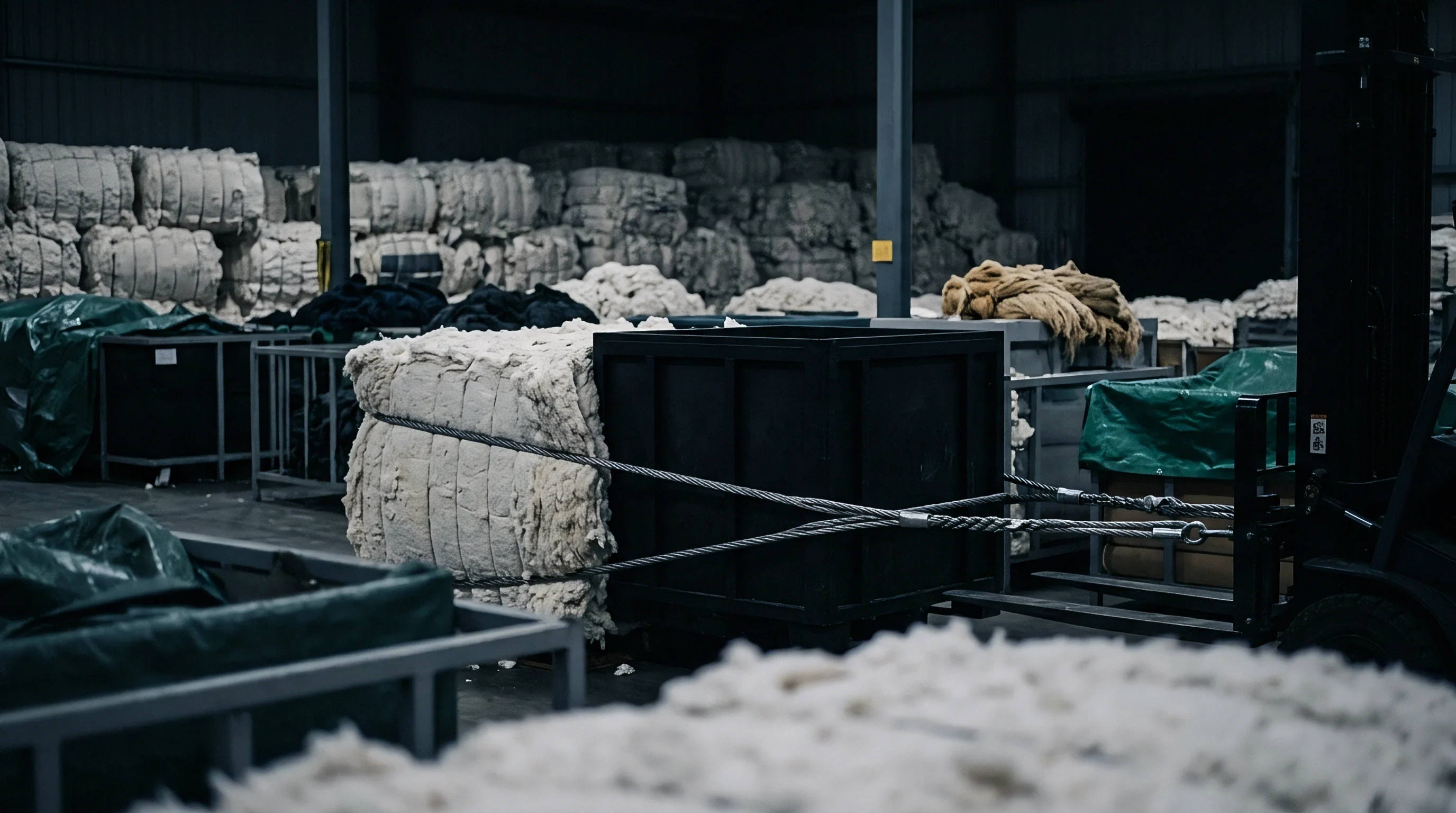
Inspectors check raw bales directly at the scour line to verify that dirt loads match certified core samples. Physical classing involves pulling hand samples from several depths within a compressed package to assess handfeel, staple length, vegetable contamination, and color. Raw down spans pure white, light cream, grey, and brown.
White down commands a price premium because it takes light pastel dyes without bleaching. Bleaching down with hydrogen peroxide degrades the protective epicuticle layer, increasing fibre friction and reducing spun yarn tenacity by up to 15 percent.
Vegetable contamination presents significant problems during mechanical separation. Seed pods, burrs, and twig fragments tangle in the crimped down, while cockleburrs and needle-grass seeds drive deep into compressed bales. Opening shatters dry vegetable matter into fine particles called hard pepper.
Because hard pepper matches the physical mass of short coarse hair, aerodynamic separation cannot remove it. Lots carrying over 2.5 percent vegetable matter suffer higher fibre breakage during carding as operators tighten cylinder pinning to work out the debris.
Microstructure dictates both processing performance and final fabric hand. Cashmere down has no central medulla, showing a smooth, solid cross-section with thin, elongated surface scales. Scale frequency runs between 60 and 70 scales per millimeter of fibre length, compared to 90 to 100 in fine Merino wool.
Cashmere scale margins are shallow and smooth, generating low directional friction. This low friction produces cashmere’s characteristic soft handfeel, though it reduces inter-fibre cohesion during drafting and requires precise twist control during spinning.
Guard hair shows the opposite structural profile, featuring a prominent central medulla filled with air cells that give it high flexural rigidity and a coarse texture. Medullated fibre in raw lots distorts optical micro-diameter measurements. When an un-dehaired sample runs through automated scanners, coarse medullated hair widens the diameter distribution curve, pushing calculated standard deviations from a typical 3.2 microns to 12.5 microns.
Assessing raw micron profiles requires physical pre-separation or selective mathematical windowing during analysis.
Bale moisture levels fluctuate during transit and storage. Raw greasy fleece is highly hygroscopic, absorbing atmospheric moisture up to 30 percent of dry weight without feeling damp. International standards fix standard moisture regain for raw fleece at 13 percent, yet incoming bales stored in humid port facilities often test between 16 percent and 19 percent.
Buying raw bales by gross weight without oven-dry regain testing means paying clean fibre prices for water.
Elevated sand content in raw bales can reflect local pasture conditions rather than deliberate weighting of the raw lot prior to consignment.
Testing
Laboratory testing establishes the true diameter distribution, fine down proportion, and contamination levels of raw and processed cashmere lots. Quantitative analysis determines whether a lot meets spinning specifications or breaches contract terms. Mean Fibre Diameter, expressed in microns, is the primary price driver; a 0.5-micron shift in mean diameter can alter the raw value of clean down by 20 percent per kilogram.
Determining this value accurately requires strict adherence to standardized measurement methods.
Optical Fibre Diameter Analysis is the principal method for rapid measurement in commercial laboratories. OFDA 2000 and OFDA 4000 instruments capture digital images of individual fibre snippets on a glass slide or through a pneumatic transport cell. The optical system measures thousands of snippet diameters in seconds, building a detailed distribution histogram.
The system calculates Mean Fibre Diameter, Standard Deviation, Coefficient of Variation of Diameter, and the percentage of fibres exceeding 30 microns ~ an index of residual guard hair content.
LaserScan instruments offer an alternative automated approach governed by IWTO-12 standards. LaserScan disperses cut snippets in isopropyl alcohol and pumps the suspension through a flow cell intersected by a laser beam. The degree of light scattering corresponds directly to snippet cross-sectional diameter.
While LaserScan offers high measurement speed and repeatability, dark or pigmented fibres absorb radiation differently than white fibres, introducing calibration drift if pigment offsets are omitted.
Projection Microscopy, defined under ISO 17751-1 and IWTO-47, remains the legal referee method for commercial disputes. Technicians cut fibre snippets to 0.8-millimeter lengths using a microtome, mount them on slides in liquid paraffin, and examine them under a calibrated microscope at 500x magnification. Individual snippet widths are measured manually with a digital scale or crosshair eyepiece.
The optical clarity of projection microscopy allows direct distinction between non-medullated down, medullated guard hair, and fine wool adulterants based on scale morphology and internal structure.
Comparative performance and operational tolerances for these instruments are summarized below.
| Measurement Method | Standard Designation | Sample Count (Snippets) | MFD Precision Tolerance (µm) | Coarse Hair Detection Limit (%) | Primary Operational Constraint |
|---|---|---|---|---|---|
| Projection Microscopy | ISO 17751-1 / IWTO-47 | 1,000 to 2,000 | ± 0.20 | 0.05 | Slow throughput; operator fatigue bias |
| OFDA Optical Scanning | IWTO-47 / ISO 17751-2 | 4,000 to 10,000 | ± 0.10 | 0.10 | Fibre crimp and overlap skewing |
| LaserScan Dispersion | IWTO-12 | 5,000 to 10,000 | ± 0.10 | 0.15 | Pigment absorption drift |
| Scanning Electron Microscopy | ISO 17751-3 | 500 to 1,000 | ± 0.15 | 0.01 | High capital equipment cost |
Laser measurement eliminates operator bias.
Sample preparation dictates test accuracy. Raw, un-dehaired fleece cannot go directly into optical scanners. Baled samples undergo solvent scouring with petroleum ether or dichloromethane to drop grease and wax residues below 0.5 percent.
Following extraction, samples pass through mini-dehairing laboratory cards or are hand-sorted to separate coarse hair from down before snippet preparation.
Conditioning governs mass and dimensional stability. Prior to analytical measurement, washed and snippeted samples rest inside a climate-controlled laboratory maintained at 20 degrees Celsius, plus or minus 2 degrees, and 65 percent relative humidity, plus or minus 4 percent, for a minimum of 24 hours in accordance with ISO 139. Cashmere absorbs atmospheric moisture, expanding in diameter by about 0.6 percent for every 1 percent increase in regain.
Measuring unconditioned, bone-dry fibres underestimates mean diameter by up to 0.3 microns, artificially inflating apparent lot quality.
Evaluating dehaired cashmere under IWTO-47 projection microscopy mandates counting at least 1,000 individual fibre snippets to achieve an acceptable mean diameter confidence interval of plus or minus 0.2 microns.
Adulteration testing is essential when sourcing commercial cashmere. Fine sheep wool, recycled scrap, and yak down are sometimes blended into lots to cut material costs. Sheep wool displays sharp, steep scale edges and scale frequencies that differ from cashmere.
Yak down shows darker internal pigmentation, a coarser mean diameter, and higher scale margins. Polymerase Chain Reaction DNA analysis under ISO 20418 provides definitive species identification by amplifying mitochondrial DNA sequences extracted from clean fibre samples.
Microscopy remains the definitive arbiter.
Diameter distribution curves reflect lot purity and blend consistency. Pure cashmere exhibits a unimodal, narrow Gaussian distribution curve with standard deviations typically below 3.5 microns and a diameter CV between 18 percent and 22 percent. Bimodal or skewed curves indicate mixed origin clips, uneven dehairing, or adulteration with fine wool.
When diameter CV exceeds 24 percent, spinning performance degrades, raising end-breaks during drafting and increasing yarn unevenness.
Calculating the percentage of fibres exceeding specific diameter thresholds establishes coarse hair contamination. Contracts for dehaired cashmere tops typically mandate that coarse hair above 30 microns cannot exceed 0.2 percent by weight. Optical instruments count coarse snippets and convert numerical frequency into mass percentage using volume equations based on diameter and assumed density.
Testing 10,000 snippets provides statistical confidence when verifying compliance with contract limits.
Can automated image recognition algorithms reliably distinguish chemically micro-stripped fine sheep wool from pure cashmere down across large commercial shipments without supplementary DNA testing?

Refinement
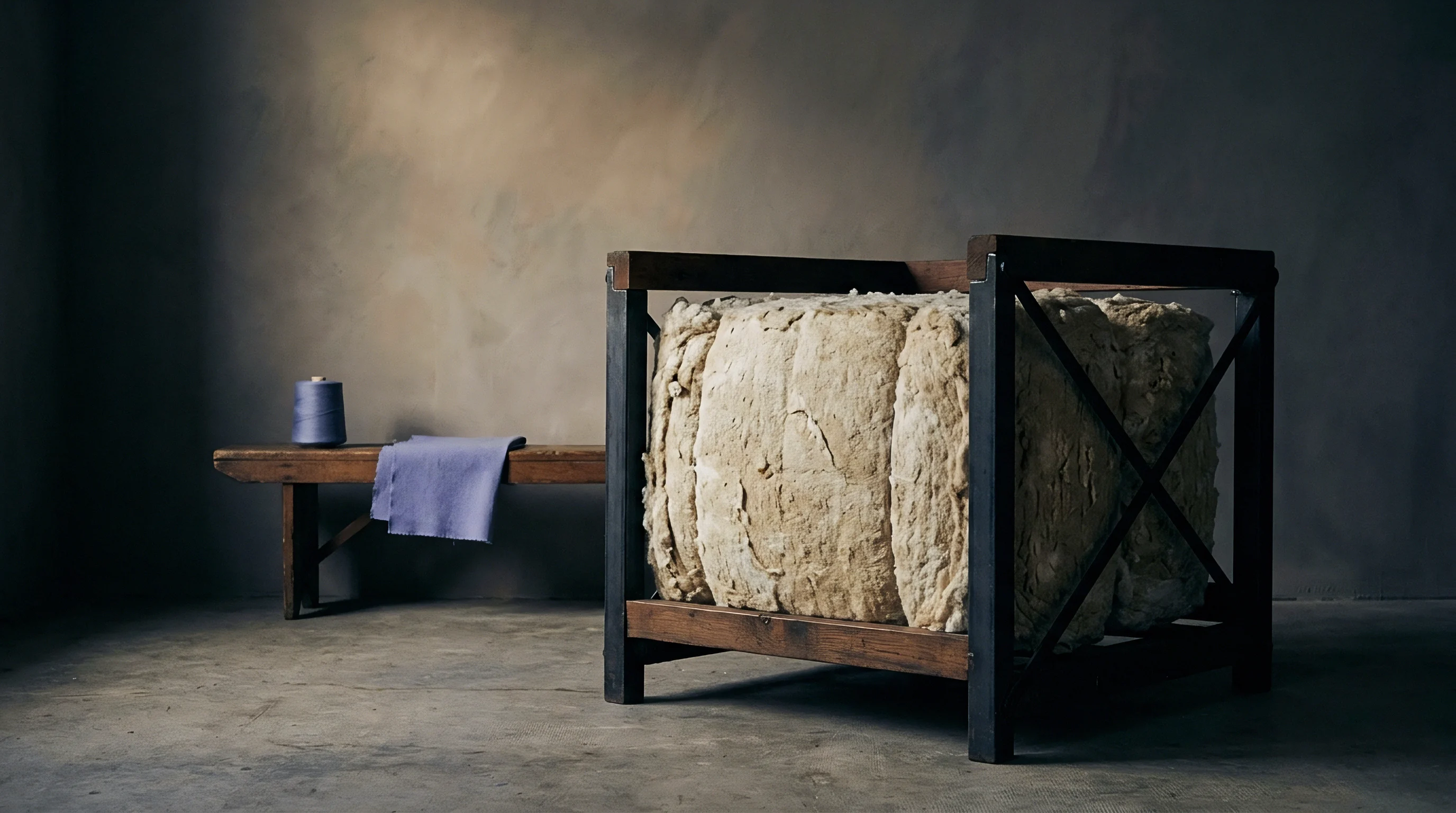
Converting raw greasy fleece into clean dehaired down requires a series of mechanical operations to remove mineral dirt, natural grease, vegetable fragments, and coarse guard hair while preserving down length. The line combines scouring, drying, opening, multi-stage carding separation, and air classification. Each mechanical pass subjects delicate down fibres to tension, friction, and impact that can break fibres and generate short lengths.
Greasy scouring begins the processing sequence. Raw bales are unpacked into feed hoppers that open compressed tufts. Loose fleece then moves through four to six scouring bowls containing warm water, non-ionic surfactants, and sodium carbonate.
Temperatures drop progressively from 45 degrees Celsius in initial washing bowls to 35 degrees Celsius in the final rinse. Excessive water temperatures or harsh agitation cause felting, wrapping down fibres around guard hair stems and reducing dehairing efficiency.
Scouring removes greasy impurities.
Scoured wool passes through squeeze rollers into warm-air dryers, reducing moisture content to between 15 percent and 17 percent. Over-drying leaves fibres electrostatic and brittle, causing severe shattering during opening. The dried fleece then passes through dust extractors and step-openers, where spiked cylinders knock out sand, dried mud, and brittle vegetable fragments.
Heavy mineral matter drops through grid bars under rotating cylinders while suction exhausts air-borne dust.
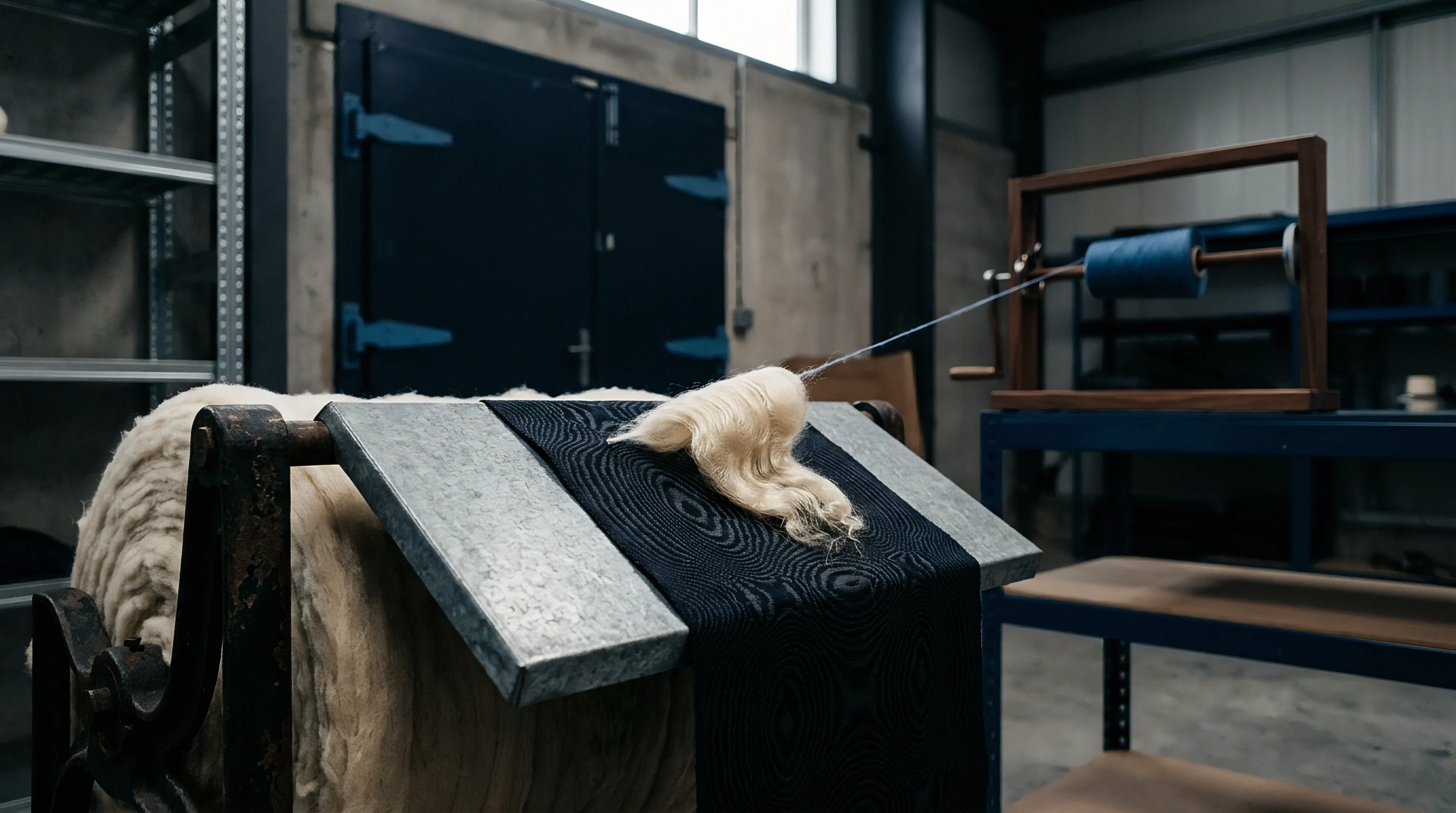
Mechanical dehairing exploits differences in density, flexural rigidity, and aerodynamic drag between coarse guard hair and fine down. Dehairing lines use carding units arranged in series, equipped with pinned cylinders, worker rollers, stripper rollers, and stationary flats. Coarse guard hair’s high rigidity and mass cause it to throw outward under centrifugal force on high-speed cylinders.
Fine down, with low mass and higher drag, hugs the cylinder clothing and airflow, enabling physical separation at knife-edge dividers.
What Drives Dehairing Machine Loss Rates across Mixed Raw Batches?
Machine settings must adapt to variations in raw lots. Fine, fragile Inner Mongolian combing fleece requires gentle mechanical handling, whereas coarse, shorn Afghan lots demand aggressive carding passes to remove heavy guard hair. Optimizing dehairing equipment involves a sequence of specific adjustments.
- Cylinder Surface Speed determines the centrifugal force throwing coarse hair off main carding rollers, typically set between 350 and 550 revolutions per minute.
- Worker Roller Clearance controls carding intensity and tuft opening, adjusted with feeler gauges between 0.20 and 0.35 millimeters.
- Air Knife Velocity governs aerodynamic separation of light down from coarse hair scrap, calibrated between 12 and 18 meters per second.
- Feed Roller Tension holds fibre tufts against initial opening pins, preventing unopened clumps from tearing into card clothing.
- Relative Humidity Controls maintain ambient processing moisture between 65 percent and 70 percent RH to suppress static charge on fine down.
Vegetable matter clogs card clothing.
Multiple dehairing passes improve down purity while progressively shortening staple length. A standard line uses 12 to 24 carding cylinders in series. Primary passes remove heavy guard hair, sand, and coarse vegetable matter.
Middle passes strip out medium guard hair and transition fibres. Final passes eliminate fine guard hair snippets to meet contract thresholds. However, each carding cylinder breaks some fine down, reducing hauteur by 1.0 to 2.5 millimeters per pass.
Fibre length degradation directly impairs spinning performance. Cashmere staple length is evaluated as Hauteur, the mean fibre length in a combed top, and Barbe, the weight-biased mean length. Fine Inner Mongolian down entering dehairing at 38-millimeter raw staple length may exit with a hauteur of 28 to 32 millimeters.
Down breaking below 20 millimeters behaves as short fibre, increasing fly waste in spinning mills and raising pilling propensity in finished knits.
Excessive carding roller speed strips out coarse guard hair faster while grinding fine down fibres into unspinning fly waste.
Fine down breaks easily.
Waste streams from dehairing fall into distinct commercial grades based on fibre content. Heavy guard hair scrap, containing over 95 percent coarse hair, sells into low-value secondary markets like felt padding and carpet backing. Card fly, consisting of micro-dust and broken down fragments, has no commercial value.
Intermediate card waste, a 50/50 mix of down fragments and coarse hair, undergoes secondary re-carding to salvage residual down, though this salvaged material has shortened staple lengths suitable only for woollen-spun blends.
Modifying carding cylinder speeds reduces fine down breakage, yielding a 1.8-millimeter gain in final top hauteur at the expense of a 3.5 percent drop in throughput capacity.

Recovery
Dehairing yield formulas determine the conversion ratio from greasy raw fleece to clean dehaired down. Yield calculations weigh economic value against processing losses to establish clean landed cost per kilogram. Buyers contract for greasy fleece based on predicted clean yields, making mass balance verification essential during industrial processing.
Mass balance accounting tracks losses through scouring, opening, dehairing, and waste extraction. Scoured clean yield measures the mass remaining after grease, suint, and mineral dirt removal. Clean dehaired down yield calculates final usable down relative to initial greasy weight.
The yield formula incorporates commercial moisture regain corrections so that mass calculations reflect dry fibre content rather than moisture fluctuations.
Net Dehaired Clean Yield is calculated using the following mass relationship:
Yield Clean Dehaired Percent = ( Mass Dry Dehaired Down × ( 1 + Commercial Regain Down ) ) ÷ ( Mass Greasy Raw Fleece × ( 1 + Actual Regain Greasy ) ) × 100
Standard commercial regain for clean dehaired cashmere is set at 17.0 percent under ISO 6741 standards, while greasy raw fleece is set at 13.0 percent. Deviations between measured regain and standard commercial rates must be reconciled before final contract settlement.
The table below outlines a representative mass balance tracking a 1,000-kilogram greasy raw lot through scouring and dehairing.
| Processing Stage | Input Mass (kg) | Extracted Waste Component | Waste Mass (kg) | Stage Loss (%) | Cumulative Clean Down Mass (kg) |
|---|---|---|---|---|---|
| Raw Bale Unpacking | 1,000.0 | Moisture deviation correction | 20.0 | 2.00 | 980.0 |
| Greasy Scouring | 980.0 | Grease, suint, soluble salts | 75.0 | 7.65 | 905.0 |
| Dusting & Opening | 905.0 | Sand, soil, mineral dust | 110.0 | 12.15 | 795.0 |
| Primary Dehairing | 795.0 | Coarse guard hair scrap | 260.0 | 32.70 | 535.0 |
| Secondary Dehairing | 535.0 | Fine guard hair & transition fibre | 65.0 | 12.15 | 470.0 |
| Final Carding Pass | 470.0 | Card fly, micro-dust, vegetable pepper | 25.0 | 5.32 | 445.0 |
| Combing Finish | 445.0 | Noils (short fibres under 18mm) | 20.0 | 4.49 | 425.0 |
Short fibres drop into waste.
Inconsistent sampling distorts yield calculations.
Establishing yield profiles for incoming shipments requires lab-scale sampling and testing before releasing bulk bales for processing.
- Extract core samples using pneumatic rotary coring tubes penetrating at least 85 percent of compressed bale depth across 20 percent of the bales in the lot.
- Blend core samples in a mechanical homogenizer to create a representative 500-gram laboratory specimen.
- Determine moisture content by drying a 100-gram sub-sample in a forced-draft oven at 105 degrees Celsius until mass stabilizes completely.
- Extract grease and wax using dichloromethane solvent wash in a Soxhlet apparatus for four hours.
- Wash the dry, scoured sample in warm distilled water to dissolve suint and potassium salts, then oven-dry to determine scoured clean mass.
- Run the scoured sample through a calibrated laboratory mini-dehairing card to separate coarse guard hair from fine down.
- Weigh separated down on a micro-balance accurate to 0.001 grams and calculate percentage yield against dry greasy mass.
- Adjust the calculated yield to standard commercial regain values of 17 percent for down and 13 percent for raw fleece.
Mongolian clips face a 4.2 percent yield penalty when raw vegetable matter contamination exceeds 3.0 percent by mass.
Vegetable matter increases processing losses beyond its physical weight. When burrs and seeds enter carding rollers, clearing the cylinder clothing causes localized fibre loss. Fine down clinging to extracted burrs ends up in waste.
A raw lot containing 2.0 percent vegetable matter typically loses an additional 1.5 percent of pure down mass solely through mechanical ejection.
A three percent shift in greasy raw moisture content moves calculated clean dehairing yield by over fifteen kilograms per tonne of raw fleece.
Clean yield dictates landed cost.
Commercial yields vary by origin. Combing fleece from Alashan in Inner Mongolia delivers clean yields between 58 percent and 65 percent. Shorn raw fleece from Outer Mongolia yields between 46 percent and 54 percent, while heavy Afghan shorn fleece yields between 34 percent and 42 percent.
Importing greasy Afghan fleece at 45 USD per kilogram results in a clean down cost exceeding 115 USD per kilogram once processing losses, transport, scouring, and shrinkage are factored in.
Consider a 5,000-kilogram greasy raw lot from Outer Mongolia purchased at 60.00 USD per greasy kilogram delivered to the mill. Contract terms specify an expected clean down yield of 52.0 percent based on 17.0 percent standard regain. On arrival, laboratory testing shows actual moisture content of 16.0 percent against the 13.0 percent standard baseline, along with scoured sand content of 14.0 percent.
Actual clean yield reaches only 47.5 percent.
The baseline calculation assumed a yield of 2,600 kilograms (5,000 kg × 0.52), giving an estimated raw clean cost of 115.38 USD per kilogram (300,000 USD ÷ 2,600 kg). The actual yield yields only 2,375 kilograms of clean down (5,000 kg × 0.475), raising true clean fibre cost to 126.31 USD per kilogram (300,000 USD ÷ 2,375 kg) ~ an extra 10.93 USD per clean kilogram before accounting for processing running costs.
High coarse hair content in raw lots reduces dehairing throughput and increases energy costs per clean kilogram.
Settlement
Commercial contracts, customs classifications, and landed pricing calculations mark the final stage of cashmere procurement. Micron profiles and yields dictate financial settlement between traders, processors, and mills. Specifying clear tolerance windows, testing standards, and penalty structures in purchasing contracts protects buyers from quality drift and misdeclaration liability.
Micron pricing grids set financial adjustments based on mean fibre diameter. Contracts establish a target baseline ~ for instance, 15.50 microns ~ with sliding price adjustments for every 0.10-micron deviation. Lots testing finer than baseline earn a price premium for higher spinning limits and softer hand.
Lots testing coarser trigger price discounts or give the buyer rejection rights if diameter exceeds maximum allowable thresholds.
Customs classification under the Harmonized System hinges on fibre diameter limits and mechanical processing stage. Importers must classify shipments correctly to satisfy tariff rules and avoid seizure or misdeclaration penalties. Cashmere goat hair falls under distinct HS headings depending on whether it is uncarded, uncombed, carded, or combed.
The table below outlines Harmonized System code designations, processing definitions, guard hair limits, and tariff categories for international shipments.
| HS Code Classification | Processing Stage Description | Coarse Hair Threshold Limit (%) | Mean Diameter Upper Limit (µm) | Customs Valuation Focus |
|---|---|---|---|---|
| 5102.11.10 | Raw greasy cashmere fleece, unhaired/dehaired, uncarded | > 5.0 (un-dehaired) | ≤ 19.0 | Greasy weight vs scoured yield verification |
| 5102.11.90 | Clean dehaired cashmere down, uncarded, uncombed | ≤ 0.5 (dehaired) | ≤ 18.5 | Clean micron verification & guard hair content |
| 5105.31.00 | Dehaired cashmere tops, carded or combed | ≤ 0.2 (top grade) | ≤ 18.5 | Hauteur length, barbe, and Neps count |
| 5102.19.00 | Coarse goat hair scrap & guard hair waste | > 90.0 | > 35.0 | Waste mass verification & industrial usage check |
Coarse hair penalizes commercial contracts.
Customs inspectors verify fine diameters.
Customs authorities use ISO 17751 optical and electron microscopy to verify declared HS classifications. Declaring fine dehaired down under raw fleece headings to lower duty rates exposes importers to audit penalties. If testing reveals coarse hair content below 0.5 percent on a shipment declared as raw fleece, authorities reclassify the consignment as dehaired down under HS 5102.11.90, assessing retroactive duties, penalty interest, and fines.
Purchasing agreements incorporate specific clauses governing yield shortfalls, micron drift, and residual coarse hair limits. Sourcing raw or dehaired cashmere requires clear terms detailing financial remedies when testing reveals deviations from contract specifications.
- Clean Yield Shortfall Clause adjusts payable mass proportionally whenever laboratory yield falls below the guaranteed contract baseline.
- Micron Penalty Scale applies a 2.5 percent price deduction per 0.10 micron increment above contract target up to 0.40 microns drift.
- Absolute Rejection Threshold gives the buyer immediate cancellation rights if mean diameter exceeds specification by 0.50 microns or more.
- Guard Hair Violation Fee assesses a 5.0 percent invoice discount if residual coarse hair over 30 microns exceeds 0.5 percent of clean weight.
- Vegetable Matter Allowance caps acceptable vegetable matter at 1.5 percent clean weight, deducting double the excess percentage mass from final payable weight.
Resolving commercial disputes relies on independent referee testing. When buyer and seller test results differ beyond agreed precision limits, samples go to a mutually accepted accredited laboratory. Referee testing follows IWTO-47 projection microscopy for diameter and ISO 6741 oven-dry protocols for yield verification.
The referee report provides legally binding arbitration, with testing fees paid by the party whose original certificate showed the larger deviation from the referee findings.
Standard purchase contract clause 14.2 specifies that incoming dehaired cashmere consignments undergo joint core sampling upon arrival at the destination warehouse, with final invoice settlement calculated exclusively against destination laboratory certificates issued under IWTO-47 test protocols.