Material Format
Untwisted bundles of thousands of extruded synthetic filaments collected into loose, parallel packaging represent the precursor format for staple fiber conversion and composite reinforcement. The primary product known as continuous filament tow supplies converter mills with organized linear strands suitable for stretch breaking, direct tow-to-top cutting or direct matrix impregnation. Fiber producers deliver this product in massive cartons or bales without imparting mechanical twist to preserve fiber parallelism.
Total tow denier ranges from thousands to several million decitex, providing the mass density required for downstream textile processing operations.
Conversion Mechanism
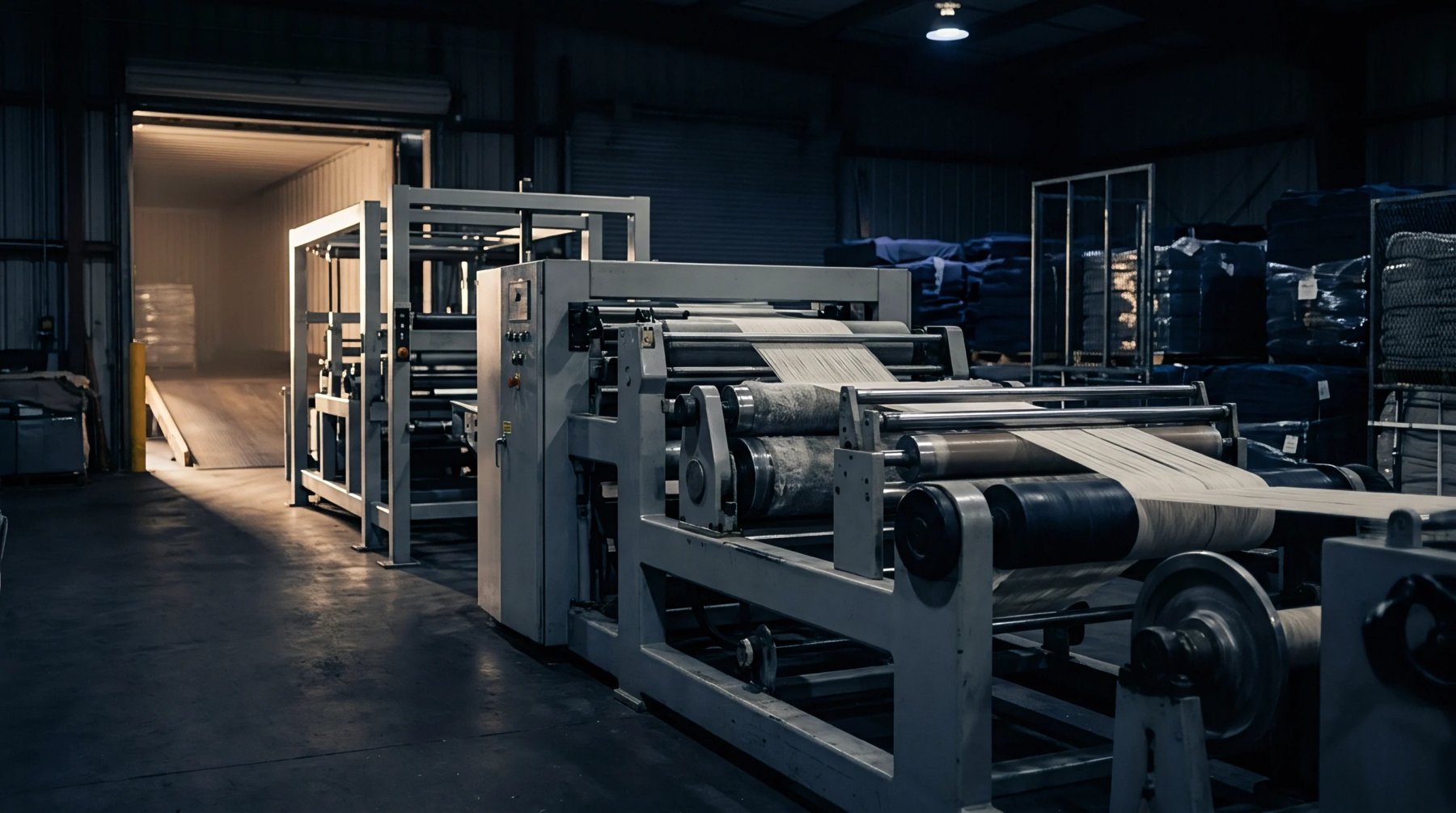
Rotary cutters and stretch-break drawing frames grip the filament bundle across differential roller nips, severing or breaking individual filaments at controlled intervals to produce uniform staple fiber slivers. Operating with continuous filament tow eliminates several opening, blending and carding steps required when handling unorganized staple fibers. Tension control across the creel feed establishes filament separation before the cutter head strikes the incoming strand.
Variable stretch tension alters fiber crimp retention, which determines cohesion during subsequent pin drafting and ring spinning. In carbon fiber manufacturing, continuous filament tow manufactured from polyacrylonitrile undergoes oxidation and carbonization while held under precise mechanical restraint to prevent longitudinal relaxation.
Processing Limit
High linear density provides processing efficiency, but excessive bundle thickness prevents uniform penetration of wet chemistry and thermal energy during tow dyeing and continuous heat-setting. Outer filaments shield core fibers from chemical bath components, producing shade depth variations across the tow cross-section. Filament entanglement within continuous filament tow causes roller wraps around conversion cylinders, bringing drawing lines to an abrupt halt.
Defect Verification
Receiving inspections at tow-to-top converter mills monitor total tow denier, individual filament decitex, crimp frequency and oil pick-up percentage. Technicians calculate filament count consistency across production lots using laboratory balances and calibrated cutting templates. Excessive spin finish concentrations cause roller slippage, whereas insufficient lubricating finish triggers static electricity accumulation and filament breakage.
Discrepancies between certified tow weight and delivered moisture-adjusted mass result in immediate billing adjustments or fiber lot rejections. Uniform linear density across the entirety of continuous filament tow remains the foundational requirement for consistent yarn count delivery in commercial mills.