CIEDE2000 Color Difference Equation Implementation in Continuous Fabric Dyeing
Implementing CIEDE2000 with 2:1:1 parametric weighting on continuous dye lines eliminates corner sorting errors and halves false rejects on textured goods.
Nip
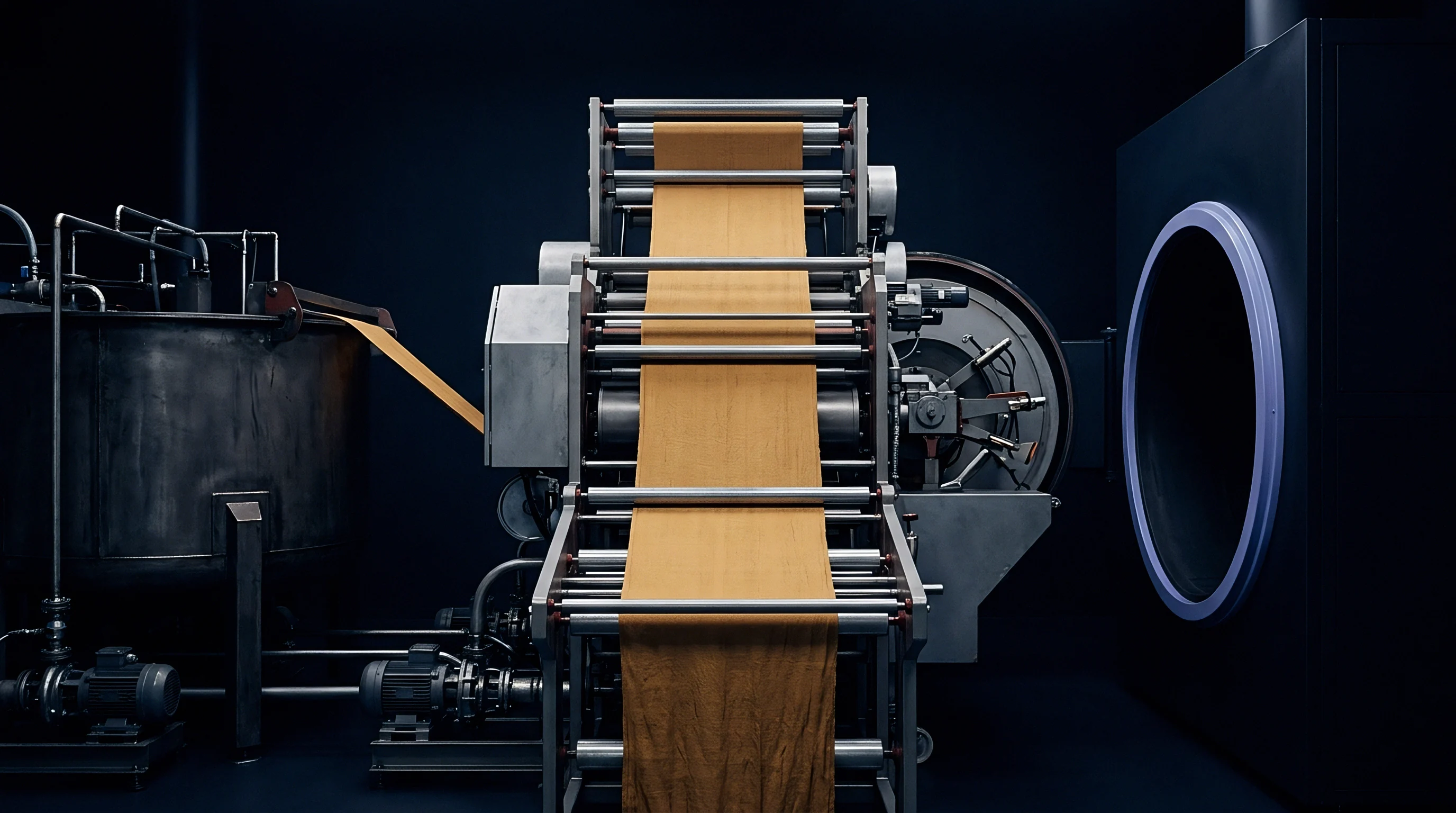
Continuous pad-steam ranges running three-hundred-gram cotton twill pull forty litres of dye liquor through the trough every five minutes. The mechanical contact line between elastomeric padder bowls governs liquor uptake across every square centimetre of passing substrate. Uneven pneumatic cylinder pressure across the roll face alters the wet pickup percentage from selvage to centre, shifting the initial dye mass deposited on the cellulose before steam fixation begins.
Dye migration ruins shade uniformity. When wet pickup varies by more than three percent across the width, standard reactive dye formulations produce immediate shade banding across the face of the cloth.
Legacy quality control protocols relied on manual cutter swatches taken from the tail ends of finished rolls, followed by off-line colorimetry using the 1976 CIELAB formula. That historical calculation treats colour space as a uniform sphere, measuring differences as simple Euclidean distances between target and batch coordinates. Industrial continuous processing exposes the mathematical limitations of that early assumption.
The human visual system perceives chromatic boundaries as elongated ellipsoids rather than spheres, particularly in saturated tones and neutral greys. Greige preparation dictates dye uptake. Substrates processed on continuous bleaching ranges carry residual wetting agents or uneven core moisture that compounds padder mechanical variance, producing tonal drift over five-thousand-metre production sequences.
- Uneven bowl deflection creates a crown variance along the contact line, raising liquor pickup in the centre relative to the selvages.
- Intermediate infrared drying imbalance accelerates water evaporation on one face, pulling soluble dye molecules toward hot spots before thermosol fixation.
- Trough level instability alters immersion contact dwell time, which shifts total dye absorption across long yardage runs.
- Thermal expansion of rubber rolls shifts shore hardness during six-hour continuous shifts, producing steady longitudinal shade drift.
Inline spectrophotometers measure hot, moving web while lab approval dockets evaluate conditioned flat swatches under static glass.
Modern continuous dye ranges integrate continuous spectrophotometric scanning heads positioned directly after the exit stenter. Replacing historical Euclidean metrics with the CIEDE2000 total colour difference equation provides the mathematical correction needed to correlate instrument data with visual human inspection. The formula reshapes the tolerance boundary at every coordinate point in color space, expanding along chromatic axes where human eyes exhibit low sensitivity and compressing in neutral regions where visual discrimination is sharp.
When operators misjudge padder bowl deflection during continuous processing, thousands of metres of off-shade yardage land in warehouse quarantine before the cut plan begins.
Weighting
Colorimetric mathematics converts reflectance spectra into numerical coordinates within a three-dimensional space. The CIEDE2000 equation incorporates specific weighting functions to adjust lightness, chroma, and hue differences according to their location in the color solid. The total difference value integrates four structural corrections: a chroma-dependent lightness weighting factor, a chroma weighting factor, a hue weighting factor, and an interactive rotation term designed specifically for blue shades where legacy formulas failed visual perception trials.
Neutral greys expose small spectral shifts. High chroma shades demand strict control.
Mathematical Adjustments in the CIEDE2000 Formulation
The equation calculates the transformed lightness difference, chroma difference, and hue difference from modified CIELAB coordinates. A scaling factor adjusts the green-red axis to improve performance near the neutral axis, eliminating the discontinuity in chroma calculations that plagued older CMC formulations. The hue rotation term operates primarily in the region around a hue angle of two hundred and seventy-five degrees, where visual tolerance ellipses tilt away from concentric radial alignment.
Without this rotation adjustment, continuous dye runs of navy blue and cobalt shades register false out-of-tolerance signals or pass goods displaying visible reddish casts.
Why Set the Lightness Parameter to Two?
Industrial dyehouses adopt the 2:1:1 ratio because human eyes tolerate greater variation in luminance along textured yarn contours than in chromatic purity. Textile constructions exhibit ribs, twill diagonals, and yarn hairiness that create microscopic shadows across the surface. These physical shadows lower the measured lightness value without altering the underlying chemical dye concentration on the fibers.
Setting the parametric lightness factor to two doubles the allowable variance along the vertical axis while maintaining strict unitary tolerances for chroma and hue. Surface texture changes apparent depth. A rigid lightness tolerance applied to textured twill or corduroy cloth generates unnecessary machine stops on the continuous range.
| Shade Category | Nominal Coordinates (L , a , b ) | CIELAB Delta E Limit | CMC 2:1 Delta E Limit | CIEDE2000 2:1:1 Delta E00 Limit | Visual Agreement Rate |
|---|---|---|---|---|---|
| Dark Navy | 21.40, 2.10, -18.60 | 0.80 | 0.75 | 0.60 | 94.2% |
| Olive Drab | 38.20, -2.15, 14.80 | 0.90 | 0.80 | 0.65 | 91.8% |
| Neutral Grey | 52.10, -0.30, 0.40 | 0.60 | 0.60 | 0.45 | 96.5% |
| Bright Scarlet | 44.80, 58.20, 36.10 | 1.40 | 1.10 | 0.85 | 89.4% |
| Khaki Beige | 61.30, 3.40, 16.20 | 0.75 | 0.70 | 0.50 | 93.1% |
ISO 105-J03 specifies parametric factors of two for lightness and one for chroma and hue, reducing erroneous lot rejections on textured goods by thirty percent.
Parametric factors allow technical managers to align mathematical pass-fail criteria with the end-use specifications of the finished apparel. While automotive trim components demand a strict 1:1:1 setting due to flush-mounted interior assemblies, apparel piece goods dyed on continuous ranges run efficiently under the 2:1:1 configuration. A purchase contract specifying ISO 105-J03 with parametric factors kL=2 and kC=kH=1 establishes clear legal grounds to reject lots whose chromatic deviation exceeds tolerance regardless of minor luminance fluctuations.
Traverse
Automated scanning systems mounted at the delivery end of the drying range monitor reflectance without touching the moving substrate. The sensor head travels continuously across an overhead beam, sweeping from the left selvage to the centre and across to the right edge while the cloth advances at eighty metres per minute. This geometric scanning pattern traces an oscillating diagonal across the yardage, capturing both lateral listing and longitudinal tailing.
Moisture shifts the spectral reflectance. As moisture evaporates during intermediate passes, chemical concentration stabilizes across the web.
Geometric Constraints and Thermal Spectral Shifts
Online instruments operate under either diffuse eight-degree geometry or forty-five-zero directional annular geometry. Directional annular illumination matches visual assessment tables by excluding specular gloss from the measurement signal. High-speed continuous lines present thermal challenges for spectrophotometers.
Fabric exiting the stenter frame carries temperatures between sixty and eighty degrees Celsius. Azo and phthalocyanine dye classes exhibit thermochromism, shifting spectral absorption toward yellow or red wavelengths at elevated temperatures. Optical processing systems incorporate thermal sensors and dynamic correction algorithms that recalculate spectral data back to conditioned twenty-degree standards before reporting the CIEDE2000 total variance.
Whose Calibration Standard Governs the Inline Sensor?
Primary reference tiles certified by national metrology institutes anchor the physical baseline before continuous lots pass beneath the scanning optics. Modern traversing heads park inside an off-line enclosure at designated time intervals to execute automated zero and white tile standardization. The scanning chassis maintains precision through strict mechanical tolerances across its linear guideways.
- Optical measurement geometry dictates whether surface gloss influences the calculated reflectance values, requiring forty-five-zero annular illumination for true visual correlation.
- Thermal compensation software calculates the reversible shade offset between hot stenter delivery cloth and room-temperature conditioned standards.
- Traverse carriage velocity matches the continuous line speed to maintain complete edge-to-edge scanning intervals every thirty metres of production.
- Aperture diameter selection spans enough yarn intersections to average local structure while remaining narrow enough to capture selvage boundaries.
Tension variations alter yarn orientation. When continuous winding brackets pull the cloth with excessive tension, warp yarn density increases while weft yarn count drops per square centimetre. This transient structural distortion shifts the angle of incident light, altering the returned spectral reflectance curve.
Finishing mills frequently claim that temporary thermal shifts will vanish once the rolls rest in regional storage, deflecting accountability for baseline chemical formulation errors.

Listing
Lateral shade variation across the usable width of continuous yardage creates severe tonal mismatches when pattern pieces are stitched together in garment assembly. Industrial continuous dyeing recognizes three distinct variance modes: side-to-side listing, where shade drifts linearly from left to right; edge-to-centre listing, where both selvages differ from the middle; and longitudinal tailing, where dye bath depletion creates end-to-end drift over thousands of metres. Uneven pickup produces immediate shade banding.
Cold wash boxes strip hydrolysed dye.
Quantitative Evaluation of Lateral and Longitudinal Drift
Evaluating continuous production requires monitoring both the absolute deviation from the approved master standard and the relative delta between adjacent physical sections. A continuous lot might stay within 0.80 CIEDE2000 units of the master standard along its entire length while failing internal consistency thresholds. If the left selvage reads plus 0.40 units and the right selvage reads minus 0.40 units along an opposing chromatic vector, the cross-roll difference reaches 0.75 units.
Joining garment sleeves cut from opposite selvages will produce an immediate customer rejection.
| Roll ID | Position (m) | Width Location | L | a | b | Delta L’ | Delta C’ | Delta H’ | Delta E00 To Standard | Lateral Delta E00 |
|---|---|---|---|---|---|---|---|---|---|---|
| Roll 01 | 100 | Left Selvage | 38.45 | -2.05 | 14.95 | 0.25 | 0.14 | 0.08 | 0.19 | – |
| Roll 01 | 100 | Center | 38.25 | -2.12 | 14.82 | 0.05 | 0.03 | 0.02 | 0.04 | 0.17 |
| Roll 01 | 100 | Right Selvage | 38.10 | -2.20 | 14.70 | -0.10 | -0.08 | -0.05 | 0.11 | 0.15 |
| Roll 10 | 5000 | Left Selvage | 38.60 | -1.95 | 15.10 | 0.40 | 0.28 | 0.14 | 0.31 | – |
| Roll 10 | 5000 | Center | 38.30 | -2.10 | 14.85 | 0.10 | 0.05 | 0.03 | 0.07 | 0.25 |
| Roll 10 | 5000 | Right Selvage | 37.95 | -2.28 | 14.55 | -0.25 | -0.22 | -0.12 | 0.24 | 0.32 |
| Roll 20 | 10000 | Left Selvage | 38.80 | -1.85 | 15.30 | 0.60 | 0.45 | 0.22 | 0.48 | – |
| Roll 20 | 10000 | Center | 38.40 | -2.05 | 14.90 | 0.20 | 0.08 | 0.05 | 0.13 | 0.36 |
| Roll 20 | 10000 | Right Selvage | 37.80 | -2.35 | 14.40 | -0.40 | -0.35 | -0.18 | 0.39 | 0.51 |
| Measurement conditions: D65 illumination, 10-degree standard observer, 45/0 annular geometry, conditioned state per ISO 139. Reference standard coordinates: L =38.20, a =-2.15, b =14.80. Parametric factors: kL=2, kC=1, kH=1. | ||||||||||
The tabulated data demonstrates progressive padder bowl crown fatigue and differential dye liquor depletion across a ten-thousand-metre run. Roll 01 shows tight alignment with the master standard, maintaining a lateral variance below 0.18 CIEDE2000 units. By the ten-thousand-metre mark on Roll 20, the lateral difference between the left selvage and right selvage expands to 0.51 CIEDE2000 units.
Thermosol units fix disperse dyes. Padder pressure adjustments must intervene before this lateral divergence crosses visual tolerance thresholds.
- Head-end strike-off approval verifies the initial liquor pickup and fixation chemistry before the range accelerates to production speed, averting bulk chemical scrap.
- Cross-width profile verification audits left, centre, and right spectrophotometric values at five hundred metres, halting the run if lateral variance surpasses 0.40 units.
- Mid-run bath replenishment auditing checks chemical concentration titration at the five-thousand-metre mark, ensuring auxiliary feed rates match dye consumption.
- Tail-end terminal auditing measures final longitudinal deviation against the master standard, determining whether the complete lot qualifies for single-marker garment cutting.
Total colour variation across a ten-thousand-metre dye run stays below 0.60 CIEDE2000 units when nip pressure variance remains within 0.05 bar across the entire bowl width.
Whether inline spectrophotometers can reliably compensate for complex multi-ply core-spun elastane recovery during high-speed scanning remains an open technical dispute among textile colorists.


Sorting
Apparel manufacturers partition conforming bulk yardage into compatible cutting groups to maintain tonal uniformity across finished garments. Historical 555 shade sorting models partitioned three-dimensional colour space into rigid rectangular boxes based on Cartesian CIELAB axes. Rolls assigned to the same numerical box were cleared for joint cutting in multi-ply markers.
That rectangular geometry creates substantial boundary errors. Two rolls occupying opposite diagonal corners of the same rectangular cell carry a Euclidean distance seventy-three percent greater than the nominal box tolerance, generating noticeable panel mismatches on sewing assembly lines. The cutter rejects mismatched panels.
Padder bowls crown under pressure.
Ellipsoidal Tolerance Envelopes and the Five Five Five Method
Modern automated shade sorting software packages map the non-Euclidean ellipsoidal contours of the CIEDE2000 equation directly into the sorting grid. By replacing rectangular blocks with interlocking conformal ellipsoids, the algorithm eliminates corner expansion errors. Fabric rolls grouped within an ellipsoidal 555 bin maintain consistent visual boundaries regardless of the chromatic vector separating their coordinates.
The volume of each sorting cell expands in high-chroma orange and yellow spaces where the human eye tolerates variation, and contracts in saturated greens and low-chroma greys where visual perception detects fractional deviations.
| Sorting Method | Mathematical Cell Shape | Usable Roll Groups | Isolated Rolls | Tonal Rejection Rate At Assembly | Marker Efficiency |
|---|---|---|---|---|---|
| CIELAB 555 | Rectangular Cube | 7 Distinct Groups | 14 Rolls | 3.8% | 84.5% |
| CMC 2:1 555 | Spheroidal Ellipsoid | 5 Distinct Groups | 8 Rolls | 1.9% | 88.2% |
| CIEDE2000 2:1:1 555 | Conformal Ellipsoid | 4 Distinct Groups | 3 Rolls | 0.4% | 92.6% |
Ellipsoidal sorting reduces the total number of distinct shade groups generated across a continuous dye run. Decreasing the count of shade groups allows garment factories to spread longer cutting markers, improving pattern nesting and lowering cutting room scrap waste. Isolated single rolls that sit outside primary group clusters require dedicated marker planning or separate re-dyeing, directly eroding the landed margin of the yardage order.
Coarse drill and broken twill constructions conceal subtle tonal variance, whereas flat poplins and high-density satins reveal the slightest boundary discrepancy between adjacent cutting panels.
Dark shades hide padder pressure imbalances while pale neutral tones expose every mechanical defect in the continuous range.