Optical Measurement
The analytical device calculates spectral reflectance across the visible spectrum to quantify color coordinates for dyed textile substrates. Mills operate a spectrophotometer during the final stages of continuous dyeing and finishing to verify shade conformity against digital targets supplied by brands. Ultraviolet filters inside the housing separate incoming illumination into discrete wavelengths before a diffraction grating splits the beam toward solid-state detectors.
Measured photocurrent signals translate into numerical values within CIELAB color space, establishing specific coordinates for lightness, red-green balance and yellow-blue balance. Calibration requires a standard white reference tile that accounts for lamp degradation over continuous operating cycles.
Shade Matching
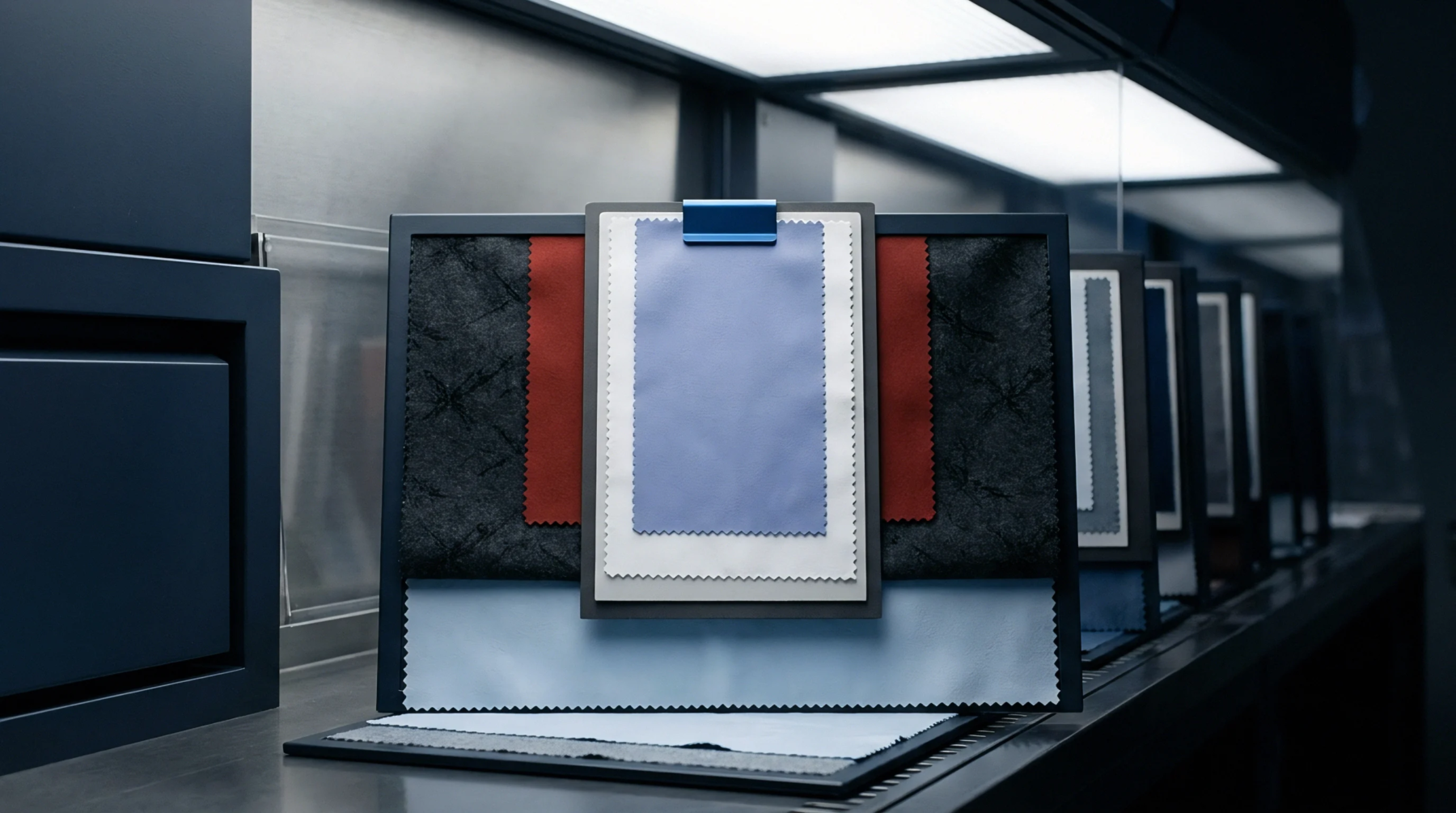
Bulk fabric production frequently deviates from approved master standards due to variations in dyestuff concentration and thermal settings inside the stenter frame. Technicians place folded textile samples over a port opening to measure reflected radiation under daylight or tungsten illuminants. Mathematical algorithms compute color differences between batches, producing a single numerical delta value that indicates whether a dye lot meets commercial tolerance limits.
Industrial buyers reject consignments exceeding specified thresholds for lightness and chromaticity variation.
Transmittance Evaluation
Transparent polymer films and clear technical yarns require a different operational mode where radiation passes entirely through the material rather than reflecting from the surface. The optical assembly directs light through the running substrate toward an integrating sphere that collects scattered rays from all forward angles. Internal detectors record absorption bands corresponding to specific chemical additives or residual processing oils embedded within the polymer matrix.
Process engineers evaluate these spectral curves to detect inconsistent additive dispersion before extrusion lines begin high-speed winding.
Surface Variance
Textured fabrics scatter incident illumination irregularly, introducing measurement errors unless operators apply specialized averaging techniques across multiple rotation angles. Smooth woven materials yield repeatable readings because reflection occurs uniformly across a flattened plane. Sample preparation protocols mandate backing non-opaque knitted goods with a standardized ceramic tile to prevent background transmission from distorting the color coordinate output.
Optical geometry selection depends entirely on whether the fabric possesses a high pile surface or a flat woven structure.