Venturi Throat Diameter Effects on Fabric Surface Abrasion during High Temperature Jet Dyeing
Venturi throat diameter directly controls liquor velocity and mechanical shear stress, where undersized throats accelerate surface abrasion and pilling on knits.

Hydraulics
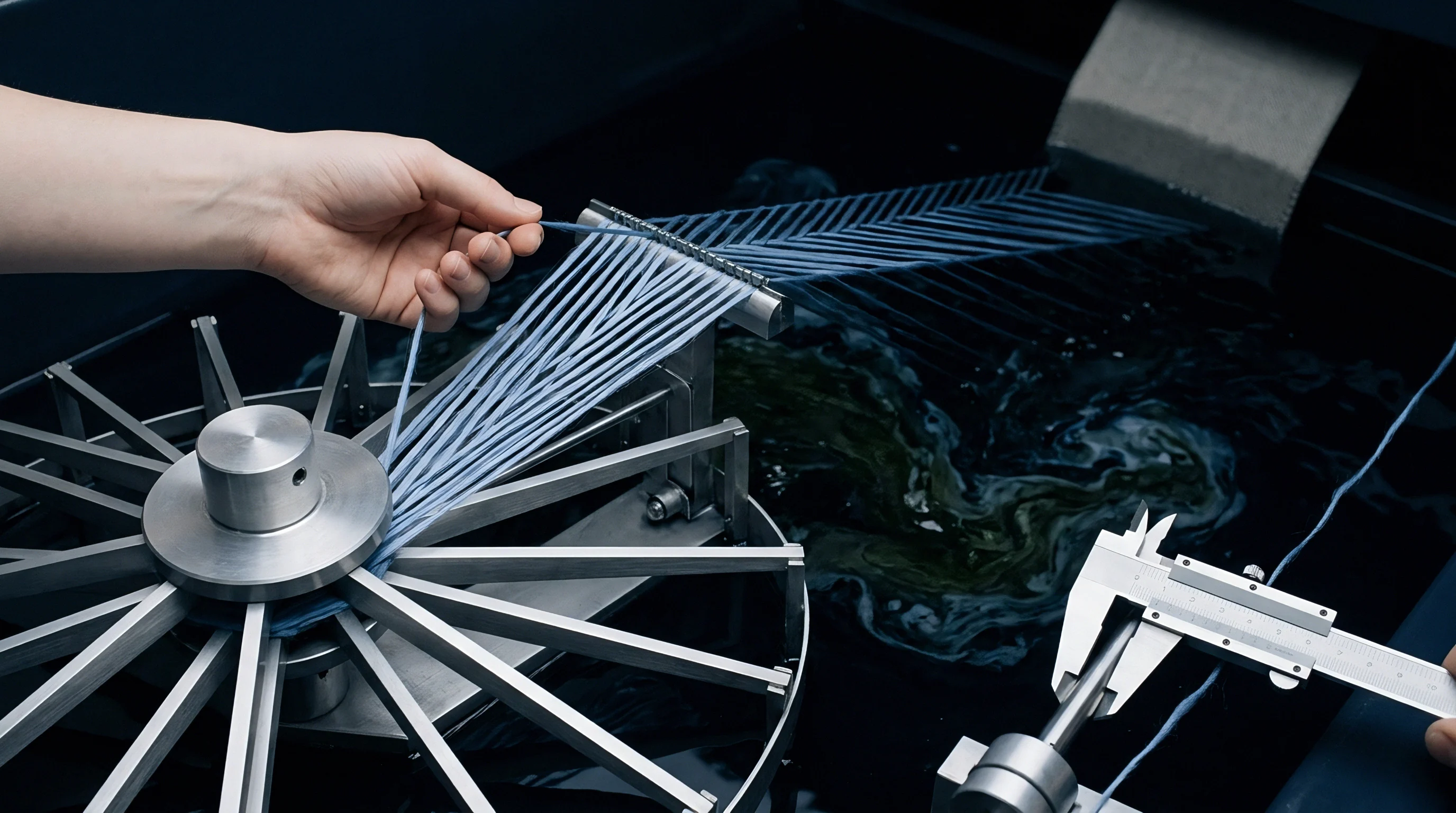
High-temperature jet dyeing machines drive textile ropes through enclosed venturi nozzles using pressurized liquor streams operating up to 130 degrees Celsius. Fluid dynamics govern rope transport. The mechanical energy delivering circulation derives from the pressure differential across the narrowing nozzle throat, where kinetic energy increases as static pressure falls.
When wet processing synthetic fabrics, particularly textured polyester knits or micro-denier filament wovens, the cross-sectional area of this venturi restriction establishes the boundary-layer liquor volume cushioning the moving fabric against solid stainless steel walls.
Liquor velocity through the throat accelerates inversely with the square of the throat diameter for a constant pump discharge rate. High liquor velocity creates elevated hydrodynamic shear stress along the surface of the moving fabric rope. Fluid drag force propels the cloth through the transport tube.
Excessive liquor velocity relative to fabric lineal speed creates turbulent boundary conditions, stripping the fluid film that insulates individual filaments from high-angle contact with the nozzle interior. Hydraulic drag pulls the cloth.
| Throat Diameter (mm) | Liquor Velocity (m/s) | Nozzle Pressure Differential (bar) | Fabric Rope Speed (m/min) | Calculated Boundary Shear Stress (Pa) |
|---|---|---|---|---|
| 80 | 11.4 | 1.85 | 380 | 142 |
| 100 | 7.3 | 1.18 | 360 | 88 |
| 120 | 5.1 | 0.72 | 310 | 54 |
| 140 | 3.7 | 0.45 | 250 | 31 |
Nozzle constriction accelerates liquor velocity. Fabric rope linear speed relies on nozzle fluid velocity and reel peripheral speed operating in synchronization. When the venturi throat diameter is oversized relative to fabric strand volume, hydraulic efficiency collapses.
The fluid stream passes through unoccupied throat area without engaging the fabric surface, causing slip between the transport reel and the wet rope. Rope speed drops while reel friction builds. Conversely, an undersized throat restricts physical clearance, forcing the fabric strand into tight mechanical contact with the throat entry cone.
At a nozzle pressure differential of 1.85 bar in an 80 mm venturi throat, surface shear stress reaches 142 Pa, tripling fiber abrasion rates compared to a 120 mm throat operating at 0.72 bar.
Mechanical shear damages filaments. The balance between static pressure inside the jet chamber and kinetic pressure at the venturi apex dictates whether the fabric rope remains floated within a continuous aqueous envelope. High temperature alters the physical properties of synthetic fibers.
Polyester reached near 130 degrees Celsius approaches its glass transition zone under wet conditions, lowering fiber flexural rigidity and increasing susceptibility to mechanical deformation. Fluid boundary collapse at high thermal energy levels initiates immediate surface degradation.
- Hydraulic channelling occurs when an oversized nozzle throat allows jet liquor to bypass the fabric core, reducing circulation drive force and causing rope stalling inside the main accumulator reel.
- Boundary film rupture develops under excessive nozzle pressure differentials where liquor is forced out of the throat interface, generating direct metal-to-fabric dry friction.
- Rope compression shock happens at the entry taper of an undersized venturi, crushing folded fabric edges against stainless steel surfaces prior to thermal shade equilibrium.
- Hydrodynamic turbulence abrasion originates from localized eddy currents inside the throat exit tube, pulling surface filaments outward from the core yarn bundle.
Improper matching of venturi throat geometry to wet fabric rope bulk triggers permanent mechanical defect clusters, forcing re-handling charges, shade stripping cycles, or scrap write-downs that eliminate converter operating margins on bulk orders.
Chafe
Surface abrasion during high-temperature jet processing presents as localized hairiness, filament rupture, frosted appearance, or severe pilling on finished goods. Heat softens synthetic fibers. Friction breaks surface fibers.
The primary damage vector is mechanical contact between high-speed fabric folds and the rigid inner circumference of the venturi throat. Secondary damage stems from internal yarn-to-yarn friction as the compressed strand surges through the constriction zone.
Filament abrasion reduces tear strength. Continuous multifilament yarns constructed from micro-denier polyester fibers, defined as individual filaments below 1.0 decitex per filament, exhibit extreme sensitivity to mechanical impact at elevated temperatures. Micro-filaments possess low bending rigidity, allowing surface loops to snag easily on microscopic imperfections along the throat wall.
When the throat clearance ratio drops below critical thresholds, individual filament bundles shear off, creating a velvet-like fuzz on flat-woven or fine-gauge jersey surfaces.
High velocity strips surface lubrication. Polymer lubricity agents added to the dye bath alter interfacial friction. Lubricants form a sacrificial boundary layer over the fabric rope.
When venturi velocity exceeds hydrodynamic limits, the shear forces inside the throat strip this lubricating film faster than redeposition can occur. The resulting high coefficient of friction converts kinetic energy into mechanical abrasion heat, localized precisely at the outer fold points of the fabric strand.
Dyeing temperature changes fiber modulus. Cellulosic fibers processed in jet machines under high-temperature conditions face distinct abrasion dynamics. Viscose and modal knits experience severe wet strength loss when exposed to hot aqueous liquor.
Wet swelling increases fiber diameter while reducing tensile recovery. An undersized throat squeezes swollen cellulosic ropes, rupturing primary wall structures and forming irreversible crease lines accompanied by severe surface fibrillated chafing.
- Mount fabric roll on primary slitting frame to evaluate greige hairiness baseline under directional grazing illumination.
- Verify chamber nozzle physical alignment with transport tube centerline using optical alignment gauges prior to lot loading.
- Inject low-foaming wet-lubricant auxiliaries into the dye bath before heating rates cross 80 degrees Celsius to establish boundary layer protection.
- Extract mid-process swatch samples at 130 degrees Celsius holding phase through high-pressure sampling ports to inspect surface loop fracture counts.
Sustaining a minimum fluid film thickness of 1.5 millimetres around the moving fabric rope inside the nozzle throat stops direct surface friction against stainless steel walls.
Visual verification of chafing requires strict lighting geometry. Abrasion defects on dark shades appear under light box conditions as pale patches, often misidentified as levelness failures or dye precipitation. Spectrophotometer measurements confirm these pale areas result from altered light scattering off disrupted surface fibers rather than lower dye mass uptake.
Surface hairiness increases pilling ratings. The Martindale abrasion resistance of fabric dyed through an improperly sized venturi throat drops by up to two full test grades when evaluated under ISO 12947 test standards.
Setting nozzle throat clearance strictly proportional to fabric wet rope volumetric density prevents filament rupture and maintains surface integrity across long holding cycles at 130 degrees Celsius.

Gauge
Selecting the correct venturi throat diameter demands precise calculation of fabric strand linear mass density and wet volumetric bulk. Fabric weight, width, and mechanical structure determine the effective cross-sectional area of the compressed fabric rope passing through the nozzle. A light circular knit of 140 grams per square metre requires fundamentally different throat volume considerations than a heavily textured double jersey of 300 grams per square metre.

Why Do Microfiber Polyester Knits Mandate Over-Sized Throat Clearance?
Fine-filament knits possess high specific surface areas and low flexural recovery. Rope density alters throat clearance. When micro-filament knits compress inside a narrow venturi throat, internal capillary forces hold the strand in a dense geometry that resists liquor penetration.
Increasing throat diameter while maintaining total pump flow rate expands the surrounding liquor blanket, permitting the rope to bloom slightly inside the throat, which distributes mechanical contact over a wider surface area.
| Fabric Build Type | Finished Weight Range (gsm) | Rope Linear Density (g/m) | Recommended Venturi Throat (mm) | Target Clearance Ratio |
|---|---|---|---|---|
| Fine Filament Single Jersey | 110 – 150 | 165 – 225 | 80 – 90 | 2.4 : 1 |
| Interlock / Double Knit PES | 180 – 240 | 270 – 360 | 100 – 110 | 2.1 : 1 |
| Heavy French Terry / Fleece | 280 – 380 | 420 – 570 | 120 – 140 | 1.8 : 1 |
| Textured Woven Filament | 130 – 190 | 195 – 285 | 90 – 100 | 2.2 : 1 |
Clearance ratio defines the proportion between nozzle throat cross-sectional area and the calculated solid cross-sectional area of the wet fabric strand. Operating below a clearance ratio of 1.8 to 1 forces physical contact against the throat wall. Operating above 2.8 to 1 risks hydrodynamic bypass, where the driving liquor streams around the fabric without transferring kinetic transport energy.
Over-tight nozzles crease delicate knits. Determining the target ratio requires accounting for fiber swelling characteristics under high temperature.
- Structural flexural rigidity dictates how readily a folded fabric rope yields to the circular compression profile of the entry nozzle cone without generating hard longitudinal creases.
- Yarn crimp recovery factor influences the volumetric expansion of textured synthetic yarns when exposed to thermal relaxation inside the high-temperature machine vessel.
- Surface filament decitex governs the force required to shear individual surface fibers away from the primary yarn axis during high-velocity fluid transit.
- Wet fabric porosity determines the volume of liquor absorbed directly into the fabric rope matrix versus the volume available for boundary layer wall lubrication.
How does the interaction between yarn texturing geometry and nozzle thermal expansion coefficients change optimal clearance tolerances across a ten-hour continuous processing shift?

Calculations
Quantifying the mechanical impact of venturi throat adjustment involves tracking liquor velocity, shear force, fabric rope turnover time, and total mechanical rub contacts per batch. Pressure drop scales with throat area. Consider a bulk dyeing run involving 400 kilograms of textured 100 percent polyester double knit fabric with a finished weight of 250 grams per square metre and a tubular width yielding a linear strand weight of 375 grams per metre.
Total fabric length loaded into a two-tube jet vessel equals 1,066 metres, split into 533 metres per chamber. The vessel operates at a 10 to 1 liquor ratio with a total liquor volume of 4,000 litres, running at 130 degrees Celsius with a holding time of 45 minutes.
Compare two operating configurations: Configuration A uses a narrow 110-millimetre diameter venturi throat, while Configuration B uses a wide 140-millimetre diameter venturi throat. Pump discharge rate is maintained at 1,200 litres per minute per tube, equivalent to 0.02 cubic metres per second.
For Configuration A with a 110-millimetre throat, the throat cross-sectional area is 0.0095 square metres. The resulting mean liquor velocity through the throat reaches 2.10 metres per second. Hydraulic drag drives the rope at a linear speed of 320 metres per minute.
A full rope circulation cycle requires 1.66 minutes. During a 45-minute holding period, the fabric completes 27.1 circulations through the nozzle throat.
For Configuration B with a 140-millimetre throat, the throat cross-sectional area increases to 0.0153 square metres. Mean liquor velocity drops to 1.30 metres per second. Rope transport speed slows to 240 metres per minute due to reduced fluid kinetic transfer efficiency.
Full rope circulation time extends to 2.22 minutes. Over the same 45-minute holding phase, the fabric completes 20.2 circulations through the nozzle throat.
| Parameter | Configuration A (110 mm Throat) | Configuration B (140 mm Throat) | Variance (%) |
|---|---|---|---|
| Throat Area (m²) | 0.0095 | 0.0153 | + 61.0 |
| Mean Liquor Velocity (m/s) | 2.10 | 1.30 | – 38.1 |
| Fabric Rope Speed (m/min) | 320 | 240 | – 25.0 |
| Rope Circulation Cycle Time (min) | 1.66 | 2.22 | + 33.7 |
| Total Nozzle Transits (45 min hold) | 27.1 | 20.2 | – 25.5 |
| Wall Shear Stress Rating (Pa) | 78.4 | 32.1 | – 59.1 |
| Calculated Surface Friction Units | 2,124 | 648 | – 69.5 |
Rope speed controls cycle frequency. The total mechanical abrasion exposure correlates with nozzle transits multiplied by the wall shear stress factor. Shear stress scales quadratically with fluid velocity.
Configuration A generates a relative shear stress value of 78.4 Pa, producing an integrated abrasion index of 2,124 friction units across the hold cycle. Configuration B produces a relative shear stress of 32.1 Pa, resulting in an integrated abrasion index of 648 friction units.
Contractual specifications demand that surface abrasion ratings on polyester knits meet ISO 12945-2 pilling values of 4 or higher after 2,000 revolutions, or the entire lot faces commercial rejection.
Choosing Configuration A yields high rope speed and rapid circulation, reducing the risk of shade unlevelness caused by slow dye liquor distribution. This speed exposes the fabric to 3.2 times the integrated surface friction energy of Configuration B. If the fabric construction exhibits sensitivity to hairiness, Configuration A causes severe surface frosting and pilling failure. Configuration B protects surface quality, but the reduced circulation rate demands careful dye addition profiles to prevent unlevel shade development across the 533-metre fabric length.
Mill management often claims that elevated batch pilling stems entirely from poor yarn spinning consistency rather than nozzle setup choices.

Audit
Verifying wet-processing conditions demands systematic floor checks before committing high-value fabric orders to bulk jet dyeing vessels. Inspection begins with the physical hardware installed in the dyeing machine. Nozzles suffer gradually from erosion, chemical scratching, and physical impact during loading.
Internal wall roughness values exceeding Ra 0.4 micrometres act like fine sanders against synthetic fibers at high velocities.
Audit logs track nozzle wear. Field technicians employ specialized optical bore scopes and surface roughness gauges to evaluate venturi interiors. Scratches running transverse to fabric flow cause extreme damage.
Every jet tube must be checked for true axial alignment; a tilted venturi forces the wet rope against one edge of the output transport tube, generating localized abrasive friction lines along the entire roll length.
Light box evaluation under standardized illuminants remains essential for verifying surface damage on dyed goods. Technicians inspect bulk swatches alongside approved lab dips under D65 daylight, TL84 store lighting, and Incandescent A light sources. Surface hairiness alters optical reflectance.
An abraded sample appears lighter and lower in chroma under directional lighting angles compared to a flat, pristine fabric structure, even when total dye mass per gram of fiber remains identical.
Systematic measurement of nozzle wall surface roughness using optical bore gauges prevents unseen interior scratches from degrading high-grade filament fabrics.
Quality management contracts specify precise operational parameters for high-temperature jet processing. Standard clauses mandate maximum allowable pump operating pressures, designated nozzle throat diameter ranges per fabric style code, and mandatory wet-lubricant dosing concentrations. Non-conformance agreements require mills to absorb reprocessing costs or compensate raw material losses when surface abrasion exceeds agreed ISO pilling standards.
Standard quality agreements mandate that jet dyeing processors record and deliver digital vessel pressure logs, nozzle size confirmation sheets, and post-dye pilling test reports for every dye lot prior to dispatching finished goods to the cutting room.