Thermal Evaporation
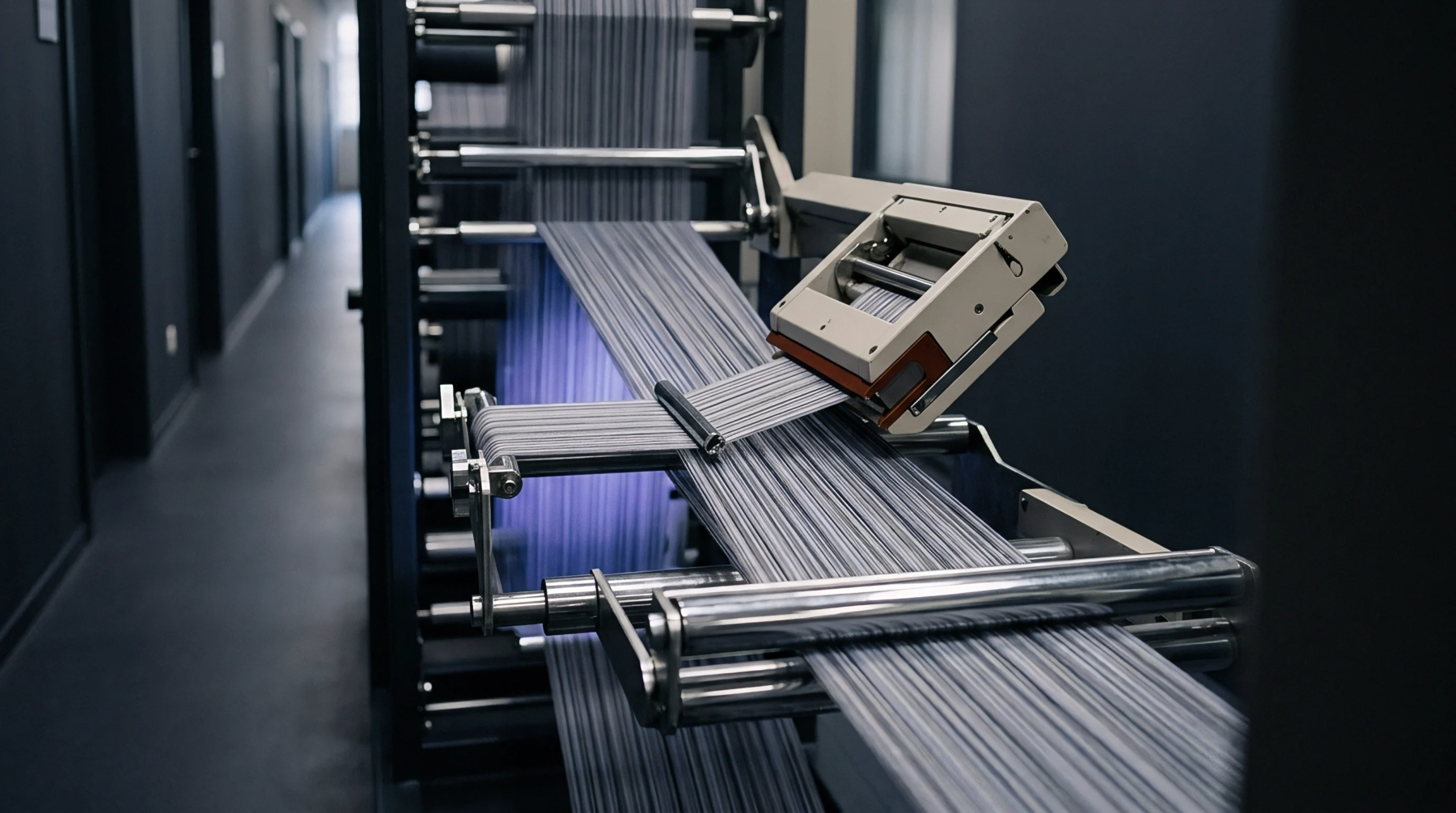
Temperature progression managed across a sequence of steam-heated metal drums regulates water evaporation from freshly sized warp sheets in a slasher. Saturated yarn emerges from the chemical squeeze rollers and routes over rotating Teflon-coated and stainless steel cylinders arranged in split or stacked tiers. Establishing an intentional cylinder drying profile drives moisture levels down to target commercial regain without causing thermal degradation, adhesive caramelization or skinning of the size matrix.
Slasher operators verify drum temperatures via integrated surface thermocouples and line condensate traps. The parameter applies strictly to conductive cylinder drying sequences within sizing ranges, ending where the cooled warp sheet reaches the dry lease divider rods.
Gradient Architecture
Initial cylinders operate at lower temperatures, commonly between eighty and ninety-five degrees Celsius, to prevent boiling blisters within the wet polymer film. Mid-zone cylinders elevate temperatures up to one hundred and twenty to one hundred and thirty-five degrees Celsius, evaporating the bulk volume of water as the wet film converts into an elastic solid coating. Final drying cylinders drop back to moderate temperatures, around ninety degrees Celsius, which avoids overdrying the yarn core and preserves natural fiber elasticity.
Warp yarns run across cylinder surfaces at controlled wrapping angles, exposing alternating yarn faces to achieve balanced radial drying.
Processing Hazards
Excessive heat on front drums causes the sizing paste to boil, leaving brittle, porous coatings that dust off violently inside loom drop wires. Uneven cylinder temperatures generate irregular residual moisture, inducing bacterial mildew growth on packed beams when under-dried or fiber brittleness when dried past the natural moisture regain point. Sudden thermal shifts shrink synthetic blends unevenly, causing variable residual elongation across the warp width.
Thermal monitoring must link drum steam pressure valves directly to machine creep speed loops, automatically throttling back steam supplies whenever the slasher halts to prevent localized thermal baking of paused yarns.
Operating Control
Steam inlet controls utilize independent pneumatic diaphragm valves mounted along split manifold lines to command individual drying sections. Rotary joints introduce dry saturated steam into hollow cylinder trunnions, while internal siphon pipes continuously clear condensate water to prevent insulating pool layers inside the drum. Surface contact probes verify real-time drum temperatures against electronic control settings during continuous running at eighty meters per minute.
Proper drying curves sustain sizing film integrity, yielding coated yarns with the pliability needed to endure millions of high-frequency harness cycles without shedding debris.