Dynamic Non-Isothermal Pore Structure Degradation Kinetics during Continuous Stenter Drying Operations
Continuous stenter thermal ramps induce capillary collapse and structural pore degradation, dictating finished air permeability and barrier performance.
Void
Drying wet textile substrates in a continuous industrial stenter triggers strong capillary tension in the internal fluid channels. As free liquid evaporates from the fiber matrix, water menisci pull back into the narrow interstitial spaces between individual filaments. Water’s surface tension, acting across microscopic pore radii, creates compressive capillary pressures that draw adjacent fibers together.
This hydro-mechanical compaction alters the native architecture of the textile matrix long before the substrate reaches nominal dry weight.
Capillary Forces during Phase Change
The mechanical pressure generated inside an unsaturated porous network follows the Young-Laplace relationship, where capillary pressure scales inversely with effective pore radius. In micro-porous channels where radii drop below five micrometers, internal negative pressures exceed several atmospheres. These localized stress fields force soft polymer walls to deform inward.
Water surface tension in sub-micron filament channels creates capillary forces capable of exceeding the elastic yield limit of un-crosslinked polymer chains.
When wet textile substrates enter the initial drying zone, liquid volume fraction remains high. Capillary pressure causes transient compaction of the macro-pores surrounding the yarn bundles. As moisture content drops below thirty percent dry-weight basis, water retreats into intra-yarn micro-voids.
The resulting compressive stress compresses the filament bundle density, permanently reducing the mean pore diameter if thermal energy softens the constituent polymers during this critical evaporation window.
Intra-Yarn versus Inter-Yarn Microstructure
Structural void spaces within a woven or knitted substrate exist in two distinct domains. Inter-yarn voids represent the visible openings formed by the crossing of warp and weft yarns or knitted loop structures. Intra-yarn voids consist of the micro-channels running between individual filaments inside a single yarn bundle.
The kinetic rate of collapse differs radically between these two porous regimes during continuous drying.
Inter-yarn porosity responds primarily to mechanical chain tension and overfeed ratios applied by the stenter transport system. Conversely, intra-yarn micro-porosity collapses under the action of capillary tension combined with thermal softening.
Gradient
Temperature distributions across the multi-zone chambers of a continuous stenter are inherently dynamic and non-isothermal. A textile substrate enters Zone 1 at ambient temperature with high water loading and rapidly undergoes a transient heating phase. The wet-bulb temperature suppresses the actual surface temperature of the fabric while surface water evaporates freely during the constant-rate drying regime.
Once the surface water film dissipates, the substrate transitions into the falling-rate regime, causing fabric temperature to spike sharply toward the ambient dry-bulb temperature of the air stream.
Thermal Trajectories across Stenter Chambers
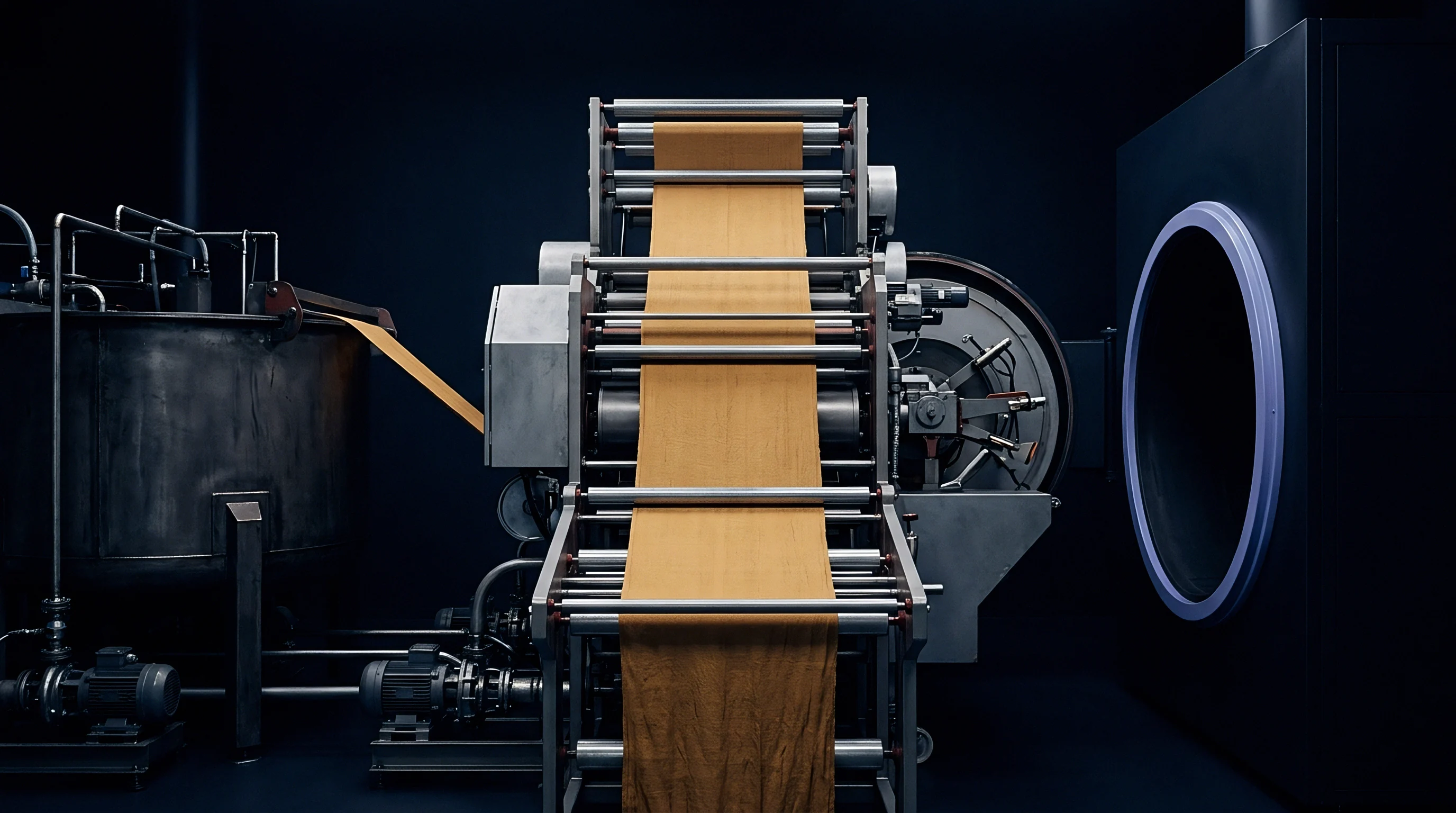
In a standard six-chamber stenter running at twenty-five meters per minute, the thermal exposure of the fabric follows a non-linear trajectory. The primary heat transfer mechanism shifts from forced-convection water evaporation to thermal conduction through the dry polymer matrix.
The transition point between the constant-rate regime and the falling-rate regime dictates the precise physical location inside the machine where pore collapse accelerates. During the constant-rate period, evaporative cooling maintains the fabric temperature around forty-five to fifty-five degrees Celsius. At these low temperatures, thermoplastic filaments remain well below their glass transition point, resisting permanent plastic deformation despite high capillary pressures.
Evaporative Cooling Boundaries
When the moisture content drops past the critical moisture threshold, evaporative cooling stops protecting the polymer matrix from the drying air temperature. The internal fabric temperature jumps toward ambient air temperature within two seconds. If the dry-bulb setting exceeds the glass transition temperature of the synthetic polymer, the modulus of elasticity drops by up to two orders of magnitude while capillary water remains in the micro-voids.
Consider a 380 grams per square meter woven polyamide 6,6 industrial filter substrate processed through a six-zone stenter. Chamber air temperatures are set to 120, 140, 170, 185, 185, and 160 degrees Celsius respectively, with a line speed of eighteen meters per minute. In Chambers 1 and 2, high evaporative cooling holds fabric temperature at 52 degrees Celsius while moisture content decreases from 65 percent to 28 percent.
In Chamber 3, the critical moisture threshold of 18 percent is crossed, causing fabric temperature to surge to 158 degrees Celsius in under three seconds. Because the glass transition temperature of wet polyamide 6,6 is approximately 40 to 50 degrees Celsius, the sudden loss of water cooling combined with high ambient heat causes immediate viscoelastic softening while residual intra-yarn capillary pressure remains high, driving permanent micro-pore volume loss of 34 percent.
Continuous drying at 185 degrees Celsius dry-bulb air temperature reduces internal intra-yarn void volume by thirty-four percent when critical moisture evaporation occurs in high-heat chambers.
Overheating during the falling-rate regime collapses micropores permanently, rendering high-density filter media incapable of meeting filtration efficiency specs.

Kinetics
Thermal degradation of porous architectures during continuous drying operates under coupled thermomechanical and capillary rate equations. The structural collapse of internal pores is a dynamic kinetic process where the rate of volume reduction scales with temperature, remaining moisture content, and polymer relaxation times. A non-isothermal exposure model accounts for the changing reaction rate as the fabric moves through shifting thermal zones inside the drying tunnel.
Viscoelastic Polymer Softening during Drying
Polymer chains inside synthetic filaments undergo rapid thermal activation when localized temperatures exceed the glass transition threshold. The yield strength of the polymer matrix falls rapidly, permitting micro-voids to shrink under external boundary pressures and internal surface energy minimization forces. The dynamic rate of pore volume loss can be modeled using a temperature-dependent Arrhenius function modified by liquid saturation levels.
The activation energy for structural pore degradation reflects the energy required for segmental polymer chain movement. When moisture acts as a plasticizer inside hydroscopic fibers such as polyamide or cellulose, the activation energy for structural collapse decreases substantially. Consequently, pore structural collapse accelerates rapidly if high heat is applied while localized moisture remains trapped inside intra-yarn channels.
What Kinetic Thresholds Dictate Irreversible Pore Collapse?
Critical structural limits depend on the relaxation time of the polymer relative to the residence time of the fabric within the falling-rate drying zone. If the thermal residence time exceeds the polymer relaxation time at a given temperature, plastic deformation becomes irreversible, locking the pore structure into a compacted state after cooling.
| Polymer Matrix | Dry Tg (deg C) | Plasticized Tg (deg C) | Activation Energy Ea (kJ/mol) | Critical Temperature Threshold (deg C) |
|---|---|---|---|---|
| Polyamide 6,6 | 75 – 85 | 35 – 45 | 142 | 130 |
| Polyethylene Terephthalate | 78 – 82 | 65 – 70 | 185 | 160 |
| Cellulose (Cotton) | 220 – 250 | 80 – 100 | 95 | 140 |
| Expanded PTFE Membrane | 126 (Transition) | 126 (Unchanged) | 310 | 210 |
Polymer softening rates double for every ten-degree rise above the plasticized glass transition point during active water removal.
The precise point where polymer chain reptation permanently fuses sub-micron wall pores prior to complete moisture removal remains disputed across non-isothermal thermal models.

Draft
Mechanical constraints applied by the stenter transport machinery directly counter or accelerate the thermal degradation of fabric pore networks. Stenter frames utilize either pin chains or clip chains to clamp the fabric selvedges, holding width under high lateral tension. Adjusting rail distance, overfeed percentage, and nozzle air velocity enables control over macro-porosity while micro-pore collapse occurs inside the yarns.
Biaxial Chain Tension and Overfeed Control
Applying positive overfeed, where the fabric feed-in speed exceeds the transport chain speed by five to twenty-five percent, feeds surplus length into the drying chamber. This reduces warp-way tension, allowing yarns to crimp and expand in diameter. The increased yarn cross-section closes inter-yarn pore openings while expanding intra-yarn void volume.
Negative overfeed or aggressive transverse stretching forces inter-yarn voids open, increasing bulk air permeability. However, excessive transverse draft stretches individual filaments tight, forcing them closer together inside the yarn bundle. High mechanical tension thus amplifies intra-yarn micro-pore compaction while artificially opening macro-porous gaps between warp and weft threads.
Boundary-Layer Air Mass Transfer Rates
High-velocity air nozzles direct heated air onto the top and bottom fabric surfaces at velocities ranging from twenty to forty-five meters per second. The mechanical force of air impingement displaces surface water films, increasing heat transfer efficiency but pushing delicate porous matrices inward.
Drying operations on delicate industrial filter fabrics face structural failure modes when mechanical stenter parameters are misaligned:
- Intra-yarn bundle densification occurs when high transverse clip tension compresses individual filaments together while thermal softening allows micro-void elimination.
- Macro-pore distortive shearing develops when differential chain drive speeds create angled cross-threads, destroying uniform air permeability profiles across the fabric width.
- Surface pore skinning results from excessive air nozzle pressure impinging on wet synthetic surfaces, sealing surface capillaries before core water escapes.
- Edge-to-center porosity gradient emerges when selvedges held by cold pin chains dry slower than the unsupported fabric center, yielding non-uniform pore distributions.
Under ISO 9237 air permeability specifications, contracts that omit pin-chain tension limits allow mills to stretch fabrics artificially to hit permeability targets, introducing high residual thermal shrinkage upon laundering.

Metrology
Accurate quantification of non-isothermal pore structure degradation demands analytical instrumentation capable of distinguishing between macro-porous transport channels and sub-micron intra-yarn voids. Standard air permeability instruments measure overall flow resistance but cannot pinpoint the spatial location or volumetric distribution of collapsed pores. Advanced porosimetry and micro-CT imaging reveal exact structural alterations resulting from stenter thermal profiles.
Mercury Intrusion Porosimetry and Adsorption Methods
Mercury intrusion porosimetry forces non-wetting liquid mercury into structural voids under incrementally rising pressure. The Washburn equation maps applied intrusion pressure directly to pore throat size, capturing pore volume distributions from three hundred micrometers down to three nanometers. High intrusion pressures can collapse delicate dry polymer walls, requiring secondary verification via capillary flow porometry.
Capillary flow porometry utilizes inert wetting liquids displaced by pressurized gas flow. The technique identifies the largest active pore diameter, known as the bubble point, along with the mean flow pore size. Nitrogen gas adsorption using the Barrett-Joyner-Halenda method measures ultra-fine micro-voids in technical membranes and coated substrates where liquid displacement methods lack resolution.

Differential Air Permeability Protocols
Verification of pore stability requires rigorous batch sampling protocols to separate physical stenter variations from inherent fiber lot defects.
- Cut swatch specimens at five points across the usable width, excluding two hundred millimeters from each selvedge edge to eliminate pin-chain thermal sink artifacts.
- Condition all swatches for twenty-four hours at twenty degrees Celsius and sixty-five percent relative humidity in accordance with ISO 139 standard atmosphere guidelines.
- Mount specimens in an ISO 9237 air permeability test apparatus using a hundred square centimeter test head at a calibrated pressure drop of one hundred Pascals.
- Perform capillary flow porometry according to ASTM F316 on adjacent swatches to establish the ratio between mean flow pore diameter and total air volume throughput.
- Cross-check volume distribution curves against unheated wet-laid control samples to calculate the absolute percentage of micro-pore volume loss.
| Analytical Method | Test Standard | Measurable Pore Range | Primary Output Metric | Structural Damage Risk |
|---|---|---|---|---|
| Mercury Intrusion Porosimetry | ISO 15901-1 | 0.003 – 360 um | Absolute pore volume distribution | High sample compaction risk |
| Capillary Flow Porometry | ASTM F316 | 0.01 – 500 um | Mean flow pore and bubble point | None (Non-destructive) |
| Differential Air Permeability | ISO 9237 | Total flow aggregate | Airflow volume per unit area | None (Non-destructive) |
| Nitrogen Gas Adsorption | ISO 15901-2 | 0.35 – 100 nm | Specific surface area and micro-pore volume | None (Requires vacuum degassing) |
Sampling fabric within two meters of the roll header yields falsely elevated permeability readings due to unstable tension during stenter threading.
Consequence
Pore structural degradation kinetics during drying directly impact the landed performance and functional compliance of technical textiles. When thermal profiles induce unmeasured intra-yarn collapse, finished fabrics fail critical end-use specifications, including liquid barrier performance, particle filtration efficiency, and uniform chemical coating intake. Downstream converters absorb severe financial exposure when unverified roll goods move to lamination or surgical garment converting.
Landed Air Permeability and Filtration Failures
Filtration efficiency relies on a precise balance between mean flow pore size and total internal void volume. Uncontrolled pore collapse during stenter drying increases flow resistance, driving up pressure drop across industrial filter bags. The filter media consumes excess fan power, leading to early field replacement and client warranty claims against the converter.
In high-density barrier fabrics certified under EN 13795 for surgical drapes, uneven pore collapse creates localized high-permeability pathways. Pathogens and fluids penetrate through macro-voids, while compacted yarn areas resist liquid absorption, leading to barrier failure under standard pressure head testing.

Coating Strike-Through Risk and Compliance Exposure
Subsequent finishing processes such as polyurethane coating or fluorocarbon back-coating depend on predictable capillary absorption. When intra-yarn voids are closed due to high stenter temperatures, liquid coatings cannot anchor into the yarn structure. The chemical polymer sits entirely on the surface, causing low peel strength, poor wash fastness, and catastrophic delamination under technical field audits.
Conversely, if mechanical overfeed creates large, uncontrolled inter-yarn macro-pores, liquid coatings strike through to the technical face of the fabric. The strike-through contaminates stenter support rollers, ruins cosmetic fabric face appearance, and alters localized stiffness. Verification of non-isothermal pore retention on every production lot prevents landed shipment rejections at the port of entry.