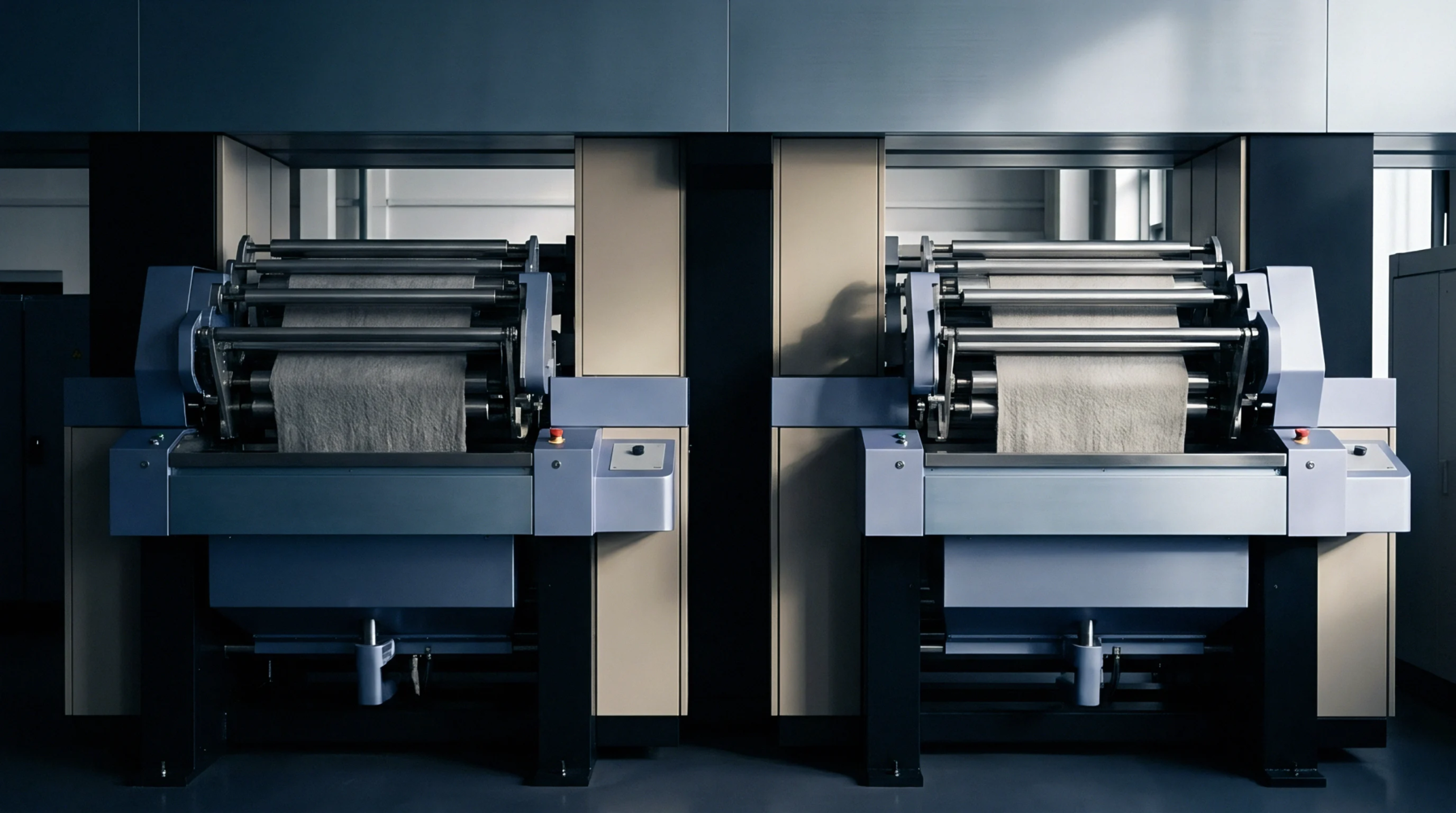
Impregnation Machinery
Continuous wet processing of heavy cotton or dense synthetic fabrics requires repeated immersion and squeezing to achieve deep chemical penetration. The double dip double nip padder uses two sequential troughs and two independent squeeze roll sets to force liquor into the core of dense yarns. This process overcomes the natural resistance of heavy fabrics.
Liquor Penetration
Initial wetting occurs during the first immersion, after which the first nip expels trapped air and surface moisture to create an empty capillary network. The second immersion of the double dip double nip padder introduces fresh finishing chemicals directly into these evacuated capillaries before the second nip establishes the final pick-up level. This dual action achieves uniform chemical distribution even in heavy drill or tightly woven corduroy.
Mills running high-speed ranges rely on this machinery to prevent surface-only finish deposits.
Pickup Regulation
Pneumatic pressure regulation across both roll sets must be adjusted independently to avoid excessive fabric crushing. Technicians measure the wet pick-up percentage by weighing fabric swatches before and after the padding process to confirm even application across the full width. Incorrect pressure balances lead to uneven drying.
Operational Boundary
Extremely delicate fabrics are unsuitable for this heavy mechanical treatment due to risk of yarn distortion. The intense shear forces can shift threads in low-density weaves. Continuous wet processing relies on this mechanical double dip double nip padder configuration to prevent uneven finish distribution.