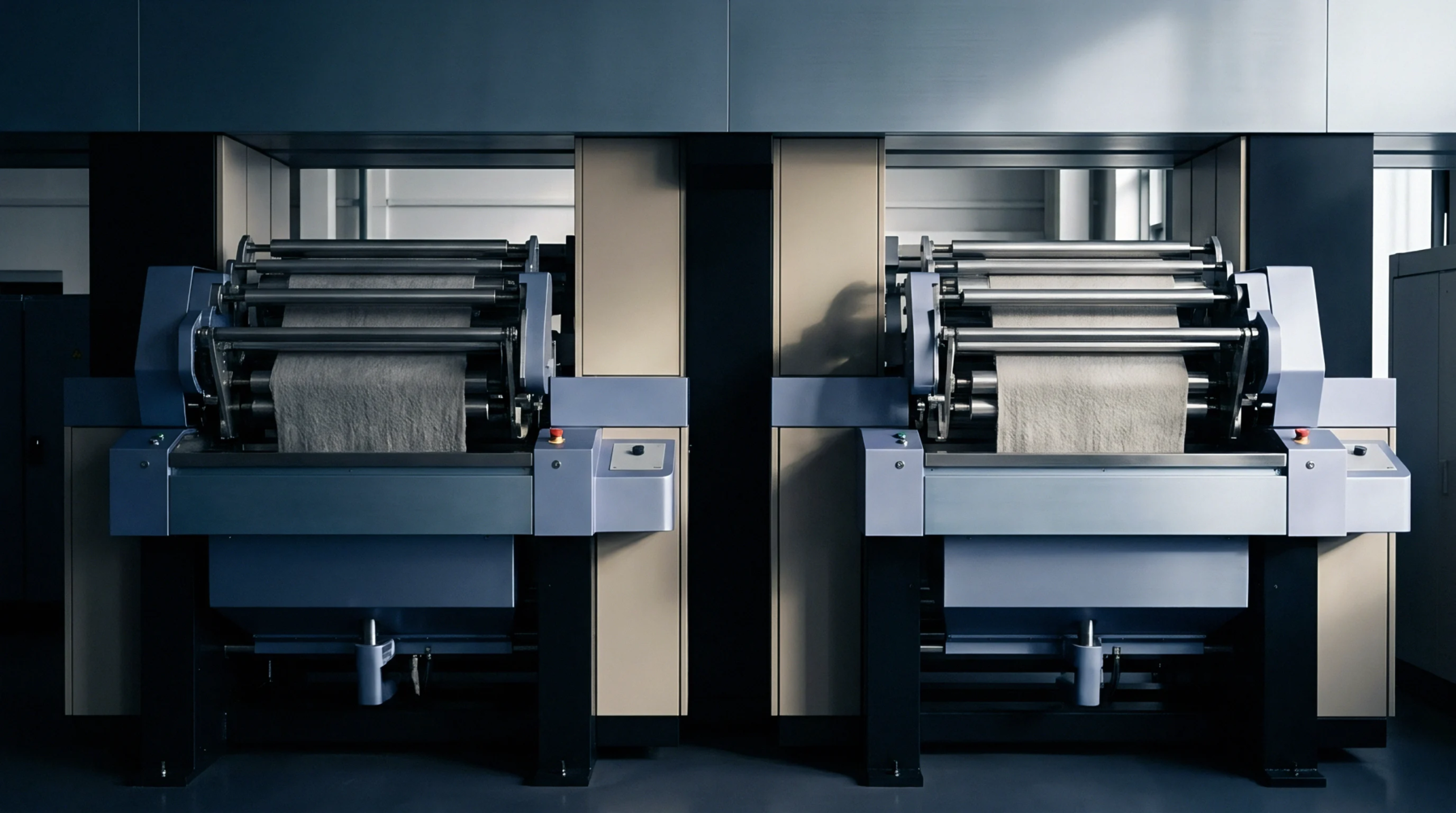
Velocity Ratio
The ratio of surface speeds between successive pairs of rollers in a drawing frame governs the parallelization and attenuation of fiber strands. A drafting speed differential establishes the mechanical draft that transforms a thick sliver into a thin roving. This action aligns individual fibers along the yarn axis.
Attenuation Dynamics
As the front roller rotates faster than the back roller, it pulls the leading fibers of the drafting speed differential forward while the trailing fibers are still held by the slower rollers. This process reduces the linear density of the fiber bundle by a precise factor determined by the speed ratio. Incorrect speed settings generate periodic thickness variations, commonly known as drafting waves, which degrade yarn strength.
Spinners monitor these variations using capacitance-based evenness testers to optimize roller pressure.
Drafting Wave
Short fiber fraction within the sliver behaves unpredictably when the draft is too high, leading to drafting wave defects. The uncontrolled fibers cluster together and form thick slubs alternating with thin regions. Correcting the speed differential reduces these periodic mass variations.
Quality Check
On-line sensor arrays continuously measure yarn evenness and trigger automated shutdown sequences if speed deviations occur. Maintaining a stable speed differential keeps the coefficient of variation within acceptable limits. Stable control of drafting speed differential prevents unevenness in the final yarn.