Measuring Dynamic Yarn Creel Stretch Variability in High Speed Synthetic Filament Warping Operations
Dynamic creel stretch variability stems from unequal yarn path lengths and friction points, producing permanent polymer draw and irreversible dyehouse barre.
Draft
A direct warper pulling fifty-denier polyester filament at one thousand metres per minute exposes every millimeter of path discrepancy between the front bobbin and the back wall. Tension differences along the running yarn sheet alter the physical dimensions of synthetic polymers before the sheet touches the collector roller. Filament yarns composed of polyethylene terephthalate or polyamide experience draw under minute load variations during beam preparation.
Warping tension exceeding ten percent of the single-end breaking strength induces permanent structural deformation rather than recoverable viscoelastic strain. The creel layout creates an unavoidable mechanical bias where yarns travelling thirty metres from the rear banks encounter greater cumulative guide friction than yarns emerging four metres from the front headstock.

Filament Tension Profiles across Creel Banks
Spatial positioning governs the baseline resistive force on individual ends. An operator running fully drawn nylon 6.6 yarn at eight hundred metres per minute observes tension readings varying between eight centinewtons on the front vertical rows and twenty-two centinewtons on the extreme rear positions. The difference stems from boundary air layers and directional eyelet contact.
As line velocity climbs, air resistance along the unsupported yarn line increases with the square of the linear speed. Yarns from the rear must traverse numerous intermediate guide rails, each contact point adding normal force according to the classic Euler-Eytelwein friction model.
Nylon 6 yields earlier.
Polyester filament retains higher initial modulus than nylon under identical operational temperatures, yet both display differential elongation across the warp width when tension gradients persist. When yarn ends with divergent tension histories wind onto the same section beam, the high-tension ends wind under extended pitch. The low-tension ends wind relaxed.
Once the section beams combine at the sizing machine or the direct assembly head, these length differences transform into cross-sheet tension bands. Unequal stretch ruins cross-dye levelness. Greige auditors identify this condition on the loom off-take through recurrent tight ends and persistent slack selvedges that disrupt shed opening.
Every ten-centinewton increase in static creel drag on fifty-denier nylon 6.6 yarn reduces residual elongation by 1.8 percent across subsequent wet processing steps.
Friction surfaces along the yarn flight accelerate structural divergence. Sintered aluminium oxide eyelets generate differing friction coefficients compared to polished ceramic or chrome-plated steel rods, especially when spinning finishes transfer from the filament onto mechanical contact points. Spin finish accumulation alters the static friction coefficient across forty-eight hours of continuous operation.
The rear bank travels furthest. The resulting tension variation across the creel manifests as intermittent draw spikes rather than a steady baseline increase.
Yarn suppliers routinely dismiss complaints regarding warp-wise dye streaks by asserting that standard beam densities absorb normal creel drag variations without altering molecular morphology.
Sensor
Electronic detection systems quantify localized elongation discrepancies across running ends before the warp beam locks in the fault. Direct measurement during commercial processing relies on three primary hardware topologies: contact tensiometer arrays, optical spatial velocimeters, and non-contact laser Doppler heads. Contact tensiometers measure normal force across a three-roller deflection system, converting mechanical displacement into millivolt electrical signals via piezoelectric or strain-gauge transducers.
These devices introduce localized friction during measurement, which slightly distorts the true running value at warping speeds above nine hundred metres per minute.

Does Creel Geometry Distort Tension Gradients?
Angular deviation between the bobbin axis and the package collector eyelet generates cyclic balloon collapse. Package unwinding creates tension ripples corresponding to the chase stroke of the cop or the traverse stroke of the pirn. The package diameter decreases from three hundred millimetres down to the base tube diameter of ninety millimetres over twelve hours of direct warping.
Package runout drops package unwinding drag. This diameter loss shifts the yarn unwinding angle against the tension discs. High speed exacerbates guide friction.
Without compensating regulators, front positions drop their tension by three to five centinewtons while rear positions retain heavy guide rail resistance.
Direct warpers pull twelve hundred ends.
| Measurement Technology | Sensor Bandwidth (Hz) | Measurement Accuracy | Yarn Contact Status | Capital Outlay per End (USD) |
|---|---|---|---|---|
| Laser Doppler Velocimetry | 10,000 | ±0.05 percent | Non-contact | 180 to 240 |
| Three-Roller Piezo Tensiometer | 500 | ±0.50 centinewton | Continuous physical contact | 35 to 55 |
| Spatial Optical Displacement | 2,000 | ±0.20 percent | Non-contact | 90 to 130 |
| Capacitive Mass-Velocity Sensor | 1,200 | ±0.40 percent | Semi-contact guide insertion | 60 to 85 |
High response speed remains essential for detecting transient elongation spikes caused by slough-offs or trapped filaments. Transducers running below two hundred hertz smooth out peak values, presenting false operational stability to the warping operator. Transients lasting under ten milliseconds trigger localized necking in semi-oriented synthetic yarns, generating latent defects that evade mechanical detection on the warping drum.
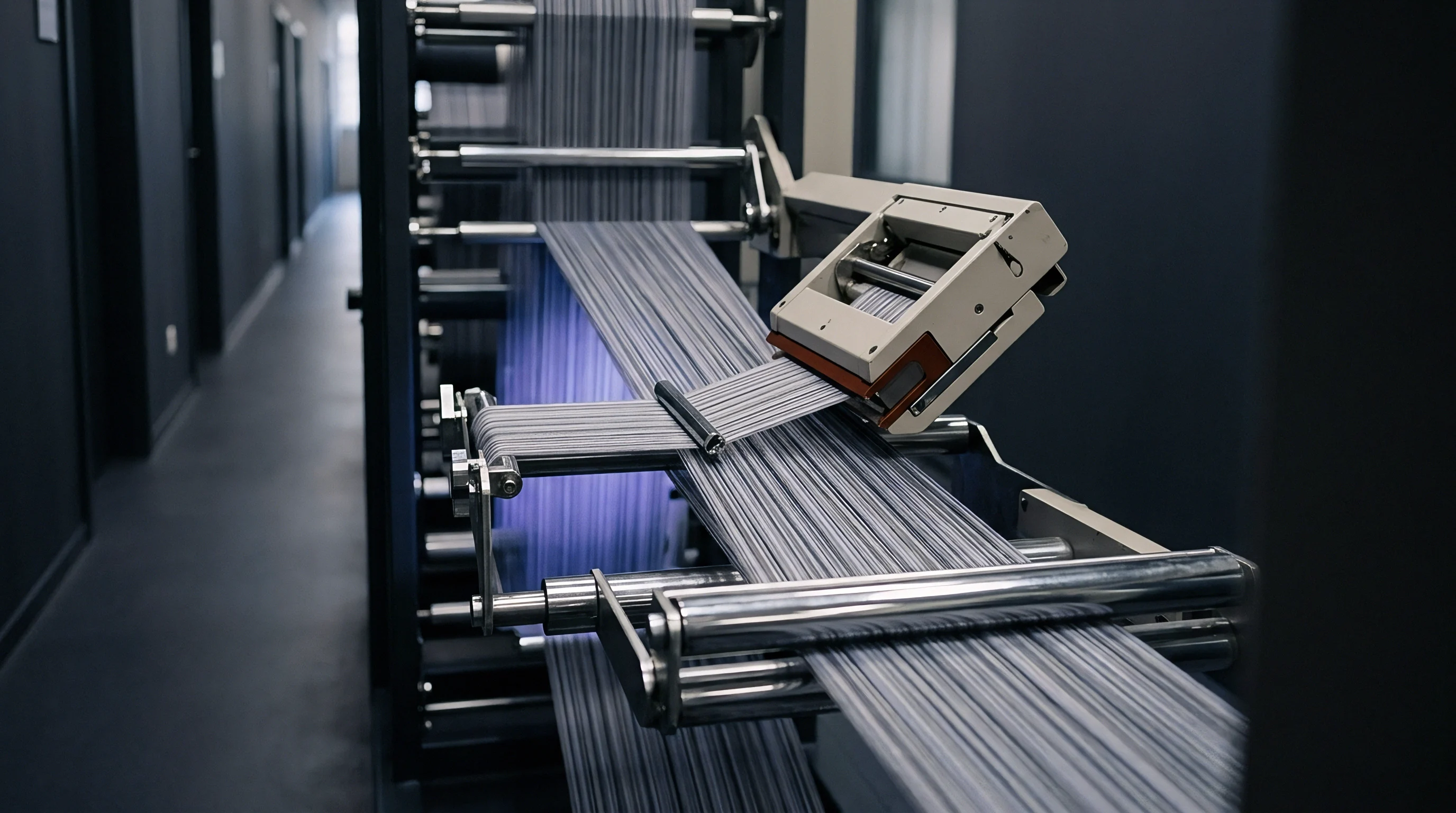
Laser Doppler Velocimetry across Running Ends
Non-contact optical instruments determine surface speed at two separate points along an individual yarn path. When the entry speed at the bobbin tension disc measures precisely one thousand metres per minute while the speed at the comb measures one thousand twelve metres per minute, the yarn experiences an active mechanical draft of 1.2 percent. Installing paired velocimeter heads across every end on a twelve-hundred-end creel carries prohibitive financial weight.
Sourcing facilities instead deploy traversing scanning carriages that ride along the creel tiers, sampling eight ends simultaneously across three-minute evaluation cycles.
Standard ISO 2062 verification of conditioned filament tenacity fails to catch intermittent warp-wise elongation anomalies created by transient friction surges on the creel.
The choice between continuous multi-point tensiometry and periodic optical scanning determines whether a mill detects persistent path drift or transient mechanical catches. Which localized sensor response time balances capital expenditure against optical accuracy on lightweight technical substrates remains an open technological dispute among machine builders.


Barre
Visual defects in finished synthetic textiles frequently originate at the warping creel rather than the dyeing machine. Differential yarn stretch alters molecular orientation within synthetic filaments, shifting the glass transition temperature and the rate of dyestuff diffusion into the polymer matrix. When fully drawn polyester filament stretches past its yield point, amorphous polymer chains align parallel to the fibre axis.
This alignment packs the molecular chains tightly, reducing the free volume accessible to disperse dye molecules during thermal fixation.
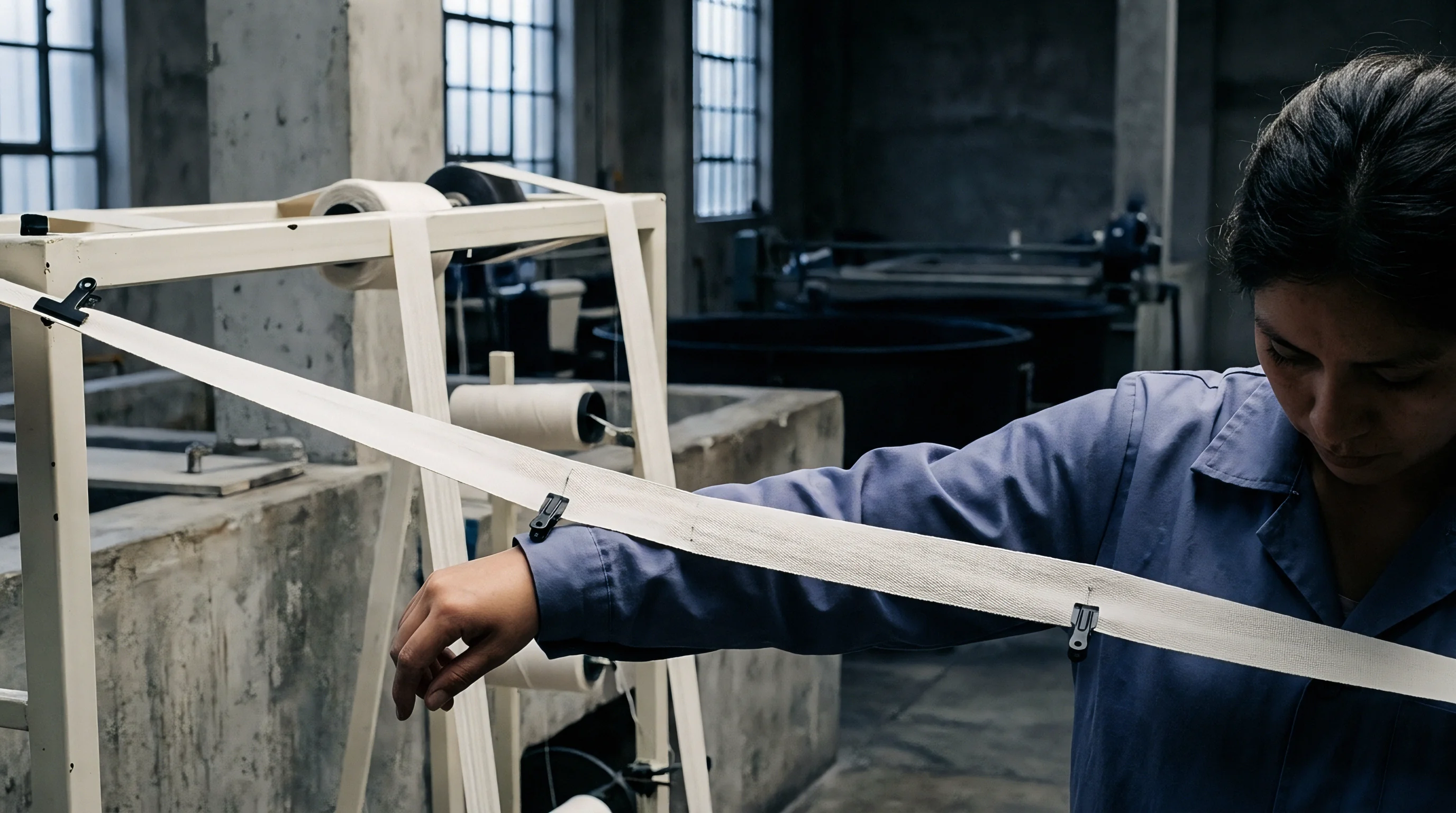
Morphological Shifts in Synthetic Polymers
Oriented filament domains absorb less dye under standard atmospheric or pressurized wet processing. Tight ends appear light against the background in disperse-dyed polyester cloth, whereas slack ends absorb excess dye and appear dark. In polyamide substrates, mechanical stretch increases crystalline orientation while altering the accessibility of amine end groups to acid dyes.
The finished woven cloth exhibits warp-direction streaks, known commercially as barre or stripiness, running parallel to the selvedge across thousands of metres.
Cold draws lock in stress.
Differential elongation creates visible warp streaks. Chemical audits of streak defects reveal that variations in draw ratio as low as 0.7 percent across adjacent warp ends produce a visible colour difference exceeding 0.8 delta E under standard CIE D65 illuminants. No subsequent scour, heat-set, or leveling auxiliary can reverse permanent molecular orientation variations introduced on the warping headstock.
The greige engineer must verify yarn physical integrity before warp beams leave the preparation floor.
| Yarn Type and Count | Creel Elongation Delta | Boiling Water Shrinkage (ISO 18137) | Acid or Disperse Dye Delta E (ISO 105-J03) | Residual Tenacity (ISO 2062) |
|---|---|---|---|---|
| Polyester FDY 50D/48f | 0.0 percent (Control) | 6.8 percent | 0.00 | 4.45 cN/dtex |
| Polyester FDY 50D/48f | +1.0 percent Draft | 5.4 percent | 0.72 | 4.58 cN/dtex |
| Polyester FDY 50D/48f | +2.5 percent Draft | 3.9 percent | 1.85 | 4.82 cN/dtex |
| Nylon 6.6 FDY 70D/68f | 0.0 percent (Control) | 7.2 percent | 0.00 | 5.10 cN/dtex |
| Nylon 6.6 FDY 70D/68f | +1.2 percent Draft | 5.8 percent | 0.94 | 5.28 cN/dtex |
| Nylon 6.6 FDY 70D/68f | +2.8 percent Draft | 4.1 percent | 2.30 | 5.52 cN/dtex |
| Test results established on continuous filament yarns conditioned at twenty degrees Celsius and sixty-five percent relative humidity per ISO 139. | ||||
Physical flaws accompany the optical shade discrepancies. Yarns stretched on the creel lose their residual elongation capacity, leading to brittle warp behavior during shedding on high-speed air-jet looms. Shed clearance deteriorates when adjacent yarns demonstrate unequal elasticity, causing micro-stops and mechanical fuzz balls behind the reed.
Structural faults in synthetic goods trace back to distinct operational sources:
- Package transfer jumps produce sudden tension spikes when tails untie unevenly from magazine setups, leaving localized tight picks across three to five metres of cloth.
- Accumulated monomer deposits settle inside ceramic tension discs, freezing disc rotation and raising single-end tension by over fifteen centinewtons.
- Misaligned drop wires score fine-denier synthetic filaments, generating broken filaments that bind adjacent ends inside the leasing reed.
- Static electricity accumulation causes balloon instability, forcing running filaments to lash against structural creel metalwork.
Failing to control tension-induced molecular orientation during warping results in entire production lots of high-density taffeta or satin being rejected at the dyehouse inspection frame, forcing the mill to scrap first-quality greige output as unmerchantable secondary goods.
Flight
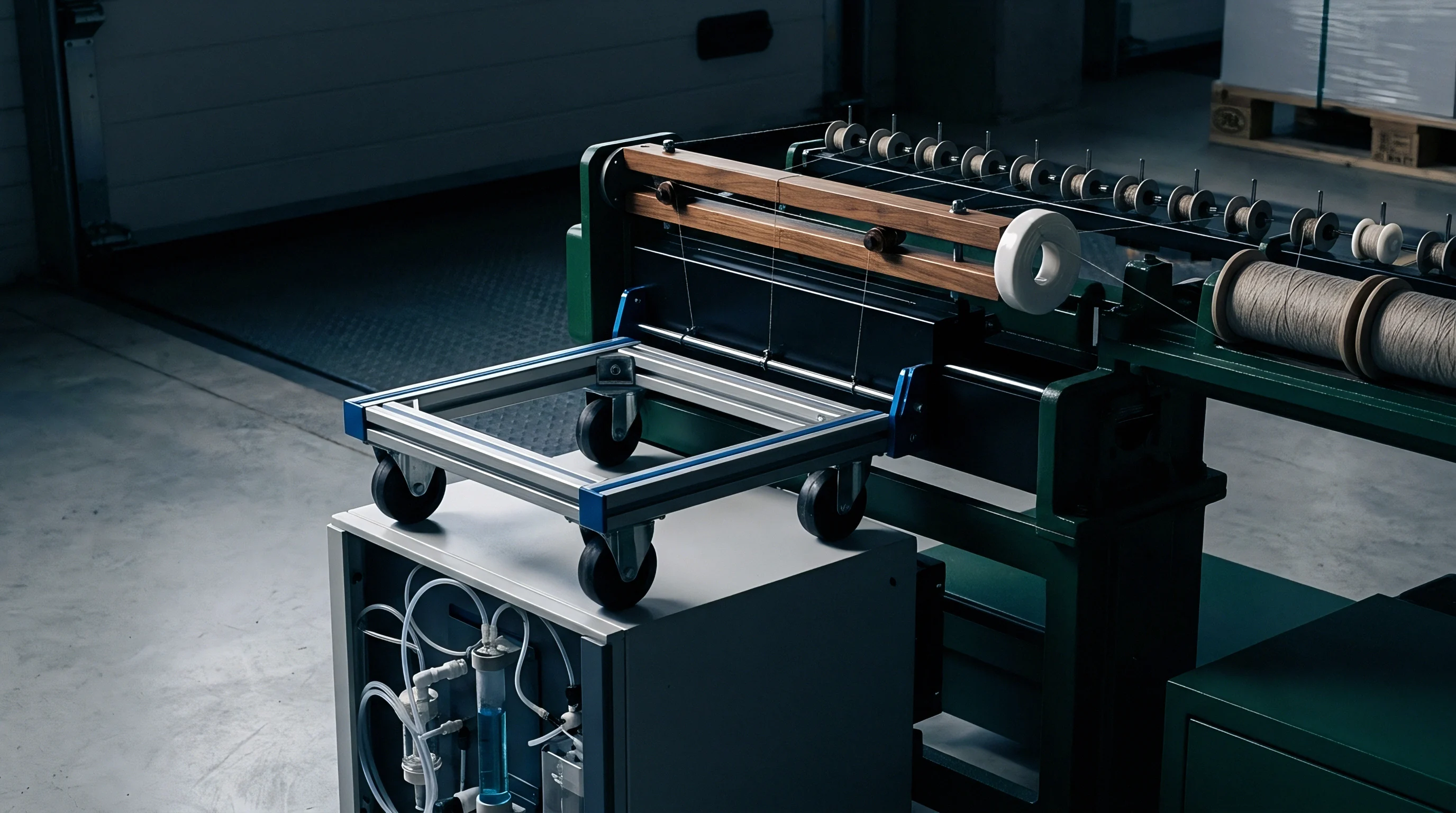
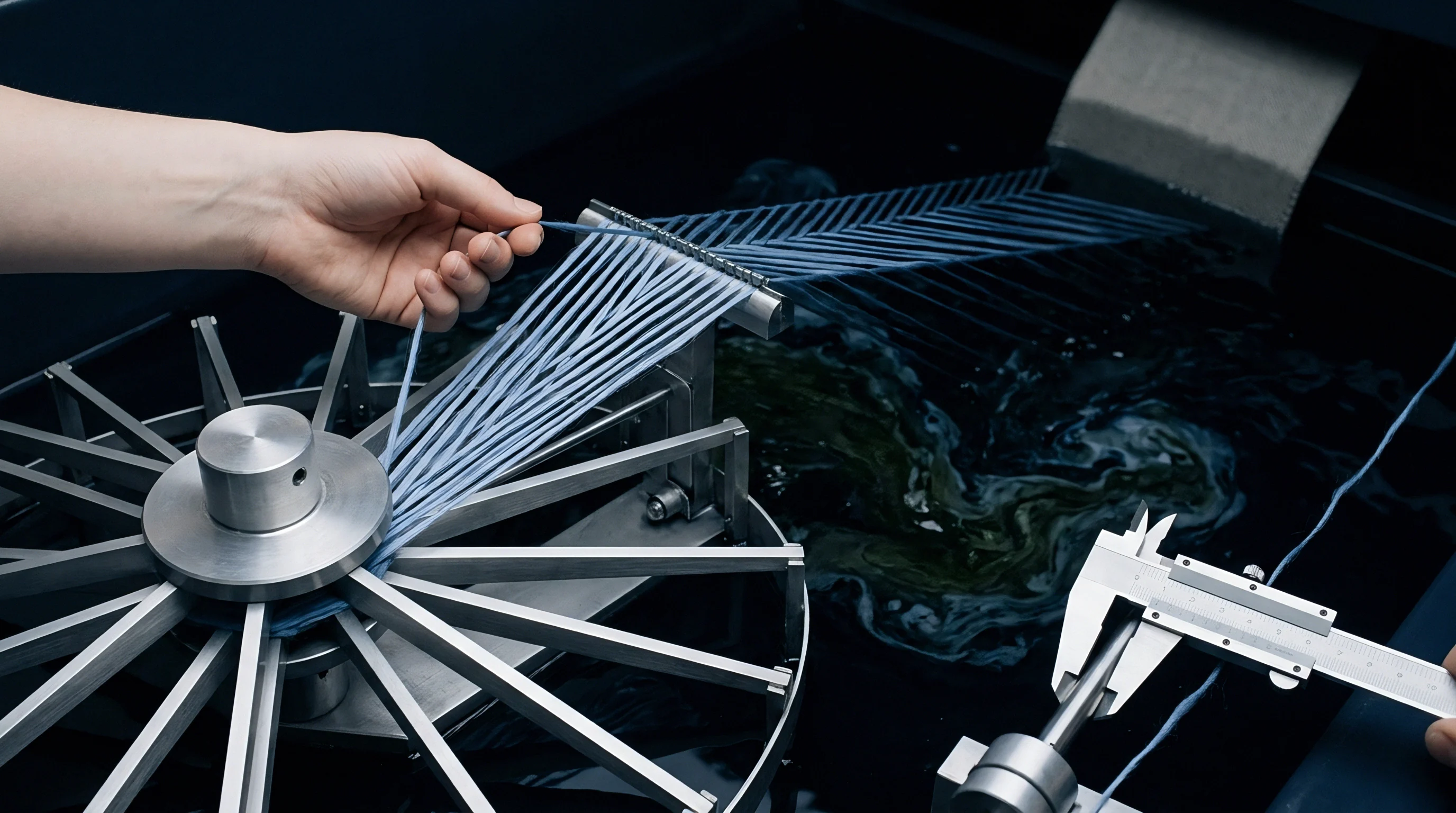
The physical transit of filament yarn from the bobbin nose through the gathering comb involves complex mechanical and fluid dynamics. Air drag along the unconstrained yarn segment forms a dynamic boundary layer that expands with distance and line speed. On a standard rectangular creel containing eight hundred active packages arranged in four vertical tiers and twenty rows, the yarn transit distance spans between four point five metres for row one and twenty-eight metres for row twenty.
Filament yarns exiting the rear bank generate substantial air drag that acts as an aerodynamic brake.
What Velocity Threshold Triggers Plastic Yield?
Synthetic filaments exhibit non-linear viscoelastic behavior when exposed to rapid strain acceleration. Take a typical warping operation processing fully drawn 50 denier polyester with an initial modulus of 9.5 gigapascals, equivalent to 75 centinewtons per tex. The yarn linear density equals 5.55 tex.
The breaking load stands at 24.7 centinewtons with an elongation at break of twenty-four percent. The elastic limit sits at approximately 1.5 percent elongation, corresponding to a single-end tension of 6.2 centinewtons.
Static discs induce thermal glaze.
Off-axis eyelets generate severe friction.
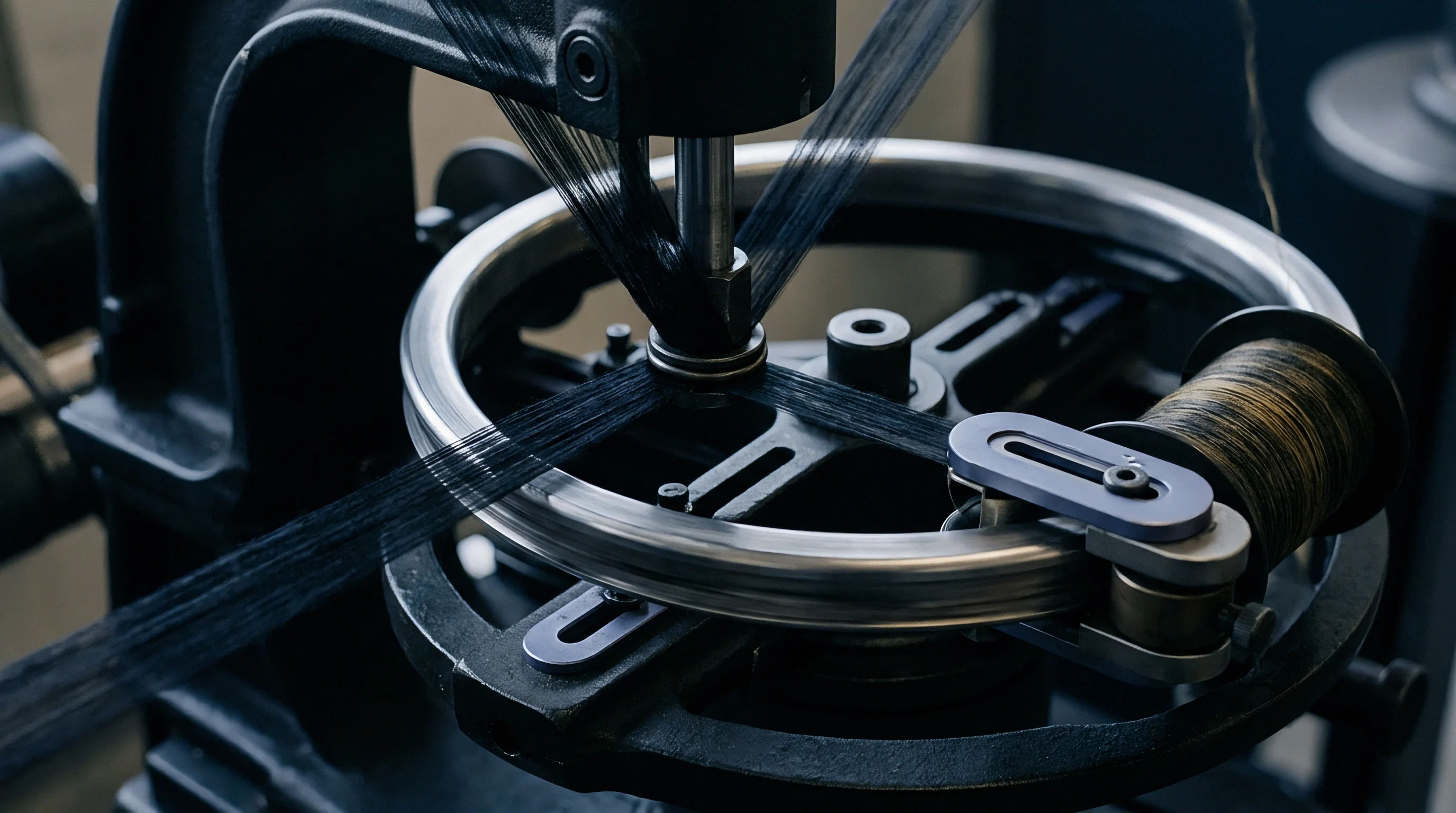
Tension calculations demonstrate the hazard of high-speed transit. Friction across stationary guides follows the Capstan formula where output tension equals input tension multiplied by Euler’s constant raised to the product of the friction coefficient and the wrap angle in radians. Assume an unwinding tension of 3.0 centinewtons at the bobbin.
The yarn passes through six ceramic guide eyelets between the creel position and the warper table, each eyelet imposing a wrap angle of twenty degrees, or 0.349 radians. The dynamic friction coefficient for ceramic against lubricated polyester filament at eight hundred metres per minute measures 0.22.
Cumulative friction multiplies tension through each successive guide:
- The initial tension of 3.0 centinewtons rises to 3.24 centinewtons after the first eyelet contact.
- Intermediate yarn passage through the second and third eyelets raises cumulative running load to 3.79 centinewtons.
- Additional boundary-layer aerodynamic drag along twenty metres of rear-bank travel adds 2.80 centinewtons of linear drag.
- Passage through the fourth, fifth, and sixth guide points escalates total tension to 8.42 centinewtons before the yarn enters the expandable v-comb.
The final tension of 8.42 centinewtons exceeds the 6.2 centinewton elastic limit of the yarn. The rear ends run continuously under 2.03 percent mechanical draft, while front ends, subjected to only two guide points and four metres of air path, register 3.85 centinewtons, remaining safely below the yield threshold at 0.93 percent elastic stretch. The resulting warp beam incorporates an intrinsic stretch delta of 1.10 percent from front to back across the creel.
Tension spikes degrade polymer crystallinity. When the direct warper speed accelerates to twelve hundred metres per minute, air resistance escalates by over eighty percent, widening the draft divergence between the front and rear yarn packages.
Synthetic filament yarns running through static ceramic eyelets incur tension increases that scale exponentially with cumulative angular deflection rather than linearly with path distance.
Correcting path-length disparity requires active mechanical balancing rather than passive monitoring. Technical mills adjust localized tension washers, install tiered tension settings across creel columns, or implement motorized pre-draw feeder rollers that isolate package unwinding forces from the warping table. The beam rejects uneven packages.
Warping creels operating with uniform disc weights across all rows inevitably stretch rear yarn ends beyond their elastic recovery limit.

Recourse
Enforcing tight quality standards across cross-border fabric sourcing programs necessitates rigid greige qualification parameters. Fabric buyers sourcing technical goods, lightweight apparel linings, or micro-denier athletic substrates cannot rely on visual inspection of raw yarns. Greige specifications must establish explicit limits on physical elongation variance across the warp sheet prior to weaving or knitting.
When dyehouse barre strikes a production run, tracing responsibility requires pre-established baseline records taken directly from the warping logs.
Greige Acceptance Specifications and Commercial Penalties
Technical dossiers for continuous filament procurement must define warp mechanical tolerances under strict laboratory conditions. The specification binds the weaver to verify that warp-wise elongation variance across any section beam or direct beam remains within narrow margins when sampled across five creel positions: front-top, front-bottom, center-tier, rear-top, and rear-bottom. Testing follows ISO 2062 methods on conditioned ends removed from the beam before sizing chemistry or knotting takes place.
Laser Doppler heads measure velocity.
Acid dye molecules reject oriented domains.
Verification checklists protect commercial buyers against downstream processing losses:
- Single-end elongation variance limits dictate that the coefficient of variation for elongation at break across the full warp sheet width cannot exceed 4.5 percent.
- Boiling water shrinkage tolerances mandate that residual thermal shrinkage tested under ISO 18137 must not vary by more than 0.6 percentage points between any ten randomly selected warp ends.
- Tensioner maintenance logs specify weekly cleaning schedules for ceramic tension assemblies and documentation of friction disc replacement intervals.
- Direct warper speed caps establish maximum allowable linear velocities tied directly to filament decitex, restricting ultra-fine deniers below fifty decitex to a maximum of seven hundred metres per minute unless active compensating creels are operational.
When greige lots fail visual inspection due to warp streaks following jig or jet dyeing, commercial liability hinges on the four-point inspection score determined under ASTM D5430. If streak defects exceed ten penalty points per one hundred square metres and laboratory analysis confirms molecular orientation shifts via differential scanning calorimetry or birefringence measurements, the fabric converter absorbs the total landed cost of the greige goods plus processing fees.
Under standard international fabric supply covenants, the inclusion of a mandatory 0.5 percent maximum allowable yarn stretch variance clause transfers all downstream stripiness liabilities and finishing costs directly back to the weaving facility.