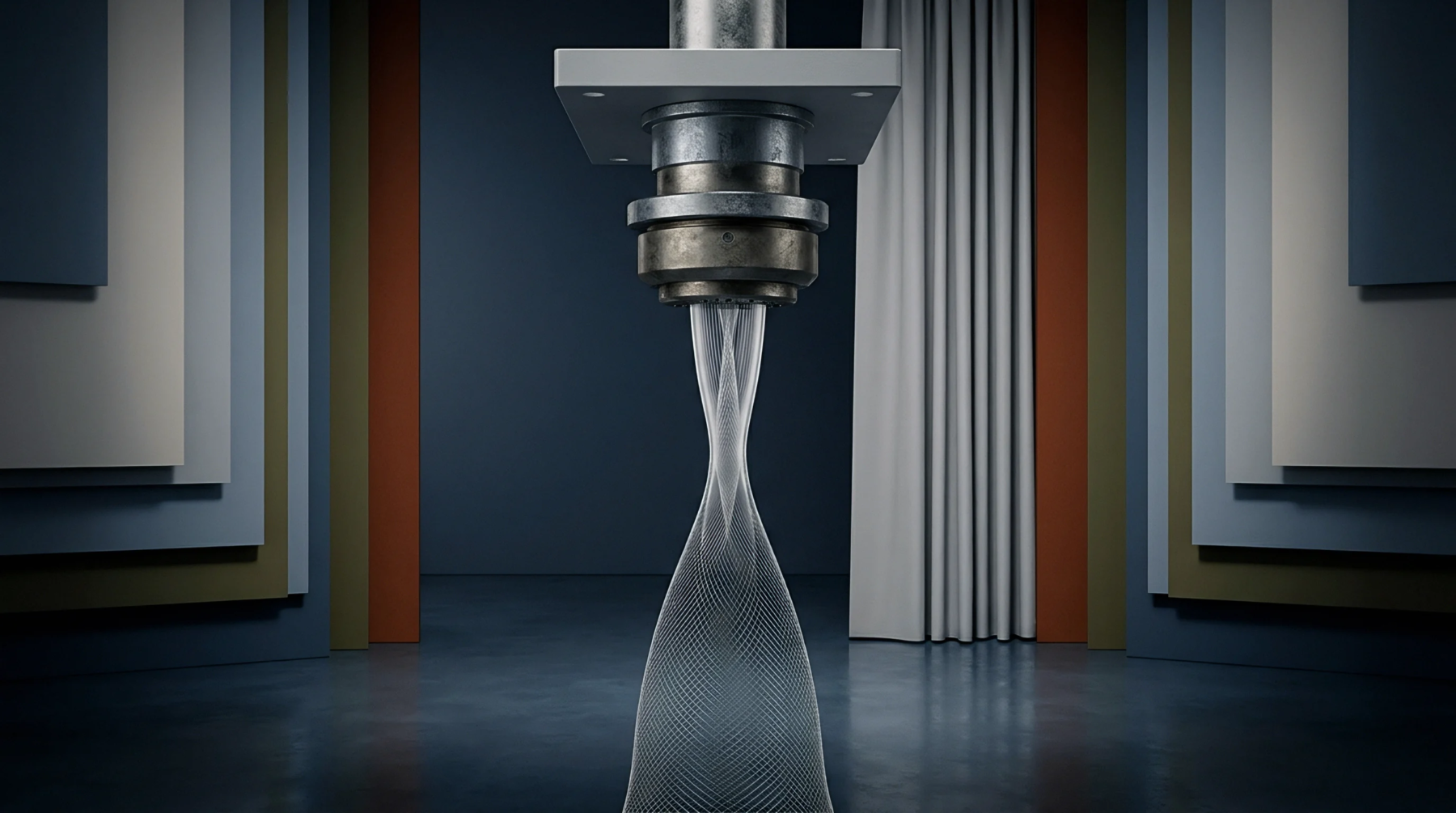
Macromolecular Transition
Polyurethane segmented copolymers exhibit physical extension mechanisms governed by the unravelling of soft polyether or polyester chain segments from their native folded states. The process of elastane uncoiling occurs when applied tensile force stretches these amorphous molecular blocks outward along the longitudinal axis of the filament. Native elastane fibers feature alternating domains where rigid urethane segments form hard, hydrogen-bonded crystalline nodes that anchor flexible, randomly coiled soft matrices.
As external mechanical stress draws the fiber outward, the tangled, high-entropy soft chains straighten into parallel alignments without shifting the permanent positions of the hard anchoring domains. This kinetic transformation ceases when the soft segments attain maximum linear conformation, beyond which further deformation requires scission of primary bonds or destructive dislocation of the crystalline domains.
Thermodynamic Kinetics
Thermodynamic forces oppose chain alignment, driving the stretched soft blocks back toward states of higher configurational entropy upon stress dissipation. During elastane uncoiling, internal thermal energy generates retractive forces as the polymer chains absorb work, shifting molecular states from disordered entropic baselines into organized, low-entropy states. Hard domains prevent bulk viscous slippage by functioning as physical crosslinks, maintaining network cohesion throughout cyclical strain patterns exceeding several hundred percent elongation.
Fast return dynamics characterize this molecular elastic snap-back, though minor internal molecular friction produces mechanical hysteresis and transient heat dissipation. Excessive draw speeds or cold operating environments retard uncoiling kinetics, producing localized stress concentration points that foster early filament breakage during yarn wrapping.
Processing Dynamics
Yarn texturing machinery coordinates elastane delivery through positive feed rollers to maintain strict tension control throughout downstream textile assembly. Mechanical draft applied during spinning forces elastane uncoiling inside core-spun and air-jet covering units where spun cotton or texturized polyester shields the elastic filament. In bare-yarn knitting, precision creels monitor unwinding package friction, preventing unwanted chain extension prior to loop formation inside the needle bed.
Incomplete or erratic soft-segment extension creates alternating light and heavy bands across dyed fabrics, showing uneven light refraction from distorted fiber cross sections. Wet-processing temperatures must not exceed the glass transition and melting limits of the hard blocks, preserving the anchored crosslink networks that govern elastic recovery.
Fabric Performance
Garment inspection protocols track dimensional recovery percentages to confirm that uncoiling mechanics remain reversible through prolonged consumer wear. In circular knits and stretch woven goods, stable elastane uncoiling yields dependable stretch performance, preventing garment sagging at stress regions like elbows and waistbands. Finished goods laboratories measure stretch resistance, residual elongation, and modulus decay under ASTM D3107 or equivalent stretch standards.
Chemical degradation from chlorine bleaching, laundering oxidants, or dry-cleaning solvents attacks the soft-block segments, causing scission that terminates elastic uncoiling capabilities entirely. Verification of proper tensioning profiles during yarn spinning ensures that finished garments exhibit uniform elasticity, smooth recovery curves, and consistent fabric density.