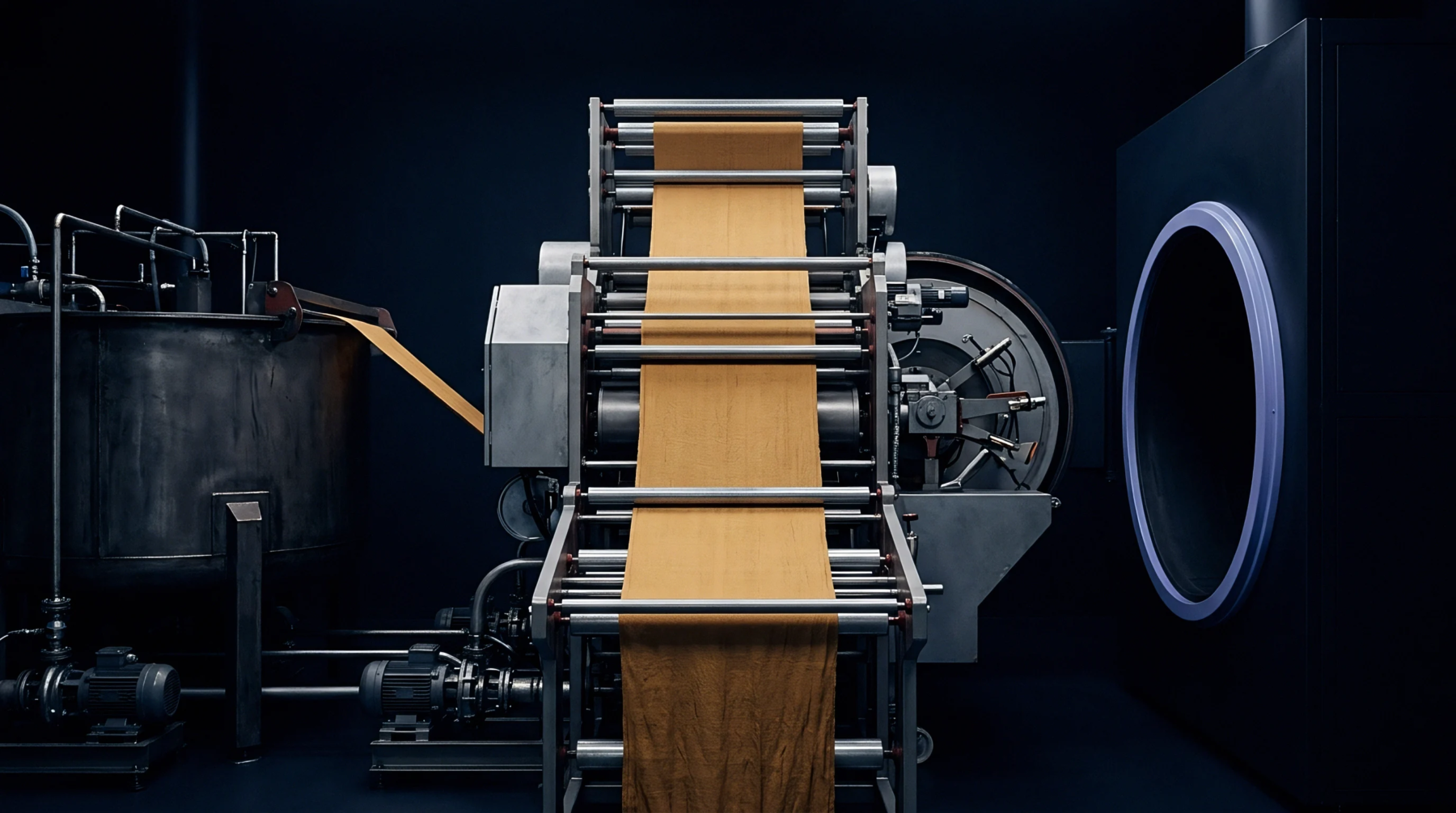
Controlling Continuous Dyeing Particulate Migration across Thermal Intermediate Dryers
Intermediate drying needs balanced radiative heat, controlled convection air speed, and pseudoplastic antimigrants to eliminate dye migration across woven fabric.
Water transport across a finished fabric surface occurs through the deliberate arrangement of open channels between contiguous strands of twisted filament or spun staple. An inter-yarn capillary represents the geometric gap between adjacent components in a textile construction where surface tension forces pull moisture into the voids. The cross-sectional area of these channels dictates the rate of movement for liquids applied to one side of the material.
Smaller gaps increase the pressure gradient while larger spaces reduce the ability to move water against the influence of gravity. Mills measure this performance to confirm that moisture wicking functions according to design specifications before shipment to garment factories.
Engineering of these openings requires control over thread tension during the production of a jersey or a plain weave. An inter-yarn capillary forms when the twist level of the input material prevents full compaction into the neighboring strands. Low twist levels cause the filaments to splay outward and obstruct the path for fluid migration.
High twist levels tighten the structure and push the strands apart to create distinct pathways for liquid movement. Technical fabric designers select specific yarn counts to dictate the size of the gaps between the structural members. These designers also adjust the density of the stitches to ensure that the material holds a fixed orientation throughout the finishing cycles.
Wetting agents applied during the dyeing stage modify the surface energy of the fibres to speed up the intake of liquid. Chemicals placed onto the surface act as a bridge between the yarn and the water molecules. Changes in the chemical finish impact the efficiency of the transport mechanism even if the physical gaps remain identical.
Consistent monitoring of these surface traits keeps the liquid management performance within the expected tolerance levels for outdoor clothing.
Moisture management reaches a point of failure when the density of the cloth exceeds the capacity of the channels to transport liquid. An inter-yarn capillary loses functionality if the yarn diameter forces the closure of the gaps during the final heat setting process. Excessive heat causes the synthetic fibres to swell and fill the voids that exist between the twisted components.
This closure prevents the lateral movement of water across the material and forces moisture to accumulate on the inner surface. Quality control checks look for evidence of such structural collapse by dropping water onto a taut sample under controlled light conditions. Observation of the spread pattern informs the technician about the state of the internal pathways.
A circular spot indicates that the channels are functioning as intended. An uneven pattern suggests that the production settings caused partial blocking of the transport network.
Loom settings and knitting machine tensions determine the initial width of the channels. An inter-yarn capillary changes dimension under the pressure of the garment assembly process if the construction allows for high levels of stretch. Excessive elongation pulls the yarn tighter and reduces the volume of the space available for transport.
Constant observation of the material tension during sewing prevents this unwanted compression from compromising the end product. Performance relies entirely on the precise maintenance of the void architecture established at the weaving stage.
Intermediate drying needs balanced radiative heat, controlled convection air speed, and pseudoplastic antimigrants to eliminate dye migration across woven fabric.
Expertise is a utility, not a secret. sentiention™ publishes its working knowledge as open reference: intelligence layer covering the materials it sources, the markets it enters, and the reference that serves both.