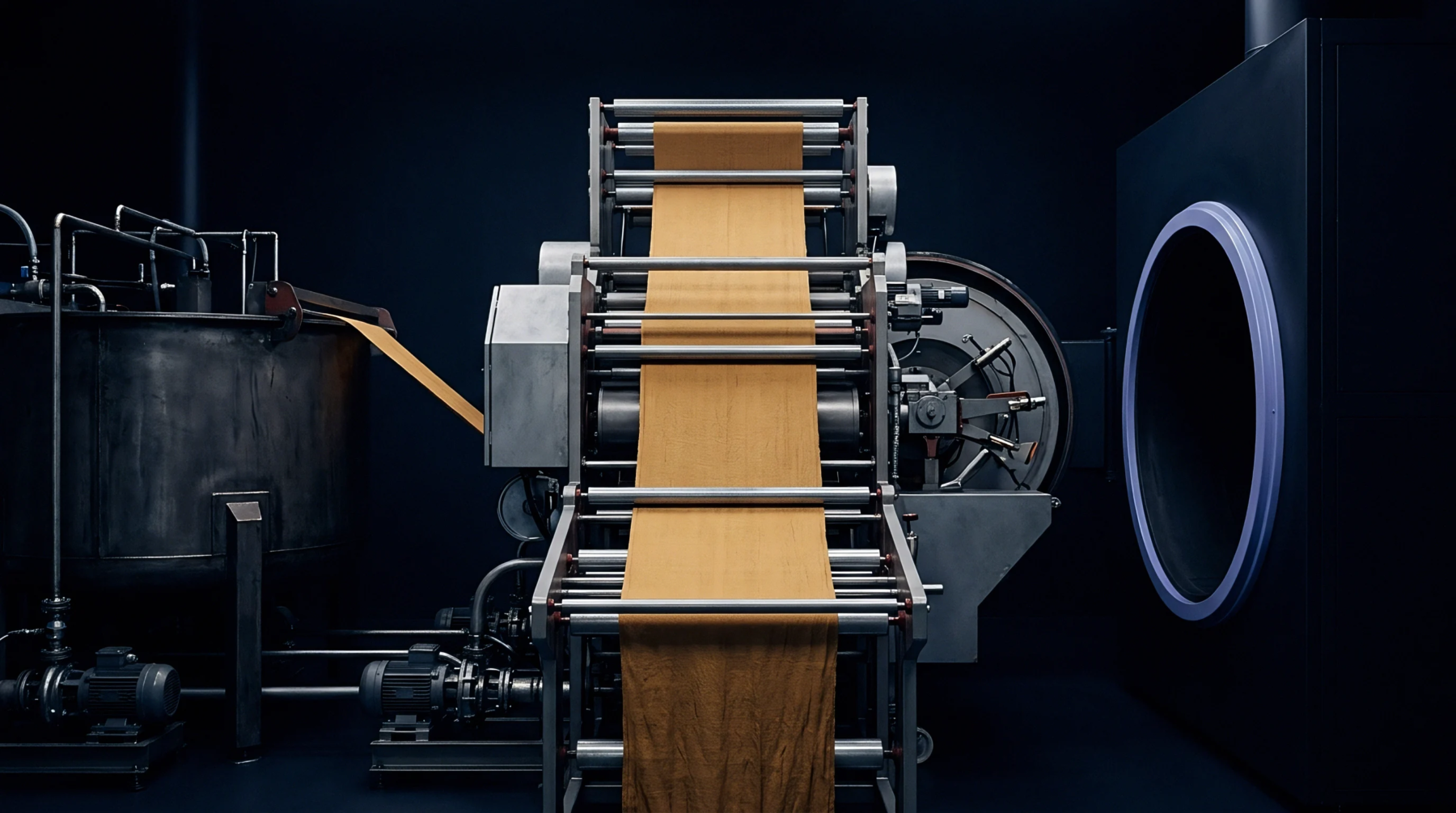
Controlling Continuous Dyeing Particulate Migration across Thermal Intermediate Dryers
Intermediate drying needs balanced radiative heat, controlled convection air speed, and pseudoplastic antimigrants to eliminate dye migration across woven fabric.
An intra-yarn pore denotes an internal void located between individual filaments within a twisted or spun textile bundle, where fluid molecules transit or deposit during finishing processes. An intra-yarn pore determines the path of dye penetration and the eventual moisture absorption rate of the completed textile. Fluid pressure gradients drive the liquid phase through these gaps, which dictate the uniformity of chemical application during padding operations.
If the internal space remains clogged or poorly constructed, the liquor fails to reach the core, resulting in core-white defects or uneven shade distributions. Proper characterization requires scanning electron microscopy to map the spatial distribution of these gaps relative to the twist density of the yarn.
Fabric integrity relies on the volume fraction of these pockets within a single bundle. Tight twist levels collapse the internal structure, which reduces the cross-sectional area available for air or liquid flow. Spinning frame tension directly influences the frequency and diameter of these openings during the initial twisting stage.
High-speed drawing processes often stretch individual filaments, effectively pinching off the void space and forcing a reduction in total porosity. Technicians monitor these spatial arrangements to predict the wicking performance of athletic apparel, because higher internal void ratios correlate with faster moisture transport away from the skin surface.
Lab analysts quantify the distribution of an intra-yarn pore by comparing the dry density of a strand against the calculated volume of the constituent fibres. This calculation accounts for the displacement of fluid under controlled atmospheric pressure. Mill operators perform this assessment during the greige stage, providing a baseline for downstream chemical processing.
If the verification procedure reveals a consistent reduction in air space, the mill adjusts the winding tension to prevent excessive compression before heat setting. This preventive measure stops the permanent collapse of the bundle before the dye bath begins. Variations in filament cross-sections also impact the measurement, as trilobal or pentalobal profiles inherently create larger pathways for liquid than circular cross-sections.
Such physical shapes maintain higher internal permeability even under substantial mechanical load from tension rollers.
Consistent processing depends on the retention of these gaps throughout every thermal cycle. Excessive pressure during calendering forces the filament arrangement into a dense state, which permanently closes the internal path. Synthetic materials remain susceptible to this collapse if the heat treatment exceeds the glass transition temperature of the polymer.
A loss of internal porosity reduces the surface area accessible for reactive dyes, which causes a decrease in color fastness and wash durability. Once the structure undergoes this permanent deformation, no secondary treatment restores the original capacity for fluid transport or chemical binding. The internal volume of an intra-yarn pore sets the upper limit for the efficacy of topical chemical finishes applied to the final fabric.
Intermediate drying needs balanced radiative heat, controlled convection air speed, and pseudoplastic antimigrants to eliminate dye migration across woven fabric.
Expertise is a utility, not a secret. sentiention™ publishes its working knowledge as open reference: intelligence layer covering the materials it sources, the markets it enters, and the reference that serves both.