Capillary Pressure Effects on Woven Fabric Pore Structures
Capillary pressure resistance in woven fabrics depends on controlling maximum inter-yarn pore throat radii rather than reliance on surface contact angles alone.

Meniscus
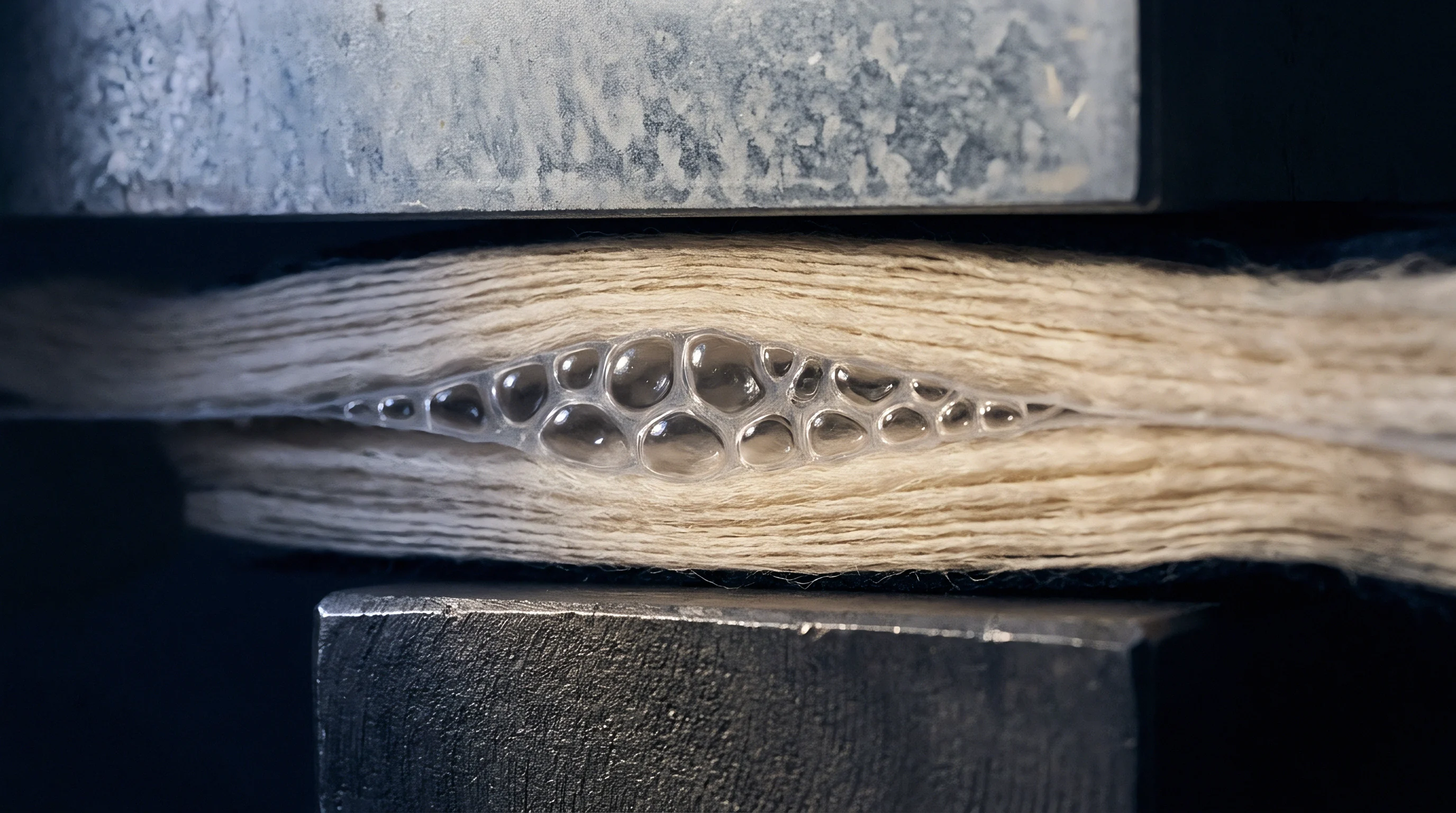
Interfacial Liquid Dynamics in Inter-Yarn Voids
Woven textiles contain bimodal pore size distributions divided between inter-yarn voids and intra-yarn capillary channels. Pore geometry governs liquid velocity. The Laplace-Young relation establishes that capillary pressure across a curved liquid-gas interface balances directly against surface tension and the cosine of the solid-liquid contact angle, divided by the effective pore radius.
When a fluid contacts a dry fabric matrix, spontaneous capillary suction draws liquid into narrow intra-yarn channels. Micro-voids between individual filaments pull liquid rapidly under low head pressures.
Interfacial tension drives boundary displacement. Larger inter-yarn spaces between warp and weft threads present lower capillary suction pressures, resisting spontaneous liquid uptake when contact angles exceed ninety degrees. Fiber cross-sectional geometry alters this liquid displacement equilibrium.
Round synthetic filaments create predictable cylindrical void paths. Trilobal or hollow fibers generate irregular channel cross-sections that modify local contact angle boundaries and accelerate directional wicking.
- Yarn Packing Density governs the structural dimension of intra-yarn channels where capillary absorption dominates at low hydraulic pressures.
- Fiber Surface Energy dictates whether incoming fluid forms a convex barrier or spreads spontaneously through micro-voids.
- Weave Interlacing Frequency creates structural throat restrictions that arrest fluid front progression across adjacent yarns.
- Fluorocarbon Finishing Residues elevate the liquid-solid contact angle above ninety degrees to convert capillary suction into hydrostatic resistance.
Surface energy dictates contact angles. Liquid front movement stalls when the local contact angle at a yarn intersection reaches its advancing limit. Hydrophobic chemical treatments lower the solid surface energy of polyamides and polyesters from forty millinewtons per meter to under eighteen millinewtons per meter.
This thermodynamic shift reverses the sign of the capillary pressure equation. Fluid is pushed out of yarn voids rather than pulled into the matrix.
Tighter yarn packing shifts fluid transport from intra-yarn capillary channels to larger inter-yarn voids under hydraulic stress.
Sensing liquid entry conditions demands monitoring both advancing and receding contact angles. Contact angle hysteresis determines whether liquid droplets remain pinned at yarn junctions or move under gravity. When external pressure presses fluid against hydrophobic yarn surfaces, local meniscus curvature increases until forced entry occurs through the widest pore throat.
Mills frequently claim that minor variance in yarn crimp stems entirely from humidity fluctuations during weaving rather than irregular loom tension settings.
Porometry
Capillary Flow Analysis and Bubble Point Mechanics
Standardized liquid displacement measurements evaluate pore neck diameters through controlled gas pressuring of wetted fabrics. ASTM F316 procedures measure the pressure required to force a non-reacting gas through a fully saturated woven matrix. Wetting fluids such as mineral oil or specialized fluorinated liquids wet the fiber surface completely, yielding a solid-liquid contact angle of zero degrees.
Under these testing conditions, gas pressure directly correlates to maximum pore throat radius.
Small pores retain fluid longer. The initial displacement of liquid by rising gas pressure yields the bubble point pressure. This value identifies the largest continuous pore throat opening across the tested surface area.
Increasing gas pressure sequentially empties smaller pore channels until the wet flow rate matches the dry fabric flow curve.
| Weave Architecture | Mean Flow Pore Diameter (µm) | Bubble Point Pore Diameter (µm) | Wetting Liquid Surface Tension (mN/m) | Capillary Breakthrough Pressure (kPa) |
|---|---|---|---|---|
| Plain 1/1 (150d/144f Polyester) | 12.4 | 28.6 | 15.9 | 2.22 |
| Twill 2/2 (150d/144f Polyester) | 18.1 | 41.2 | 15.9 | 1.54 |
| Satin 5/1 (150d/144f Polyester) | 24.5 | 58.3 | 15.9 | 1.09 |
| Ripstop Plain (70d/68f Polyamide) | 8.2 | 19.4 | 15.9 | 3.28 |
Liquid tension alters pore geometry. Mercury intrusion porometry applies high compressive pressures to force mercury into dry fabric voids. Applied mercury pressures exceeding one hundred megapascals compress soft textile structures, collapsing intra-yarn voids and yielding artificially low pore volume measurements.
Liquid displacement capillary porometry avoids structural yarn crushing because maximum test pressures rarely exceed five hundred kilopascals.
Standard test methods using low surface tension wetting liquids alter raw contact angle values during displacement testing.
Wetting fluid shifts contact angles. Evaluating pore size distribution curves reveals structural differences between tight plain weaves and open satin structures. Plain weaves produce narrow pore throat variations concentrated around twelve micrometers.
Satin weaves demonstrate broad pore size spreads due to long yarn floats that create asymmetrical inter-yarn voids under gas displacement pressure.
The precise point where intra-yarn fiber movement under wetting stress permanently alters maximum throat diameter remains an open area of inquiry in pore structure modeling.
Deformation
Hydrostatic Pressure Forces on Pore Geometry
High hydraulic heads strain structural yarn cross-sections, forcing micro-pore widening prior to bulk liquid penetration. Woven textiles act as flexible viscoelastic networks under fluid stress. As water pressure builds against a hydrophobic fabric boundary during an ISO 811 test, fluid forces warp and weft yarns apart at their intersection points.
Yarn packing changes throat diameters.
Fabric tension alters void sizing. Mechanical elongation of the textile matrix expands inter-yarn voids while flattening individual yarn bundles. Flat filament bundles decrease intra-yarn void volume while expanding inter-yarn clearance gaps.
This structural shift enlarges the maximum effective pore radius r, lowering the threshold capillary entry pressure required for liquid breakthrough.
Is Static Hydrostatic Testing Sufficient for Dynamic Wetting?
Standard static hydrostatic head tests apply liquid pressure at a controlled linear rate of six kilopascals per minute. Field exposure during heavy rainfall involves dynamic kinetic impacts from drops striking fabric at terminal velocity. Dynamic impact generates localized microsecond pressure spikes reaching thirty kilopascals.
These transient pressure surges overcome capillary entry barriers without allowing time for yarn structural relaxation.
- Mount the woven specimen securely in the test chamber clamped at fifty newtons to prevent edge slippage.
- Apply distilled water at a constant pressure gradient of sixty millibars per minute against the face side.
- Monitor the sample surface optically to observe initial liquid droplet emergence across inter-yarn throat openings.
- Record the precise hydrostatic head pressure at the exact moment three distinct liquid droplets penetrate the pore matrix.
Pressure head expands yarn gaps. Hydrophobic finishes raise capillary resistance. Elastomeric woven fabrics containing polyurethane yarns display extreme pore dilation under hydraulic load.
Tension shifts yarn alignment, increasing pore throat areas by up to forty percent before fluid penetration occurs.
A ten percent expansion in pore throat diameter reduces capillary resistance by over nine percent under ISO 811 test parameters.
Hydrophobic coating integrity degrades when yarn movements shear surface chemical bonds. Durable water repellent finishes based on short-chain fluorocarbons or silicones cracked under yarn strain permit localized liquid wetting. Once local liquid wetting occurs, the solid-liquid contact angle drops below ninety degrees, causing catastrophic loss of capillary pressure resistance.
Ignoring yarn structural distortion under hydraulic pressure results in fabric barrier failure during high-velocity liquid impacts in protective field clothing.

Computation
Mathematical Models of Entry Pressure across Weave Patterns
Determining liquid penetration resistance requires modeling the maximum throat radius within asymmetric yarn intersections. Hydrostatic breakdown pressure calculations utilize modified Laplace equations incorporating fabric structural variables. Warp and weft yarn diameters, thread counts per centimeter, and yarn crimp percentages define the geometry of the theoretical pore neck.
A tight plain weave fabric constructed from 150 denier polyester yarns with 40 threads per centimeter yields a theoretical square inter-yarn pore radius of 14.2 micrometers.
Applying water with a surface tension of 72.8 millinewtons per meter against a hydrophobic finish exhibiting a contact angle of 110 degrees establishes the baseline capillary entry pressure. The cosine of 110 degrees equals negative 0.342. Using these parameters, the theoretical capillary breakdown pressure calculates to 3.51 kilopascals, equivalent to 35.8 centimeters of hydrostatic water head.
| Fabric Construction | Cover Factor (%) | Effective Pore Radius (µm) | Calculated Entry Pressure (kPa) | Measured Breakthrough Pressure (kPa) |
|---|---|---|---|---|
| Plain Weave 1/1 (High Density) | 88.5 | 10.5 | 4.75 | 4.60 |
| Twill Weave 2/2 (Standard) | 82.1 | 16.8 | 2.97 | 2.75 |
| Satin Weave 5/1 (Low Crimp) | 76.4 | 22.4 | 2.23 | 1.95 |
| Ripstop Micro-Grid 1/1 | 91.2 | 7.8 | 6.39 | 6.45 |
Static heads miss dynamic breakdown. Discrepancies between calculated entry pressure and measured breakthrough pressure arise from yarn movement and non-uniform chemical deposition. Twill and satin structures display larger deviations from theoretical models than plain weaves.
Long yarn floats in twill 2/2 fabrics allow lateral filament displacement under fluid weight, expanding effective pore radii beyond static geometric predictions.
- Equivalent Pore Diameter establishes the maximum throat opening size controlling initial liquid breakthrough under hydrostatic testing.
- Warp Crimp Differential causes asymmetric pore deformation when hydraulic stress shifts tension from weft to warp threads.
- Filament Cross-Sectional Geometry modifies the internal surface perimeter of intra-yarn capillaries to change viscous fluid drag.
- Hydrophobic Finish Uniformity prevents local contact angle degradation that creates low-resistance liquid penetration pathways across the fabric surface.
The mathematical relationships governing capillary pressure breakdown confirm that reducing effective pore radius provides greater hydrostatic resistance gains than incremental increases in solid-liquid contact angle. Elevating contact angles from 105 degrees to 115 degrees increases capillary pressure resistance by 62 percent. Cutting effective pore radius in half doubles the capillary pressure resistance regardless of initial finish chemistry.
Clause 6 of ISO 811 specifies a hydrostatic pressure rise rate of six kilopascals per minute for technical fabric release qualification.
Textile mills optimizing barrier performance balance thread density against fabric weight. Inserting high dtex yarns increases fabric weight without reducing inter-yarn pore radii if thread counts drop. Micro-filament yarns containing hundreds of sub-denier filaments create extremely dense intra-yarn structures that block capillary flow, forcing liquid to contend exclusively with tightly controlled inter-yarn pore necks.
Technical specifications that mandate minimum hydrostatic head levels without defining maximum pore diameter tolerances leave suppliers exposed to batch rejections upon border audit inspection.

Discharge
Batch Verification Practices and Border Enforcement
Documenting compliance for water-resistant woven textiles relies on aligning accredited laboratory test scopes with lot-specific production parameters. Import compliance authorities verify fabric barrier claims by sampling physical shipments against ISO 811 or AATCC 127 standards. Scope certificates issuing broad product approvals fail to guarantee batch performance when finishing bath chemical concentrations drift during manufacturing runs.
Certificates of conformity must tie directly to batch-specific test reports showing consistent bubble point pore distributions and hydrostatic head values. Standard ISO 811 testing requires five test specimens cut across the full width of the fabric roll, excluding selvedges. A single test failure below contract specification triggers lot retesting protocols or customs detention at port facilities.
Laboratories executing test protocols must maintain ISO/IEC 17025 accreditation covering liquid physical properties testing. Variations in water quality, test temperature, or pressure ramping rates skew capillary breakdown measurements. Testing conducted at twenty-three degrees Celsius with distilled water yields reliable baseline data; rising water temperatures reduce surface tension, lowering observed capillary entry pressures on identical fabric samples.
Contractual agreements specifying water resistance performance mandate clear compliance language defining acceptance quality limits. Buyers auditing technical textile deliveries check both mean hydrostatic head values and variance distributions across roll lots. Broad variance in breakthrough pressures signals irregular loom tension or uneven durable water repellent application, exposing importers to product liability enforcement under market surveillance regulations.
Uniform hydrophobic finishing across a weave cannot compensate for loose structural yarn packing when fluid breaks through enlarged pore throats.