Pore Collapse Kinematics inside Woven Fabric Constructions under Warp Tension
Warp tension straightens load-bearing ends, deepens weft crimp, and flattens yarn cross-sections, compressing pore apertures and slashing air permeability.

Aperture
On an inspection frame running at twelve metres per minute, an operator monitors an open-sett filtration plain cloth under eighty Newtons of line tension. The aperture closes. What sat on the loom off-loom bench as a square ninety-micron pore window compresses along the lateral direction.
Warp yarns pull flat against the crosswise picks, driving interstitial void margins into contact long before the polymer reaches its yield strain. Tensile pulling force transforms the interstitial void boundaries from symmetrical quadrilaterals into narrow rectangular apertures.
Pore geometry in technical wovens depends on the equilibrium between warp crimp amplitude and weft crimp amplitude. When tensile force acts along the warp axis, yarn decrimping draws the longitudinal filaments taut, depressing the yarn crown height. This displacement drives the orthogonal weft yarn into an exaggerated flexural curve.
Weft spacing compresses. In plain constructions with cover factors above eighteen, this geometric shift eliminates lateral inter-yarn spacing. The void area diminishes.
The open area percentage measured under optical transmission microscopy drops precipitously across the initial two percent of warp strain.
- Inter-yarn clearance reduction eliminates open fluid pathways through the cross-over regions as longitudinal tension pulls parallel yarns into contact.
- Aperture aspect ratio elongation skews rectangular pores from an initial 1.05 quotient toward 2.40 under sustained line pull, altering filtration thresholds.
- Perimeter compaction forces yarn filament bundles to spread sideways, restricting lateral fluid egress around the interlacing knuckles.
The transformation occurs in distinct structural stages. Microscopic analysis confirms that inter-yarn friction initially resists yarn sliding up to a threshold displacement. Once frictional lock releases, yarn decrimping accelerates rapidly.
Lateral contraction follows Poisson mechanics, drawing selvedges inward and compressing the transverse picks against one another. This compression concentrates at the yarn knuckles where shear stresses peak. Open pore area contracts by twenty to forty-five percent depending on yarn diameter and starting yarn sett.
A longitudinal tensile load of forty Newtons per centimetre reduces pore area by thirty-two percent in plain woven monofilament textiles.
Failure to account for tension-induced pore closure in wet filtration media yields premature cake buildup, blinding the filter screen and triggering complete production shutdown across chemical processing circuits.
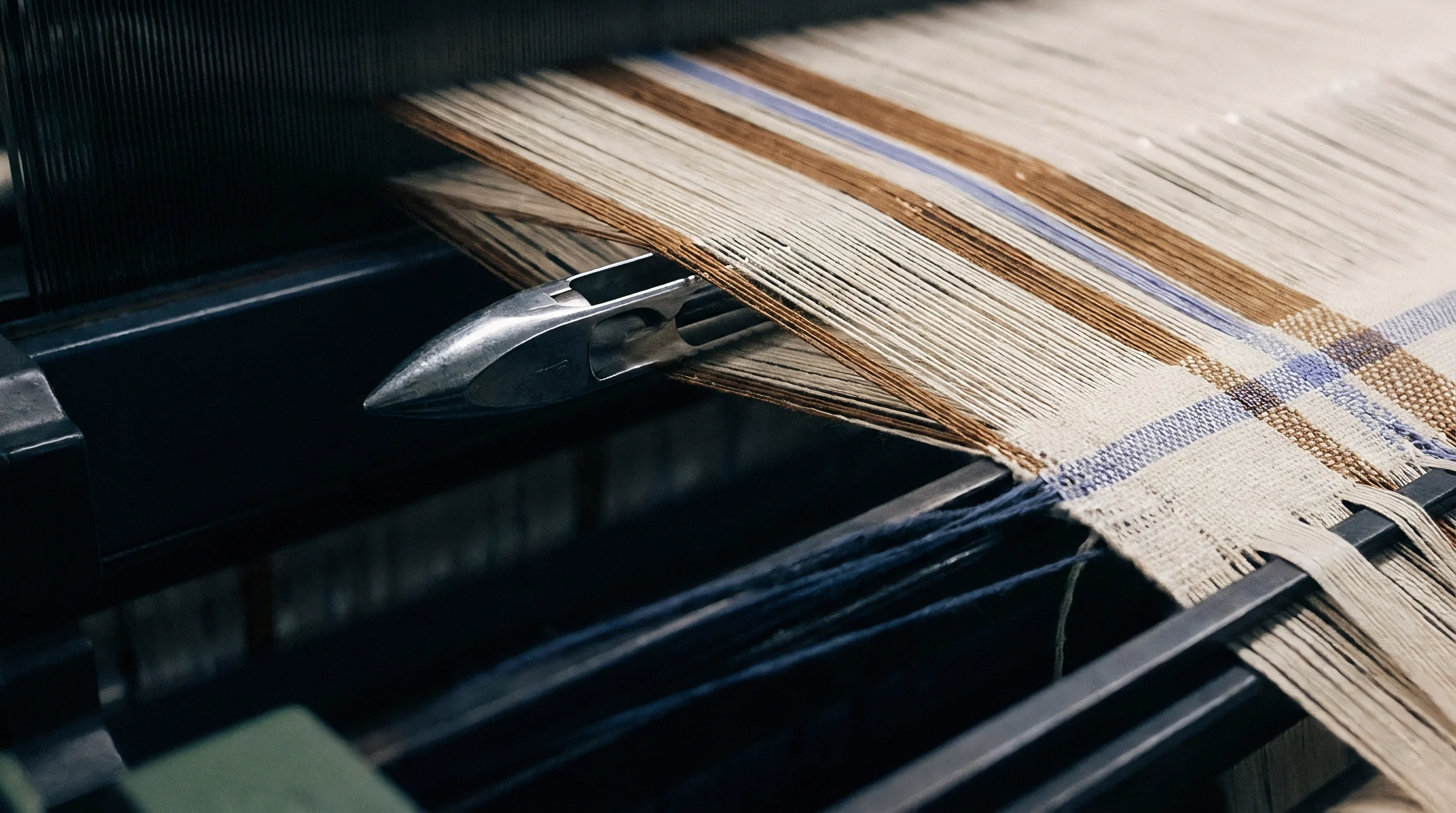
Crimp
Longitudinal extension straightens the axial core elements while simultaneously forcing the filling to buckle into deeper undulations. This mechanical interdependence is crimp interchange. In a balanced square plain weave with forty ends and forty picks per centimetre, initial crimp values hover near eight percent in both yarn systems.
Applying warp tension stretches the warp yarns toward zero crimp. The crimp angle drops. To accommodate the straightened path of the longitudinal yarn, the weft yarn must bend around the taut warp filaments, elevating weft crimp beyond fourteen percent.
The warp ends straighten. As the filling picks assume a higher crimp amplitude, their center-to-center lateral distance decreases under the drawing force of the loom take-up or finishing stenter. Lateral contact increases.
This transverse packing forces adjacent picks together, pinching the interstitial apertures shut along the machine direction. The structural shift alters both the mechanical modulus and fluid transfer dynamics of the technical cloth.

Can Yarn Flattening Counteract Crimp Exchange?
Monofilament polyester structures display cross-sectional aspect ratios shifting from 1.05 to 1.32 during uniaxial extension. Transverse compressive stresses generated at the interlacing knuckles flatten the round filaments into ellipses. Flattening broadens the effective yarn width, covering open space within the aperture windows.
Even if pick spacing were maintained mechanically, filament flattening alone reduces pore width by up to fifteen percent. When flattening pairs with crimp interchange, pore collapse accelerates exponentially.
- Tension onset initiates immediate elastic elongation in warp yarn segments between interlacing points, consuming initial slack within thirty milliseconds.
- Crown depression forces the warp yarn knuckle downward, transferring transverse bending energy directly into the intersecting weft filament.
- Transverse jamming occurs when adjacent weft yarns reach physical contact, locking the construction against further lateral compaction.
The rate of crimp exchange varies across weave architectures. Plain weaves generate the highest normal contact forces at yarn intersections, resulting in rapid pore constriction under low tension values. Twill weaves, containing longer floats between binding points, show delayed pore collapse because float segments absorb lateral displacement without immediate knuckle jamming.
| Tensile Load (N/cm) | Warp Crimp (%) | Weft Crimp (%) | Pore Length (μm) | Pore Width (μm) | Open Area (%) |
|---|---|---|---|---|---|
| 0 | 8.2 | 8.4 | 120 | 118 | 24.6 |
| 15 | 5.1 | 10.8 | 128 | 98 | 21.8 |
| 30 | 3.0 | 13.2 | 134 | 76 | 17.7 |
| 45 | 1.4 | 15.6 | 139 | 54 | 13.0 |
| 60 | 0.5 | 17.1 | 142 | 38 | 9.4 |
Tighter warp pull always crowds the crosswise yarns into tighter contact until the structural locking limit stops all further interstitial reduction.

Load
Uniaxial longitudinal force pulls the interlacing intersections into severe structural asymmetry. When tensile testers exert pull along the machine direction, the transverse dimensions contract naturally according to fabric Poisson ratios, which frequently exceed 0.5 in loosely sett textiles. This Poisson contraction pulls the selvedges toward the centerline, accelerating weft compaction.
Biaxial tensioning fixtures isolate these variables, proving that clamping weft pins to prevent lateral contraction preserves open area longer than unconstrained processing lines.
Poisson Contraction Ratios across Weft Directions
Lateral necking reduces the total width of the bolt on processing lines. In open web handling across guide rolls, web tension reaches seventy to one hundred Newtons per metre. The inter-yarn gap narrows.
Without stenter pin chains holding crosswise dimension, transverse shrinkage compresses picking margins by three to five percent across the production width. This width loss corresponds to a reduction in mean pore hydraulic diameter from ninety-five microns down to sixty-two microns. Tension flattens the crown.
Compliance with ISO 9237 air permeability limits at two hundred Pascals fails when finishing stenter tension exceeds fifty Newtons per metre.
The contraction coefficient depends on the ratio of warp modulus to weft modulus. Highly oriented warp yarns resist axial deformation, transmitting line tension directly into knuckle depression. Softer or lower-modulus weft yarns yield under this transverse compression, flattening across the inter-yarn voids and accelerating pore shut-off.
Worked Calculation of Interstitial Area Reduction
Assume a precision monofilament polyester filter specification with fifty ends per centimetre and fifty picks per centimetre. Filaments measure one hundred microns in diameter. In an unconstrained, zero-load state, yarn spacing equals two hundred microns center-to-center.
Subtracting yarn diameter yields a square pore measuring one hundred microns by one hundred microns, giving a clean initial pore area of ten thousand square microns.
Subject this construction to forty Newtons per centimetre of warp tension on a continuous processing range. Tensile extension straightens the warp yarns, extending pick spacing along the machine direction by six percent to two hundred twelve microns. The clamp pressure holds.
Decrimping concurrently depresses the warp crown, forcing the weft picks into higher crimp amplitude and dragging adjacent warp yarns closer together through transverse Poisson contraction. The effective weft spacing compresses by eight percent down to one hundred eighty-four microns.
Normal pressure at interlacing intersections compresses the round monofilaments into ellipses. Warp yarns widen laterally to one hundred eight microns. Weft yarns flatten vertically, spreading laterally to one hundred six microns.
The new machine-direction pore length equals two hundred twelve microns minus one hundred six microns, leaving one hundred six microns. The new cross-direction pore width equals one hundred eighty-four microns minus one hundred eight microns, leaving seventy-six microns. Multiplying one hundred six microns by seventy-six microns yields an active interstitial area of eight thousand fifty-six square microns.
The resulting geometric distortion shifts the pore opening from a square window into an elongated, narrow slit having twenty-eight percent lower open space.

Flow
Air permeability measured under ISO 9237 at two hundred Pascals drops as longitudinal extension climbs. Airflow falls immediately. The hydraulic diameter of textile pores governs fluid conductance in accordance with the Darcy-Weisbach formulation, meaning flow resistance scales inversely with the fourth power of equivalent pore radius.
A ten percent reduction in effective aperture size reduces fluid volume throughput by more than thirty percent under laminar conditions. Fluid breakthrough pressure spikes.
In liquid filtration operations, particle retention thresholds shift dramatically under line pull. A cloth engineered to reject seventy-micron silica slurry particles under static bench conditions allows elongated eighty-micron particles to pass when tensile pull distorts pores into rectangular slits. Off-axis leakage escalates.
While the total surface area of open space contracts, the longitudinal axis of the aperture widens slightly, permitting asymmetric particulate penetration along the stretched boundary.
Warp extension inevitably transfers transverse compressive loads onto weft cross-sections, forcing square interstices into restrictive rectangular slits.
Are Jammed Interlacings Susceptible to Pressure Surges?
High hydrostatic heads force fluid across boundary boundaries when tension locks the cross-threads into rigid lateral contact. Bubble point tests conducted according to ASTM F316 demonstrate that initial bubble breakthrough pressure rises by forty percent when warp strain reaches three percent. Pore volume decreases rapidly.
The liquid displacement occurs at higher differential pressures because the smallest pore dimension dictates the capillary meniscus stability.
- Bubble point pressure rating increases from 2.4 kilopascals to 3.8 kilopascals under tension, indicating severe constriction of the critical minimum pore diameter.
- Permeation flux rate decays nonlinearly across three minutes of progressive mechanical loading, stabilizing at thirty-five percent of baseline volume.
- Filter cake compressibility intensifies as the distorted mesh surface creates uneven boundary layer shear, clogging narrow slit openings.
- Off-axis bypass leakage emerges along selvedge borders where tension differentials create local shear distortion and irregular aperture opening.
Filtration efficiency climbs. Fine dust retention increases under static air permeability tests, but pressure drop across the filter medium escalates simultaneously, demanding higher blower energy to sustain target cubic feet per minute.
| Warp Strain (%) | Air Permeability (L/m²/s) | Hydraulic Diameter (μm) | Bubble Point (kPa) | Euler Flow Coefficient |
|---|---|---|---|---|
| 0.0 | 1420 | 84.2 | 2.15 | 0.48 |
| 1.0 | 1240 | 76.5 | 2.48 | 0.54 |
| 2.0 | 980 | 65.8 | 3.02 | 0.66 |
| 3.5 | 640 | 51.3 | 4.10 | 0.89 |
| 5.0 | 410 | 38.9 | 5.45 | 1.18 |
Whether high-pressure fluid flow dynamically opens clamped pores during continuous inline processing remains unresolved across industrial filtration research.
Calender
Heated steel bowls running at thirty bar nip line force fix the distorted geometry before winding. When technical textiles undergo continuous thermo-mechanical finishing, warp tension applied upstream of the nip permanently sets the crimp interchange. Operating the calender or stenter line without precise load-cell closed-loop tension control freezes the collapsed pore shape into the finished roll.
The cutter rejects the roll. Once polyester or polyamide passes through the glass transition zone under warp load, cooling locks the elongated, pinched apertures into place, rendering the pore reduction irreversible.
Tension applied along warp yarns flattens structural arches and eliminates clearance at interlacing intersections.
Finishing mills lacking multi-zone tension telemetry routinely introduce significant roll-to-roll variation in filtration ratings. The finishing stenter sets tension. If the unwinding brake applies eighty Newtons while the rewinder exerts one hundred twenty Newtons, the air permeability of the outer roll layers diverges by up to twenty-five percent from the core layers.
The resulting substrate fails incoming quality audits at industrial filtration converters despite using identical greige yarn and reed configurations.
Thermal stabilization under relaxed tension restores a portion of the original pore symmetry. Running overfeed zones at positive three percent on the pin stenter relieves warp stress, allowing thermal shrinkage to restore weft spacing and reopen squeezed interstitial windows. This procedure increases cost per finished metre by slowing production line speed from twenty-five metres per minute down to fourteen metres per minute, adding fifteen cents per linear metre to conversion costs.
Inserting a clause defining maximum pore dimensional shift under five percent extension in accordance with ISO 9073-3 forces the finisher to calibrate stenter overfeed before issuing commercial compliance certificates.