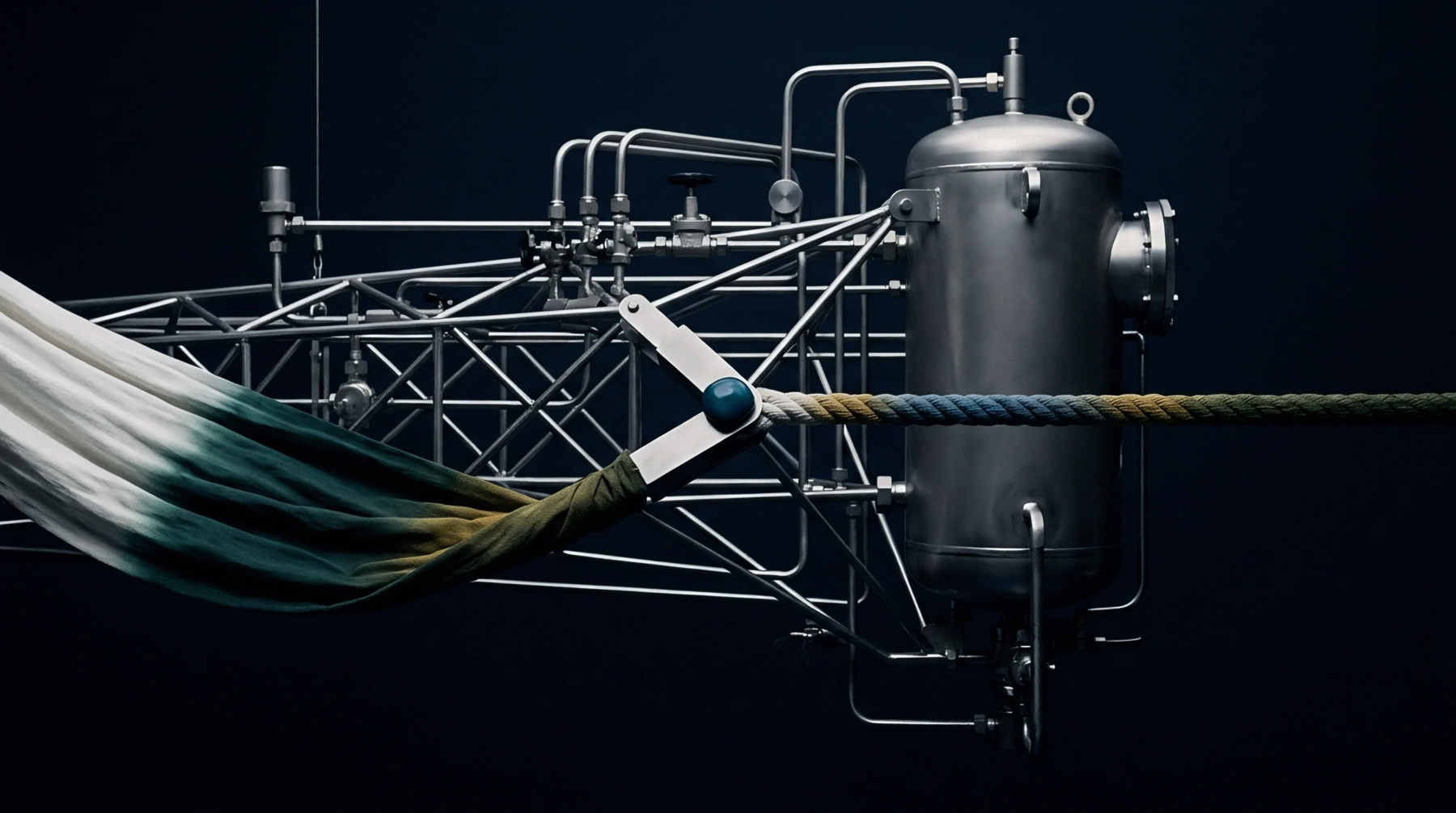
Modeling Hydrolyzed Reactive Dye Diffusion Resistance in High Cover Factor Cotton Twills
High cover factor twills restrict intra-yarn mass transport, requiring wash-off temperatures above 85 degrees Celsius to desorb trapped hydrolyzed reactive dye.
Pressure gradients exerted between adjacent strands during wet processing constitute the physical environment for internal liquid displacement. Inter-yarn hydraulics define how aqueous solutions migrate laterally through a textile structure when subjected to mechanical compression or capillary suction. This phenomenon governs the uniformity of chemical distribution throughout dense warp or weft alignments.
It applies strictly to the period of saturation and extraction within finishing equipment where fluid dynamics dictate final penetration depths. The boundary of this physical effect terminates at the air-water interface of the surface fibers where evaporation takes over.
Variations in local density create zones of unequal resistance that impede or accelerate the flow of finishing agents. Inter-yarn hydraulics respond to these differences by shifting liquor from high-pressure compressed areas toward lower-pressure channels formed by loose interlacing points. Dense twill patterns inhibit free passage more effectively than open basket weaves.
Factories monitor these flow paths to predict striping defects that emerge when dye baths fail to reach the core of thick construction bundles. Excessive turbulence during padding operations forces liquid into these interstitial gaps at speeds that disrupt the intended concentration gradients. Stabilizing this movement prevents the mottling often found on heavier weight fabrics processed on high-speed continuous ranges.
Textile engineers quantify the efficiency of this transfer by measuring the uptake ratio against the structural porosity of the base material. Inter-yarn hydraulics represent a dynamic equilibrium established between the viscosity of the treatment solution and the tortuosity of the path created by twisted filaments. Low viscosity fluids move with minimal friction through these microscopic tunnels.
High viscosity pastes accumulate at the intersection of warp and weft components instead of penetrating the internal matrix. This resistance forms a measurable drag factor that dictates the maximum throughput speed of the impregnation zone. Adjusting the squeeze pressure on the calendar rollers alters the width of these channels and forces a redistribution of the remaining volume.
Accurate control over these variables maintains consistency across wide fabric widths.
Testing labs verify the performance of these dynamics by observing the rate of capillary rise under controlled atmospheric conditions. Inter-yarn hydraulics characterize the difference between bulk absorption and superficial coating during standardized immersion trials. Technicians place specific fabric swatches into solutions containing tracer dyes to visualize the internal path of the liquid.
Those samples displaying clear lines of migration indicate successful fluid penetration through the depth of the weave. Poor saturation results in a distinct white core that indicates the failure of the chemistry to reach the internal fibers before the setting stage. Uniform color intensity throughout the cross section confirms that the treatment successfully penetrated the structure without leaving stagnant pockets.
The total volume of captured liquid remains proportional to the interstitial void space available for occupation during the dwell time. Mechanical force acting on saturated filaments ensures the total replacement of residual air pockets with processing liquor.
High cover factor twills restrict intra-yarn mass transport, requiring wash-off temperatures above 85 degrees Celsius to desorb trapped hydrolyzed reactive dye.
Expertise is a utility, not a secret. sentiention™ publishes its working knowledge as open reference: intelligence layer covering the materials it sources, the markets it enters, and the reference that serves both.