Cellulosic Fragment Identification Protocols in Recycled Ternary Yarn Solvent Extraction Residues
Fragment identification via FTIR deconvolution and selective staining corrects quantitative solvent extraction errors in recycled ternary yarn analysis.
Fraction
Post-consumer mechanical shredding degrades cotton and regenerated fibers long before yarn spinning begins. When garments blended from cotton, viscose, and polyester are shredded into staple stock, garnetting cuts and fibrillates long polymer chains. Virgin upland cotton exhibits an average degree of polymerization from 2,000 to 2,400, compared to 400 to 800 for modal and lyocell.
After aggressive garnetting, chain lengths in post-consumer cotton fragments drop into the 350 to 600 range. That drop alters the thermodynamic solubility of the cellulosic material, leaving short fragments far more susceptible to chemical dissolution than virgin fiber.
Cellulosic components in recycled tri-component systems do not behave as homogeneous chemical phases. In a ternary yarn composed of post-consumer cotton, lyocell, and recycled polyethylene terephthalate, micro-structural non-uniformity alters extraction rates. Rotor and ring spinning deposit short, damaged cellulosic micro-fragments unevenly across the yarn cross-section.
Fine fibrillar debris, or micro-dust, concentrates in the interstitial spaces between synthetic carrier filaments. Fiber length distribution in garnetted stock forms a bimodal curve, where intact staple fibers exceeding 20 millimeters coexist with cellulosic fragments shorter than 500 micrometers.
Mechanical Degradation Profiles
Tearing shredded garments breaks long polymer chains, dropping the degree of polymerization of virgin cellulose from over two thousand to four hundred. Rotary rag-tearing machinery subjects individual fibers to tensile stress, shear, and transverse impact. Native cotton fibers possess a hierarchical morphology ~ a primary cell wall, a secondary wall of spiraling cellulose microfibrils, and a central lumen.
Garnetting strips away this protective primary wall, exposing the crystalline secondary wall directly to environmental degradation and chemical reagents.
Lacking a natural cell wall hierarchy, regenerated cellulosic fibers respond to mechanical stress by splitting longitudinally and fibrillating at the surface. Highly oriented lyocell filaments split into micro-fibrils under friction, while skin-core viscose filaments lose their outer protective skin during mechanical recycling. Without tight thermal control, chemical selectivity breaks down, so post-consumer ternary yarns arrive at analytical laboratories with variable amorphous content, damaged crystal lattices, and exposed surface area.
Standard dissolution protocols designed for pristine virgin fibers fail to handle these kinetic shifts.

Phase Segregation in Shredded Stock
Differences in fiber strength cause short staple fragments to concentrate near the outer surface of rotor-spun yarns. During open-end rotor spinning, short cellulosic debris accumulates in the rotor groove, forming dense periodic clusters within the yarn core. In ring-spun ternary yarns, shorter fragments migrate toward the periphery during hairiness generation.
This uneven distribution creates localized composition changes along a single yarn package, so sampling errors escalate quickly when laboratories cut small swatches without pre-homogenizing the specimen.
During primary solvent extraction, the physical location of cellulosic fragments dictates how quickly reagents penetrate. Synthetic components like polyester or polyamide often shield inner cellulosic fragments from immediate contact with aqueous solvents, while fine micro-dust on the yarn exterior dissolves much faster than the thermodynamic baseline for intact fibers. Analysts evaluating recycled tri-component systems need structural baseline metrics before applying standard separation protocols.
Short fiber fragments detected in insoluble residues can reflect standard processing loss rather than unseparated raw material.

Reagent
Quantitative separation protocols under ISO 1833 depend on precise chemical dissolution kinetics between distinct fiber families. In a ternary blend of cotton, regenerated cellulose, and polyester, testing relies on step-wise solvent extraction. Standard quantitative separation uses concentrated formic acid and zinc chloride reagents to dissolve regenerated cellulosics, followed by concentrated sulfuric acid or boiling solvents to isolate cotton or synthetic components.
Mechanically degraded post-consumer fragments undermine this selectivity by dissolving outside their calibrated temperature and concentration windows.
Standard solvent systems target specific inter-chain interactions. Formic acid combined with zinc chloride breaks hydrogen bonds within amorphous cellulose regions, taking regenerated cellulosics like viscose and cuprammonium into solution. But when cotton suffers severe mechanical damage during garnetting, its crystalline structure collapses into short amorphous segments.
Concentrated zinc chloride attacks these damaged zones, partially dissolving native cotton while removing regenerated cellulosics. That cross-dissolution systematically underestimates true cotton content while overstating the regenerated fraction.
Do Residual Cellulosic Fibrils Survive Formic Acid Extraction?
Concentrated zinc chloride solutions intended for viscose removal frequently attack severely degraded cotton core structures. Concentration purity defines the threshold of chemical dissolution. Standard ISO 1833-6 reagents specify 20 grams of anhydrous zinc chloride dissolved in 68 grams of 85 percent formic acid and 12 grams of water.
Bath temperature must stay at 40 degrees Celsius within plus or minus 0.5 degrees Celsius. If temperature drifts to 43 degrees Celsius, the dissolution rate of crystalline cotton increases by 14 percent, driving cotton mass into the liquid phase.
Small fragments pass through coarse frits. Conversely, post-consumer regenerated cellulosic fibers bearing durable finishes, fluorine-free water repellents, or durable press resins like dimethyloldihydroxyethyleneurea hinder solvent penetration. Cross-linked fragments resist zinc chloride dissolution entirely, remaining in the insoluble residue alongside polyester or acrylic components.
Analysts must apply micro-chemical pre-treatments, such as hot dilute hydrochloric acid strip cycles, to remove resin finishes before solvent extraction.
Concentrated formic acid containing zinc chloride dissolves regenerated cellulosic fibers within twenty minutes at forty degrees Celsius when liquor ratio equals one to one hundred.
Solvent Selectivity Limits
Temperature fluctuations during dissolution alter reaction kinetics beyond standard tolerances. Cold sodium zincate protocols present an alternative for separating regenerated cellulose from native cotton. Prepared by dissolving zinc oxide in concentrated sodium hydroxide at sub-zero temperatures, sodium zincate dissolves viscose and modal at minus 5 degrees Celsius while leaving native cotton largely intact.
However, damaged cotton fragments with low degrees of polymerization show partial solubility even in cold zincate, making thermal control across the bath critical to test accuracy.
Alternative solvent systems, such as dimethylacetamide with lithium chloride or cupriethylenediamine, face similar constraints on recycled ternary mixtures. Dimethylacetamide containing 8 percent lithium chloride dissolves native cotton completely, leaving polyester intact. If the mixture contains acrylic or polyacrylonitrile filaments, however, lithium chloride complexes interact with nitrile groups, causing swelling and partial mass loss into the liquid phase.
Choosing reagent chemistry therefore requires knowing every synthetic and natural component in the yarn matrix beforehand.
Chemical reagent selection must match the degradation state and finish history of incoming recycled ternary yarns:
- Zinc Chloride Formic Acid System dissolves regenerated cellulosics rapidly at elevated temperatures, but causes up to four percent cross-dissolution in severely damaged post-consumer cotton fragments.
- Cold Sodium Zincate Reagent provides superior selectivity for undamaged virgin fibers, but requires sub-zero thermal control to prevent premature crystallization of sodium hydroxide salts.
- Seventy Five Percent Sulfuric Acid selectively dissolves native cotton and viscose at room temperature, but attacks nylon 6 and nylon 66 components in synthetic tri-component mixtures.
- Boiling Dimethylformamide Solvent strips acrylic and polyurethane filaments from residue mats, but presents high toxicity hazards and demands closed-loop solvent recovery apparatus.
- Cupriethylenediamine Hydroxide Solution enables precise intrinsic viscosity measurements, but oxidizes rapidly in ambient oxygen, distorting baseline cellulosate mass measurements.
Because mass loss directly alters tariff classification, laboratories operating without precise environmental controls experience significant variance in measured composition ratios. Selecting inappropriate reagents without preliminary fiber screening systematically skews quantitative results and destroys transaction margins.
| Reagent System | Target Phase | Temperature Limit | Primary Cellulosic Reaction | Interference Mechanism |
|---|---|---|---|---|
| ISO 1833-6 Zinc Chloride Formic Acid | Viscose Modal Lyocell | 40.0 °C (± 0.5 °C) | Cleaves hydrogen bonds in amorphous cellulose regions | Attacks low DP post-consumer cotton fragments (up to 4% mass loss) |
| Cold Sodium Zincate (10% NaOH / 1% ZnO) | Regenerated Cellulosics | -5.0 °C (± 0.2 °C) | Forms soluble zincate-cellulose complexes | Precipitates salt crystals if temperature drifts above 0 °C |
| 75% Mass Fraction Sulfuric Acid | Cotton and Regenerated Cellulose | 20.0 °C (± 1.0 °C) | Hydrolyzes cellulose glucosidic bonds into soluble sugars | Partially hydrolyzes polyamide 66 filaments during extended contact |
| Concentrated Cupriethylenediamine | Total Cellulosic Fraction | 25.0 °C (± 0.5 °C) | Coordinates copper amine complexes with hydroxyl pairs | Oxidizes in open atmosphere, reducing measured intrinsic viscosity |

Sieve
Isolating undissolved micro-fragments from chemical liquors demands tight control over filtration pore size. During quantitative solvent extraction of recycled ternary yarns, dissolving target fiber phases generates a suspension of fine cellulosic particles. Standard analytical methods use sintered glass filtration crucibles to capture undissolved residues.
ISO pore size class 3 crucibles, with nominal pore diameters between 16 and 40 micrometers, serve as the benchmark. Mechanically garnetted fragments, however, regularly drop below 15 micrometers in length, passing straight through class 3 filter pores into waste liquor.
When micro-fragments escape through filter pores, the measured mass of undissolved residue drops, creating an artificial deficit in the reported mass fraction of that component. Conversely, finer filters like ISO pore size class 4 (diameters between 4 and 10 micrometers) cause severe blinding. Gelatinous regenerated residues and degraded cotton micro-fibrils quickly clog glass pores, forming an impermeable filter cake over class 4 frits that stops liquid drainage and prevents thorough chemical washing.

Filtration Mechanics and Mass Transfer
Glass frits with nominal pore diameters between fifteen and forty micrometers capture intact fibers while letting liquid reagents pass. Mechanical agitation during extraction breaks fragile, degraded fibers into smaller fragments. Analysts operating vacuum filtration systems must calibrate pressure differentials precisely: excessive vacuum exceeding 20 kilopascals forces deformable cellulosic fibrils through tortuous pore pathways inside the frit.
Vacuum pressure should remain at a gentle 5 to 10 kilopascals to retain fibrillar fragments without compacting the filter cake.
Applying ISO 1833-1 filtration guidelines without coarse pre-filtering leads to glass frit blinding and introduces gravimetric errors up to three percent.
Standard laboratory workflows implement double-rinsing with boiling distilled water to eliminate inorganic solvent salt deposits. Residual zinc chloride or sulfuric acid trapped within the filter cake adds artificial mass to the final dry residue tare. Liquid wash cycles must balance complete reagent removal against fragment erosion, as excessive washing with high-velocity water jets dislodges trapped micro-fragments from the upper surface of the glass frit, carrying them into the filtrate receiver.

Gravimetric Tare Stabilization
Desiccation protocols prior to final weighing dictate whether laboratory results reflect true dry material mass. Sintered glass crucibles containing cellulosic and synthetic residues absorb moisture rapidly upon removal from drying ovens. Cellulose exhibits a dry moisture regain rate exceeding 8 percent under standard laboratory conditions of 20 degrees Celsius and 65 percent relative humidity.
Weighing crucibles without vacuum desiccation introduces substantial positive mass errors into gravimetric balance calculations.
Recovering undissolved micro-fragments requires strict execution to maintain analytical accuracy across sample series:
- Dry sintered glass filter crucibles in a forced-air oven at 105 degrees Celsius for two hours to establish absolute baseline tare mass.
- Transfer hot crucibles directly into a sealed desiccation chamber charged with freshly activated silica gel, cooling for 45 minutes under ambient pressure.
- Weigh crucibles on an analytical balance reading to 0.1 milligrams immediately upon removal from desiccation to capture stable dry tare mass.
- Pour solvent extraction slurry through the conditioned filter crucible under controlled vacuum pressure held continuously between 5 and 10 kilopascals.
- Rinse filter residue cake with three successive 50-milliliter portions of boiling deionized water to remove residual zinc salts and acidic reagents.
- Dry crucible containing final residue at 105 degrees Celsius until mass constancy is achieved across consecutive weighings spaced 30 minutes apart.
Because oven drying requires strict temperature stability, gravimetric errors propagate directly into commercial invoices when large fabric shipments clear on laboratory certificates. Incorporating ISO 1833 Annex B filtration retention mandates into purchase agreements forces processing mills to absorb retesting expenses when residue drift exceeds point five percent.

Stain
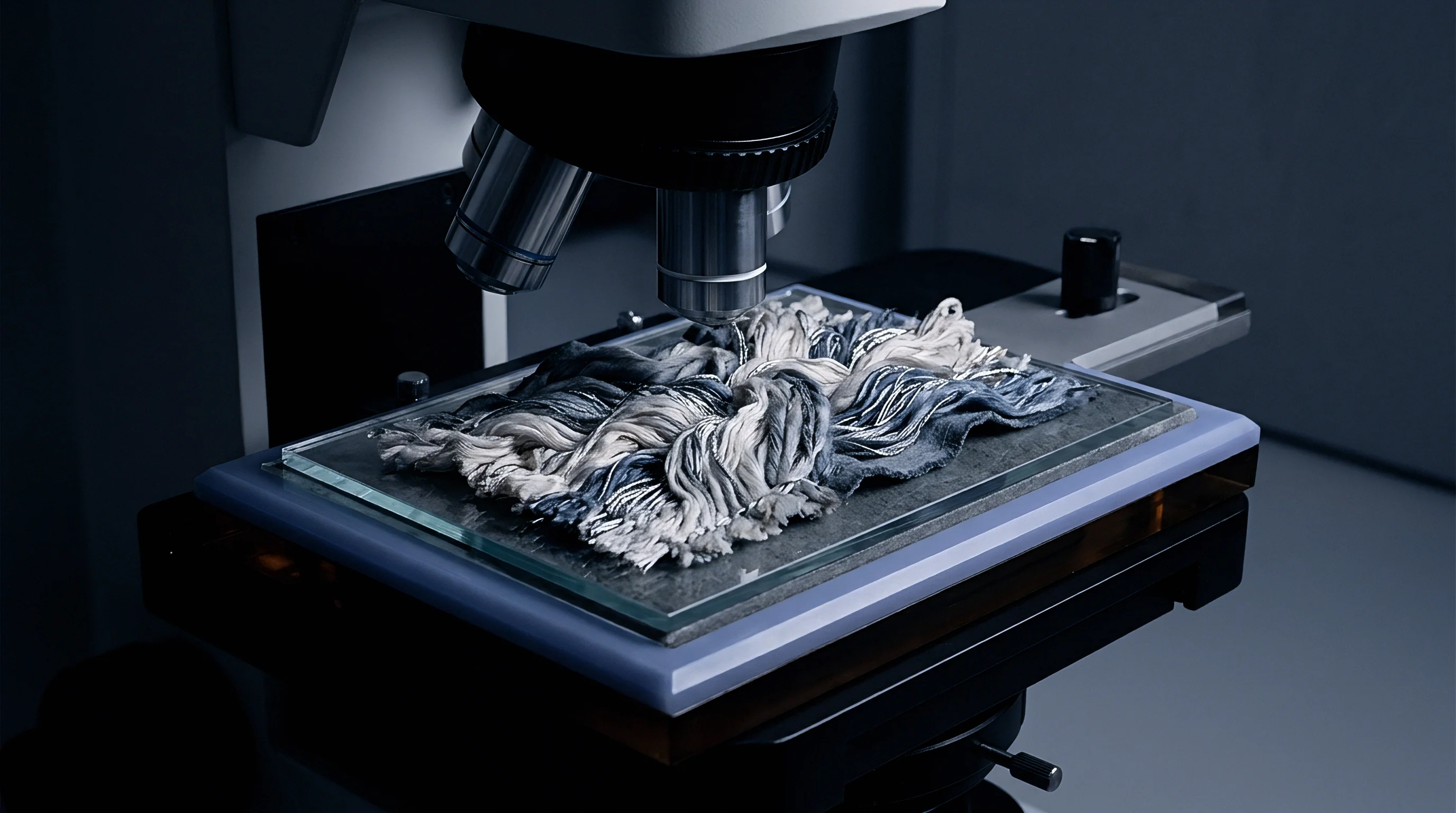
Optical micro-analysis offers direct visual confirmation when chemical extraction leaves unseparated organic residues. Sintered glass filtration captures insoluble residues containing synthetic filaments mixed with unseparated cellulosic fragments. Distinguishing native cotton fragments from regenerated viscose or lyocell fibrils within an extracted mat requires differential micro-staining.
Plain light microscopy cannot differentiate a degraded, surface-damaged cotton fiber from an amorphous viscose fragment once both have lost their original surface morphology during mechanical recycling and aggressive chemical treatment.
While polarized light microscopy exposes structural orientation, chemical stain reagents exploit fundamental differences in crystalline structure, hydroxyl group accessibility, and internal surface area between cellulose polymorphs. Native plant cellulose exists primarily in the Cellulose I crystal structure, with parallel polymer chain arrangements. Regenerated cellulose, formed through dissolution and re-precipitation, exists in Cellulose II, where anti-parallel chain packing dominates.
Staining protocols deliver distinct colorimetric responses when reagents bind to these contrasting configurations.

Differential Colorimetry Protocols
Zinc chloride and iodine formulations react differently with primary plant cell walls than with regenerated cellulose structures. Herzberg stain reagent, prepared by combining saturated zinc chloride solution with iodine and potassium iodide, serves as a primary diagnostic tool for fragment identification. Applied to insoluble residue fragments, Herzberg reagent stains native cotton fibers dark wine-red or purple, whereas regenerated viscose and lyocell absorb iodine deeply, turning dark blue or bluish-violet.
Synthetic components like polyester or acrylic remain unstained and colorless under identical conditions.
High crystalline native cotton fibers resist mild alkaline dissolution, whereas amorphous regenerated fibrils yield readily to cold zincate treatment.
Simons stain protocols offer finer differentiation between fibrillated cellulosic fragments. Using a dual-dye mixture of Direct Blue 1 and Direct Orange 15, Simons stain evaluates internal surface area accessibility. Direct Orange 15 has a large molecular weight and binds preferentially to damaged, highly accessible fibrillar regions with abundant hydroxyl groups.
Direct Blue 1, with its smaller molecular footprint, penetrates tight crystalline spaces within undamaged cotton secondary walls. Highly fibrillated lyocell micro-fragments turn intense orange, while intact cotton core fragments display a distinct blue coloration.

Infrared Micro-Spectroscopy Deconvolution
When dye absorption from residual dark dyestuffs makes staining ambiguous, attenuated total reflectance Fourier-transform infrared spectroscopy (ATR-FTIR) provides clear molecular structure identification by resolving crystal lattice differences between Cellulose I and Cellulose II. ATR-FTIR micro-spectroscopy maps individual micro-fragments isolated from residue mats, generating localized absorption spectra across the 4,000 to 600 wave-number range.
The spectral region between 1,500 and 890 wave-numbers contains critical diagnostic absorption bands for cellulosic polymorph identification. Native cotton (Cellulose I) displays a sharp, dominant absorption peak at 1,420 wave-numbers ~ corresponding to the CH2 symmetric bending vibration ~ alongside a minor peak at 893 wave-numbers. Regenerated cellulose (Cellulose II) exhibits a shifted spectrum: the 1,420 wave-number peak broadens and loses intensity, while the absorption band at 893 wave-numbers (C1-O-C1 asymmetric stretching at glucosidic linkages) intensifies dramatically.
Quantifying the peak height ratio between 1,420 and 893 wave-numbers yields a crystallinity index (CI-1) defining the proportion of native plant cellulose remaining in the solvent residue.
Analytical errors during cellulosic fragment identification arise from specific procedural and structural interferences:
- Resin Masking Errors occur when residual durable press resins inhibit iodine stain absorption, causing regenerated cellulose fragments to appear erroneously as unstained synthetic filaments.
- Thermal Degradation Shifts alter infrared absorption spectra, causing severely heat-damaged cotton to display broadened 1,420 wave-number peaks that mimic Cellulose II regenerated profiles.
- Cross-Sectional Distortion caused by mechanical shredding flattens round synthetic filaments, producing artifacts that resemble flat, ribbon-like native cotton lumens under plain light microscopy.
- Dye Extraction Interference develops when dark post-consumer dyestuffs bleed into testing reagents, shifting observed colorimetric hues away from standard diagnostic charts.
- Birefringence Quenching happens when residual chemical solvents swell cellulosic fragments, temporarily collapsing molecular orientation and neutralizing optical polarization patterns under cross-polarized light.
Because residual resins distort infrared spectral bands, analysts must systematically eliminate external contamination before confirming component ratios. Fibers showing dark blue core staining under iodine reagents are treated as native plant material, whereas uniform yellow coloration signals a regenerated structure.
| Cellulosic Phase | Herzberg Stain Response | Simons Stain Color | Dominant FTIR Absorption Bands | Cross-Sectional Geometry |
|---|---|---|---|---|
| Native Cotton (Cellulose I) | Wine Red / Dark Purple | Dominant Blue (Direct Blue 1) | 1420 cm⁻¹ (Sharp), 1055 cm⁻¹, 893 cm⁻¹ (Weak) | Kidney-bean shape with central lumen cavity |
| Viscose (Cellulose II) | Dark Blue / Violet | Mixed Blue-Orange | 1418 cm⁻¹ (Broad), 1160 cm⁻¹, 893 cm⁻¹ (Strong) | Serrated irregular skin-core perimeter |
| Lyocell (Cellulose II Crystalline) | Deep Blue-Violet | Intense Orange (Direct Orange 15) | 1415 cm⁻¹ (Broad), 1022 cm⁻¹, 893 cm⁻¹ (Dominant) | Smooth circular or oval cross-section |
| Mechanically Damaged Cotton | Pale Purple / Mottled | Orange Fibrils with Blue Core | 1420 cm⁻¹ (Shifted), 1315 cm⁻¹, 893 cm⁻¹ (Moderate) | Flattened ribbon with split micro-fibrillar edges |

Balance
Quantitative calculation models require baseline mass adjustments to account for incomplete solvent extraction. In a ternary yarn system containing post-consumer cotton, regenerated lyocell, and recycled polyester, establishing absolute component mass fractions demands multi-stage mass balance calculations. When chemical extraction leaves unseparated cellulosic fragments within the insoluble residue, simple gravimetric weighing overstates synthetic filament content.
Mathematical correction factors must be integrated into mass balance equations to reallocate residual cellulosic masses back to their respective fiber accounts.
Uncorrected moisture regain assumptions distort synthetic fiber percentage calculations across high-humidity transit cycles. Standard commercial mass calculations apply fixed moisture regain values established in national and international standards. Official regain allowances set native cotton at 8.5 percent, viscose and modal at 13.0 percent, lyocell at 11.5 percent, and polyester at 0.4 percent.
Mechanically degraded post-consumer fragments exhibit significantly lower moisture regain capacities than virgin fibers. Applying standard regain percentages to damaged cellulosic residues introduces systematic mass calculation errors up to 1.8 percent across total shipment volume calculations.
Mass Correction Formulas
Mathematical adjustments compensate for material losses during intermediate wash stages. The baseline equation for calculating the dry mass fraction of insoluble residue (Pr) relative to total dry starting specimen mass (m0) relies on direct gravimetric measurements ~ a point eight percent mass discrepancy occurs when drying temperature varies by two degrees Celsius. When solvent cross-dissolution occurs, the corrected dry mass of native cotton (mc) is calculated using chemical correction factors (d1 and d2) derived from parallel extraction runs on pure fiber reference specimens.
The mathematical formulation governing component mass balance correction across a tri-component solvent extraction sequence is structured as follows:
First, establish the uncorrected dry mass of insoluble residue mat (mr) following target solvent treatment:
mr = mcrucible+residue – mcrucibletare
Next, adjust total starting dry specimen mass (m0) for preliminary solvent extractable finishes, wax coatings, and elastomeric sizing agents using loss factor (S):
mclean = m0 × (1 – S)
Where optical microscopy and FTIR deconvolution reveal that insoluble residue mass (mr) contains a residual fraction of cellulosic fragments (αcell) alongside clean synthetic polyester filaments (mpet), calculate the true synthetic mass fraction (PPET) using corrected dissolution retention factor (dPET):
mpet = mr × (1 – αcell) × dPET
PPET = left( fracmpetmclean right) × 100
The remaining mass fraction is reallocated to native cotton and regenerated cellulosic components by solving simultaneous linear equations derived from differential FTIR peak height ratios (I1420/I893) measured directly across residue micro-fragments.

Worked Residue Reconstruction
A fifty-gram test lot of post-consumer tri-component yarn undergoes triple solvent extraction under strict thermal monitoring. Declared composition reads 40 percent recycled cotton, 30 percent lyocell, and 30 percent recycled polyester. Analytical sampling yields an absolute dry specimen mass (m0) of 10.0000 grams following oven conditioning at 105 degrees Celsius.
Solvent extraction stage one applies ISO 1833-6 zinc chloride/formic acid reagent at 40 degrees Celsius to selectively dissolve lyocell. The dried insoluble filter residue (mr1) weighs exactly 6.8200 grams.
Microscopic analysis of residue mr1 using Herzberg staining reveals that zinc chloride extraction failed to dissolve all lyocell fragments due to heavy resin finishing on the post-consumer stock. FTIR deconvolution indicates that residue mr1 contains 8.5 percent undissolved lyocell fragments (αlyocell = 0.085) entangled within the cotton and polyester matrix. Without correction, gravimetric calculation would report lyocell content as 31.8 percent, misrepresenting yarn composition.
Reallocating the 0.5797 grams of residual lyocell back to the dissolved fraction yields a corrected lyocell dry mass of 3.7597 grams, corresponding to a true dry mass fraction of 37.60 percent.
In stage two, the residue mat undergoes 75 percent sulfuric acid extraction to dissolve native cotton. The final insoluble synthetic residue (mr2) weighs 3.1200 grams. Applying synthetic correction factor dPET = 1.01 to compensate for minor polyester filament erosion during acid exposure yields a corrected polyester dry mass of 3.1512 grams (31.51 percent).
Subtracting polyester and corrected lyocell masses from total cleaned specimen mass leaves a corrected native cotton dry mass fraction of 30.89 percent. Comparing uncorrected and corrected figures shows how fragment identification prevents severe commercial misreporting.
Commercial specifications for recycled ternary yarns require clear parameter boundaries across analytical documentation:
- Absolute Mass Tolerance defines maximum allowable variance between dual-laboratory test certificates, capped strictly at plus or minus one point five percent.
- Correction Factor Calibration specifies mandatory monthly extraction testing on certified virgin reference materials to recalculate chemical loss factors d1 through d5.
- Moisture Regain Protocol mandates applying exact oven-dry mass calculations (d) rather than standard commercial allowance mass (dk) during tariff classification disputes.
- Fragment Size Cutoff establishes five micrometers as the lower retention limit for filter crucibles used during quantitative residue collection runs.
- Residue FTIR Verification requires performing attenuated total reflectance infrared scans on every insoluble synthetic residue mat before signing final laboratory release reports.
Because temperature drift introduces systematic error, quantitative testing demands verified extraction protocols. The degree to which mechanical shear during garnetting breaks cross-linked cellulosic chains beyond solvent solubility boundaries remains an open experimental question.
| Extraction Step | Target Phase | Measured Dry Mass | Identified Fragment Fraction | Uncorrected Mass % | Corrected Mass % |
|---|---|---|---|---|---|
| Baseline Specimen (m0) | Total Raw Yarn | 10.0000 g | None (Raw State) | 100.00 % | 100.00 % |
| Stage 1: Zinc Chloride / Formic Acid | Lyocell Dissolution | 6.8200 g (Residue mr1) | 8.5% Undissolved Lyocell in Residue | 31.80 % | 37.60 % |
| Stage 2: 75% Sulfuric Acid | Cotton Dissolution | 3.1200 g (Residue mr2) | 1.2% Cellulosic Ash in Synthetic Mat | 37.00 % | 30.89 % |
| Final Synthetic Residue | Polyethylene Terephthalate | 3.1512 g (Corrected) | 0.0% Cellulosic Residue Remaining | 31.20 % | 31.51 % |
Audit
Customs authorities examine entry declarations to verify whether reported component percentages align with actual fabric weights. In international trade, textile goods are classified under the Harmonized Commodity Description and Coding System (HS Code). Classification of woven and knitted fabrics containing multi-component yarns turns on chief weight.
If a recycled ternary yarn fabric contains 51 percent cotton, 29 percent polyester, and 20 percent viscose, it falls under Chapter 52 (Cotton). If solvent extraction residue errors misreport cotton content at 49 percent and polyester at 51 percent, classification shifts instantly to Chapter 55 (Man-made Staple Fibers), triggering substantial tariff changes.
Because duty rates turn on chief weight, the customs tariff differential between natural cotton woven fabrics and synthetic staple fiber fabrics regularly spans 4 to 8 percent ad valorem. On a single commercial shipment of 50,000 meters of finished fabric valued at 6 USD per meter, an erroneous tariff classification resulting from uncorrected cellulosic residue analysis creates an immediate import tax exposure exceeding 12,000 USD. Customs audit laboratories perform quantitative analysis using ISO 1833 methods, searching for undeclared components to reclassify incoming goods and assess penalties.
Customs Line Sensitivity
Tariff classification rules enforce sharp duty rate jumps when one fiber type exceeds fifty percent total net mass. Under rules established by major customs administrations, including United States Customs and Border Protection and the European Commission Directorate-General for Taxation and Customs Union, recycled content claims do not grant tariff exemptions. Importers declaring post-consumer recycled yarn fabrics under preferential trade agreements must present absolute quantitative test dossiers.
If laboratory reports fail to account for cellulosic fragments remaining in solvent residues, customs authorities reject preferential origin claims and assess full mfn duty rates retroactively.
When customs laboratories detect discrepancies between declared invoices and physical test samples, they initiate formal misdeclaration proceedings. Importers face severe financial exposure, including seizure of shipments, penalties equal to the domestic value of the merchandise, and mandatory re-testing across all subsequent import entries for two years. Technical accuracy in quantitative solvent residue protocols serves as primary commercial risk mitigation against regulatory enforcement action.
Laboratory Protocol Verification
Commercial buyers establish rigorous sampling dossiers before placing bulk yarn production orders. Relying on single test reports issued by supplier-affiliated domestic laboratories presents unacceptable commercial risk. Independent accredited testing facilities operating under ISO/IEC 17025 certification must execute quantitative ternary yarn separations following standardized split-sample protocols.
In a split-sample audit, representative yarn packages drawn from production lots are divided into three identical specimens: one for primary factory batch release testing, one for buyer verification analysis, and one sealed reserve specimen set aside for binding third-party arbitration in the event of quantitative divergence.
Laboratory audit dossiers are evaluated by comparing baseline raw fiber analytical curves against bulk production extraction certificates. Qualification dossiers submitted by processing mills must contain complete raw analytical data, including FTIR spectrum scans of extraction residues, gravimetric tare logs, oven drying calibration charts, and chemical correction factor derivation sheets. If a supplier dossier presents round composition numbers, such as exactly 50.0 percent cotton and 50.0 percent polyester, without attached confidence intervals or test tolerances, the document represents a commercial estimate rather than an accredited laboratory determination.
Commercial contracts governing recycled ternary yarn procurement must incorporate explicit analytical protocols. Contracts should specify that quantitative fiber composition declarations will be audited using ISO 1833 sequential extraction methods backed by optical staining micro-analysis of insoluble residues. Specification clauses must stipulate that if independent ISO 17025 laboratory verification reveals a component mass discrepancy exceeding 1.5 percent from declared contract percentages, the supplier absorbs all re-testing fees, assumes full responsibility for duty adjustments, and replaces non-conforming bulk lots at their sole expense.
Cross-border trading practices ultimately align when commercial contracts link invoice settlement to independent laboratory test certificates.