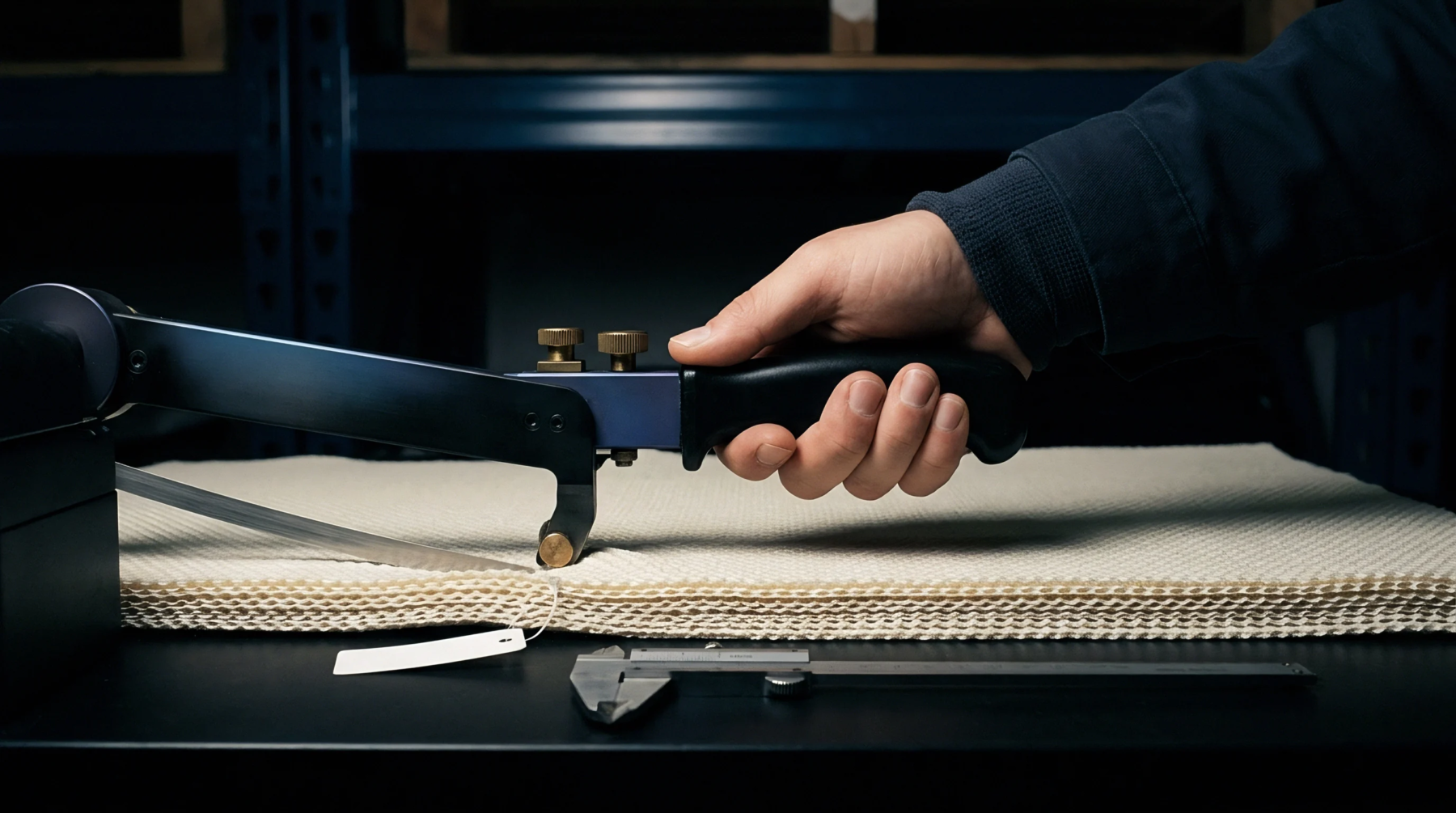
Swatch Sampling Position Deciding Whether a Batch Passes
Physical swatch position across fabric width and length determines chemical compliance, requiring three-point cross-web sampling to validate batch pass status.
Production throughput synchronization identifies the temporal duration a textile substrate remains stationary within a heated finishing chamber while the continuous conveyor transport moves at a defined constant velocity. Measurements of line speed dwell time govern how long fabrics endure thermal exposure during resin curing or pigment fixation stages in industrial stenters. Thermal energy transfer requires precise contact duration to achieve chemical bonding across synthetic fibres or natural cellulose chains.
Excess duration triggers scorch marks or tensile strength degradation while insufficient exposure prevents permanent setting of finishing agents. Operators verify these values by calculating the distance of the heating zone divided by the belt rate of travel. Control systems maintain this constant to ensure quality consistency across large dye batches.
Molecular interactions inside high temperature zones necessitate predictable retention cycles for uniform polymer crosslinking on polyester yarns or cotton blends. The conveyor speed dictates the residence quantity during heat setting operations. Mechanical sensors calibrate the motor rotations against internal temperature probes to adjust the transport pace.
Variations in fabric weight force technicians to recalibrate the machine to maintain a set heating period. Higher mass fabrics demand slower transit through the oven to allow core temperature reaching the required reaction point. Thick upholstery materials move slower than lightweight silk voile to guarantee uniform heat distribution throughout the internal fibre structure.
Calibration errors at this stage create uneven dyeing results or patches of weak material that fail durability testing protocols. Accurate duration management prevents overexposure of heat sensitive finishes during final garment preparation.
Machine capacity sets the upper limits of dwell duration within the finish sequence for textile manufacturing facilities. The oven length acts as the physical hard constraint while the belt motor provides the variable throughput adjustment. Engineers monitor the variance between the theoretical model and the actual residence time recorded by optical scanners placed at the oven exit.
Differences arise from slip in the drive rollers or tension fluctuations along the length of the processing belt. Maintenance teams perform weekly checks on the tensioning equipment to ensure the belt maintains constant contact with the driving gears. These adjustments reduce the risk of inconsistent curing across the width of the fabric bolt.
A steady motion profile ensures that every centimetre of the production lot receives identical thermal energy treatment.
Laboratory assessments of resin depth demonstrate the efficacy of the established dwell period on textile substrates. Quality inspectors extract swatch samples from the start and end of a production run to confirm uniform chemical penetration. Testing machines stretch the fabric to confirm the expected modulus and compare the results against standard control swatches from previous batches.
Failure in the dwell cycle often results in poor colour fastness or premature shedding of functional coatings. Deviations in these mechanical settings signify a breakdown in the process chain or a miscalibrated control loop. Consistent measurement of this period provides the empirical basis for approving industrial lots for global distribution.
Technical precision in this time measurement remains the primary determinant of long term fabric performance under field conditions.
Physical swatch position across fabric width and length determines chemical compliance, requiring three-point cross-web sampling to validate batch pass status.
Expertise is a utility, not a secret. sentiention™ publishes its working knowledge as open reference: intelligence layer covering the materials it sources, the markets it enters, and the reference that serves both.