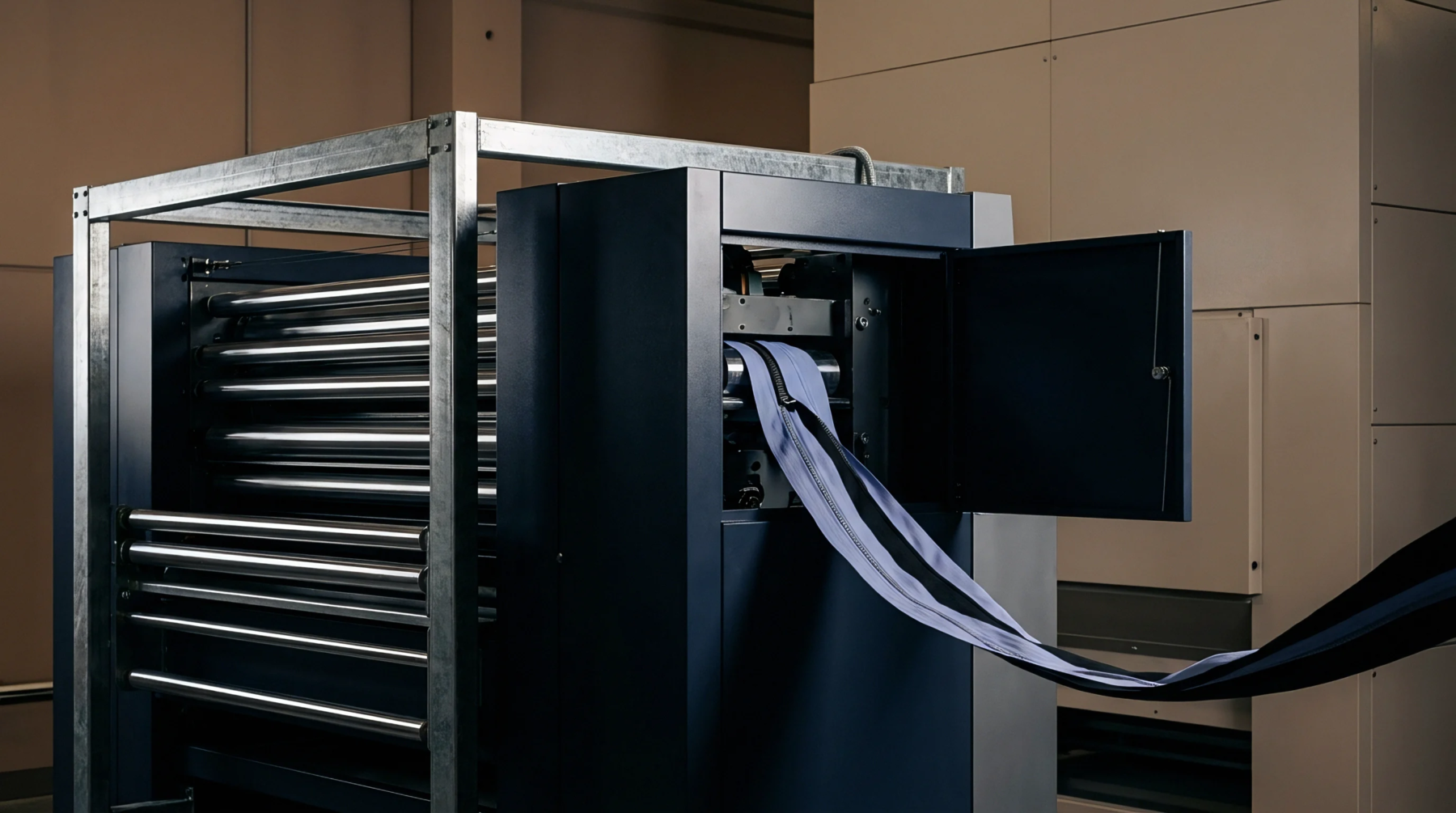
Continuous Hydrolytic Scission Kinetics of Polyether Elastane Cores in Jet Dyeing Machinery
Polyether elastane undergoes rapid hydrolytic urethane scission at 130C, cutting tenacity by thirty percent when jet nozzle shear accelerates degradation.
Non-recoverable structural distortion remaining in a yarn, knit or woven fabric after the complete removal of an applied tensile, compressive or shear load represents unrecoverable mechanical change. Quantifying the extent of permanent deformation establishes the degree to which molecular slip or structural dislocation prevents a textile article from returning to its original unloaded dimensions. The property governs the long-term shape retention, recovery performance and dimensional fidelity of garments, industrial filters and architectural membranes under dynamic use.
Testing evaluates residual elongation after standardized loading and dwell periods, expressed as a percentage of original specimen length. Instantaneous elastic recovery and time-dependent viscoelastic recovery that return to zero strain over time fall entirely outside this classification.
Application of mechanical stress exceeding a textile material’s elastic limit drives irreversible changes at both molecular and macroscopic structural scales. Macromolecular chains undergo unrecoverable slip past adjacent chains, breaking non-covalent hydrogen bonds or dispersion forces and reforming them in displaced, unaligned configurations. At the yarn level, individual fibres shift past one another within the spun bundle, causing friction-locked longitudinal translation that prevents re-coiling upon load release.
In woven and knit fabrics, yarn crimp redistributes irreversibly, tightening warp yarns while slackening weft threads or permanently elongating knit loops beyond their mechanical jamming limit. Severe permanent deformation causes visible fabric bagging at stress points, structural thinning and an irreversible loss of compressive resilience.
Laboratory assessment follows standardized cyclic tensile methods such as ASTM D3107 for stretch wovens or ASTM D2594 for low-power knits. Specimen strips are subjected to specified extension percentages or static hanging weights for designated dwell periods, followed by controlled relaxation intervals on flat surfaces. Calibrated measurement boards calculate tension set by subtracting the recovered length from the original gauge length.
Dynamic tensile testing frames execute continuous load-recovery hysteresis loops, recording energy dissipation and unrecoverable plastic strain curves over multiple loading sequences.
Fabric specification agreements impose strict percentage ceilings on non-recoverable growth to ensure finished garments retain fit through repeated wear and cleaning. Quality control labs reject apparel fabrics exhibiting excessive permanent deformation, as high values manifest commercially as unrecoverable bagging in garment knees, elbows and waistbands. Finished goods inspection checkpoints verify that post-test deformation remains below agreed thresholds, typically three to five percent depending on fabric weight and spandex content.
Failure indicates inadequate elastane core integration, insufficient heat-setting temperature during tentering or incorrect yarn crimp balance across the loom. Lots meeting structural criteria maintain consistent sizing specifications across production bulk runs.
Polyether elastane undergoes rapid hydrolytic urethane scission at 130C, cutting tenacity by thirty percent when jet nozzle shear accelerates degradation.
Expertise is a utility, not a secret. sentiention™ publishes its working knowledge as open reference: intelligence layer covering the materials it sources, the markets it enters, and the reference that serves both.