Optimizing Stenter Dwell Parameters to Minimize Permanent Set in High Gauge Circular Knits
Permanent set in high-gauge knits is minimized by maintaining 188-192°C core dwell for 12-15 seconds with 22-28% overfeed to prevent irreversible plastic loop strain.
Strain
Fine-gauge circular knits exiting the needle cylinder carry massive residual stresses within every microscopic yarn loop. In a 44-gauge single jersey composed of 22 dtex semi-dull polyamide 6,6 paired with 17 dtex bare elastane, stitch density exceeds 48 courses and 38 wales per centimetre in the unrelaxed greige state. The knitting needles impart severe three-dimensional bending moments upon the synthetic filaments.
When the greige fabric is wound under commercial take-down tension of 12 to 18 centinewtons per needle, these loops elongate longitudinally, collapsing the lateral stitch width. Permanent set develops when the polymer substrate undergoes irreversible plastic slip, crystalline redistribution, or elastane core thinning before thermal equalization can relax these stresses. The finished cloth loses its elastic recovery envelope, resulting in garment bagging at the knees and elbows after minimal domestic wear.
Tension governs recovery. Circular knit mechanics diverge from wovens because knitted loops store potential energy purely through curved elastomeric geometry. When pulling forces during scouring, continuous bleaching, or stenter entry exceed the proportional limit of the fine-filament structure, yarn slippage occurs at the loop crossover points.
If the fabric enters the thermal stabilization zone while stretched beyond its neutral geometry, the elevated stenter chamber temperature fixes the distorted loop configuration into permanent crystallization. Subsequent laundering cannot collapse the stitch back to its intended cover factor.
Under continuous transverse tension exceeding 14 centinewtons per centimetre at 190 degrees Celsius, bare polyurethane filaments exhibit permanent structural elongation of 8.5 percent.
Loop stability depends on the balance between filament linear density, stitch length, and machine gauge. As circular knitting machines advance from 28-gauge to 36-gauge, 44-gauge, and 50-gauge cylinders, the clearance between adjacent sinkers shrinks below 0.4 millimetres. The yarn must negotiate tighter turn radii, increasing internal shear stresses across the cross-section of both the host synthetic filament and the interlooped elastane core.
- Inter-Loop Contact Friction generates localized shear resistance during stenter entry, restricting the spontaneous relaxation of distorted loop heads when line tension remains unchecked.
- Elastane Modulus Depletion sets in when bare polyurethane filaments stretch beyond 220 percent elongation inside pre-stenter washing ranges, initiating irreversible cross-link cleavage.
- Filament Crystalline Reorientation locks non-recoverable longitudinal elongation into the polyamide or polyester sheath under simultaneous thermal exposure and longitudinal pull.
- Course Skew Angular Displacement twists vertical stitch axes away from perpendicular alignment, producing permanent fabric torque that distorts downstream garment panels.
Knitting tension variations across multi-feeder machine configurations create periodic structural waves that show up during heatsetting. A 50-gauge circular knit frame running 96 yarn feeds requires rigorous tension equalization across every storage feeder; a variance of a single gram-force between feeds produces noticeable course spirality and uneven yield thresholds. When such irregular rolls undergo stenter finishing without adequate relaxation, the tighter courses absorb excess line tension, sustaining permanent elongation while looser courses buckle.
| Machine Gauge | Yarn Count (Synthetic) | Elastane Denier | Stitch Density (Courses × Wales / cm) | Elastic Limit (N/5cm) | Permanent Set Onset Strain (%) |
|---|---|---|---|---|---|
| 28G | 44 dtex / 34 filament PA6,6 | 44 dtex (40D) | 28 × 22 | 18.4 | 14.2 |
| 32G | 33 dtex / 24 filament PA6,6 | 33 dtex (30D) | 34 × 26 | 15.1 | 11.8 |
| 36G | 22 dtex / 20 filament PA6,6 | 22 dtex (20D) | 40 × 30 | 11.6 | 8.9 |
| 40G | 17 dtex / 18 filament PET | 17 dtex (15D) | 44 × 34 | 8.7 | 6.4 |
| 44G | 15 dtex / 14 filament PA6,6 | 13 dtex (12D) | 48 × 38 | 6.2 | 4.7 |
| 50G | 11 dtex / 12 filament PA6,6 | 11 dtex (10D) | 54 × 42 | 4.5 | 3.5 |
Thermal stability requires total structural relaxation immediately before heat transfer begins. Processing fine-gauge substrates without pre-relaxation compacts the stitch loops irreversibly. Mills that bypass tensionless compact scouring to save processing time introduce set errors that make uniform finished width impossible across bulk garment cutting tables.

Heat
Thermal energy delivered inside the stenter chamber acts directly upon the synthetic polymer chains to dissolve internal stresses. In forced-convection stenters, air impinges at high velocities through upper and lower nozzle arrays, stripping the boundary layer of cooler, stagnant air that wraps around each yarn bundle. High-gauge circular knits feature high specific surface areas and low thermal mass per square metre, making them sensitive to convective heat transfer rates.
While a standard 220 gsm single jersey can tolerate minor temperature overshoots, a 90 gsm 44-gauge knit experiences near-instantaneous substrate heating, shifting the polymer from its glassy state into its viscoelastic window within seconds.
Substrate temperature diverges from indicated chamber air temperature. Circulating hot air might register at 195 degrees Celsius on the central display, but the actual fabric temperature lags during the entry zones due to moisture evaporation. Once the moisture evaporates completely, the fabric temperature ramps toward the ambient air temperature.
Effective dwell time spans only the seconds during which the core filaments reside precisely within the target heatsetting window, rather than the entire passage through the heated enclosure.
A target core fabric temperature of 192 degrees Celsius maintained for 14 seconds sets polyamide 6,6 without lowering elastane tensile recovery below 92 percent.
Elastane loses modulus rapidly. Synthetic polyurethane urea consists of alternating soft polyether or polyester segments and hard urethane-urea segments. The soft segments provide long-chain elasticity, while the hard segments form hydrogen-bonded physical cross-links that prevent permanent slippage under stress.
Heatsetting destabilizes these hard segments, allowing them to dissociate and reform in an untensioned configuration, thereby fixing the fabric dimensions. Exceeding the thermal decomposition threshold breaks covalent urethane links, turning dynamic elasticity into non-recoverable mechanical elongation.
Substrate Thermal Properties
Polyester and polyamide respond differently to thermal exposure within the stenter box. Polyamide 6,6 reaches dimensional stability between 185 and 195 degrees Celsius, where its hydrogen-bonded amide linkages break and reform into lower-stress arrangements. Polyamide 6 sets lower, between 175 and 185 degrees Celsius, reflecting its lower melting point.
Polyester requires temperatures between 190 and 205 degrees Celsius to unlock its crystalline domains and reset loop curvature.
Air velocity strips insulation. In fine-gauge finishing, nozzle air velocities between 24 and 32 metres per second strip the laminar vapor barrier, elevating convective heat transfer coefficients to 120 Watts per square metre Kelvin. Excess air velocity generates aerodynamic turbulence that flutters the lightweight web between pin chains.
This flutter exerts cyclic bending loads on softened filaments at temperatures where their yield points fall toward zero, leaving visible surface distortions and permanent elongation along the fabric edges.
The 188 degree Celsius thermal fixation threshold for 22 dtex elastane rests on single-laboratory micro-tensile data from 2021 utilizing five-gram specimen loads. Industrial verification across high-volume production lines reveals that air humidity variations within gas-fired stenters shift this transition point by up to four degrees Celsius. When combustion exhaust gases circulate directly back into the drying bays, ambient water vapor accelerates thermal transfer, shifting the operational stabilization threshold lower than dry-air laboratory findings indicate.
Analogous phenomena govern precision copper foil annealing in printed circuit manufacturing, where uneven convective boundaries induce thermal curling across micro-scale metal sheets. Fine synthetic textile webs share identical boundary-layer thermodynamics. When heat penetrates faster than internal loop stresses can relax, structural distortion freezes permanently into the material grid.
Finishing technicians verify temperature stabilization by tracking yellowing indices and unrecovered elastomeric creep. Exceeding heat exposure targets by even a brief margin sacrifices elastomeric recovery to secure dimensional stability.
Pin
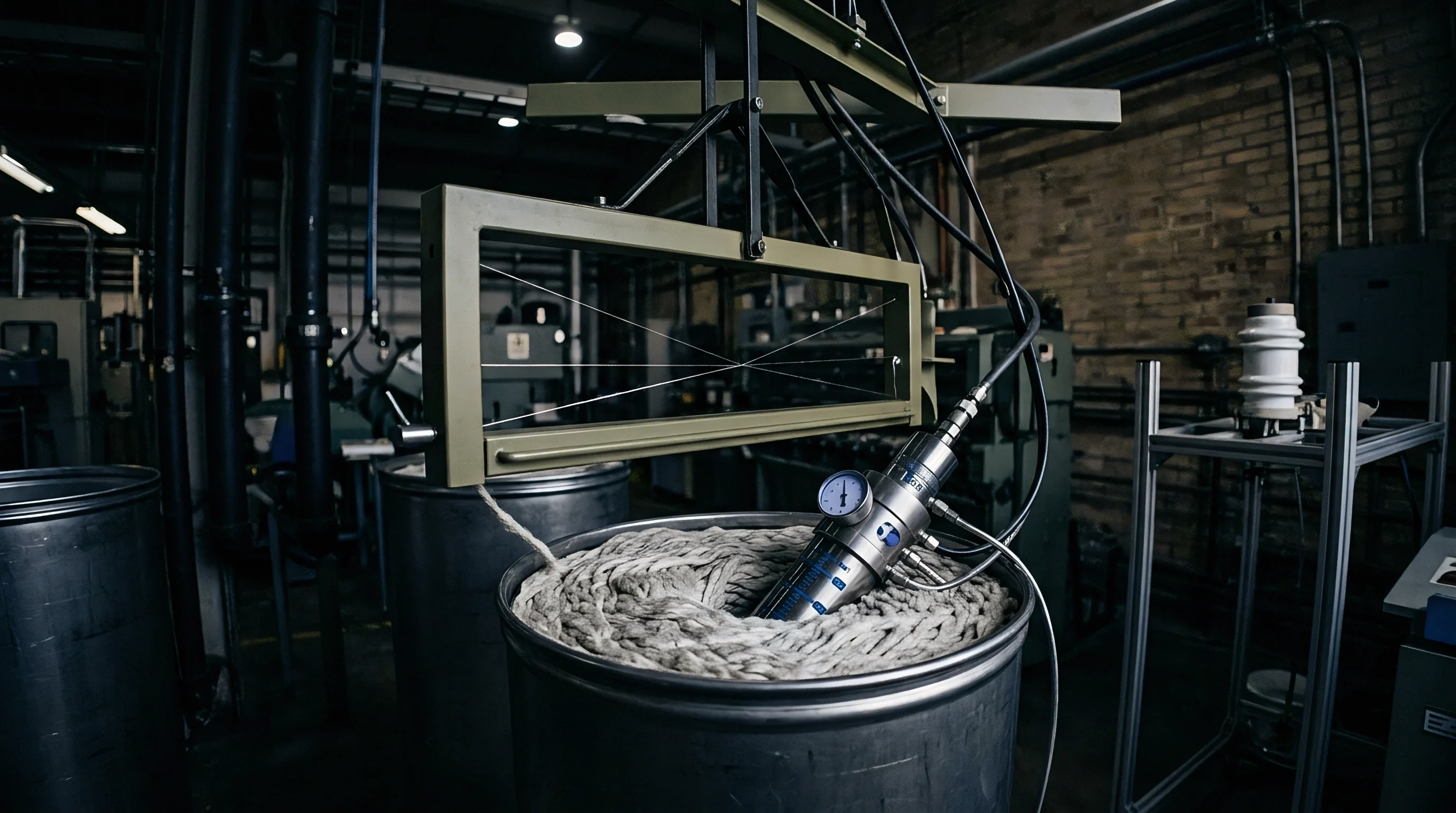
Mechanical conveyance rails guide the knitted web through the stenter chambers, establishing its boundary geometry under transverse and longitudinal tensions. The pin chains grip the selvedges, pulling the fabric outward to the target width while entry overfeed wheels drive excess fabric onto the needles. In high-gauge knitwear, managing these mechanical vectors matters just as much as setting chamber heat.
If the transverse chain divergence is too aggressive, loops in the centre of the web pull thin, while loops adjacent to the pin line deform permanently under concentrated shear forces.
Overfeed restores stitch bulk. Delivering fabric onto the pins at a positive speed differential of 18 to 35 percent relative to chain velocity creates longitudinal slack. This slack allows the loops to contract along the machine direction, counteracting the tensile draw experienced during upstream wet processing.
Without sufficient positive overfeed, line draw pulls the courses flat, collapsing the fabric width and causing heavy structural shrinkage during garment laundering.
Transverse pin rail divergence exceeding two degrees produces permanent edge skew across knits finer than 36-gauge.
Does Chamber Overfeed Mitigate Core Filament Yield?
Positive longitudinal overfeed prevents the elastane core from bearing machine tension while softened by chamber heat. When a 40-gauge single jersey enters the pin line with 25 percent overfeed, the excess fabric forms microscopic vertical ripples between successive pin clusters. The hot air nozzles flatten these ripples without translating longitudinal line drive tension to the yarn.
The elastane contracts freely, establishing an equilibrium stitch density before the crystalline structure sets.
Width settings determine shrinkage. Over-pinning the fabric past its natural circular diameter stretches the loop heads horizontally, narrowing the loop legs. While this expands yield per linear metre for converters seeking to hit width targets, it pushes the fabric beyond its elastic yield boundary.
The resulting lateral set locks the yarn into an unnaturally wide, flat profile that drops recovered stretch below acceptable quality thresholds.
- Rail Entry Divergence Rate governs how rapidly lateral mechanical force spreads across the web, where steep angles tear the fine loops off the pin points.
- Brush Wheel Penetration Depth forces the lightweight edge loops completely down to the base of the brass pins, preventing selvedge lifting during drying.
- Selvedge Uncurler Alignment flattens rolled knitted edges through directional air nozzles or counter-rotating scroll spindles before pin engagement.
- Pin-to-Clip Interchange Dynamics define chain stability, where mechanical vibration transmits micro-shocks directly into the hot, tensioned fabric edge.
A continuous audit of the pin line involves inspecting needle sharpness and bent pin shafts. High-gauge single jerseys, containing ultrafine microfilaments as fine as 0.5 decitex per filament, snag easily on burred pin points. Damaged pins punch ragged holes through the selvedge, initiating lateral tear propagation across the width as the fabric enters divergent rail segments.
Converters frequently claim that high fabric growth results entirely from bad yarn spinning rather than their aggressive stenter rail expansion. That argument collapses whenever physical examination of the rejected bulk reveals distorted loop angles directly matching the stenter pin geometry.
Profile
Chamber configuration requires continuous tuning of thermal zones, fan velocities, and air exhaust dampers across the stenter length. An eight-chamber finishing frame must treat the delicate knit as a dynamic heat sink, dividing the operational path into pre-heating, moisture evaporation, stabilization, and cooling sectors. Introducing high-gauge fabrics into immediate peak heat shocks the surface filaments, causing rapid water flashing and localized surface glazing.
The process sequence instead raises substrate temperatures progressively, reaching the heatsetting threshold in the final active heating bays.
Line speed controls dwell. Total chamber dwell breaks down into warming time, drying time, and effective heatsetting dwell. For an eight-bay stenter with three-metre chambers running at 24 metres per minute, gross residence time reaches 60 seconds.
In a lightweight 100 gsm 44-gauge circular knit carrying 15 percent residual moisture from the padder, water evaporation consumes the first three chambers. The substrate reaches the 190 degree Celsius set temperature only halfway through chamber five, leaving chambers six and seven to deliver an effective dwell time of 15 seconds. Chamber eight functions as a cooling zone, lowering web temperatures below the polymer glass transition before the fabric leaves the pin chains.
Cooling sets polymer orientation. Discharging a high-gauge synthetic knit while still hot allows ambient room tensions and winder pull to stretch the unstable loop structure, causing immediate permanent set. Rapid chilled-air impingement or pass-through chilled water rollers at the stenter exit drop fabric surface temperatures below 50 degrees Celsius within two seconds.
This rapid quench freezes the rearranged crystalline domains in place, stabilizing the balanced loop configuration.
Execution Steps for Finishing 40g Circular Knit
- Feed the wet scoured, open-width fabric roll through a low-tension compensator cradle running at under 8 centinewtons total web tension.
- Apply functional finishing auxiliaries through a low-liquor padder maintaining nip pressure between 1.2 and 1.8 bar to guarantee uniform 12 percent moisture pick-up across the entire width.
- Engage motorized motorized mechanical edge uncurlers and driven slat expanders to eliminate selvedge roll without adding longitudinal strain.
- Impale the fabric selvedges onto stenter pins with an overfeed setting calibrated at positive 28 percent relative to chain transport speed.
- Advance the substrate through pre-heat chambers one and two maintained between 140 and 160 degrees Celsius to drive off applied moisture without inducing filament thermal shock.
- Elevate chamber temperatures in bays three, four, and five to 182 degrees Celsius, initiating boundary layer breakdown and controlled elastomeric relaxation.
- Sustain effective heatsetting core dwell across bays six and seven at 190 degrees Celsius for precisely 12 seconds under continuous infrared surface pyrometer monitoring.
- Quench the fabric web across chilled exit cylinders operating at 16 degrees Celsius before winding the roll under minimum programmable surface drive tension.
Take an industrial order of 5,000 kilograms of 36-gauge polyamide 6,6 with 20 percent elastane, processed on an 8-bay stenter at 22 metres per minute. The fabric enters the machine at an open width of 165 centimetres and leaves pinned at 155 centimetres with 24 percent overfeed. The padder deposits a hydrophilic softener bath at 15 percent wet pick-up.
Operating at 22 metres per minute across 24 metres of active chamber yields a gross dwell time of 65.4 seconds. If uneven chamber exhaust ventilation causes bay five to run six degrees cold, the fabric fails to reach its thermal stabilization window until chamber seven. Effective dwell time plunges from the targeted 14 seconds down to 5.5 seconds.
The entire 5,000-kilogram lot leaves the stenter under-set, displaying 12 percent longitudinal domestic wash shrinkage instead of the contracted 4 percent target.
| Fibre Blend | Weight (g/m²) | Chamber Temp (°C, Bays 1-3) | Chamber Temp (°C, Bays 4-7) | Effective Dwell (s) | Overfeed (%) | Cooling Exit Temp (°C) |
|---|---|---|---|---|---|---|
| 80% PA6,6 / 20% Elastane | 110 | 150 – 165 | 188 – 192 | 12 – 15 | +22 to +28 | < 45 |
| 85% PA6 / 15% Elastane | 125 | 140 – 155 | 178 – 182 | 14 – 18 | +18 to +24 | < 40 |
| 88% PET / 12% Elastane | 140 | 155 – 170 | 195 – 200 | 15 – 20 | +15 to +20 | < 50 |
| 92% Micro-Modal / 8% Elastane | 160 | 130 – 145 | 175 – 180 | 18 – 22 | +25 to +32 | < 38 |
| 75% PA6,6 / 25% Elastane | 85 | 145 – 160 | 186 – 190 | 10 – 12 | +28 to +35 | < 40 |
| Dwell parameters evaluated using inline optical fabric thermometers under nozzle air impingement velocity of 28 m/s. | ||||||
Air nozzle impingement velocities between 28 and 34 metres per second represent a disputed operating boundary where published laboratory benchmarks diverge from plant realities. Aerodynamic flutter tests demonstrate that high-velocity jets risk dislodging ultra-light 50-gauge knits from fine pin lines, inducing permanent loop distortion. Finishing plants running without closed-loop optical pyrometry reduce fan speeds to prevent edge fluttering, sacrificing convective heat transfer efficiency.
A buyer navigating this trade-off specifies strict maximum growth figures rather than mandating fan motor hertz targets.
The exact air temperature variance that initiates uneven elastane degradation across wide stenter frames remains open to ongoing empirical verification across high-speed equipment.

Loss
Substandard dimensional recovery in fine-gauge circular knits triggers severe financial write-downs across the global apparel supply chain. When high-gauge fabric sustains permanent set on the stenter, the damage remains undetectable to visual inspectors at the machine exit. The cloth looks flat, smooth, and on-shade.
The operational failure surfaces only after the goods reach automated garment cutting rooms, where tensionless relaxation tables cause cut panel bundles to shrink or twist, or after finished garments stretch irreversibly during early customer use.
Unrecovered strain produces bagging. Standard test procedures quantify this failure through cyclic tensile loading and recovery measurements. Under ASTM D3107 testing for stretch fabrics, a high-performance fine-gauge sports knit must exhibit static growth below 4.0 percent following a 30-minute static load, with unrecovered set dropping below 2.5 percent after a one-hour relaxation period.
Knits processed through misaligned thermal profiles regularly show growth values exceeding 8.0 percent. When cut into performance activewear, these under-recovered fabrics fail to return to garment design measurements.
A three percent permanent set across a 30,000-metre production run translates to 900 metres of dimensionally unstable fabric rejected at inspection.
Spirality undermines garment utility. High-gauge single jerseys naturally want to twist due to residual yarn torque imparted during spinning and knitting. Correct thermal stabilization balances these torsional vectors, neutralizing the tendency of vertical wales to lean away from perpendicular alignment.
When insufficient dwell time or incorrect longitudinal overfeed fails to set this torque, downstream wash cycles trigger violent spirality. Side seams twist toward the front and back centres of the garment, turning finished inventory into off-spec factory seconds.
| Defect Category | Physical Root Cause | Testing Threshold Failed | Production Waste Rate (%) | Cost Consequence per 10,000m |
|---|---|---|---|---|
| Permanent Set / Bagging | Excessive chain width tension; insufficient longitudinal overfeed | ASTM D3107 Growth > 4.0% | 4.5% – 8.0% | $12,500 – $22,000 |
| Severe Course Spirality | Inadequate effective dwell time; failure to neutralize yarn torque | ISO 16322-2 Skew > 3.0° | 6.0% – 12.0% | $16,800 – $33,600 |
| Uneven Width Shrinkage | Chamber air temperature gradients across frame width | ISO 5077 Dimensional Change > ±5.0% | 3.0% – 6.0% | $8,400 – $16,800 |
| Elastane Thermal Degradation | Excessive chamber temperature; prolonged slow-speed dwell | DIN 53835-2 Elastic Recovery < 85% | 100% (Scrap Lot) | $48,000 (Total Loss) |
Rejections erode converter margin. The price of premium 44-gauge circular knit hovers between $4.50 and $7.00 per finished metre depending on yarn blend and regional duty tariffs. A standard bulk dye lot running across an automated stenter represents tens of thousands of dollars in direct material investment.
When an auditor flags unrecovered permanent set on incoming roll docks, the entire lot is quarantined. Scrapping or discounting an off-spec run wipes out the converting margin for that production run, converting projected operating profits into net balance-sheet losses.
Commercial contracts protect the purchasing desk by integrating explicit performance thresholds into binding master purchase agreements. Incorporating ASTM D3107 with a mandatory maximum 3.5 percent fabric growth cap, coupled with ISO 5077 domestic laundering dimensional change tolerances constrained within positive or negative 3.0 percent, empowers the sourcing director to reject out-of-specification lots at the port of entry without arbitration delays.