Knitting Machine Gauge Selection for Cotton Single Jersey Stability
Select knitting machine gauge to maintain a cotton single jersey tightness factor between 1.35 and 1.50 tex^0.5/mm to prevent laundering shrinkage and spirality.
Tightness
Circular knitting plants convert raw cotton yarn into plain single jersey under constant mechanical tension. Machine gauge, defined as the number of needles per circumferential inch along the cylinder, determines the physical space allocated to each individual stitch. Selecting an inappropriate gauge for a specified cotton yarn count produces persistent dimensional distortion that no wet finishing process can rectify.
Greige cloth knitted too loosely exhibits extreme shrinkage during domestic laundering, whereas overly tight constructions cause needle cutting, drop stitches, and excessive greige spirality right at the machine take-down rolls.
Matching yarn linear density to machine gauge relies on the cover factor, also known across knitting sheds as the tightness factor. In metric units, the tightness factor equals the square root of the yarn tex divided by the loop length in millimetres. Cotton single jersey reaches balanced dimensional stability within a tightness factor range of 1.35 to 1.50 tex0.5/mm.
When the tightness factor drops below 1.30, the knitted loops lack internal friction. Loose loops slide under mechanical tension. The resulting knitted web stretches easily during jet dyeing and shrinks aggressively in domestic tumble drying.
Tight loops resist laundering contraction.
Needle Density and Yarn Count Coordination
Cylinder needle density dictates the clearance envelope for incoming yarn strands. Single jersey cylinders operated on 24-gauge (E24) or 28-gauge (E28) tooling handle the bulk of worldwide cotton T-shirt production, yet their operating envelopes differ sharply. A 24-gauge cylinder accommodates cotton counts from 24/1 Ne (24.6 tex) to 30/1 Ne (19.7 tex).
An E28 cylinder requires finer counts, functioning reliably between 30/1 Ne (19.7 tex) and 40/1 Ne (14.8 tex). Forcing a 24/1 Ne yarn into a 28-gauge needle hook packs excess cotton mass into the needle trick, raising yarn-to-metal friction and causing stitch breakage across high-speed runs.
A twenty-eight gauge cylinder knitting thirty-single Ne combed cotton achieves dimensional equilibrium at a loop length of 2.70 millimetres.
Knitting plants often substitute yarn counts to compensate for spinning mill shortages, pairing coarse yarns with fine gauges. This substitution increases yarn tension at the knitting point, forcing the needle hook to pull yarn over the sinker belly under severe friction. The resulting loop experiences severe mechanical strain, locking residual energy into the cellulose structure before scouring even begins.
The cloth leaves the knitting frame with high residual stress, masking its structural instability behind temporary greige compactness.
| Machine Gauge (E) | Recommended Yarn Count (Ne) | Recommended Yarn Count (tex) | Loop Length (mm) | Tightness Factor (tex0.5/mm) | Finished Weight (g/m²) |
|---|---|---|---|---|---|
| 20 | 18/1 to 22/1 | 32.8 to 26.8 | 3.15 to 3.35 | 1.38 to 1.45 | 190 to 220 |
| 24 | 24/1 to 30/1 | 24.6 to 19.7 | 2.80 to 2.95 | 1.41 to 1.48 | 160 to 185 |
| 28 | 30/1 to 40/1 | 19.7 to 14.8 | 2.55 to 2.75 | 1.40 to 1.46 | 135 to 160 |
| 32 | 40/1 to 50/1 | 14.8 to 11.8 | 2.30 to 2.50 | 1.37 to 1.44 | 115 to 135 |
Cover Factor Boundaries for Laundering Control
Stitch length determines whether cotton loops preserve structural equilibrium during industrial wet processing. When a cylinder knits at a tightness factor exceeding 1.52, the cotton loops jam against adjacent wales. This jamming limits structural relaxation, but introduces high yarn shear stresses during needle knocking-over.
High cover factors reduce air permeability, increase burst strength, and limit length-direction shrinkage. The excessive yarn packing increases spirality because yarn twist torque cannot balance out across jammed loop structures.
Underestimating gauge tightness generates loose single jersey that shrinks past ten percent in household laundering, triggering retailer chargebacks and bulk inventory rejections.
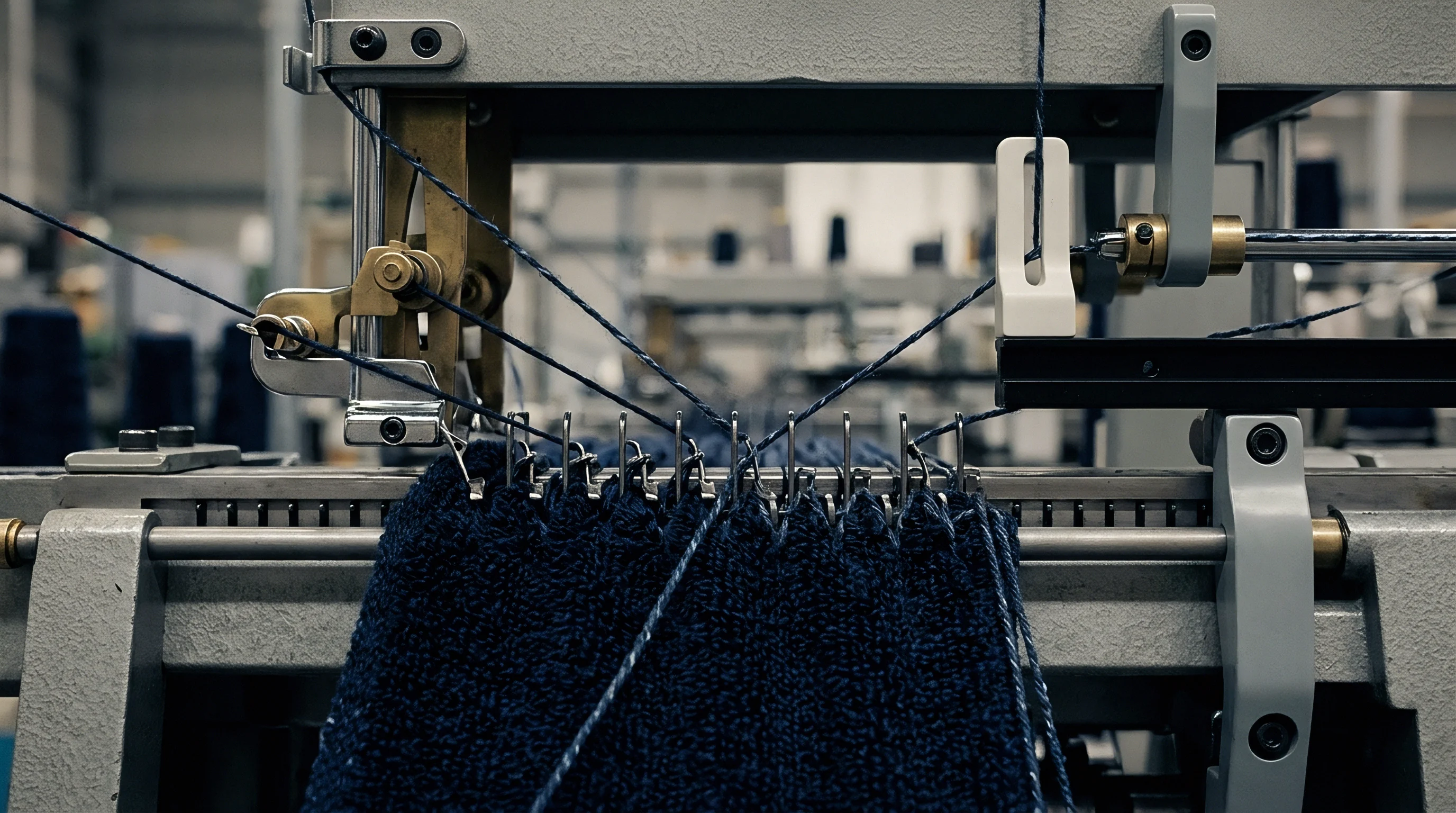

Sinker
Cam tracks guide the latch needles through clearing, feeding, and knock-over cycles at angular velocities exceeding one thousand revolutions per hour. Radial sinkers move perpendicular to the vertical needle path, holding down the knitted loops while the needles rise to clear the previous stitch. Sinker timing controls the exact instant yarn draws over the sinker breast, governing the tension transmitted along the yarn path.
Improper sinker positioning or worn sinker throats distort the loop geometry, producing wale-to-wale irregularities that alter relaxation kinetics during washing.
Stitch cams set the draw depth. As the needle descends down the stitch cam, it pulls yarn from the package through the ceramic yarn guide. When sinkers advance too early, the sinker belly clamps the incoming yarn strand against the needle shank.
This premature clamping increases yarn tension exponentially, stretching the cotton strand beyond its yield point. Friction robs yarn from preceding loops. The newly formed loop steals length from the previously cast loop, creating uneven stitch lengths across adjacent needle feeds.
Knock over Timing and Loop Robbing
Synchronized sinker action prevents loop robbing along multi-feeder circular machines. Modern circular knitting machines deploy between 72 and 108 yarn feeders across a thirty-inch cylinder. When sinker cams lose concentricity, individual feeders draw varying loop lengths despite identical stitch cam micrometer settings.
A variation of 0.05 millimetres in loop length across feeders causes visible horizontal stripiness, termed barre, while destabilizing the post-wash dimensional balance of the goods.
- Throat wear groove develops on sinkers after processing abrasive open-end yarns, catching fibers and producing irregular loop drawdown across consecutive machine courses.
- Premature sinker advance pinches the strand before the needle hook reaches its lowest casting point, causing yarn abrasion and generating random greige pinholes.
- Uneven cam track clearance permits vertical play in the needle butts, generating stitch length variations that show up as spirality bands after scouring.
- Residual lint accumulation inside the sinker ring prevents full sinker retraction, yielding short loops and local fabric tightness variations.
Mechanical Clearing Faults in Single Feeds
Needle hooks dictate strand clearance limits. When a latch needle fails to open fully during clearing, the old loop remains trapped on the hook latch, creating a double loop on the subsequent feed. These mechanical imperfections disturb the uniform stress distribution within the jersey plane.
During wet finishing, localized stress imbalances trigger irregular relaxation, causing puckering along the wale lines.
Knitting floor supervisors routinely claim that uneven stitch formation and jagged course lines stem from dirty yarn paraffin rather than worn sinker throats.

Torque
Spinning rings insert mechanical twist into cotton strands to achieve tensile coherence. The internal torsion generated by this mechanical twist remains stored within the core of single cotton yarns. In a single jersey structure, every loop faces the same direction, exposing the technical face with upright loop legs and the technical back with horizontal loop semicircles.
Single jersey curls toward the face. When wet processing releases fiber strain, the stored yarn twist relaxes, causing each individual stitch to twist around its own axis. Torque forces the knitted loop askew.
Loop skewing produces garment spirality, visible when side seams twist toward the front or back of a T-shirt after washing. The twist multiplier (TM) selected during ring spinning directly dictates the residual torque level in the knitted piece. Standard ring-spun cotton knits utilize yarns with a twist multiplier between 3.2 and 3.8.
Raising the twist multiplier elevates yarn strength and reduces pilling on the Martindale bench. The higher twist multiplier increases internal yarn liveliness, worsening post-wash spirality across single-cylinder knits.
Yarn torque unbalances loop walls whenever twist energy exceeds the bending resistance of the wet knit.

Twist Multiplier Ratios in Single Yarns
Yarn manufacturing parameters set the fundamental torque limits before knitting starts. Combed ring yarns display higher torque than carded yarns due to parallel fiber alignment. Rotor yarns display lower residual liveliness.
Rotor-spun yarns possess a disordered outer wrapper fiber architecture that locks the internal core twist, reducing spirality tendencies in single jersey knits. Rotor yarns produce a harsher hand feel, driving high-end retail programs toward combed ring-spun cotton where torque management relies entirely on mechanical gauge coordination and wet finishing control.
| Yarn Spinning System | Twist Multiplier (TM) | Machine Gauge (E) | Feeder Count / Cylinder Diameter | Greige Spirality Angle (°) | Finished Spirality (ISO 16322) (%) |
|---|---|---|---|---|---|
| Ring Spun Combed Z-Twist | 3.8 | 24 | 72 / 30 inch | 7.5 to 9.0 | 8.0 to 11.5 |
| Ring Spun Combed Z-Twist | 3.2 | 24 | 72 / 30 inch | 4.5 to 6.0 | 5.0 to 7.0 |
| Ring Spun Combed Z-Twist | 3.4 | 28 | 84 / 30 inch | 5.0 to 6.5 | 4.5 to 6.0 |
| Rotor Spun Carded Z-Twist | 4.0 | 24 | 72 / 30 inch | 3.0 to 4.5 | 3.0 to 4.5 |
| Two-Ply Combed (Z-Spin, S-Fold) | 3.4 | 28 | 84 / 30 inch | 0.5 to 1.5 | 0.5 to 2.0 |

Will Alternate Feeder Twisting Eliminate Residual Spirality?
Knitting mills sometimes mitigate single-yarn torque by alternating Z-twist and S-twist yarns across adjacent feeders on the circular machine. Feeding Z-twist yarn into feeder one and S-twist yarn into feeder two balances the aggregate rotational moment across the knitted web. While this feeder arrangement lowers measurable spirality below three percent under ISO 16322, it introduces structural distortion across the face of the jersey.
Adjacent wales display contrasting loop inclinations, generating a visible herringbone texture that buyers reject for standard flat jersey programs.
Steam conditioning of yarn packages inside vacuum autoclaves stabilizes twist before knitting. Autoclave cycles heating cotton cones to 85 degrees Celsius under vacuum relax up to forty percent of live yarn torque. This thermal treatment temporarily sets the hydrogen bonds between cellulose chains.
Once the knitted piece enters aqueous scouring and jet bleaching at 98 degrees Celsius, the temporary thermal set breaks down completely, re-activating dormant yarn torque on the dyehouse floor.
Higher twist multipliers stiffen the yarn strand and force the knitted loop to tilt out of vertical alignment.

Relaxation
Laundering releases the internal strain stored within cotton cellulose during mechanical pulling. When dry greige jersey drops from the circular knitting cylinder, the loops assume an elongated, flattened profile under the pull of machine take-down rollers. Wet processing in rope-form jet dyeing machines introduces additional longitudinal stretching while abrading the loop heads.
Full relaxation occurs only when the cotton fibers absorb water, swell radially, and lubricate adjacent contact zones, allowing the loop to reach its minimum energy state.
Cellulose swells in alkaline wash baths. In the Starfish relaxation model, knitted loop dimensions follow predictable geometric ratios once fully relaxed through agitation. The fully relaxed state defines dimensional constants: Kc for courses per unit length, Kw for wales per unit length, and Ks for stitches per unit area.
For cotton single jersey, Kc settles near 5.0, Kw near 3.8, and Ks near 19.0 when stitch length is measured in centimetres. If a finished knit departs from these natural constants, the displaced geometry causes subsequent dimensional change during home laundering.
Testing under ISO 5077 after three wash cycles per ISO 6330 procedure 4N penalizes overstretched greige lots by exposing true relaxation shrinkage.
Starfish Constants under Wet Processing Cycles
Industrial processors track the Kc and Kw constants to predict whether a finished roll will shrink along its length or widen across its cut width. When finishing stenters pull jersey out to meet garment cutting marker widths, the loop widens artificially, depressing the Kc value and driving length-direction shrinkage above eight percent. Tumble drying collapses the loop height.
Agitation in heated airflow permits the cotton loops to contract longitudinally and expand laterally, restoring the natural 1.32 ratio between courses and wales.
- Greige conditioning takes place at standard atmosphere (20 ± 2 degrees Celsius, 65 ± 4 percent relative humidity) for 24 hours to stabilize physical dimensions before baseline course and wale counting.
- Aqueous scouring washes out knitting oils and natural waxes at 95 degrees Celsius, allowing the yarn to swell and initiate loop reorganization.
- Tumble drying subjects the wet piece to repeated mechanical impacts at 60 degrees Celsius per ISO 6330 cycle A, overcoming mechanical inter-yarn friction.
- Specimen measurement records dimensional movements along marked 500-millimetre benchmarks per ISO 5077, establishing relaxation shrinkage benchmarks.
Testing Protocols Governing Dimensional Drift
Commercial contracts routinely mandate testing across multiple home laundering cycles. Single-cycle washing fails to reveal the true shrinkage potential of cotton single jersey because mechanical tensions imparted by compacting machines temporarily lock the loops in a compressed configuration. By the third and fifth laundering cycles, the temporary mechanical compaction washes out completely, exposing the underlying greige construction stability.
Standard purchase specifications enforcing ISO 5077 testing at five tumble-dry cycles cancel supplier exemptions for post-wash garment twisting.
Compaction
Mechanical sanforizing compresses knitted loops along their length using heated rubber belts and pressurized steam. Compactor shoes compress the course line. The open-width or tubular compactor feeds wet, overfed jersey onto a heated drum while thick rubber blankets compress the technical face, physically pushing the courses together.
Compaction increases finished areal weight (g/m²) and counteracts the longitudinal stretching induced by continuous bleaching ranges and pad-batch dye padders.
Overfeed forces loops into closer contact. Setting stenter overfeed between twenty and thirty-five percent feeds extra length into the drying chamber, allowing the jersey to contract along its length while pinning needles hold the selvages at a specified width. If the greige gauge was selected incorrectly for the target weight, stenter overfeed creates wavy edges and unstable horizontal course alignment that relaxes during garment cutting.
Is Open Width Compaction Superior for Width Control?
Open-width processing routes split the knitted tube along a single drop-stitch line before washing or stentering. Slitting the tube eliminates the severe edge creases common in tubular finishing, enabling precise pin-wheel overfeed across the entire width of the web. Tubular finishing relies on internal expanding rings that stretch the circular knit horizontally, often overstretching the wales and causing severe subsequent width contraction.
Open-width finishing lines cost substantially more in capital expenditure and waste up to three percent of usable width in trimmed selvages, yet they deliver tighter dimensional control across bulk runs.
- Rubber belt thickness dictates the compressive shear force applied to the loop heads during drum transit.
- Steam injection volume plasticizes the cotton cellulose fibers, enabling permanent mechanical resetting without scorching.
- Calender roll temperature maintains precise heat transfer at 110 to 130 degrees Celsius to dry excess moisture during compaction.
- Delivery roll lead must run slower than the entry rolls to preserve the compressed loop structure as goods exit the shoe.
Stenter Overfeed Settings for Cotton Recovery
Overfeeding fabric onto stenter pins cannot permanently fix a deficient knitting construction. When a plant attempts to knit a 180 g/m² single jersey on a 28-gauge machine using 34/1 Ne yarn, the structure lacks sufficient fiber mass. The dyehouse attempts to achieve the target weight by overfeeding the stenter by thirty percent, crowding courses together artificially.
Garment side seams twist after laundering. The finished garment washes back to its natural cover factor, losing ten centimetres in body length while expanding four centimetres in body width.
Technicians continue to debate whether chemical resin crosslinking permanently stabilizes mechanical compaction without degrading the burst strength of lightweight cotton knits.
Tolerance
Commercial purchase contracts define allowable variances across bulk shipments of dyed cotton knitwear. Textile converters and apparel manufacturers negotiate boundaries for finished areal weight, width, shrinkage, and spirality to maintain marker yields and sizing consistency across garment assembly lines. Narrow tubes mask excessive machine stretch.
When single jersey drifts outside agreed tolerance envelopes, garment factories face severe fabric consumption losses, misaligned patterns, and sizing rejections at final inspection.
Finished areal density tolerances typically span plus or minus five percent from the approved technical cut sheet. A target specification of 160 g/m² accepts rolls between 152 and 168 g/m² measured under ISO 3801 conditioning. Maintaining this weight tolerance requires coordinating yarn spinning count tolerances, which vary by plus or minus two percent, with knitting machine loop length variations across seasonal humidity changes.
Without automated positive yarn storage feeders, circular knitting machines drift across daily temperature cycles, producing greige rolls that finish outside legal delivery bands.
Finished Areal Density Acceptance Thresholds
Dimensional stability tolerances must balance functional performance against the mechanical realities of the cotton single jersey structure. Standard commercial thresholds demand post-wash shrinkage performance under ISO 5077 within minus five percent in length and minus five percent in width after three domestic wash cycles at 40 degrees Celsius. Achieving minus five percent length shrinkage on single jersey requires rigorous greige tightness coordination and open-width rubber belt compaction.
When buyers demand minus three percent shrinkage without synthetic elastane core yarns, mills must lower spirality limits and accept lower cutting yields.

Shrinkage Settlement Rules in Cut Make Trim
Garment cutting rooms reject bulk yardage when spirality exceeds four percent for matched-stripe programs or six percent for solid-dyed casualwear. If a thirty-inch circular machine operates with 84 feeders knitting single Z-twist yarn, the inherent mechanical feed angle introduces 2.5 degrees of structural spirality before yarn torque even asserts itself. Combining machine spiral inclination with live yarn torque easily drives finished spirality to eight percent unless mitigated by resin finishing or cross-plied spinning.
The technical cut sheet protects the buyer when written tolerances govern finished width, spirality angle, and weight per unit area before rolls leave the dyehouse gate.