Finished Fabric Dimensional Stability Testing and Commercial Tolerances
Mechanical compaction combined with relaxed drying controls residual textile shrinkage within commercial three percent tolerances across repeated launderings.
Loop
Knitted goods exit circular needles under substantial mechanical draft. Yarn drawn from yarn carriers experiences bending moments, friction across needle latches, and steady axial pull from the takedown rollers beneath the cylinder. This mechanical energy remains trapped within the interlocking yarn heads and sinker loops.
When water contacts the structure during scouring, bleaching, or dyeing, hydrogen bonds inside natural cellulosic polymers break, releasing the latent strain imposed by machine knitting. The elongated loop recoils toward a circular geometry with lower free energy. Stitch density increases along the length, pulling wales closer while courses compress.
Stitch density governs the spatial equilibrium of circular knits. A loose knitted structure produced with high cam settings exhibits substantial void space between adjacent loops, permitting extensive relocation of yarn segments when mechanical tumbling occurs. Dense structures knitted with compact loop lengths restrict yarn migration during laundering, establishing an earlier physical boundary against relaxation shrinkage.
Loop shape factor, defined as the ratio of course spacing to wale spacing, shifts from an unstable oblong geometry straight off the knitting machine toward a stable round configuration during repeated wetting and drying cycles.
Cotton yarns swell radially when wet. Water molecules penetrate the amorphous domains of the cellulose fibers, causing individual cotton filaments to expand outward by roughly fourteen percent while their longitudinal axis shortens by less than one percent. This lateral swelling forces the yarn cross-section to thicken inside the knitted stitch.
Because adjacent yarn segments occupy a confined space within the loop head, the thickened yarn takes a more tortuous three-dimensional path, pulling neighboring courses together. Lengthwise contraction occurs as a direct geometric consequence of radial yarn expansion.
A knitted structure relaxes toward minimum energy equilibrium the moment water releases internal spinning torque.
Aqueous immersion releases mechanical strains introduced during high-speed yarn conversion. Single jersey textiles display unique structural vulnerability because every stitch pulls yarn in the same direction, generating an unbalanced internal torque that twists the entire web. Rotor-spun yarns possess random surface wrapper fibers that resist untwisting, whereas ring-spun yarns retain concentrated torsional energy proportional to the twist multiplier selected during ring spinning.
Steaming yarn cones before knitting dissipates a portion of this torsional energy, yet residual liveliness causes knitted wales to skew across the finished garment body.
Knitted structures undergo multiple distinct stages of physical movement when subjected to standard wet processing and retail consumer laundering:
- Complete dry relaxation occurs when unconstrained textiles rest on flat tables in conditioned laboratory atmospheres, allowing temporary elastic strains from mechanical winders to dissipate over twenty-four hours.
- Static wet relaxation takes place during aqueous immersion without mechanical agitation, dissolving chemical size, lubricating contact points between yarns, and enabling swollen cotton fibers to contract loop heights.
- Dynamic laundry contraction combines warm wash water, detergent lubrication, and vigorous mechanical tumbling in rotary drums, forcing loops into fully relaxed three-dimensional configurations.
- Rotary tumbler compaction drives yarns past their resting positions through continuous impact and thermal airflow, creating fiber jamming where loop heads collide and mechanically lock together.
Spirality exceeds five percent in singles. Single jersey garments twisted along side seams create severe consumer dissatisfaction and automated sewing line downtime. When garment panels are cut along the apparent grain of a skewed knitted roll, the loops realign toward their natural vertical axis during subsequent home laundering, pulling side seams diagonally across the front of the body.
Double-knit structures such as 1×1 rib and interlock counter this defect by alternating face and back loops, neutralizing opposing torsional forces. Failure to account for knit loop restructuring yields distorted garment side seams and immediate retail store return waves.

Crimp
Woven textiles stabilize through the interlacing geometry of warp and filling systems. During shed formation on high-speed air-jet and rapier looms, warp yarns experience sustained tensions exceeding seventy centinewtons per yarn end. Filling picks, propelled across the shed with minimal mechanical resistance, lay flat while the taut warp yarns bend sharply over and under them.
This disparity generates unbalanced yarn crimp, defined as the percentage difference between the straightened yarn length and the distance it traverses inside the woven web. Off-loom goods hold high warp crimp and low filling crimp.
Warp yarns bend around straight filling yarns during shed formation on air-jet looms. When the greige cloth enters wet preparatory ranges for desizing and scouring, water releases the axial tension holding the warp yarns rigid. The filling yarns swell, absorb water, and begin to buckle out of their flat trajectory, acquiring crimp at the direct expense of the warp.
This crimp interchange shifts internal geometry without altering total yarn mass. As filling picks take up wave configurations, the warp ends straighten slightly, causing unexpected widthwise contraction accompanied by varying longitudinal behavior.
Cellulosic fibers expand across their cross-sections upon absorbing moisture. As cotton yarns absorb up to eight percent moisture regain under standard atmospheric conditions, their swollen cross-sections demand larger clearance paths around orthogonal yarns. The interlacing points jam against one another.
If loom settings produced a high cover factor, the swollen yarns have nowhere to displace except into deeper out-of-plane waves, pulling the outer boundaries of the yardage inward. Twill constructions skew along twill lines.
Three consecutive laundry cycles at forty degrees Celsius drive plain cotton poplin through two percent warp shrinkage while filling picks lengthen by one percent through crimp interchange.
Greige yarn construction dictates the magnitude of crimp interchange. Ring-spun yarns with high twist levels maintain dense packing fractions that resist transverse compression, forcing whole yarns to displace around perpendicular yarn systems. Open-end rotor yarns compress more readily under lateral loads, dampening the severity of crimp transfer during washing.
Combed yarns with uniform fiber alignment display predictable crimp curves, whereas carded yarns with irregular surface hairiness create unpredictable localized friction points that lock crimp prematurely during wet finishing.
| Construction Type | Yarn Count (Warp x Weft) | Off-Loom Crimp (Warp / Weft) | Finished Crimp (Warp / Weft) | Warp Dimensional Change | Weft Dimensional Change |
|---|---|---|---|---|---|
| Plain Sheeting | 30/1 Ne x 30/1 Ne | 11.2% / 4.1% | 8.5% / 7.8% | -3.1% | -1.8% |
| Poplin Broadcloth | 40/1 Ne x 40/1 Ne | 14.8% / 3.2% | 9.6% / 8.4% | -2.2% | +0.6% |
| Twill Chino 3/1 | 20/1 Ne x 16/1 Ne | 9.4% / 5.6% | 7.1% / 8.2% | -3.8% | -2.4% |
| Sateen 4/1 | 60/1 Ne x 40/1 Ne | 12.5% / 2.8% | 8.8% / 7.2% | -1.9% | -0.8% |
| Heavy Denim 3/1 | 7/1 Ne x 6/1 Ne | 8.1% / 4.8% | 6.2% / 7.9% | -4.5% | -3.1% |
Off-loom warp tensions leave latent memory inside synthetic filaments. Continuous filament polyester and polyamide yarns undergo cold drawing during synthetic production, locking oriented molecular chains into position. When looms pull these synthetic yarns tight during weaving, the yarns store elastic strain that does not release during cold aqueous rinsing.
Hot processing above the glass transition temperature of the polymer allows the amorphous molecular chains to fold and contract. Steam frames cannot fix structural elongation. Dyehouse managers routinely argue that off-loom warp tension automatically dissipates once garment dye houses apply final softeners.

Compactor
Industrial finishing lines employ compressive shrinkage machinery to mechanically foreshorten continuous running lengths. The primary conversion facility uses these machines to anticipate and neutralize consumer laundering contraction before piece goods reach cutting tables. A stenter frame alone cannot stabilize cotton goods against longitudinal shrinkage because the pins or clips continuously exert tension along the selvedges to maintain operational travel through drying chambers.
Calenders set width without compacting length. Compaction machinery relocates yarn segments by applying physical friction and compressive vectors while the textile contains specific moisture fractions.
Does Mechanical Compacting Eliminate Residual Length Shrinkage?
Heated felt blankets press moist textiles against polished chrome cylinders to recoil yarn segments. In tubular and open-width knit compactors, the textile passes between an electrically heated drive roll and a thick Nomex or polyester needle-punched felt blanket. As the thick blanket wraps around the feeding roll, its outer surface extends; as it reverses curvature around the heated cylinder, its outer surface contracts sharply.
The moist cloth, held firmly against the contracting felt surface under pneumatic pressure, is compressed longitudinally. While this operation eliminates loose knit loop elongation, it cannot prevent subsequent fiber swelling caused by aggressive aqueous agitation.
Overfeeding wet yardage onto stenter pins yields false length stability that vanishes during domestic laundering.
Sanforizing lines handle heavy woven yardage using heavy-duty rubber belts. The thick vulcanized rubber belt wraps around a small-diameter steel roll, elongating the rubber surface before the cloth contacts it. The moistened, heated woven web enters the nip between the rubber belt and the large steam-heated drying drum.
As the belt straightens and reverses its curvature around the drum, the outer rubber surface contracts laterally and longitudinally, forcing the woven warp yarns to buckle into the spaces between picks. The dried cloth retains this compressed configuration through inter-yarn friction.
Finished goods require disciplined operating parameters during compressive finishing to prevent structural destruction:
- Moisture conditioning applies saturated steam to raise cloth water content to roughly twelve percent, plasticizing natural cotton fibers before mechanical compression begins.
- Overfeed control delivers yardage onto the stenter or compactor entry rollers at ten to twenty-five percent above linear line speed, providing physical slack for longitudinal recoil.
- Shoe temperature regulation maintains metal shoes and drying drums at one hundred thirty to one hundred sixty degrees Celsius, setting compressed geometries via rapid water evaporation.
- Belt nip pressure applies five to seven bars of hydraulic force against the thick rubber belt, matching compression depth to the specific basis weight of the incoming lot.
Resin finishes degrade tear strength sharply. To lock unstable cellulosic fibers against aqueous swelling without relying exclusively on mechanical compactors, chemical finishing plants apply crosslinking resins. Low-formaldehyde dimethyloldihydroxyethyleneurea formulations react with hydroxyl groups on adjacent cellulose chains, forming covalent ether crosslinks.
These chemical bridges prevent cotton microfibrils from expanding laterally when exposed to water, holding the fiber cross-section rigid. Tensile strength drops by twenty to thirty-five percent because crosslinked fibers cannot distribute applied mechanical loads evenly across the crystalline lattice. Excessive longitudinal tension applied during roll winding cancels mechanical shrinkage previously imparted by compressive blankets.

Matrix
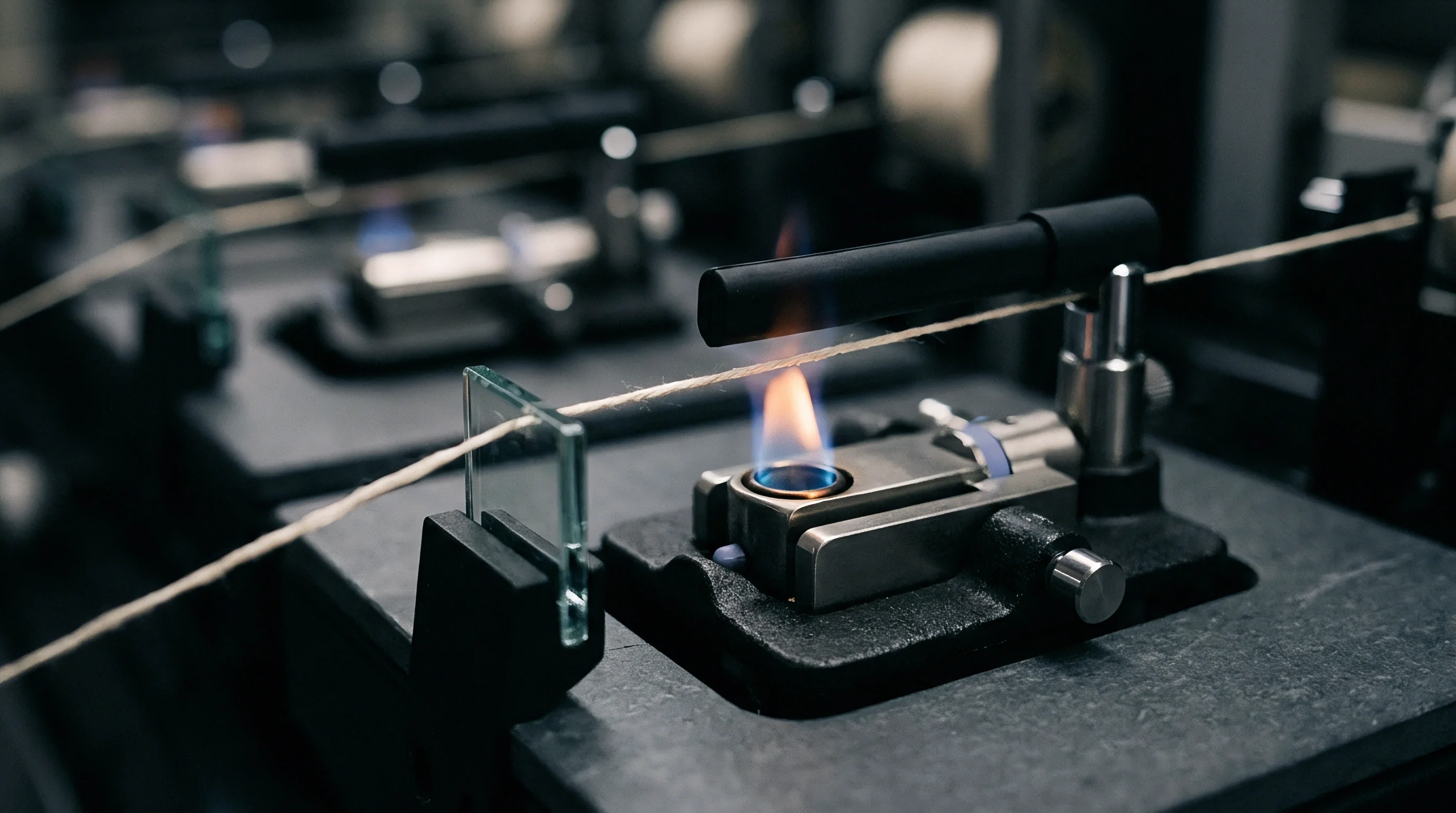
Laboratory evaluations establish commercial benchmarks across diverse product categories. Testing protocols measure dimensional changes under controlled thermal and mechanical cycles, translating wet floor processing reality into legal purchase order specifications. The international market relies on two prominent standards bodies: the International Organization for Standardization and the American Association of Textile Chemists and Colorists.
ISO 5077 operates in conjunction with ISO 6330 washing protocols, while AATCC TM135 governs dimensional changes in automatic home laundering of woven and knit fabrics.

Will Multiple Wash Cycles Expose Latent Instability?
Single laundering evaluations fail to measure progressive contraction across cellulose and regenerated fibers. A single wash cycle according to AATCC TM135 or ISO 6330 only measures immediate relaxation shrinkage, the release of temporary strains left by finishing overfeeds and winding rollers. Regenerated cellulosic fibers like viscose, modal, and lyocell display progressive shrinkage that continues through three, five, and even ten laundry cycles.
Five wash cycles reveal progressive contraction. Viscose fibers experience continuous microfibrillar slippage under domestic laundry agitation, causing the garment to shrink incrementally across every domestic wash cycle.
Specimen benches require conditioned ambient air. Before initial benchmark markings occur, cut specimens must condition flat on perforated racks for at least four hours per ASTM D1776 or ISO 139 at twenty degrees Celsius plus or minus two degrees, and sixty-five percent relative humidity plus or minus four percent. Marking templates place calibrated indelible marks across length and width axes, typically spaced three hundred fifty or five hundred millimeters apart.
Technicians take three distinct pairs of length measurements and three pairs of width measurements across every specimen to account for structural variations across the roll width.
Purchase orders specifying ISO 5077 without designating drying procedure 8A under ISO 6330 permit suppliers to air dry specimens flat and conceal latent shrinkage.
Drying procedures dictate final dimensional readings. ISO 6330 outlines multiple drying procedures, ranging from line drying and flat drying to tumble drying. Tumble drying, designated as Procedure A in ISO 6330, subjects specimens to exhaust temperatures up to sixty degrees Celsius combined with continuous mechanical drops inside a rotating perforated cage.
Tumble drying accelerates loop crowding and crimp expansion, generating shrinkage values twice as severe as flat drying methods. An unprincipled supplier can meet a minus three percent stability target on viscose challis by testing with flat drying, whereas the retail customer using a domestic dryer experiences an eight percent reduction in length.
| Substrate Category | Fiber Composition | Test Protocol | Warp / Length Tolerance | Weft / Width Tolerance | Max Spirality / Skew |
|---|---|---|---|---|---|
| Single Jersey Knit | 100% Combed Cotton | AATCC 135 (3 Cycles, 40°C) | -5.0% / +2.0% | -5.0% / +2.0% | 4.0% |
| Single Jersey with Elastane | 95% Cotton / 5% Elastane | ISO 5077 / 6330 (3 Cycles, 4N) | -4.0% / +1.0% | -4.0% / +1.0% | 3.0% |
| Interlock Double Knit | 100% Combed Cotton | AATCC 135 (3 Cycles, 40°C) | -3.5% / +1.5% | -3.5% / +1.5% | 2.0% |
| Poplin Shirting | 100% Ring Spun Cotton | ISO 5077 / 6330 (1 Cycle, 6N) | -2.0% / +1.0% | -1.5% / +1.0% | 1.5% |
| Twill Bottomweight | 100% Cotton Chino | AATCC 135 (3 Cycles, 50°C) | -3.0% / +1.0% | -2.0% / +1.0% | 2.5% |
| Dobby Oxford | 60% Cotton / 40% Polyester | AATCC 135 (3 Cycles, 40°C) | -2.0% / +1.0% | -1.5% / +1.0% | 1.5% |
| Viscose Plain Weave | 100% Viscose Rayon | ISO 5077 / 6330 (5 Cycles, 3N) | -4.0% / +1.0% | -4.0% / +1.0% | 2.5% |
| Fleece Three-End Terry | 80% Cotton / 20% Polyester | AATCC 135 (3 Cycles, 40°C) | -5.0% / +2.0% | -4.0% / +2.0% | 3.5% |
| Notes: All testing performed with conditioned specimens per ISO 139 standards. Cycle designations indicate machine wash temperature and agitation levels specified in published international test methods. | |||||
Testing laboratory execution exhibits procedural failure modes when internal discipline slips:
- Unconditioned specimen benchmarking occurs when laboratory technicians mark measurement points immediately after cutting from tightly wound shipment rolls, recording distorted baseline numbers.
- Specimen edge curling distorts dimensional verification in open-knit single jersey swatches when unpinned edges roll tightly inward during hot drum drying cycles.
- Ballast load imbalance alters mechanical action when technicians mix heavy denim test pieces with lightweight modal jersey swatches to complete a standard two-kilogram wash load.
- Drying cycle over-baking subjects cellulosic yardage to zero percent moisture regain under prolonged heating, registering excessive thermal shrinkage that misrepresents domestic use.
Calculating the landed financial cost of dimensional failure exposes why brands enforce rigorous matrices. Assume an apparel program consumes forty thousand running meters of cotton twill costing four dollars and twenty cents per finished meter. The purchase specification demands maximum warp shrinkage of minus two percent under ISO 5077.
The delivered mill lot tests at minus four point five percent length shrinkage after three wash cycles. If the garment factory cuts this lot without pattern modification, finished trousers will finish one and a half sizes too short after industrial garment laundering, ruining thirty thousand garments worth twenty-two dollars each at wholesale value. The buyer faces a six hundred sixty thousand dollar inventory write-off, dwarfing the original one hundred sixty-eight thousand dollar piece goods purchase order.
Adding an explicit five-cycle domestic wash requirement under ISO 6330 procedure 4N shifts financial liability for latent shrinking directly back onto the primary conversion mill.
Cut
Garment manufacturing facilities encounter serious sizing defects when unrelaxed rolled piece goods enter automated spreading lines. Rolls shipped directly from dyehouse finishing lines retain wound tension around cardboard cores. The outer wraps of a roll display different tension profiles than the heavily compressed inner layers close to the core.
Cold water washes prevent severe shrinkage. When spreading machines roll yardage onto long tables without tensionless cradles, machine drive rollers induce additional axial stretch. Unrelaxed rolls distort across cutting tables.
Automated rolling carriages introduce longitudinal drag during piece goods unrolling. When an unspooling cradle lacks positive feed servo motors, the trailing weight of the roll pulls the laid plies taut. The top plies of a fifty-ply lay experience free air relaxation, while the bottom plies remain pinned against the table surface under the cumulative weight of the stack.
After the automated knife slices through pattern markers, the perimeter of every cut piece begins to contract toward its natural equilibrium. Spreading tension ruins garment assembly fits.
Pattern design software alters perimeter dimensions according to verified third-party laboratory data. When bulk roll testing confirms consistent minus three percent length shrinkage and minus one percent width shrinkage, computer-aided pattern grading systems expand pattern pieces along length markers by three percent and width markers by one percent. This adjustment assumes total lot-to-lot consistency.
If dyehouse lots within a single shipment fluctuate between minus one percent and minus five percent length shrinkage, marker grading adjustments fail completely. Garments cut from the same marker will emerge from final garment wash ranges with intolerable size deviations across small, medium, and large size bands. Pattern adjustments cannot correct uneven lots.
Differential shrinkage curls cut pattern panels. When shell piece goods exhibit two percent shrinkage while fusible interlinings contract by four percent during steam collar-pressing, the composite collar bands buckle and bubble. Pocket flaps, waistbands, and front plackets twist when component materials shrink asynchronously.
Similar structural degradation occurs in metal stamping operations where cold-worked sheet metal springs back unpredictably after progressive die forming; the trapped residual crystal dislocations mimic the frozen mechanical strains of unrelaxed fibers. In garment manufacturing, asymmetrical contraction produces puckered seam lines along armholes and curved neck openings that no industrial pressing iron can flatten.
Apparel brands levy monetary penalties against textile mills when delivered roll lots exceed agreed dimensional variations. If laboratory inspection flags five percent warp contraction against a three percent contract threshold, the buyer issues a formal quality dispute notice. The mill either pays for specialized external chemical stabilizing treatments, accepts a negotiated price discount of twenty to forty percent per meter, or absorbs complete rejection of the rejected rolls.
Whether automated laser cutting tables can dynamically adjust marker boundaries in real time for varying roll-to-roll shrinkage across a single dyelot remains unsettled across commercial apparel manufacturing.