Quantifying Finished Fabric Shrinkage and Compositional Shift Mechanics
Fabric compaction and selective finish stripping alter finished composition ratios, requiring grey yarn adjustments to maintain imported chief weight compliance.
Mechanics
When raw woven or knitted fabrics go through scouring, dyeing, and drying, internal spinning tensions relax, causing the material to shrink in length and width. This contraction redistributes mass across the surface without destroying fibre mass. Mechanical compaction simply packs a longer length of warp and weft yarn into every square metre, raising thread count per unit area as the overall dimensions shrink.
Physical Compaction and Area Density Creep
Yarns stay under constant longitudinal tension during weaving or knitting. Wet processing lets the crimped yarn paths and strained polymers relax toward equilibrium. As the fabric shrinks in length and width, its weight per unit area in grams per square metre naturally rises.
In single-component fabrics like pure cotton or pure polyester, this density creep leaves the overall fibre ratio unchanged ~ the composition stays uniform despite the rise in weight per linear metre.
The problem arises with heterogeneous yarns or intimate fibre blends. Different fibres have distinct elastic moduli, swelling capacities, and thermal shrinkage rates. When a blended fabric contracts unevenly during wet processing, the structural shift of its constituent yarns changes the measurable physical proportions across the surface.
Fabric area compaction increases thread count per square centimetre while preserving absolute fibre mass.
Differential Contraction in Core Spun Blends
Core-spun yarns with elastomeric cores and staple sheaths are particularly prone to compositional shifts. Elastane filaments have far higher elastic recovery than cellulosic sheath fibres. During heat setting and wet relaxation, the elastane core pulls back forcefully, crowding the surrounding cotton or viscose sheath fibres and concentrating the elastane mass within a smaller footprint.
If finishing pulls the cloth under continuous warp tension, the elastane ratio can appear unchanged. But if the mill uses overfeed drying or tumble relaxation, warp shrinkage can reach fifteen percent. That contraction alters the relative proportion of elastane to sheath fibre inside any cut sample, shifting laboratory results away from the original grey spin ratio.
Whether predictive stress-strain modelling of raw yarn crimp can fully eliminate post-finishing blend variance across high-speed air-jet looms remains an open question in mill practice.

Swell
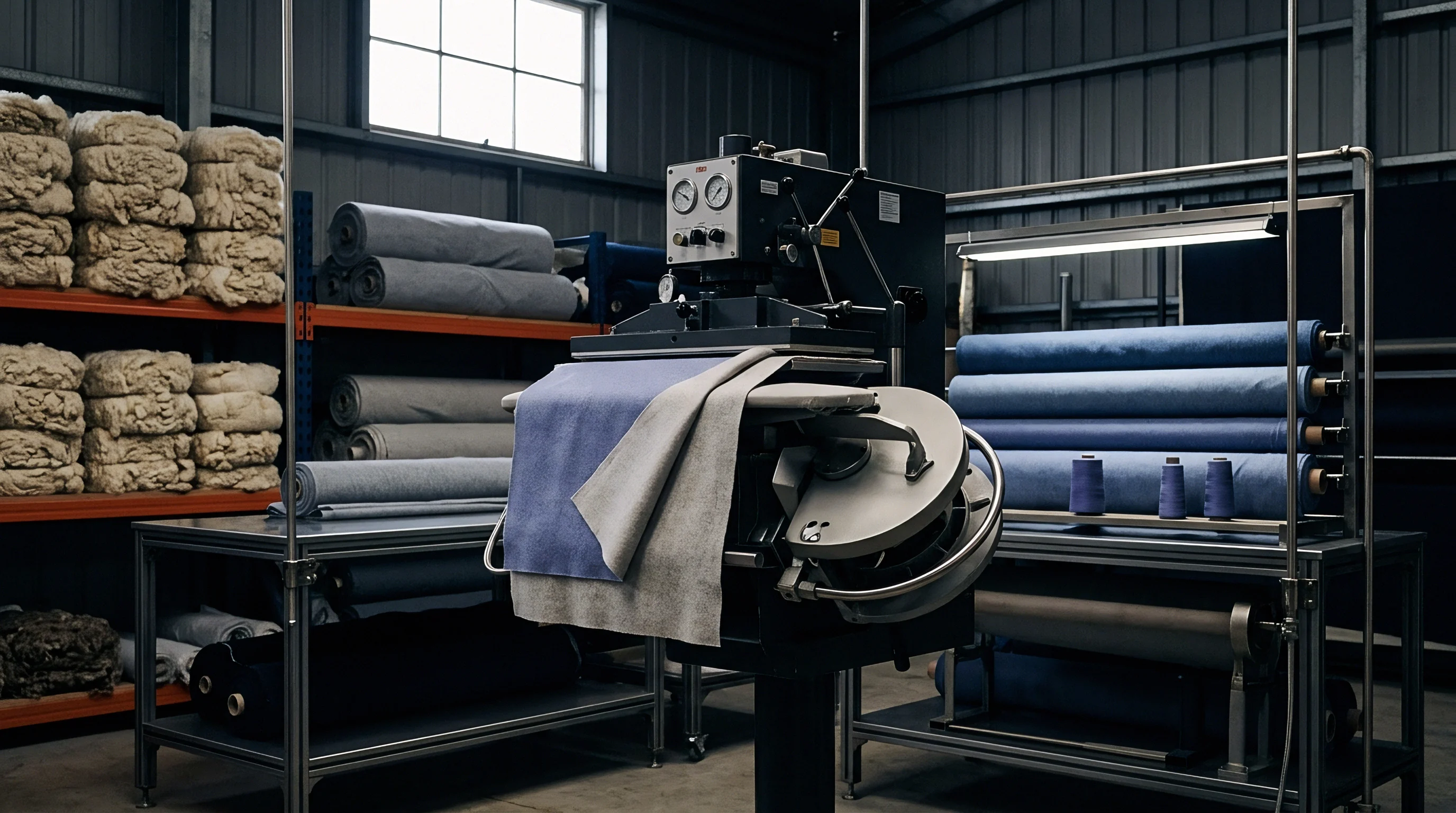
Water forces hydrophilic polymer chains to expand in diameter, driving structural yarn shifts. Cotton, viscose, and wool absorb significant moisture, causing transverse swelling that thickens the yarn cross-section. This expansion shortens the path of interlocking weave crimps, pulling adjacent yarns together and shrinking the entire fabric plane.

Aqueous Absorption and Crimp Redistribution
Synthetics like polyester and nylon take up almost no moisture and show negligible swelling. In a cotton-polyester bath, the cotton expands sideways, forcing the hydrophobic polyester yarns to bend around the swollen cellulosic structure. When dried, the cotton fibres shrink axially while the synthetic yarns remain set in their altered wave paths.
This uneven crimp distribution shifts the structural balance between warp and weft. In a fifty-fifty cotton-polyester plain weave, warp shrinkage can hit eight percent while weft shrinkage stays at two percent. That directional imbalance concentrates mass unevenly across the two yarn systems, causing composition readings from small cut swatches to vary across different sections of the finished roll.
| Fibre Blend Construction | Grey GSM | Finished GSM | Warp Shrinkage (%) | Weft Shrinkage (%) | Measured Shift (%) |
|---|---|---|---|---|---|
| 100% Ring Spun Cotton | 180 | 212 | 8.5 | 3.0 | 0.0 |
| 65% Polyester / 35% Cotton Plain Weave | 145 | 158 | 4.2 | 1.5 | +0.8 Poly / -0.8 Cotton |
| 95% Cotton / 5% Elastane Core-Spun Twill | 220 | 265 | 12.0 | 4.5 | -1.2 Cotton / +1.2 Elastane |
| 50% Bamboo Viscose / 50% Recycled Polyester | 160 | 184 | 9.8 | 2.2 | -1.5 Viscose / +1.5 Poly |
Selective Mass Reduction during Wet Processing
Dimensional contraction is not the only cause of composition shifts. Chemical stripping and soluble mass loss during wet processing alter the dry weight of specific components before physical shrinkage even occurs.
- Differential elastane draw happens when core-spun polyurethane filaments contract at higher thermal thresholds than surrounding cotton fibres, driving up the synthetic weight percentage per square metre.
- Sizing solubilisation loss takes place when starch or polyvinyl alcohol protective coatings wash out in scouring, taking away up to eight percent of warp mass.
- Alkaline weight reduction results from aggressive sodium hydroxide treatments dissolving outer polyester surfaces and raising the apparent cellulosic ratio.
- Asymmetric relaxation contraction develops when warp tensions released during jet dyeing outpace weft contraction, distorting directional thread counts and relative density.
Unprocessed greige warp yarns carry heavy sizing loads ~ mostly starches, polyvinyl alcohol, and polyacrylates ~ applied almost entirely to the warp. Desizing and scouring strip this coating away. If the warp is cotton and the weft is polyester, losing that sizing selectively reduces warp mass, tilting the post-wash chemical analysis toward the synthetic weft.
Applying ISO 5077 wet processing procedures without preliminary oven-dry conditioning skews measured mass ratios by differential moisture regain.
Never declare finished composition ratios based on unwashed loom-state greige swatches.


Separation
Determining component fibre mass accurately requires selective chemical dissolution or microscopic sorting under standardized conditioning. Methods like ISO 1833 and AATCC 20A isolate fibres using reagents that dissolve one polymer class while leaving the other as a dry residue.

Quantitative Dissolution under ISO 1833
Chemical separation depends on correcting for solvent attack on insoluble residues, as well as accounting for official moisture regain. Every fibre has a recognized standard regain set by commercial convention: cotton is set at eight point five percent, viscose at fourteen percent, polyester at zero point four percent, and elastane at one point five percent.
| Blend Components | Target Dissolved Fibre | Reagent System | Test Temp (°C) | Method Tolerance (%) |
|---|---|---|---|---|
| Cotton / Polyester | Cotton | 75% Sulfuric Acid | 50 | ±1.0 |
| Viscose / Polyester | Viscose | Sodium Zincate or Formic Acid/Zinc Chloride | 20 | ±1.0 |
| Polyamide / Elastane | Polyamide | 80% Formic Acid | 20 | ±1.5 |
| Wool / Synthetic | Wool | 75% Alkaline Sodium Hypochlorite | 20 | ±1.0 |
When a lab receives a fabric sample, testing measures the clean oven-dry weight of the dissolved and residual components. True commercial composition is then calculated by applying regain values to those dry weights. Skipping these adjustments inflates hydrophobic fibre percentages, as their dry mass stays near commercial weight while hydrophilic cellulosics lose up to fourteen percent of their ambient weight in the drying oven.
Should Wet Processing Tolerances Override Landed Customs Declarations?
Customs officers inspect finished fabric at the destination port and will reject origin certificates built solely on greige yarn specifications. Take a worked example of a cotton-elastane core-spun woven cloth: the greige specification calls for a 95.0% cotton and 5.0% elastane ratio, with a warp carrying 6.0% polyvinyl alcohol sizing by mass.
During wet finishing, desizing strips that 6.0% warp size completely. Scouring and dyeing then cause 10.0% warp shrinkage and 4.0% weft contraction, reducing total surface area by 13.6%. Because the elastane core keeps its mass while pulling back in length, its weight per square metre increases relative to the cotton sheath, which also loses a small amount of lint during bleaching.
Chemical dissolution of the finished, desized fabric gives an oven-dry mass of 94.2% cotton and 5.8% elastane. Adding standard moisture regain (8.5% for cotton, 1.5% for elastane) yields a final commercial blend of 94.6% cotton and 5.4% elastane. Between sizing loss and differential shrinkage, the secondary fibre ratio has shifted 0.4 percentage points away from the initial greige mill target.
- Draw representative swatches across the full width of the finished roll, discarding the outer two metres of the fabric roll end.
- Condition samples at twenty degrees Celsius and sixty-five percent relative humidity for twenty-four hours according to ISO 139.
- Perform quantitative chemical dissolution using seventy-five percent sulfuric acid for cellulosic separation or zinc chloride for viscose removal.
- Dry residual non-soluble fibres to constant mass in a ventilated drying oven at one hundred and five degrees Celsius.
- Apply standard moisture regain correction factors to oven-dry residual masses before calculating commercial percentage composition.
A twelve percent longitudinal compaction in a core-spun elastane weave elevates the secondary elastane weight ratio by zero point six percentage points.
Relying on uncorrected dry weights without regain adjustments produces inaccurate blend declarations, leaving shipments vulnerable to re-testing penalties during customs audits.

Duty
Customs authorities classify blended textiles strictly by the fibre that predominates by weight at entry. General Rule of Interpretation 3b under the Harmonized Tariff Schedule places mixed products under the heading of whichever material carries chief weight. A shift of just zero point five percent across a fifty percent threshold can change the entire classification, re-categorizing a cotton fabric as a synthetic weave.

Chief Weight Thresholds and Harmonized Tariff Schedule Shifts
Crossing chief weight boundaries carries steep financial consequences. Under many tariff schedules, Chapter 52 covers cotton-chief woven fabrics at typical duty rates between six and eight percent. Chapters 54 and 55 cover synthetic filament and staple fabrics, where duty rates often reach twelve to fourteen percent.
Consider a mill spinning greige yarn targeted at 51.5% cotton and 48.5% polyester, intended for entry under HS Code 5211 as a cotton-chief material. During jet dyeing and mercerization, sodium hydroxide treatments strip natural cotton waxes and soluble pectins, taking away two point five percent of the cotton mass. At the same time, warp tension during drying stretches the synthetic yarn, locking in a wider final dimension.
Lab testing at import shows a finished composition of 49.6% cotton and 50.4% polyester. Synthetic fibre now holds chief weight, leading customs to reclassify the shipment under HS Code 5514. The importer is hit with a duty increase of over six percentage points on total invoice value, along with possible penalties for inaccurate origin declarations.
- Borderline percentage buffer ~ maintain a two percent target cushion away from fifty percent boundaries so finishing drift does not push fabric into a higher tariff chapter.
- Dual-laboratory validation ~ run parallel ISO 1833 testing at both origin and destination accredited labs before releasing final invoices.
- Finishing loss tracking ~ log size removal and weight loss yields on every production run prior to completing export paperwork.
- Regain adjustment audit ~ confirm commercial moisture regain figures align with Harmonized System legal notes rather than informal mill estimates.
Customs authorities classify composite textiles strictly on the physical composition of the finished fabric at the port of entry.
Commercial Exposure at Tariff Classification Boundaries
Regulatory frameworks in the European Union and the United States allow narrow legal tolerances for composition labels, but these do not apply to tariff classification. The EU Textile Labelling Regulation permits a three percent manufacturing allowance between labeled and analyzed weights on binary blends, while US FTC rules allow three percent for non-functional fibres.
While these tolerances shield brands from mislabeling charges on retail hangtags, border agencies enforce tariff law based solely on physical composition. Inspectors assess actual weight at entry: a fabric labeled 51% Cotton / 49% Polyester under FTC rules will still be taxed as synthetic if lab analysis finds 50.1% polyester by weight.
Pre-shipment wash shifts are sometimes treated as temporary structural variations that reverse during garment pressing.


Target
Hitting a target finished composition requires factoring shrinkage and mass loss directly into the initial greige yarn specification. Engineers cannot simply order a greige yarn blend that mirrors the target finished fabric without risking border rejections. Formulations must adjust for expected sizing removal, chemical weight loss, and differential shrinkage in the warp and weft.

Greige Yarn Specification Recalibration
Determining the right greige blend requires tracking historical loss factors on specific finishing lines. If scouring regularly removes two percent of cotton mass while thermal relaxation shrinks elastane core yarns eight percent in length, the spinning mill must adjust its initial fibre feed ratios accordingly.
To hit a verified finished composition of 95.0% cotton and 5.0% elastane, for example, the blowroom mix might load 95.4% cotton and 4.6% elastane into carding. This intentional offset compensates for downstream elastane compaction. Engineering the initial mix around known shrinkage vectors ensures the finished fabric performs as intended while remaining safely within target tariff brackets.

Contractual Compliance Frameworks
Sourcing agreements, purchase orders, and technical specifications should formalize these requirements in clear, binding clauses. Specifications must tie composition percentages to specific ISO or AATCC test methods, setting out clear moisture regain rules and dimensional stability targets.
Tolerances in technical documents need to account for tariff boundaries. When ordering fabrics near a fifty percent chief-weight limit, contracts should restrict mill tolerance to plus or minus zero point five percent rather than the standard three percent. Sampling schedules and pre-shipment lab clearances protect margins and avoid costly customs disputes at entry.
Standard commercial supply contracts typically include a binding clause allowing immediate lot rejection at the supplier’s expense if finished fabric exceeds a two percent composition tolerance.