Predictive Calculation of Finished Mass Shifts in Synthetically Blended Interlock Knits during Jet Dyeing
Predict finished mass by balancing oil extraction losses against planar compaction ratios derived from jet thermal relaxation and stenter overfeed settings.
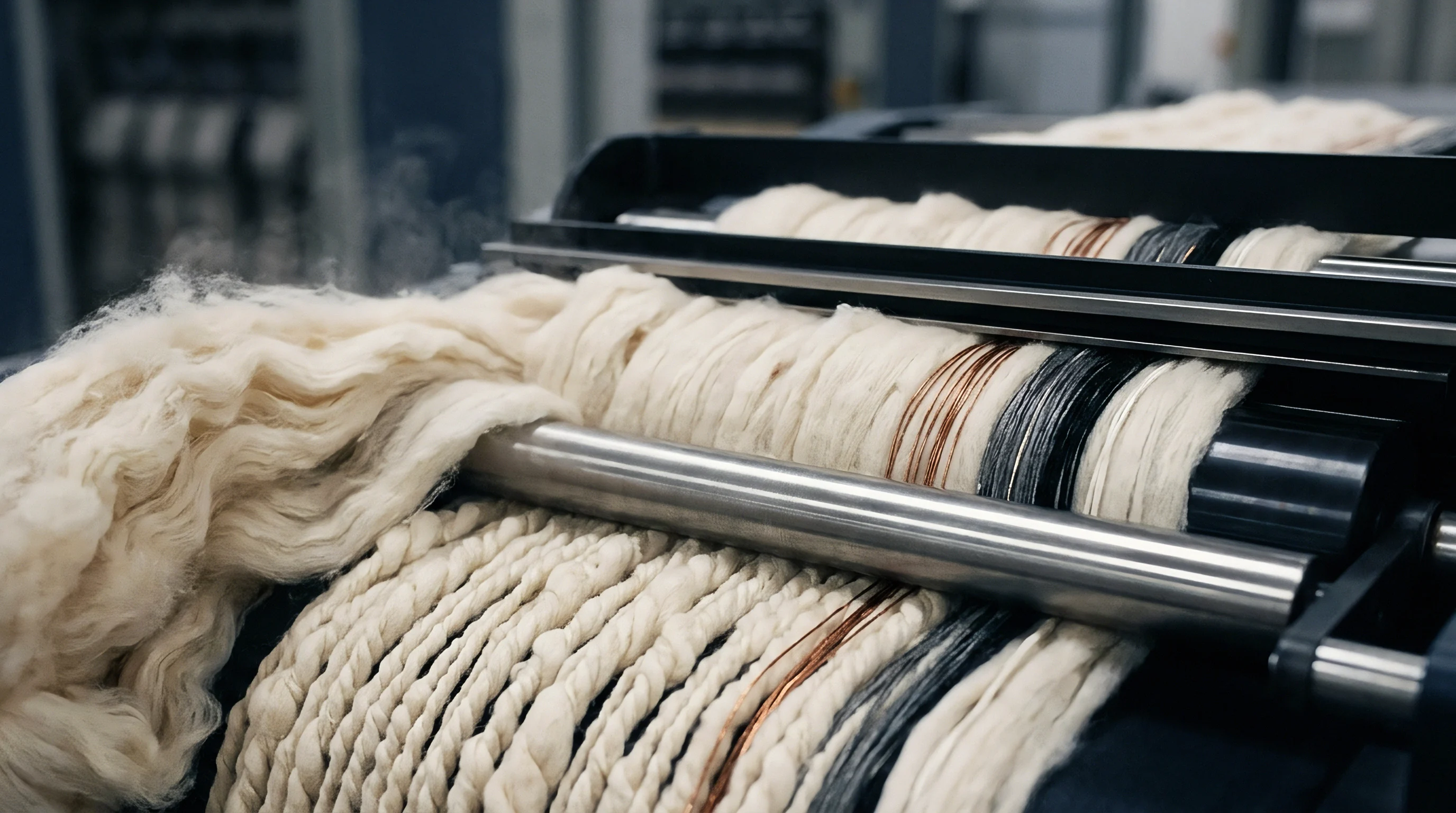
Intake
Circular knitting registers 185 grams per square metre on the conditioning table under ISO 139 standard atmosphere. The greige scale reads 182 grams. Target finished weight measures 220 grams.
That thirty-five-gram delta represents the combined effect of elastomeric yarn retraction, aqueous yarn relaxation, knitting oil extraction, and longitudinal overfeed compaction during wet processing. A 75-denier 72-filament textured polyester interlooped with 40-denier bare elastane on a 28-gauge double-jersey machine exits the needles under machine take-down tension that artificially elongates loop geometry. Relaxing that structure within aqueous liquor collapses the stitch length, elevating areal density while reducing finished width.
Predictive calculation of finished mass requires balancing chemical mass subtractions against physical structural contractions. Knitting lubricants, synthetic sizing polymers, and surface antistatic agents account for two to four percent of incoming greige mass. Scouring strips five percent spinning oils.
When the aqueous scouring bath dissolves these processing aids, the dry solid weight drops before dimensional consolidation begins. Calculating the final mass requires establishing the greige dry mass baseline minus extractable lubricants, then multiplying by the planar compaction quotient derived from course and wale density shifts.
Conditioning interlock swatches at twenty degrees Celsius and sixty-five percent relative humidity for twenty-four hours establishes the true baseline mass under ISO 139.
The mathematical formulation for predicting finished square-metre mass builds upon loop length conservation across machine gauge and finishing passes. Let the greige aerial density be designated as M_g in grams per square metre, with lubricant mass fraction loss designated as L_s. Let the greige course count per centimetre be C_g and wale count per centimetre be W_g.
If finished courses and wales per centimetre are C_f and W_f, the dry structural compaction factor equals the product of the course ratio and the wale ratio. Finished mass per square metre M_f resolves through the direct formula: M_f equals M_g multiplied by one minus L_s, multiplied by the course ratio C_f over C_g, multiplied by the wale ratio W_f over W_g, adjusted for dye pickup mass P_d. Dye pickup for disperse dyestuffs on polyester runs between 1.5 and 3.5 percent on weight of goods for medium to deep shades.
Incorrect estimation of the oil extraction percentage leaves the knitter with finished rolls below legal buyer specification limits, voiding commercial acceptance without recourse.

Nozzle
Hydraulic transport inside the jet chamber subjects the knitted rope to cyclic mechanical shock. Venturi jets run differential pressures between 0.8 and 2.2 bar, forcing liquor through the annular nozzle ring to propel synthetic ropes at speeds from 250 to 450 metres per minute. The nozzle differential reads 1.4 bar.
Liquor turbulence drives yarn realignment. Interlock structures contain two independent 1×1 rib wales back-to-back, with loops in one wale supported by the intercrossing yarns of the opposite side. When hydraulic pressure accelerates the cloth through the nozzle throat, the impact forcibly compresses the loops in the machine direction while the subsequent deceleration in the transport tube allows elastic recovery.
Where Resides the Primary Compaction Vector?
Displacement inside the jet nozzle acts as an intermittent mechanical mill. Each cycle through the venturi imparts longitudinal strain followed immediately by total immersion relaxation in the J-box basket. The liquor-to-goods ratio dictates the mechanical dwell environment.
Operating at a 1 to 6 liquor ratio creates higher physical contact between the rope and chamber walls than a 1 to 10 ratio, accelerating surface friction and driving the yarn toward its minimum energy state. Elastane draft generates forty percent retractive force. When thermal energy in the dyeing zone surpasses the glass transition temperature of the synthetic matrix, loop geometry yields to this internal contractile stress.
Structural alterations during jet circulation fall into distinct physical categories:
- Hydrodynamic loop shortening pulls the needle loops into a rounder configuration within the throat, permanently raising courses per unit length.
- Elastomeric retentive snapping draws adjacent wales together immediately upon rope exit from the liquor jet, closing open space between yarn crowns.
- Yarn cross-section flattening results from continuous mechanical impact across conveyor rolls, densifying the planar cross-section of the interlock construction.
Planar area compaction across differing synthetic compositions exhibits variable response thresholds based on machine gauge, filament decitex, and mechanical settings during dyeing passes.
| Fiber Composition | Machine Gauge | Yarn Count Dtex | Greige Mass g/m² | Finished Mass g/m² | Mass Shift Ratio | Width Contraction % |
|---|---|---|---|---|---|---|
| 88% Polyester / 12% Elastane | 28 Gauge | 84 dtex / 44 dtex | 185 ± 5 | 224 ± 4 | +21.1% | 18.5% |
| 82% Polyamide 6.6 / 18% Elastane | 32 Gauge | 50 dtex / 33 dtex | 160 ± 4 | 208 ± 5 | +30.0% | 24.0% |
| 92% Micro-Polyester / 8% Spandex | 24 Gauge | 110 dtex / 44 dtex | 210 ± 6 | 242 ± 5 | +15.2% | 14.0% |
| 100% Textured Polyester Interlock | 28 Gauge | 84 dtex / 0 dtex | 170 ± 4 | 182 ± 3 | +7.1% | 8.5% |
Interlock gates both needle beds simultaneously. The locked structure resists curl along the raw edges, yet jet nozzle impact forces yarn segments to migrate between the face and reverse beds. High nozzle velocities drive yarn from the cross-under interlock segments into the loop crowns, expanding yarn bulk.
The volumetric swell of texturized synthetic yarns within high-temperature liquor reduces inter-yarn porosity, altering finished opacity along with areal density.
Predictive calculation models assume uniform mechanical work across the complete rope length. Yet the question remains whether the leading twenty metres of a dyed rope cycle encounter the exact shear history experienced by the inner folds of the batch.
Heat
Thermal processing governs the absolute dimensional memory of synthetic interlock textiles. Polyesters achieve macromolecular chain mobility at the glass transition point around seventy-five degrees Celsius, while crystallite reorganization occurs between 180 and 215 degrees Celsius. Heatsetting fixes the crystallite lattice permanently.
When the dyer subjects synthetic goods containing elastane to jet dyeing at 130 degrees Celsius without prior stabilization, uncontrolled thermal shrinkage occurs inside the nozzle liquor. A preliminary heatsetting pass on a stenter frame establishes the geometric perimeter, setting maximum loop length before jet processing begins.
A thirty-second dwell at one hundred ninety degrees Celsius locks elastane chain extensions against hydrothermal jet extraction.
Stenter overfeed settings dictate course compaction. Running ten percent overfeed delivers excess length into the heating zones, causing courses to press against each other while the cross-directional chain pins maintain target width. Cooling tanks lock yarn geometry instantly.
The predictive formula for mass shift must incorporate the stenter pin width and longitudinal overfeed percentages applied during post-dye finishing.
Execution of thermal stabilization follows a rigorous sequential progression:
- Pre-heatsetting raw greige goods at 190 degrees Celsius for 35 seconds to stabilize width, neutralizing residual circular knitting machine torque before aqueous exposure.
- Scouring in continuous open-width washers at 85 degrees Celsius with non-ionic surfactants to remove all processing silicone and paraffin oils.
- Jet dyeing at 130 degrees Celsius for 45 minutes under controlled heating gradients of 1.5 degrees Celsius per minute to avoid thermal shock creasing.
- Cooling down to 60 degrees Celsius at 2.0 degrees Celsius per minute before draining to lock loop morphology without thermal quenching distortion.
- Final post-finishing through stenter pin chains with seven percent longitudinal overfeed at 165 degrees Celsius to apply chemical softeners and fix final mass.
Width contracts eighteen percent in water. The balance between thermal shrinkage and chemical relaxation determines the target output density. In polyester-elastane matrices, thermal exposure causes elastane filaments to lose ten to fifteen percent of their original retractive power through thermal degradation if dwell times exceed forty-five seconds at 195 degrees Celsius.
Such loss reduces finished elasticity, preventing the goods from recovering their programmed density upon cooling.
| Process Stage | Temperature °C | Nozzle Pressure Bar | Rope Speed m/min | Overfeed % | Finished Weight Impact |
|---|---|---|---|---|---|
| Aqueous Scour | 80 – 90 | 1.0 – 1.2 | 300 | 0% | -2.5% to -3.8% Mass |
| Disperse Dye Cycle | 130 – 135 | 1.4 – 1.8 | 380 | 0% | +18.0% to +26.0% Mass |
| Reduction Clear | 70 – 80 | 1.0 – 1.2 | 350 | 0% | -0.5% Mass |
| Stenter Post-Set | 160 – 170 | 0.0 (Dry) | 35 m/min line | +5% to +12% | +4.0% to +9.0% Mass |
| Data normalized for 28-gauge polyester-elastane 88/12 interlock knits under ISO 3801 standard atmospheric conditioning. | |||||
Residual torque causes edge rolling. In modern production, thermal fixation sets the polymer chains in the configuration dictated by the pins of the finishing frame. Overstretching width in the stenter to achieve higher fabric yield reduces courses per centimetre, lowering finished aerial mass below the target specification.
Controlling mass requires coordinating greige diameter, knitting machine cut, stenter pin distance, and overfeed velocity.
Stable dimensional properties follow consistent thermal dwell times rather than extreme heat spikes.

Drift
Production variance across multiple dye lots induces finished mass divergence. Even when knitting machines utilize identical yarn lots, incoming elastane packages exhibit draft fluctuations between 2.8 and 3.2 draw ratios during feeding. This yarn tension divergence produces raw goods with disparate loop lengths.
Scouring and dyeing inside high-temperature jets amplify these initial variances. A lot dyed in chamber one at a six-to-one liquor ratio experiences higher shear forces than a lot processed in chamber four of a multi-tube machine with irregular nozzle orifice wear. The resulting mass shifts manifest as lot-to-lot shade and weight divergence.
When Will Relaxation Exhaust Elastic Draw?
Full dimensional exhaustion occurs when internal strain energy within the synthetic interlock drops to zero. Water at elevated temperatures acts as a plasticizer for synthetic polymers, accelerating molecular reorganization. As the knitted loops tumble through the jet transport tube, elastomeric yarns contract until physical loop crown jamming occurs.
At this jamming limit, adjacent yarn diameters touch, preventing further contraction regardless of mechanical overfeed or moisture presence. Calculating this limit requires knowing the yarn diameter under compression, derived from yarn decitex, packing factor, and fiber density.
Planar jamming limits define the absolute upper boundary of aerial density for double-knit constructions.
Parameter reconciliation for drifted mass calculations requires verifying specific production settings:
- Yarn package feed tension must be maintained at 2.5 to 3.0 centinewtons during circular knitting to establish uniform initial loop lengths across every feed.
- Chamber nozzle calibration demands monthly laser verification of orifice diameters to preserve matched hydraulic propulsion velocities across all jet ports.
- Stenter pin rail parallelism prevents cross-web mass variation where roll edges finish heavier than the central textile strip.
- Batch cooling discharge temperature requires termination strictly below fifty degrees Celsius to avoid irregular elastic draw down inside unloading trucks.
Divergence occurs when mills blend distinct filament texturizing profiles within one dye lot. Texturizing differences alter polymer crystallinity and dye uptake kinetics. When drawing draw-textured polyester yarns from separate synthetic spinning lines, internal contraction forces under 130-degree jet liquor diverge by as much as eight percent.
This variance alters course density, producing different aerial masses from identical knitting machine stitch cams.
Mills frequently attribute off-weight lots to uncontrollable yarn variations from synthetic polymer suppliers.

Target
Engineering synthetic interlock knits to an exact finished weight specification demands backward mathematical derivation from the cutting table to the circular knitting needle. Target finished weight measures 220 grams per square metre with acceptable commercial limits set at plus or minus five percent under ISO 3801. Achieving this window means establishing the exact greige knitting weight that accommodates jet contraction and finishing frame pin settings.
If the finished goods must measure 150 centimetres in usable width, the greige knit tube diameter and needle selection must match the predictable shrinkage percentage.
The mathematical pathway to reverse-engineer the required greige weight operates through the consolidated mass shift equation. Let M_f be the target finished mass of 220 g/m². Let the total planar area shrinkage factor be S_a, calculated from longitudinal shrinkage S_l and width shrinkage S_w as: one minus S_l multiplied by one minus S_w.
For an 88/12 polyester-elastane interlock, longitudinal shrinkage in wet processing averages twelve percent while width shrinkage averages eighteen percent. S_a resolves to 0.88 multiplied by 0.82, yielding an area yield factor of 0.7216. Accounting for a three percent mass loss from oil extraction L_s and a two percent dye mass pickup P_d, the conversion coefficient equals 0.7216 divided by 0.99, yielding 0.7289.
Multiplying target M_f of 220 by 0.7289 reveals the required greige mass: 160.3 grams per square metre.
Inspection rejects lots below specification bounds. Circular knitting cam settings must be locked to deliver 160 grams per square metre off the machine. If the knitting shed allows greige density to rise to 175 grams per square metre, the identical jet dyeing and stenter procedure will yield a finished textile weighing 240 grams per square metre.
That twenty-gram excess represents unrecoverable raw material loss across thousands of kilograms. Off-spec goods trigger chargeback deductions. Garment markers become unusable when finished roll width drops below purchase order dimensions due to over-compaction.
A purchase contract clause stipulating finished mass compliance under ISO 3801 within a four percent bilateral tolerance transfers the financial liability for excess yarn consumption entirely to the processing mill.