Controlling Biaxial Stenter Overfeed to Minimize Finished Fabric Washing Shrinkage
Biaxial stenter overfeed balances longitudinal pin delivery against rail divergence to lock yarn crimp and reduce finished fabric washing shrinkage below 3 percent.


Feed
Dimensional instability in finished fabric surfaces on the cutting table when tension relaxes, or inside the laundry drum when hot moisture breaks internal hydrogen bonds. A stenter controls this behavior through longitudinal overfeed and transverse rail divergence. Setting machine overfeed between positive 15 percent and positive 35 percent delivers excess linear yardage directly to the needle chain or clip track.
The fabric pins slack. As it enters the heated chambers, thermal energy and mechanical agitation permit the distorted yarn structure to contract, relieving longitudinal strains imposed during upstream spinning, weaving, or wet processing.
Every percentage point of warp extension pulled through continuous dye ranges, wash boxes, and extraction padders converts directly into residual shrinkage potential. Left uncorrected, wet processing stretches a typical single jersey cotton by 8 to 14 percent in length while reducing its natural width. The stenter neutralizes this distortion.
By decelerating the transport chains relative to the pinning wheels, the machine accumulates loops or picks per centimetre before thermal locking occurs. Processors operating without precise overfeed balance routinely watch finished goods collapse 12 percent along the length in home laundry cycles.
ISO 5077 testing after five wash cycles at 40 degrees Celsius exposes every unresolved longitudinal strain left behind by an underfed pin rail.
The relationship between overfeed velocity and finished dimensional change behaves predictably across stable builds. Increasing longitudinal entry feed shortens the yarn crimp interval in wovens and compresses the loop height in circular knits. When pinning wheels overfeed the chain by 22 percent on a 180 gram per square metre cotton jersey, finished length shrinkage drops from negative 9.5 percent down to negative 3.2 percent under ISO 6330 domestic wash procedures.
Achieving this balance requires coordinating three mechanical speeds: the traction drive roll, the brush-wheel delivery, and the pin chain carriage.
Overfeed failure manifests instantly in unit mass. Feeding cloth too slowly stretches the structure, lightening the finished areal weight and expanding washing shrinkage. Excess overfeed causes pin drop, scalloped selvages, and wavy edges that jam automated cutting spreaders.
The engineer establishes machine settings based on greige yarn twist liveliness, chemical pre-treatments, and the mechanical tension profiles of preceding pad mangles.
The contract buyer who approves a fabric specification without auditing overfeed parameters risks paying for dimensional rejections at the garment factory gate.

Mechanics
The biaxial stenter applies mechanical work through two orthogonal axes simultaneously. Length control depends on the speed differential between the fabric entry nip and the carriage drive chain. Width control relies on diverging horizontal rail tracks that pull the selvages to a programmed cross-machine dimension.
Inside the dryer zones, circulating air impinges upon the wet or resin-impregnated substrate, transferring sensible heat that evaporates water and plasticizes synthetic polymers or relaxes cellulosic networks.
Coupled Longitudinal and Transverse Forces
Distorting a textile along its width induces an immediate structural contraction along its length. When stenter rails diverge to pull a 150-centimetre greige woven duck to an open 160-centimetre target, the weft yarns straighten. This transverse tension forces warp yarns into higher crimp amplitude.
If the entry line fails to provide sufficient longitudinal overfeed to feed this newly required warp path length, the machine pulls the warp tight. That tension becomes locked as latent strain when moisture leaves the web.
Circular and warp knits exhibit an even more dramatic Poisson-type coupling. Forcing a knitted structure wide pulls the needle loops into flat, horizontally elongated ellipses. The fabric exits the machine at width, but the natural elasticity of the yarn loops asserts itself during aqueous laundering.
The loops round out, driving significant length contraction. Controlling biaxial overfeed counteracts this tendency by compacting the courses along the machine direction while the rails establish the required wale count across the width.
| Construction and Composition | Pre-Stenter Processing State | Stenter Overfeed Setting | Rail Divergence Over Greige | Target Chamber Temperature | Finished Length Shrinkage | Finished Width Shrinkage |
|---|---|---|---|---|---|---|
| Single Jersey 100% Ring Spun Cotton (30/1 Ne) | Bleached, dyed in soft-flow jet, pad extracted | +24% to +28% | +6% to +8% | 140°C to 150°C | -3.5% (ISO 6330 4N) | -2.5% (ISO 6330 4N) |
| Interlock Knit 95% Cotton / 5% Elastane (40/1 Ne) | Scoured, reactive dyed, slit from circular tube | +18% to +22% | +4% to +6% | 185°C to 192°C | -4.0% (ISO 6330 4N) | -3.0% (ISO 6330 4N) |
| 3/1 Twill Bottomweight 100% Cotton (16/1 x 12/1) | Continuous vat dyed, vacuum extracted | +6% to +9% | +2% to +3% | 130°C to 140°C | -2.0% (ISO 5077) | -1.5% (ISO 5077) |
| Plain Weave 65/35 Poly-Cotton Workwear (20/1 Ne) | Pad-dry-pad-cure thermosol, washed, extracted | +4% to +7% | +1% to +2% | 195°C to 205°C | -1.2% (ISO 5077) | -1.0% (ISO 5077) |
| Four-Way Stretch Warp Knit 80/20 Polyamide/Elastane | Beam dyed, hydro-extracted, moisture 25% | +12% to +16% | +10% to +14% | 180°C to 188°C | -2.8% (ISO 6330 4N) | -2.0% (ISO 6330 4N) |
Pinning integrity governs actual feed delivery. The drive system operates a pair of motorized rubber or synthetic polyurethane wheels that press the selvage onto hardened steel needle pins. If brush pressure drifts low, cloth skims the pin tips rather than bedding fully into the pin base.
Slipping fabric changes the effective feed ratio. The machine computer logs positive 25 percent overfeed, but the physical fabric experiences only positive 10 percent because the pin chain slides beneath the selvage. Operators check needle cleanliness and brush bristle wear at every shift turnover.
Air velocity inside the drying bays produces aerodynamic flotation forces that lift the fabric off the chain if entry slack accumulates excessively. High-velocity nozzle fields must distribute air equally between top and bottom boxes. Unbalanced bottom nozzle pressure lifts an overfed knit, dislodging pins and shredding the selvage along the chain track guide.
A pinning line running with worn brush wheels loses up to half its programmed longitudinal feed to slippage before entering the first drying chamber.
Machine configuration dictates whether the stenter acts merely as a drying frame or as a setting range. Synthetic blends require thermal transition zones that exceed the glass transition point of polyester or the melting point of elastane core filaments. Once heated beyond these operational thresholds, polymer chains recrystallize around the new, relaxed geometry.
When overfeed correctly buffers the warp direction during this plastic phase, the memory of weaving or knitting draw tension disappears permanently.

Relaxation
Thermal input drives moisture vaporization while unlocking the mechanical constraints held within twisted yarn bundles. In cotton and other cellulosic substrates, water acts as an effective plasticizer. When wet cellulosic goods travel through the initial drying bays, capillary drying forces pull fibers together, promoting structural recovery.
If external tension holds the fabric taut along the machine direction, these natural restorative contractions cannot occur. The fiber network dries in an extended, high-energy state.
Can Dynamic Air Turbulence Substitute for Stenter Overfeed?
Modern stenter drying chambers generate sinusoidal fabric wave profiles by utilizing offset top and bottom jet nozzles. This configuration creates aerodynamic lifting and dropping actions as the cloth passes down the bay. Dynamic flapping agitates the yarns, breaking localized friction between interlacing contact points.
This kinetic energy allows overfed yardage to shrink freely inside the safe perimeter of the pin chains before the exit nip locks the structure.
Synthetic polymers respond to thermodynamic crystallization rather than moisture drying mechanisms. Polyester fibers experience glass transition between 70 and 80 degrees Celsius, but stabilizing the yarn against residual shrinkage requires crystallization temperatures between 190 and 210 degrees Celsius. At these thermal stages, internal drawing stresses from yarn manufacturing dissolve.
If the stenter chain lacks adequate positive overfeed during this twenty to thirty second exposure, the hot synthetic web pulls against the pins, guaranteeing massive length shrinkage during downstream garment pressing or home drying.
- Selvage Pinning Accuracy sets the foundation for mechanical stability, holding the web flat without localized edge curl.
- Thermal Chamber Entry exposes the wet web to rapid heat transfer, initiating moisture evaporation and softening sizing residues or finishes.
- Aerodynamic Web Aeration levitates the overfed fabric mass between opposing jet chambers, allowing yarn crimp to distribute evenly without directional drag.
- Polymer Thermal Locking takes place in the final dry zones where core temperatures reach fiber stabilization thresholds, setting the mechanical loop count permanently.
- Chilled Roll Takeoff freezes the structural geometry before exit traction tension pulls the hot, pliable cloth.
Overfeeding elastane blends introduces critical hysteresis risks. Elastomeric yarns stretch instantly under the smallest mechanical tension during wet processing. When an elastane blend enters a stenter without sufficient overfeed, the core filaments remain drawn out.
Post-cure relaxation at room temperature causes these yarns to retract slowly over seventy-two hours, throwing fabric width and areal weight completely off the approved commercial specification.
Exit cooling requires active refrigeration rolls or high-volume ambient air sweeps. Fabric leaving the final heated bay at 180 degrees Celsius remains structurally malleable. If the winder or plaiter applies three kilograms of draw tension while the fiber is hot, every millimeter of longitudinal compaction gained through pin overfeed stretches back out.
The cloth must fall below 50 degrees Celsius before meeting the first draw cylinder.
Exit tension spikes above forty Newtons on a warm fabric roll strip the structural relaxation achieved inside five successive drying bays.
The auditor checks the physical distance between the last pin chain release zone and the final batching station. A long, unassisted overhead web path exposes the hot fabric to gravity and mechanical dragging resistance. Tension-controlled conveyor belts or driven accumulator rollers protect the relaxed state achieved in the stenter oven.

Friction
Internal fiber friction governs whether mechanical overfeed stays set or washes out during laundering. Within spun yarns, surface hairiness, fiber fineness, and twist per inch create mechanical interlock that holds individual fibers in place. Chemical wet processing alters these frictional coefficients dramatically.
Caustic scouring and enzyme washing strip protective natural waxes from raw cotton, increasing inter-fiber friction. High friction impedes the structural realignment needed to absorb overfeed smoothly, yielding surface puckers rather than uniform yarn compaction.

Chemical Finishes and Inter-Fiber Slippage
Applying softening agents inside the stenter chemical padder drops fiber-to-fiber friction, modifying the way the web accepts overfeed. Macro-emulsion and micro-emulsion amino-functional silicones coat the yarn filaments with low-energy polydimethylsiloxane layers. This lubrication allows warp and weft yarns to slide over one another easily during the stenter pinning stage, facilitating dense structural compaction under moderate overfeed ratios.
This lubrication acts as a two-edged sword during practical finishing. While reduced friction allows the stenter to achieve higher courses per centimetre without pin puckering, it simultaneously lowers the mechanical barrier against laundry shrinkage. Lubricated yarns slip freely during agitation in wash water, allowing yarn loops to collapse into their lowest energy states.
Resins like dimethyloldihydroxyethyleneurea crosslink the cellulose polymer chains directly, reducing fiber swelling and mechanically locking yarn junctions to hold the stenter-set dimensions.
- Crosslinking Resins bind hydroxyl groups within cellulosic fiber networks, halting laundry shrinkage but reducing tear strength by up to thirty percent.
- Cationic Softeners reduce surface roughness to aid pin-feed accommodation while slightly increasing yarn slippage under wet mechanical agitation.
- Hydrophilic Polyurethanes form elastic exterior film matrices across yarn intersections, anchoring the overfed stitch density without stiffening the handle.
- Wetting Agents accelerate uniform liquor pickup across dense yarn bundles in the chemical pad trough, eliminating dry spots that distort feed absorption.
Weave density directly controls the upper boundary of mechanical overfeed acceptance. A loose plain weave with low cover factor accommodates positive 8 percent overfeed easily as the yarns slide into the interstitial voids. A tightly woven cotton poplin with high warp cover factor leaves no physical clearance for additional yarn crimp.
Attempting to force positive 6 percent overfeed onto a dense poplin produces rippled, blistered fabric that cannot lie flat on an inspection table.
The engineer balances yarn twist mechanics against chemical finish selection to match the structural capacity of the weave. Highly twisted yarns retain rotational energy that generates skew or spirality when forced into compressed states. Finishing chemistry must temper this torque, or the cloth will trade longitudinal shrinkage failure for excessive panel spirality.
If the chemical bath balance shifts during a continuous production run, the physical compaction accepted by the web drifts simultaneously, causing lot-to-lot dimensional variance.

Qualification
Validating stenter overfeed parameters requires an empirical testing protocol that tracks dimensional shifts from padder entry to finished garment washing. Mill technicians frequently rely on single-cycle wash tests to approve machine settings, a shortcut that conceals significant latent shrinkage. Cellulose-rich blends and open-structure knits require three to five progressive domestic laundering cycles to reach structural equilibrium.
An operational qualification dossier documents physical fabric metrics at three specific production milestones: immediately off the stenter, twenty-four hours post-finishing, and following complete domestic laundry testing.
Worked Stenter Compaction Balance
Consider a continuous finishing run of 24/1 Ne 100 percent ring-spun cotton single jersey. Greige specifications show an unwashed areal weight of 155 grams per square metre with a target finished specification of 185 grams per square metre at 180 centimetres cuttable width. Maximum allowable dimensional change is fixed at negative 4.0 percent in length and negative 3.0 percent in width under ISO 5077 after three washing cycles according to ISO 6330 Method 4N at 40 degrees Celsius with tumble drying.
Continuous jet dyeing and slitting stretch the length by 11 percent while narrowing fabric width to 168 centimetres. The wet extracted web enters the stenter chemical pad at 65 percent residual moisture. To hit 180 centimetres cuttable width, the rail divergence is set to expand the pins from 172 centimetres at the entry to 184 centimetres through bays two, three, and four, relaxing back to 182 centimetres in the exit cooling bay.
This 8.3 percent transverse extension forces an automatic longitudinal contraction.
To compensate for upstream processing stretch and transverse rail expansion while building mass to 185 grams per square metre, the entry overfeed is set to positive 26 percent. At a carriage speed of 28 metres per minute, the pinning drive wheels deliver 35.3 metres per minute of wet fabric to the pin line. The fabric dries at 145 degrees Celsius across five chambers with balanced top and bottom nozzle air velocity at 22 metres per second.
Measured fabric metrics shift sequentially across the run:
| Processing Stage | Areal Weight (ISO 3801) | Wales per 10 cm (ISO 7211-2) | Courses per 10 cm (ISO 7211-2) | Length Shrinkage (3 Cycles) | Width Shrinkage (3 Cycles) |
|---|---|---|---|---|---|
| Wet Entry Padder Nip | 148 g/m² (dry basis) | 120 | 138 | -12.8% | +1.2% |
| Chamber 3 Mid-Point | 172 g/m² | 114 | 164 | Not testable | Not testable |
| Fresh Off Machine Exit | 188 g/m² | 112 | 178 | -3.1% | -2.2% |
| 24-Hour Conditioned Roll | 185 g/m² | 112 | 174 | -3.4% | -2.4% |
| Underfed Control (+8% feed) | 164 g/m² | 112 | 148 | -8.9% | -0.5% |
The underfed control run demonstrates the commercial cost of miscalculated machine settings. Attempting to gain additional linear yardage by dropping the overfeed to positive 8 percent stretches the courses out, dropping finished weight to 164 grams per square metre. While this setting increases finished yield by 14 percent for the mill, the goods fail the brand specification on areal weight and fail length shrinkage by nearly five percentage points.
Garments cut from this underfed yardage drop an entire size grade after the first home laundering.
Woven fabrics undergo an identical qualification logic, although overfeed boundaries are tighter. On a heavy cotton twill, exceeding positive 8 percent overfeed creates chain marks and ripples because the dense structure cannot compress longitudinally beyond its tight yarn diameter limits. For wovens, compressive shrinkage machines such as rubber-belt Sanforizers follow the stenter to achieve final warp stability, leaving the stenter to handle precise width setting, skew correction, and chemical resin curing.
Standard purchase contracts establish clear tolerances for physical dimensions. Sourcing teams enforce verification clauses based on test data rather than visual lot swatches:
Every bulk fabric lot delivered outside the agreed dimensional tolerance of plus or minus three percent length shrinkage undergoes full re-finishing or rejection at converter expense.
The auditor checks the physical pin line during bulk processing. If the fabric displays deep waves between the pin plates inside the first heated zone, the overfeed exceeds the substrate capacity, which causes edge curling and uneven coating pick-up. Conversely, if the fabric shows horizontal tension lines extending inward from the pins, the overfeed setting is insufficient to balance transverse divergence.

Yield
Tension control in finishing directly governs commercial yield, creating a permanent structural conflict between converter margins and garment performance. Fabric transactions close based on finished weight, cuttable width, and linear yardage. When a converter processes circular knit goods, stretching the fabric lengthwise generates additional linear metres from the same raw yarn lot.
An overfeed setting adjusted downward by ten percentage points increases billed fabric length by approximately seven to nine percent. This stretched length represents fictitious yield that disappears in the consumer laundry basket.
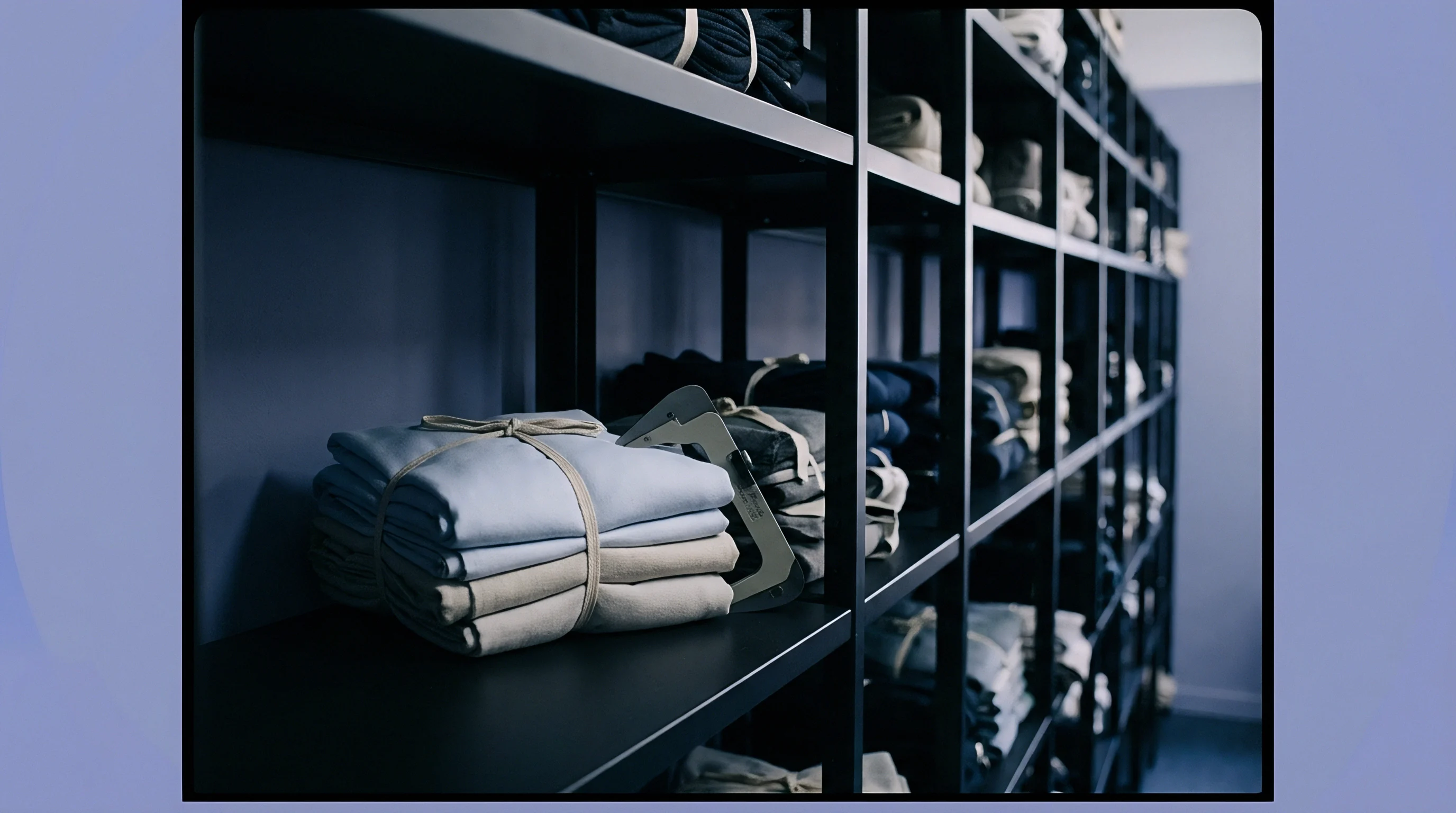
Commercial Mechanics of Linear Meterage versus Areal Weight
A brand purchasing 100,000 metres of cotton interlock specifies 220 grams per square metre at 160 centimetres width. If the finishing mill reduces stenter overfeed from positive 22 percent to positive 10 percent, the finished areal weight drops to 198 grams per square metre while extending the lot to 108,000 metres. The mill captures additional invoiced meterage while saving raw material costs.
The buyer receives goods that feel thin, fail burst strength testing, and contract ten percent longitudinally when washed.
Converting contracts must bind linear yield directly to conditioned areal weight measured under ISO 3801 standards. If the areal weight drops below the specification lower control limit, the billing formula shifts from linear metres to dry fiber mass. Sourcing agreements eliminate the financial incentive for aggressive machine stretching by applying price penalties when fabric weight falls more than two percent below the agreed technical dossier targets.
Width control introduces identical commercial hazards. Spreading stenter rails wide to squeeze extra cuttable width drops courses per centimetre and degrades warp shrinkage. Cutting rooms find that pattern markers fit cleanly on the spread, but finished garments distort asymmetrically.
The seam lines twist toward the front of the body because unresolved machine stresses release unevenly across the knitted garment panels.
The mill strategy of maximizing linear output through reduced stenter overfeed shifts the commercial burden entirely to downstream cut-and-sew operations. Garment factories experience high cutting room reject rates, panel size deviations, and consumer returns for ill-fitting clothing. True production efficiency balances stable dimensional shrinkage against legitimate mechanical yield without compromising fiber architecture.
A supplier defending high length shrinkage often claims the garment wash formula was too aggressive for the specified construction.