Structural Geometry
The degree of waviness or undulation found in a thread after it has been removed from a finished fabric indicates the level of tension memory held by the fibres. Measuring this yarn crimp involves carefully extracting a length of thread and comparing its wavy length in situ with its fully straightened length when pulled taut. It identifies how much space the thread occupies within the interlaced pattern and dictates the ultimate stretch properties of the woven or knitted material.
High values suggest a voluminous and soft texture while low values point to a flat and rigid cloth construction typical of technical filters or sails. Technicians record this percentage value to confirm that the mechanical loading during production matches the initial design parameters. This specific checkpoint is verified by taking random samples from finished rolls during the final laboratory audit at the mill exit.
Processing Strain
Factors such as the beat up force of the loom or the tension on the knitting needles directly contribute to the final configuration of the yarn threads. High yarn crimp values often result in higher fabric shrinkage because the threads are eager to return to their compact and wavy rest state once moisture is added. If the machine settings pull the yarns too straight during production, they might snap under pressure or lose their ability to bend around each other.
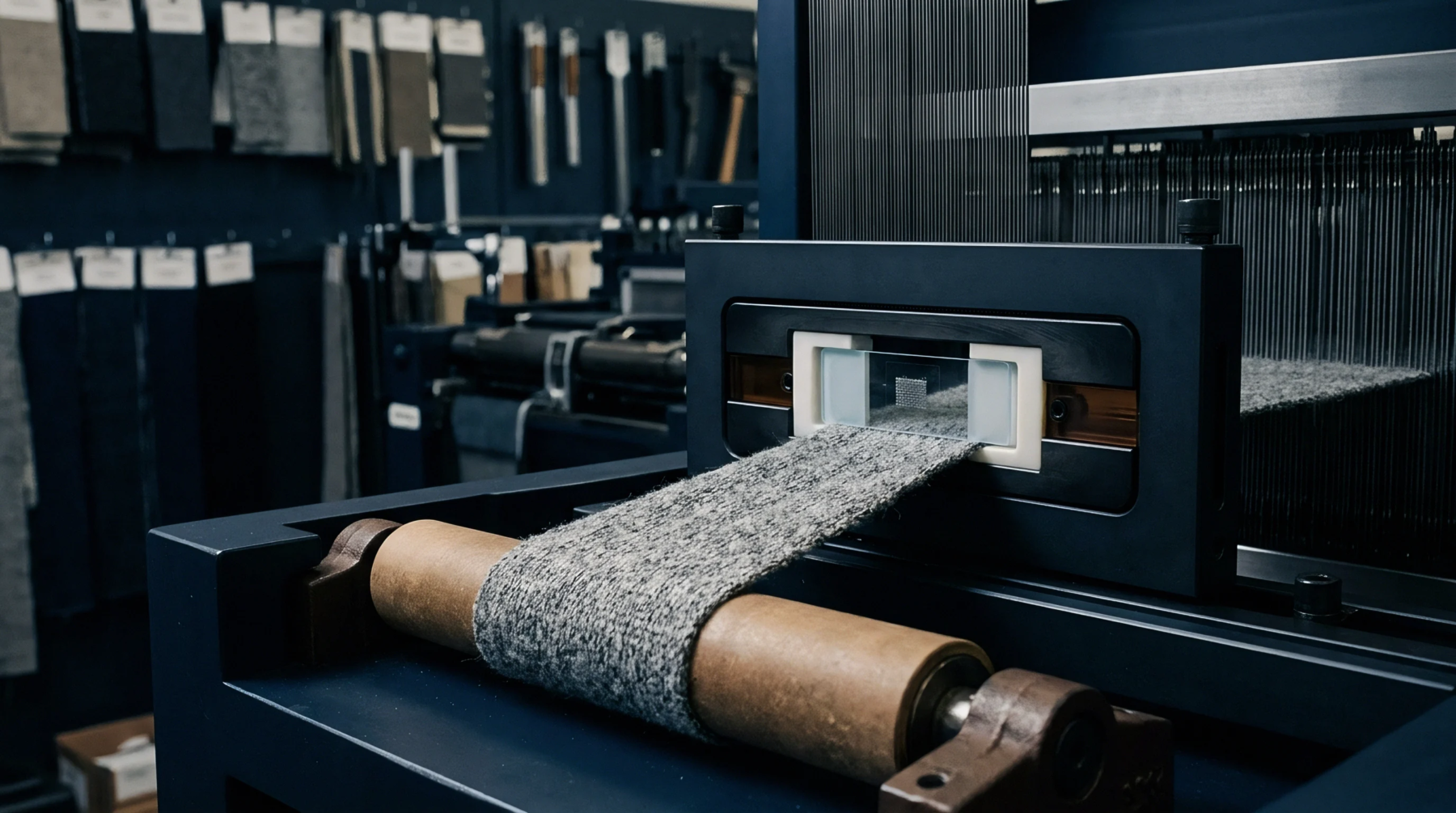
Mill managers adjust the speed of the take up roller and the alignment of the harnesses to set the specific level of curvature required for the hand feel. Maintaining a uniform result across thousands of picks ensures that the fabric maintains its specified density and mass throughout the batch. If the crimp profile shifts between different looms, the resulting fabric will show variations in its thickness and drape that are visible to the trained eye.
Dimensional Influence
Recovery of the fabric from mechanical stress depends on the potential energy stored in these microscopic waves within the individual strands. Proper management of yarn crimp ensures that items like jeans or stretch trousers do not become permanently bagged out at the knees after repeated use. When the fabric is extended, the internal waves straighten first before the actual fibres begin to elongate or fail.
In blended fabrics, unequal values between the longitudinal and lateral threads lead to structural instability and skewing after the finishing processes. Laboratory analysts specify these settings to prevent the seams from puckering when exposed to steam during the industrial pressing stage at the garment factory. Monitoring this geometric factor at the loom allows the factory to hit exactly the weight and yield targets planned at the start of the week.
Consistent monitoring of thread geometry prevents the production of stiff or unresponsive textiles that fail the comfort test.
Mill Verification
Verification protocols include measuring samples across the complete width of the loom to detect if tension differences have created a non uniform look across the fabric web. Stable yarn crimp results point to a production environment where thermal and mechanical stresses are kept in balance over long cycle durations. Reports show that if the values drop below the target, the fabric will be too long and thin, whereas exceeding the count creates items that are too heavy and narrow.
Buyers look for data that proves consistency roll after roll to ensure that cutting patterns match every shipment of fabric exactly. Modern electronic sensors at the loom site track these tension factors in real time to allow for immediate corrections to the feed speed. Adherence to these quantitative boundaries ensures that technical textile attributes remain reproducible at full industrial scale.
Regular audit of the thread profile is the standard method for ensuring high consistency in woven and knitted goods.