Dimensional Stability after the Wash Cycles a Mill Never Ran
Standard one cycle wash tests hide progressive shrinkage; verifying dimensional stability requires multi cycle laundering data and mill finishing tension audits.


Stress
A ten-metre roll of dyed cotton twill unrolled on an inspection table carries tension in every thread. High-speed looms insert weft yarn under electronic brake control at rates exceeding twelve hundred picks per minute, while warp threads endure cyclic extension through heald frames and reeds. When greige cloth moves through aqueous preparation, jet dyeing, and heat setting, these mechanical stresses shift without fully clearing.
Standard compliance testing evaluates dimensional change after a single wash or three domestic laundry cycles under ISO 5077 or AATCC 135 specifications. Those brief bench tests measure immediate relaxation, but overlook the structural compaction that continues across five, ten, or twenty laundering cycles in real use.
Woven and knitted goods work toward physical equilibrium through repeated wetting and mechanical tumbling. During weaving, warp ends are held taut to keep a clear shed for weft insertion. That tension straightens warp yarns and forces weft picks to bend sharply around them.
When a finished garment enters a washing machine, water penetrates the amorphous regions of the cellulose or synthetic polymers, disrupting intermolecular hydrogen bonds. Acting as a lubricant, water allows the yarn matrix to settle: warp yarns shorten as they absorb crimp from relaxing weft yarns, while agitation packs the yarns closer together. This crimp exchange drives substantial length contraction over repeated washes, continuing long after surface finish chemistry breaks down.
Knitted fabrics undergo an even more pronounced geometric shift. Loops formed during circular or flat knitting stretch lengthwise under the pull of tension rolls, dyeing jets, and stenter frames. A circular-knit single jersey coming off a finishing line appears stable only because line tension holds the stitch loops in an elongated ellipse.
Domestic laundering provides the moisture and heat that let those loops revert to their circular shape. The initial wash releases macro-level drying strain, but subsequent cycles clear the micro-strains locked inside the twisted staple fibers. As inter-fiber friction yields under agitation, stitch width expands and fabric length contracts, noticeably altering garment proportions over early laundry cycles.
Mechanisms of Progressive Strain Recovery
Deformation in textiles falls into two broad categories: temporary mechanical extension and permanent polymer displacement. Yarn strain begins during spinning, where fibers undergo draft and twist under load. Continuous filament synthetic yarns retain elastic strain within their molecular chains when drawn without adequate thermal control, while staple yarns store mechanical potential energy through friction locked in by twist.
Processing these yarns into fabric introduces further strain: weaving reeds pack weft threads against the cloth fell under heavy beat-up force, and knitting needles pull loops past sinkers under tight feeder tension.
Testing that stops after one or three cycles creates false confidence because progressive strain recovery has not yet plateaued. A single ISO 6330 cycle removes only the surface tension left by final tentering and calendering. The micro-strains buried in the core of high-twist yarns require repeated wetting, mechanical flexure, and drying to overcome static inter-fiber friction.
In cotton, moisture absorption swells individual fibers cross-sectionally by up to fourteen percent while length increases by less than one percent. This lateral swelling forces the helical path of twisted fibers outward, pulling yarn ends closer together. Repeated wet-dry cycling ratchets the structure inward until the yarn reaches its maximum compact density.
A 3/1 cotton twill finished under high warp tension loses 6.8 percent of its length between wash cycles 3 and 20 under ISO 6330 procedure 4N.
Elastomeric composite yarns follow more intricate recovery curves. Core-spun yarns with polyether-ester or polyurethane cores wrapped in cotton or synthetic staple fibers hold substantial elastic memory from manufacturing. High temperatures during jet dyeing can overstretch that core if tension is not managed precisely.
Across repeated home laundering at warm temperatures, micro-voids in the polyurethane core relax, contracting steadily over ten to fifteen cycles. This pulls the staple sheath into a thicker, denser profile, compounding shrinkage while increasing fabric mass per unit area and reducing air permeability.

Longitudinal and Lateral Crimp Restructuring
Woven yarn geometry operates within limits set by yarn diameter, end and pick counts, and crimp percentages. Crimp represents the excess percentage of yarn length relative to the measured distance between cloth edges. In newly finished fabric, warp and weft crimp sit in an artificial imbalance caused by machine-direction pull during wet processing.
Finishing mills often stretch warp yarns to maximize linear yield, pulling out warp crimp and forcing higher crimp into the weft.
Laundering removes the mechanical fixatives and sizing agents that preserve this imbalance. As water enters the matrix, weft yarns try to straighten, returning crimp energy to the warp. The warp yarns then buckle more sharply around the unbending weft threads, closing the gap between warp lines and pulling in fabric length.
At the same time, the weft axis may stay flat or expand slightly, skewing garment proportions in ways pattern grading cannot correct.
Tracking five distinct commercial cloth constructions across fifty consecutive standardized home wash cycles illustrates this shift, highlighting how standard three-wash certifications fail to capture cumulative dimensional change over extended consumer use.
| Fabric Construction Specification | Fibre Composition | Cycle 1 Shrinkage (Warp/Weft %) | Cycle 3 Shrinkage (Warp/Weft %) | Cycle 10 Shrinkage (Warp/Weft %) | Cycle 20 Shrinkage (Warp/Weft %) | Cycle 50 Shrinkage (Warp/Weft %) |
|---|---|---|---|---|---|---|
| 3/1 Left-Hand Twill 280 gsm (60×30 yarns/cm) | 100% Ring Spun Cotton | -1.5 / -0.5 | -2.8 / -0.8 | -5.2 / -1.2 | -6.8 / -1.5 | -7.1 / -1.6 |
| Plain Weave Workwear Poplin 115 gsm (42×28 yarns/cm) | 65% Polyester / 35% Cotton | -0.4 / -0.2 | -0.8 / -0.3 | -1.2 / -0.4 | -1.5 / -0.4 | -1.5 / -0.5 |
| Single Jersey 180 gsm (28 Gauge) | 100% Combed Cotton | -3.1 / +0.5 | -5.5 / +1.2 | -8.9 / +2.1 | -11.4 / +2.8 | -12.2 / +3.0 |
| Single Jersey Stretch 210 gsm (28 Gauge) | 95% Cotton / 5% Elastane | -1.8 / -0.2 | -3.2 / -0.5 | -5.8 / -1.1 | -8.1 / -1.8 | -9.4 / -2.1 |
| French Terry Loopback 320 gsm (20 Gauge) | 100% Ring Spun Cotton | -2.5 / -1.0 | -4.8 / -1.8 | -8.2 / -2.9 | -10.9 / -3.4 | -11.5 / -3.6 |
For cotton-rich fabrics, dimensional change occurring after cycle three accounts for up to sixty percent of total shrinkage measured at cycle fifty. Gauging quality strictly by a three-wash standard leaves apparel brands exposed to severe sizing drift during wear. Synthetic blends stabilize earlier due to heat setting, typically reaching equilibrium near cycle ten.
Four primary internal forces govern how the yarn network behaves under continuous laundering.
- Hydrophobic synthetic memory prevents moisture absorption inside polymer crystals, limiting progressive shrinkage to the physical relaxation of mechanically induced yarn bending.
- Cellulosic hydrogen cross-linking breaks repeatedly upon water immersion, allowing progressive displacement of cotton amorphous domains across dozens of wet-dry cycles.
- Elastomeric hysteresis loss occurs as rubber or polyurethane filaments undergo cyclic wet thermal relaxation, continuously pulling surrounding fibers into tighter configurations.
- Mechanical frictional abrasion wears down surface fibers, reducing static inter-fiber friction and letting trapped structural strains release long after finishing.
Internal forces locked into woven and knitted matrices persist until moisture and mechanical energy clear them. When commercial pressures encourage finishing mills to prioritize yardage over full relaxation, stability remains purely cosmetic.
Stenter
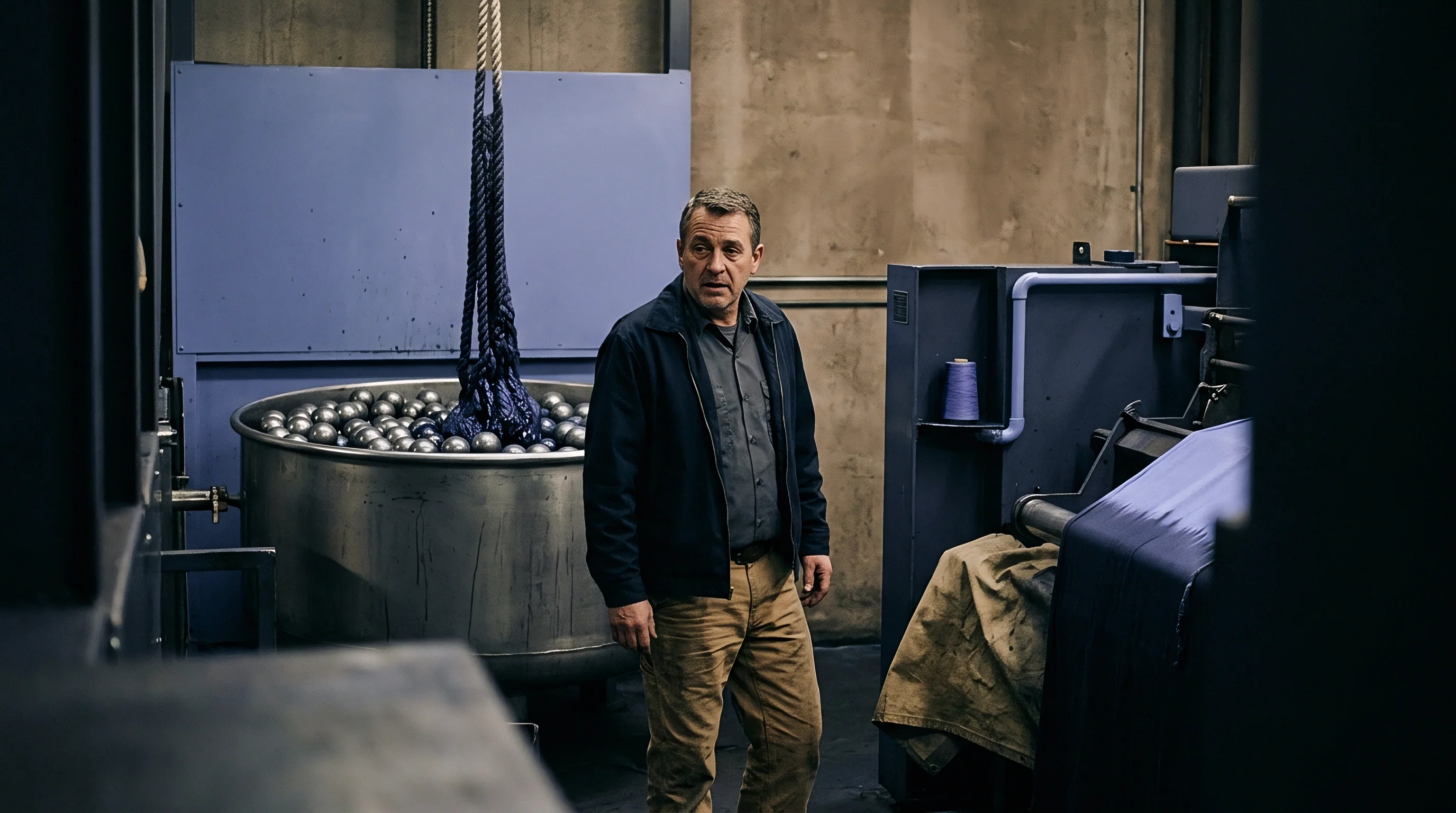
Finishing mills face steady commercial incentives to maximize linear yield ~ the sellable metres recovered from a given weight of greige cloth. On a stenter frame, operators balance width, overfeed, chamber temperatures, and line speed. By pulling longitudinal tension at entry and spreading the web across wide pin chains, a plant expands total yardage.
This mechanical stretch disguises residual instability, allowing fabric to pass single-cycle shrinkage checks while locking in progressive shrinkage downstream.
A stenter uses heated zones to dry cloth and cure chemical finishes. Overfeed systems pin fabric onto chains faster than chain speed; a plus fifteen percent overfeed forces fifteen percent extra length into the pin interval, allowing warp yarns to relax, crimp, and heat-set in the drying chamber. Running zero or negative overfeed stretches the fabric instead, drying warp yarns under tension.
The resulting heat-set holds the cloth flat temporarily, but the internal strain remains. The first home wash breaks that thermal set, triggering heavy lengthwise contraction.
Compressive shrinkage units, such as Sanforizers, mechanically compact cellulosic goods. Moist, steamed cloth runs around a tensioned rubber belt; as the belt passes over a curved cylinder, its surface contracts, forcing warp yarns together and restoring crimp. Achieving proper compaction demands strict monitoring of moisture levels, steam pressure, and nip roll settings.
Mills running fast often bypass the compactor or increase line speeds past the point where heavy fabrics can compact through to their core.

Chemical Fixation and Cross-Linking Degradation
Chemical finishes offer an alternate route to dimensional stability. Resin systems apply cross-linking agents like dimethyloldihydroxyethyleneurea to cellulosic fibers. Cured with acid catalysts at high temperatures, these resins build covalent cross-links across adjacent hydroxyl groups on cellulose chains.
The network restricts chain movement during wetting, preventing fiber swelling and locking the yarn into its finished geometry to limit both initial and late-stage shrinkage.
Sourcing contracts specifying shrinkage testing solely under ISO 5077 after one cycle leave buyers exposed to progressive relaxation exceeding 8 percent by wash cycle 10.
Resin cross-linking carries performance penalties. Acid catalysts and curing heat weaken cellulose chains, lowering tensile strength by fifteen to thirty-five percent and tear strength by over forty percent. Furthermore, commercial detergents, water alkalinity, and tumble drying cause hydrolytic breakdown across five to twenty wash cycles.
As cross-links cleave, fibers reacquire their capacity to swell. Cloth showing negligible shrinkage on an initial mill report can begin shrinking noticeably around wash five and continue through cycle fifteen.
Drying rates during resin application determine chemical distribution. Drying resin-treated cloth too fast causes chemicals to migrate outward with evaporating moisture, concentrating cross-links on the fabric surface while leaving yarn cores untreated and creating a stiff hand. Uniform stabilization requires two stages: low-temperature drying to maintain even chemical penetration across yarn cross-sections, followed by high-temperature curing at one hundred and sixty to one hundred and seventy degrees Celsius.

Auditing Finishing Floor Parameters
Assessing mill capability requires examining machinery directly during live production rather than relying on laboratory certificates. Audits focus on actual line speeds, thermal profiles, overfeed settings, and compactor moisture application across the run.
- Verify the stenter entry overfeed indicator matches actual fabric speed by measuring physical roller surface velocity with a calibrated tachometer.
- Check chamber temperature gauges across all heating zones to ensure the curing temperature stays within plus or minus two degrees Celsius of specified chemical parameters.
- Measure fabric moisture content at the stenter exit using a high-frequency microwave moisture sensor before the cloth reaches the batcher roll.
- Inspect the rubber belt thick-section radius on the compressive shrinkage unit to confirm proper mechanical compression ratios for heavy woven styles.
- Examine the steam injection pressure gauges on the rubber belt compactor entry shoe to verify steam penetration into the yarn core.
- Collect swatch samples immediately before stenter entry and immediately after batching to calculate actual width compaction and length relaxation ratios.
Audits regularly turn up machine settings configured to boost yardage and line output at the expense of long-term dimensional stability.
| Finishing Line Setup Profile | Stenter Overfeed (%) | Sanforizer Compactor Speed (m/min) | Resin Add-On (% owf) | ISO 6330 1-Cycle Shrinkage (Warp %) | ISO 6330 20-Cycle Shrinkage (Warp %) | Tensile Strength Loss (Warp %) |
|---|---|---|---|---|---|---|
| High-Yield Unstabilized Profile | +2.0 | Bypassed | 0.0 | -4.8 | -9.5 | 0.0 |
| Standard Mechanical Sanforized Profile | +12.0 | 25.0 | 0.0 | -1.1 | -2.4 | -3.0 |
| Over-Speed Mechanical Profile | +6.0 | 55.0 | 0.0 | -2.5 | -6.2 | -1.5 |
| High Chemical Cross-Linked Profile | +4.0 | Bypassed | 4.5 | -0.5 | -4.1 | -28.0 |
| Optimized Dual Mechanical-Chemical Profile | +10.0 | 30.0 | 1.8 | -0.4 | -1.2 | -10.5 |
The operational data confirms that relying on resins without sufficient mechanical overfeed and compressive shrinkage results in severe late-cycle movement as chemical bonds break down. Keeping shrinkage controlled through twenty washes requires sufficient overfeed, thorough rubber-belt compaction, and modest resin application.
Tension applied throughout wet processing establishes baseline fabric stability. Operating stenters without adequate overfeed simply stores residual tension within finished rolls.
Structural relaxation avoided on the finishing floor inevitably takes place in domestic laundering.

Dissection
Evaluating long-term dimensional stability requires looking past basic bench measurements. Standard protocols mark a fifty-centimetre square on a swatch with indelible ink, run one wash-dry cycle, and record changes with a rule. That identifies initial relaxation, but reveals nothing about the mechanisms governing multi-cycle movement.
Comprehensive analysis pairs thread count tracking with mass per unit area under ISO 3801, yarn crimp testing via ISO 7211-3, and cross-sectional loop assessment.
Tracking structural compaction across washes requires monitoring mass per unit area alongside yarn counts. As a woven fabric shrinks, its mass per unit area in grams per square metre should rise proportionately, assuming fibers are not abrading away. When a garment shrinks five percent in both directions while its mass per unit area stays unchanged, fiber has been lost as lint during washing.
Bench testing that ignores area mass misses this structural loss.
Skewness and spirality cause secondary fit issues. In circular-knit single jersey, spirality refers to course lines shifting relative to wales, driven by torque inside single Z-twist or S-twist yarns. Repeated washing releases that twist energy, twisting side seams around the body.
In woven goods, skewness occurs when warp and weft lose their ninety-degree orientation during finishing, causing trouser legs or plackets to torque after laundering.
Multi-Cycle Laboratory Testing Parameters
Quality checks configured for rapid production sign-off miss long-tail shrinkage behavior. ISO 5077 calls for a single wash cycle, and AATCC 135 protocols commonly stop at three. Detecting progressive shrinkage requires extending laundering sequences to twenty or fifty cycles while maintaining strict control over laboratory conditions.
Water hardness, wash temperature, drying methods, and ballast loads alter multi-cycle test results. Hard water with elevated calcium and magnesium levels leaves mineral residue on fibers that shifts inter-fiber friction. High tumble-drying temperatures speed drying and accelerate thermal contraction, compressing fibers faster than flat or line drying.
In one uniform delivery failure, five thousand cotton workwear coveralls lost two full garment sizes after six months of industrial laundering, despite mill test certificates showing full compliance under standard 1-cycle testing.
| Laundering Cycle (ISO 6330 6N / Tumble Dry) | Warp Density (threads / cm) | Weft Density (threads / cm) | Mass per Unit Area (g/m²) | Cumulative Warp Shrinkage (%) | Cumulative Weft Shrinkage (%) | Air Permeability (mm/s at 100 Pa) |
|---|---|---|---|---|---|---|
| Unwashed Control Sample | 24.0 | 18.0 | 265.0 | 0.0 | 0.0 | 185.0 |
| Cycle 1 | 24.4 | 18.1 | 270.2 | -1.6 | -0.5 | 172.0 |
| Cycle 3 | 24.8 | 18.2 | 275.8 | -3.2 | -1.1 | 158.0 |
| Cycle 5 | 25.2 | 18.3 | 281.4 | -4.8 | -1.6 | 144.0 |
| Cycle 10 | 25.8 | 18.4 | 289.0 | -7.0 | -2.1 | 126.0 |
| Cycle 20 | 26.2 | 18.5 | 294.5 | -8.4 | -2.5 | 112.0 |
| Cycle 50 | 26.4 | 18.5 | 296.8 | -9.1 | -2.7 | 106.0 |
The data shows warp density climbing from twenty-four to over twenty-six threads per centimetre as length shrinkage accumulates across twenty washes. Fabric air permeability drops by more than forty percent as tightening yarns close interstitial pores. Single-cycle testing fails to anticipate these shifts in fit, weight, and air flow.
Multi-cycle laboratory sequences reveal several distinct failure mechanisms across extended laundering.
- Progressive crimp imbalance occurs when warp yarns continually absorb weft crimp across multiple washes, turning flat garments into short, wide structures.
- Differential elastomeric decay arises when synthetic elastomeric cores degrade unevenly under detergent alkalinity, creating local puckering and wavy seam distortions.
- Resin hydrolysis uncoupling manifests when formaldehyde-based cross-linking networks break down, causing dormant shrinkage to activate suddenly after wash cycle five.
- Frictional felting compaction develops in untreated wool or coarse cellulosic blends as surface scales or fibers interlock progressively during drum tumbling.
Fabric reaching dimensional equilibrium during wet finishing will not continue to contract in domestic laundering regardless of water temperature.
Dyehouse commercial defenses routinely point to three-cycle industry compliance benchmarks, attributing any movement after cycle three to domestic washing conditions or aggressive tumble drying.
Remedy
Preventing progressive shrinkage issues in production requires writing explicit performance criteria into fabric purchase specifications, contracts, and mill qualification audits. Boilerplate purchase order clauses offer little recourse against dimensional movement occurring after cycle three. Sourcing specifications must set numerical limits on the progressive delta between initial and extended laundering, linked to clear commercial chargebacks.
A rigorous fabric specification sets performance limits across multiple wash intervals. Instead of a single tolerance like three percent shrinkage after one wash under ISO 5077, specifications should establish ISO 6330 thresholds at cycle one, cycle three, and cycle twenty. Setting a narrow limit on the progressive delta ~ the difference in shrinkage between cycle three and cycle twenty ~ compels mills to run adequate mechanical overfeed and compaction rather than relying on short-lived chemical finishes.
A delta cap of one point five percent ensures genuine mechanical stability.
Commercial agreements require defined sampling protocols for bulk production. Swatches must be pulled from the head, middle, and tail of every dye lot, with accredited third-party laboratories running multi-cycle wash sequences before shipment sign-off. When lots fail, contracts should establish direct remedies: re-finishing at mill expense, fabric replacement, or chargebacks covering cutting waste and related retail losses.
Drafting Precision Technical Specification Clauses
Clear fabric contracts define specific test methods, laundering parameters, drying setups, and acceptance limits. Vague wording gives mills room to contest failures by claiming test conditions exceeded normal garment use.
The specification dossier must cite exact standards ~ such as ISO 6330:2021 Procedure 4N at forty degrees Celsius with Procedure A tumble drying. It should establish limits for warp and weft dimensional change, spirality, mass per unit area drift, and visual appearance after twenty cycles. Contracts should also require mills to submit digital stenter logs for every lot, confirming overfeed rates, line speeds, and chamber temperatures.
Mill test reports routinely document compliance after a single wash cycle because standard commercial protocols do not demand extended testing.
Managing dimensional risk involves a clear verification sequence when qualifying mills and approving contracts.
- Extended testing mandate requires vendor lab dips and bulk production lots to pass a minimum twenty-cycle laundering test under ISO 6330 prior to fabric dispatch release.
- Progressive delta capping limits maximum allowable additional warp shrinkage between wash cycle three and wash cycle twenty to no more than one point five percent.
- Finishing parameter transparency obligates the mill to provide continuous digital stenter logs detailing real-time entry overfeed, pin-chain width, and heat chamber dwell times for all rolls.
- Compressive compaction verification mandates mechanical sanforizing or rubber-belt compaction on all cellulosic-rich woven constructions exceeding one hundred and twenty grams per square metre.
- Pre-shrunk garment allowance updates require cutting patterns and marker grading rules to incorporate actual twenty-cycle fabric shrinkage data rather than temporary one-cycle lab reports.
Writing these controls into procurement documents shifts quality assurance from resolving garment failures after delivery to enforcing process controls at the mill.
Spending an additional three cents per linear metre on mechanical overfeed and compressive sanforizing at the finishing plant avoids costly returns, customer dissatisfaction, and retail penalties stemming from late-cycle garment shrinkage.
The standardized fabric supply contract shall include the following mandatory performance clause: Bulk fabric lots exhibiting a progressive dimensional change delta exceeding 1.5 percent between ISO 6330 3-cycle and 20-cycle testing shall be rejected at destination port with all freight, duty, and garment conversion costs charged directly back to the supplying finishing mill.