Inter-Instrument Calibration Drift and Metameric Risk Management in Multi-Mill Conversion Contracts
Lock spectrophotometer geometry to d/8 specular included, mandate monthly BCRA tile profiling across all partner mills, and cap metamerism under secondary lighting at 0.60.
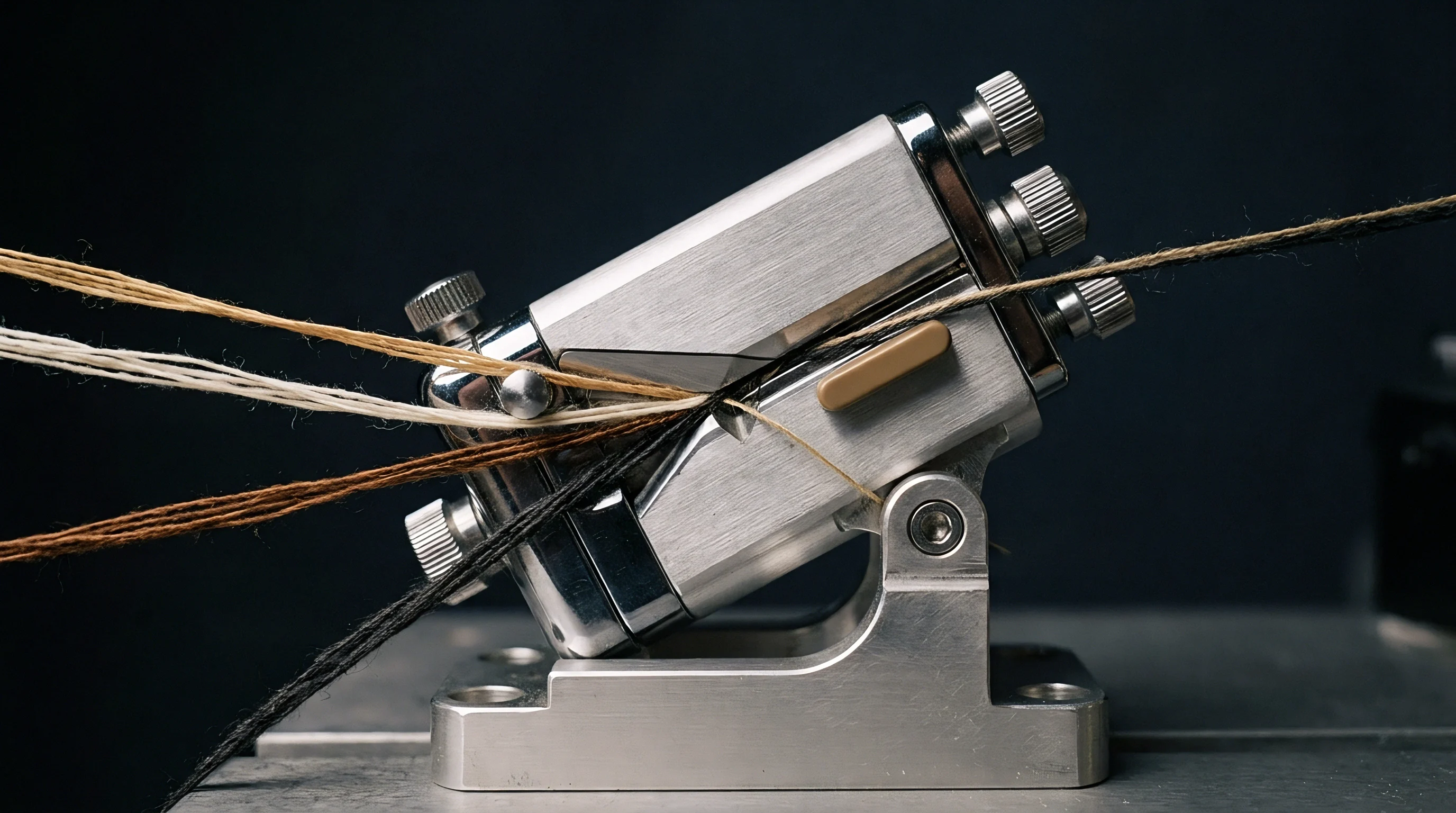

Aperture

Master Standard Geometry
Shade approval on multi-mill conversion programmes breaks down when conversion partners read the same target standard through discordant optical geometries. Diffuse integrating-sphere instruments configured for d/8 geometry capture total reflectance by including the specular gloss component or exclude it through a gloss trap. Bidirectional 45/0 instruments illuminate at forty-five degrees and read perpendicularly, isolating surface scattering entirely.
An operator comparing a compact 400-gram plain weave dyed on a continuous pad-steam range against a loose 220-gram knit processed in an atmospheric overflow jet introduces optical variance before dye chemistry interacts with fibre. The surface texture of an uncalendered twill alters reflectance paths across instrument benches, generating synthetic colour deviations between spectrophotometer profiles.
Instrument divergence magnifies across distributed regional supply routes. Standardizing on d/8 specular included modes protects shade continuity across distinct fabric structures by isolating colourant reflectance from physical surface topology.
d/8 specular included geometry eliminates physical surface sheen differences between distinct weave architectures.
Mill laboratories working under international conversion agreements routinely maintain different maintenance histories on their bench spectrophotometers. Lamp aging shifts spectral energy distributions across tungsten-halogen and xenon flash sources, producing significant measurement bias in the near-ultraviolet and short-wavelength visible bands between 360 and 420 nanometers. When conversion plants evaluate lab dips against digital spectral reflectance datasets rather than a physical ceramic tile standard, this systematic inter-instrument drift registers as an artificial formulation error.
Dyehouse managers compensate by adjusting pad liquor ratios or shading formulas on production jigs, driving bulk lots out of true shade alignment.
| Optical Configuration | Reference Geometry | Shortwave Drift Band | Maximum Inter-Model Variance | Primary Failure Mode |
|---|---|---|---|---|
| Benchtop Integrating Sphere | d/8 Specular Included | 360 to 400 nm | 0.15 dE CMC | Sphere wall yellowing and lamp decay |
| Benchtop Integrating Sphere | d/8 Specular Excluded | 400 to 440 nm | 0.35 dE CMC | Gloss trap optical misalignment |
| Portable Bidirectional | 45/0 Circumferential | 420 to 480 nm | 0.50 dE CMC | Aperture orientation and surface pile nap |
| Multi-Angle Sphere | Multi-illumination d/0 | 380 to 420 nm | 0.28 dE CMC | Diffuser plate dust contamination |
Contractual shade acceptance requires identical specimen presentation routines. Fabric folding thickness alters transmittance through porous knits, requiring a minimum of four specimen layers or an opaque backing tile read at a verified zero percent transmission baseline. Standardizing the aperture mask diameter between twenty-five and thirty millimetres integrates local yarn unevenness across the measurement port, suppressing false batch alarms.
A laboratory operating a small aperture viewing window of six millimetres reads single pick variations, misrepresenting uniform yardage.
The operational buyer writes calibration standards directly into master supply master agreements, specifying optical geometry and sample folding thickness.

Calibration

Physical Tile Hierarchies
Digital reflectance transmission across multiple mill locations depends on calibrated tile hierarchies maintained to National Physical Laboratory standards. Master reference tiles consisting of neutral grey and BCRA ceramic series stabilize spectrophotometer performance across conversion tiers. Regional dyehouses run working calibration sets daily, reserving primary reference plates in vacuum-sealed desiccators to prevent environmental surface degradation.
Condensation, airborne plasticizers from finishing stenters, and dyehouse particulate settle on unshielded bench targets, drifting optical baselines across consecutive quarterly productions.
ASTM E2214 governs instrument drift calculation and mandates monthly BCRA ceramic reference audits.
Spectral performance audits verify repeatability across short-term and long-term operating horizons. Technicians establish baseline stability by reading a standard white calibration plaque thirty times at intervals of five seconds without specimen replacement. The resulting standard deviation cannot exceed 0.01 dE CMC to confirm short-term stability.
- Working standard verification requires recording twenty consecutive reads of the uncalibrated working white plaque against the primary ceramic master tile.
- Green tile drift tracking identifies wavelength scale shifts by measuring spectral reflectance at the steep 510-nanometre absorption slope.
- Specular trap validation isolates physical gloss component clearance on integrating spheres through comparative black trap readings.
- Aperture exchange inspection confirms mechanical alignment of lenses and baffles after switching measuring diameters.
Conversion agreements linking spinning, weaving, and wet processing facilities fail when partner mills rely on local working tiles without reciprocal cross-checking. A variation of 0.20 dE CMC between factory instruments consumes forty percent of the total allowable commercial shade tolerance before greige enters the dye bath. Purchasing agreements designate an absolute primary standard instrument, forcing all subcontracted dye houses to profile their machines against this hardware master through mathematical matrix profiling.

Profiling Distributed Spectrophotometers
Mathematical instrument profiling links distributed dyehouse equipment to the buyer central spectrophotometer. Software profiling uses a set of twelve BCRA colour tiles alongside customized dyed textile swatches representing the target substrate palette. When a conversion mill measures this standardized diagnostic panel, mathematical transform algorithms calculate localized calibration vectors, adjusting factory readings to match the master benchtop unit across all wavelengths.
The dyehouse manager typically points to the factory white plaque calibration record as absolute proof of instrument accuracy, disregarding internal integrating sphere contamination.

Illuminant
Indices under Secondary Lighting
Conversion contracts governing uniform apparel and performance workwear mandate shade acceptance under primary and secondary illuminants to control metameric variance. A formulation balancing perfectly under simulated daylight D65 can diverge aggressively under store lighting represented by point-of-sale fluorescent TL84, warm white LED, or incandescent illuminant A. Formulators match spectrophotometer measurements to standardized CIE 1964 ten-degree observer tables, tracking metamerism index values across the full spectral profile rather than isolated trichromatic values.
A metamerism index exceeding 0.60 dE CMC under secondary illuminant TL84 produces garment panel rejection at assembly.
The metamerism index quantifies the spectral divergence between an approved lab dip and continuous yardage under secondary illumination sources. Spectrophotometers calculate this value by deriving the delta E colour difference under the secondary light source after normalizing the mathematical difference under primary illuminant D65 to zero. Formulations showing zero visual difference on the inspection frame under daylight switch shades when hung beneath retail light fixtures.
| Fibre Composition | Dyestuff Class | Primary Illuminant | Secondary Illuminant | Allowable MI Limit | Risk Profile |
|---|---|---|---|---|---|
| 100% Combed Cotton | Reactive Tri-chromatic | D65 / 10 Deg | TL84 / CWF | 0.50 dE CMC | Low metamerism risk |
| 65/35 Poly-Cotton | Disperse / Vat Blend | D65 / 10 Deg | Illuminant A | 0.80 dE CMC | Moderate cross-dye variance |
| 100% Texturized Polyester | High Energy Disperse | D65 / 10 Deg | LED 3000K | 0.40 dE CMC | Elevated LED spectral shifts |
| 85/15 Wool-Polyamide | Acid / Metal Complex | D65 / 10 Deg | Ultralume 84 | 0.65 dE CMC | High dye-site competition drift |
Managing multi-illuminant conformity forces dyehouses to optimize dyestuff selection during initial laboratory recipe formulation. Using trichromatic combinations with dissimilar spectral reflectance profiles invites metameric failure across multi-mill conversion programmes. Technical contracts specify maximum allowable metamerism indices across three defined illumination channels, protecting finished assemblies from panel-to-panel shade divergence.
Visual inspection boxes in conversion mill testing rooms must operate calibrated lux output and logged bulb burning hours. Fluorophore degradation inside fluorescent tubes shifts emission spectra silently over two thousand operational hours, invalidating visual shade sign-offs against digital spectrophotometer pass ratings.
The contract standardizes digital spectral data files as the ultimate arbitration mechanism over subjective light box viewing.
Formulation

Dyestuff Selection Controls
Multi-mill conversion structures require strict central formulation discipline to suppress metameric risk across distributed piece dyeing and continuous dye operations. Individual commission dyehouses favor locally sourced dye equivalents to shave production overhead, replacing specified reactive or disperse colourants with alternatives bearing different chemical structures and absorption coefficients. While a substitute recipe delivers an acceptable dE CMC tolerance under standard D65 illuminant, the substitution alters spectral reflectance bands between 580 and 680 nanometers, creating acute metamerism under retail lighting.
A central technical specification enforces locked dye recipes across every qualified conversion mill. The master dye library defines exact dyestuff combinations, compatibility factors, fixation profiles, and permissible salt concentrations across all approved wet processing sites.
- Binary dye pairing restricts recipe formulations to two primary colourants with minimal shading components to maintain broad spectral parity across production lots.
- Absorption curve matching verifies that all dyestuffs in a combination exhaust at parallel strike rates to prevent batch core-to-surface listing.
- Fibre cross-staining controls govern dye selection in multi-fibre blends to suppress erratic cross-dyeing under shifting liquor ratios.
- Electrolyte purity standards establish strict chemical grade baselines for sodium chloride and glauber salt across participating processing facilities.
Finished goods constructed from multiple components reveal metameric mismatching at assembly points. When collar ribs, pocketing, and body fabrics undergo wet processing across different finishing facilities, non-standard dye selections produce severe colour shifts across garment sections. The master conversion contract obligates all secondary and tertiary commission dyers to source dyestuffs exclusively from designated synthesis lots, eliminating molecular variance at the mill level.
Controlling chemical recipes stabilizes shade production across disparate wet-processing operations.


Tolerancing

CMC and CIEDE2000 Equations
Industrial shade management across multi-mill supply lines relies on elliptical colour difference equations that map human eye sensitivity accurately across colour space. The legacy CIELAB delta E formula calculates Euclidean distances in three dimensions, assuming uniform visual tolerance volumes throughout the colour solid. In practice, visual sensitivity to chroma and hue variations changes drastically across saturation levels, rendering linear spherical tolerances commercially unviable for volume textile procurement.
The CMC l:c and CIEDE2000 mathematical formulations resolve these discrepancies by generating dynamic ellipsoidal tolerance boundaries around the target shade. Adjusting the lightness to chroma weighting ratio to 2:1 for woven and knitted textiles aligns machine verification with human visual acceptance criteria.
| Equation Model | Parametric Ratios | Total Tolerance Band | Visual Correlation Index | Commercial Exposure Risk |
|---|---|---|---|---|
| CIE 1976 Delta E | 1:1:1 Unweighted | 0.80 Total dE | 0.62 STRESS units | Severe false rejection of saturated tones |
| CMC (l:c) | 2.0:1 Commercial | 0.75 dE CMC | 0.84 STRESS units | Standard contract baseline for apparel |
| CMC (l:c) Strict | 1.5:1 High Precision | 0.50 dE CMC | 0.88 STRESS units | Excessive mill reprocessing costs |
| CIEDE2000 | kL:kC:kH 1:1:1 | 0.60 dE 00 | 0.91 STRESS units | Optimal blue-region rotational performance |
CIEDE2000 introduces explicit rotation functions that correct perceptual anomalies in the blue-violet coordinate sector between 250 and 300 degrees hue angle. This rotation eliminates false pass ratings on navy, midnight, and deep indigo shades, which represent a large proportion of volume conversion programmes. Conversion agreements specify the exact parametric factors kL, kC, and kH, alongside the explicit formula iteration, closing contractual loopholes exploited by processors.
Commercial supply terms specifying bare delta E without designating the underlying equation yield unresolvable financial arbitration disputes.
Parametric factors adjust mathematically for surface structure and viewing environment. For high-pile fleece or raised surfaces, shifting lightness weighting from 2.0 to 1.5 accounts for reduced human perception of depth variations caused by structural shadows. Setting unyielding tolerances across incompatible weaves produces continuous production stoppages without delivering visible improvements in cut-and-sew panel consistency.
The procurement contract links pass and fail boundaries directly to the calculated CIEDE2000 envelope, eliminating subjective visual dispute on the factory dock.
Settlement

Arbitration Protocols for Metameric Failure
Metameric divergence across finished lots delivered from independent conversion partners triggers immediate financial liabilities across the cutting room. Garment manufacturers discovering shade discordance between body panels and assembled trim during sewing face direct product rejections from buying houses. Multi-mill conversion contracts must establish transparent, legally defensible arbitration sequences to handle contested shade tolerances, assigning financial accountability through objective physical evidence.
Arbitration protocols start with immediate impounding of disputed fabric rolls at the cut-and-sew facility. A designated third-party testing house samples ten percent of the delivered roll yardage, conditioned for twenty-four hours to ISO 139 atmosphere standards at twenty degrees Celsius and sixty-five percent relative humidity. Laboratory staff re-measure swatches across both master integrating spheres and reference bidirectional instruments, neutralizing local calibration drift.
When composite shade measurements confirm CIEDE2000 values exceeding 0.75 under secondary illuminants, the finishing mill forfeits conversion payments and absorbs greige replacement costs.
Contract dispute language specifies the precise hierarchy between digital spectrophotometric records and third-party laboratory panel reviews. Uncalibrated light box evaluations conducted in unconditioned cut-and-sew environments have no legal weight in multi-mill arbitration proceedings.
Section 14.3 of the Master Conversion Agreement assigns absolute financial liability for metameric shading failure directly to the finishing mill whenever non-approved dyestuff substitutions are confirmed through thin-layer chromatography.