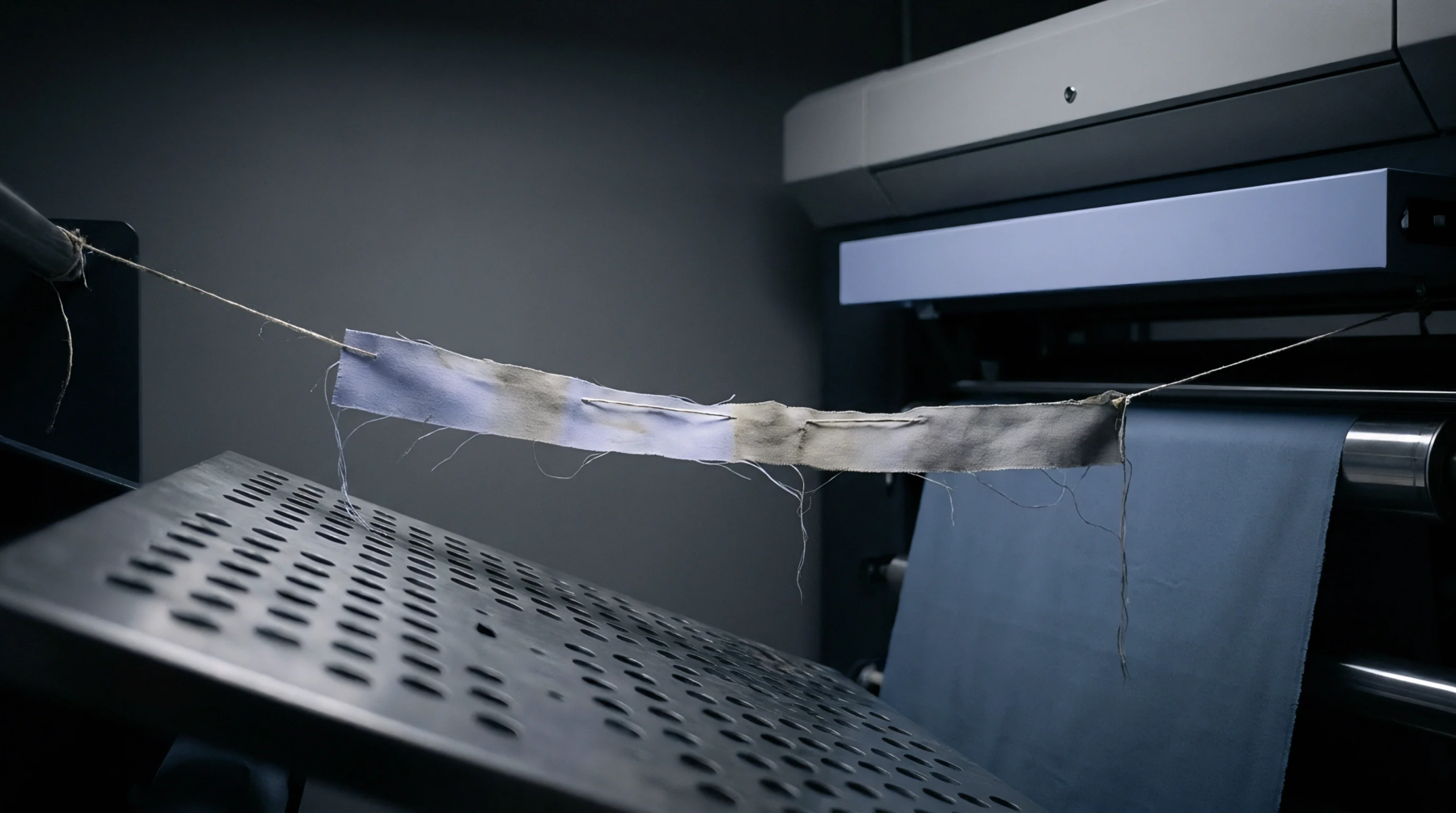
Aligning Spectral Reflectance and Fastness Metrics across Printing Technologies
Aligning print technologies requires specifying CIEDE2000 tolerances below 0.8, capping metamerism indices under secondary illuminants, and adjusting wet crock floors.
Aligning print technologies requires specifying CIEDE2000 tolerances below 0.8, capping metamerism indices under secondary illuminants, and adjusting wet crock floors.

Controlling multi-mill spectral reflectance variance requires standardized d/8° geometry, digital CxF3 master distribution, and strict CIEDE2000 tolerances.

Optical sorter limits depend on tuft opening, duct air velocity, and spectral contrast between white polypropylene and raw cotton fibers.

Establishing dual-route printing tolerances requires CIEDE2000 spectral limits under D65/TL84 illuminants paired with strict ISO 105 fastness verification.

Extended InGaAs sensors expand optical contaminant contrast up to 2.2 micrometers, trading lower quantum efficiency and higher dark current for absolute polypropylene detection.

InGaAs sensor integration requires thermoelectric dark current control and dynamic radiometric calibration to isolate synthetic polymers from raw cotton.
Expertise is a utility, not a secret. sentiention™ publishes its working knowledge as open reference: intelligence layer covering the materials it sources, the markets it enters, and the reference that serves both.