Establishing Spectrophotometric Tolerances and Fastness Metrics for Dual Route Textile Printing Replenishment
Establishing dual-route printing tolerances requires CIEDE2000 spectral limits under D65/TL84 illuminants paired with strict ISO 105 fastness verification.

Spectra
Color consistency between dual print routes falls apart when evaluation relies on a single illuminant. An original design printed via high-volume rotary screen using aqueous pigment dispersions carries a specific spectral reflectance curve. When that motif is reordered on a direct-to-textile digital inkjet press using low-viscosity reactive or pigment inks, the spectral signature changes.
Lightness, chroma, and hue angle can align cleanly under standard shop-floor viewing lamps, only to drift under retail or home lighting. Managing color across rotary screen base runs and digital inkjet reorders requires spectrophotometric tolerance protocols built on multi-illuminant spectral matching rather than single-point color difference formulas.
Spectrophotometers measure light reflected from fabric across visible wavelengths between 360 and 750 nanometers at 10-nanometer intervals. Single-number calculations simply determine the geometric distance between two coordinates in a three-dimensional color space. Early CIELAB formulas plotted spherical tolerance zones around target coordinates, treating color variation uniformly across all hues despite how the human eye actually sees color.
The human eye catches hue shifts in desaturated blues far earlier than identical shifts in high-chroma yellows. Modern color quality systems rely on the CIEDE2000 formula, which applies ellipsoidal tolerance boundaries aligned with human perception. CIEDE2000 incorporates dedicated weighting functions for lightness, chroma, and hue, along with a rotation term for the blue region where visual tolerance ellipses tilt non-linearly.

Illuminant Metamerism in Dual Production Channels
Switching a repeat order from high-volume rotary screens to short-run digital inkjet machinery introduces noticeable optical shifts. Rotary screen print pastes rely on high pigment or dye solids bound with emulsion thickeners, sodium alginate, or synthetic acrylic polymers, forming a dense, continuous film across woven or knitted yarns. Digital inkjet presses fire droplets between 4 and 35 picoliters onto pre-treated fibers.
As capillary action draws these tiny drops into the yarn interstices, pigment distribution and light scattering change completely. Even when the pigment chemistry is nominally identical between paste and ink, the physical film distribution alters the spectral reflectance profile.
Metamerism describes two fabric swatches that match under one light source but diverge under another. Illuminant metamerism occurs when the spectral power distribution of a viewing lamp interacts with differing spectral reflectance curves in two colorants. A rotary screen recipe using Pigment Red 122 and Pigment Yellow 155 reflects light across the 400 to 500 nanometer band differently than a digital ink formulation based on Pigment Red 254 and Pigment Yellow 180.
Under Standard Illuminant D65 (average daylight at 6500 Kelvin), both swatches yield identical colorimetric coordinates. Under Illuminant TL84 (tri-band store fluorescent at 4000 Kelvin) or Illuminant A (tungsten home lighting at 2856 Kelvin), those coordinates split, producing a visible shade mismatch on retail display racks.
Quantifying metameric risk requires calculating a Metamerism Index between production swatches. This index measures the CIEDE2000 color difference between target and sample under a test illuminant after using a chromatic adaptation transform to lock coordinates under a reference illuminant. If two printed production lots show a CIEDE2000 value below 0.5 units under D65, but their Metamerism Index between D65 and TL84 exceeds 1.0 unit, the replenishment lot will fail visual inspection on store fixtures.
Dual-route production specifications must establish maximum Metamerism Index limits alongside standard primary illuminant thresholds.
A spectrophotometric tolerance of Delta E 2000 under 0.8 units between rotary screen and digital inkjet runs holds color consistency only when measured with a 10-degree observer angle under D65 illumination.
Standardizing measurement protocols eliminates hardware-induced discrepancies across supplying mills. Spectrophotometers use varied optical geometries, including directional 45-degree illumination with 0-degree detection or diffuse d/8-degree integrating spheres. Diffuse sphere instruments capture specular reflectance, accounting for surface texture differences between flat screen prints and micro-structured digital prints.
Measuring textiles with the specular component included isolates colorant reflectance from surface sheen variations caused by calendering, stenter drying tension, or chemical pre-treatments. Reliable colorimetric sign-off for replenishment orders requires matching instrument geometry, aperture size, and observer angles across all participating plants.
Calculating CIEDE2000 Boundaries for Replenishment Batches
Mathematical tolerance models track human visual perception across shifting color spaces without creating unworkable factory scrap rates. The CIEDE2000 color difference calculation incorporates specific parametric factors for viewing conditions, background brightness, and specimen handling. Standard laboratory evaluations set lightness, chroma, and hue weighting parameters to unity.
The overall color difference expression balances shifts in lightness, chroma, and hue angle against interactive parameters:
Delta E 00 = Square Root
In this equation, Delta L, Delta C, and Delta H represent lightness, chroma, and hue differences between the replenishment lot and the master rotary screen standard. SL, SC, and SH modify tolerance boundaries based on where the standard rests in CIELAB space. The RT interaction term rotates the hue tolerance ellipsoid in the blue region to match human visual thresholds.
Setting rigorous boundaries requires establishing individual directional limits for lightness, chroma, and hue rather than relying solely on a total Delta E value. A total Delta E 00 pass score of 0.8 units can mask an unacceptable hue shift if lightness and chroma variations remain near zero.
- Standardize greige fabric moisture content at sixty-five percent relative humidity for twenty-four hours before taking spectrophotometric readings.
- Measure target rotary screen swatches across ten distinct planar locations using a sphere spectrophotometer with specular component included.
- Export spectral reflectance data into the digital front-end software to construct a colorimetric target map.
- Jet calibration charts onto pre-treated substrate using identical production ink lot numbers.
- Read printed step wedges to adjust primary channel limit curves and linearize tone values.
- Execute a pilot trial of fifty meters on the digital printer at full production linear speed.
- Compare spectrophotometric readings between pilot output and screen swatches under secondary light sources.
- Modify individual drop volume parameters inside the raster image processor to neutralize metameric shifts.
Unchecked color variation can turn entire reorders into dead stock. Setting tight spectrophotometric boundaries prevents expensive rejections during cutting and assembly. The table below details practical CIEDE2000 colorimetric limits across major shade families for dual-route replenishment runs, drawn from industrial dyehouse trials comparing rotary screen pigment prints against direct-to-fabric digital pigment prints on combed cotton woven substrates.
| Hue Class | Primary Illuminant (D65) Delta E 00 Limit | Secondary Illuminant (TL84) Delta E 00 Limit | Maximum Metamerism Index (MI D65-TL84) | Lightness Allowance (Delta L) | Chroma Allowance (Delta C) | Hue Angle Allowance (Delta H) |
|---|---|---|---|---|---|---|
| 0.75 | 0.90 | 0.45 | +/- 0.40 | +/- 0.50 | +/- 0.30 | |
| 0.60 | 0.75 | 0.35 | +/- 0.30 | +/- 0.35 | +/- 0.25 | |
| 0.70 | 0.85 | 0.50 | +/- 0.35 | +/- 0.40 | +/- 0.35 | |
| 0.50 | 0.65 | 0.30 | +/- 0.25 | +/- 0.30 | +/- 0.20 | |
| 0.85 | 1.10 | 0.60 | +/- 0.50 | +/- 0.60 | +/- 0.40 | |
| Measurements taken using sphere d/8 geometry, specular included, 10-degree standard observer, averaging 5 readings per sample after 24-hour conditioning at 20 degrees Celsius and 65 percent relative humidity. | ||||||
When spectral reflectance curves diverge across visible light wavelengths, visual harmony breaks under store lighting regardless of a passing colorimetric score.
Screen
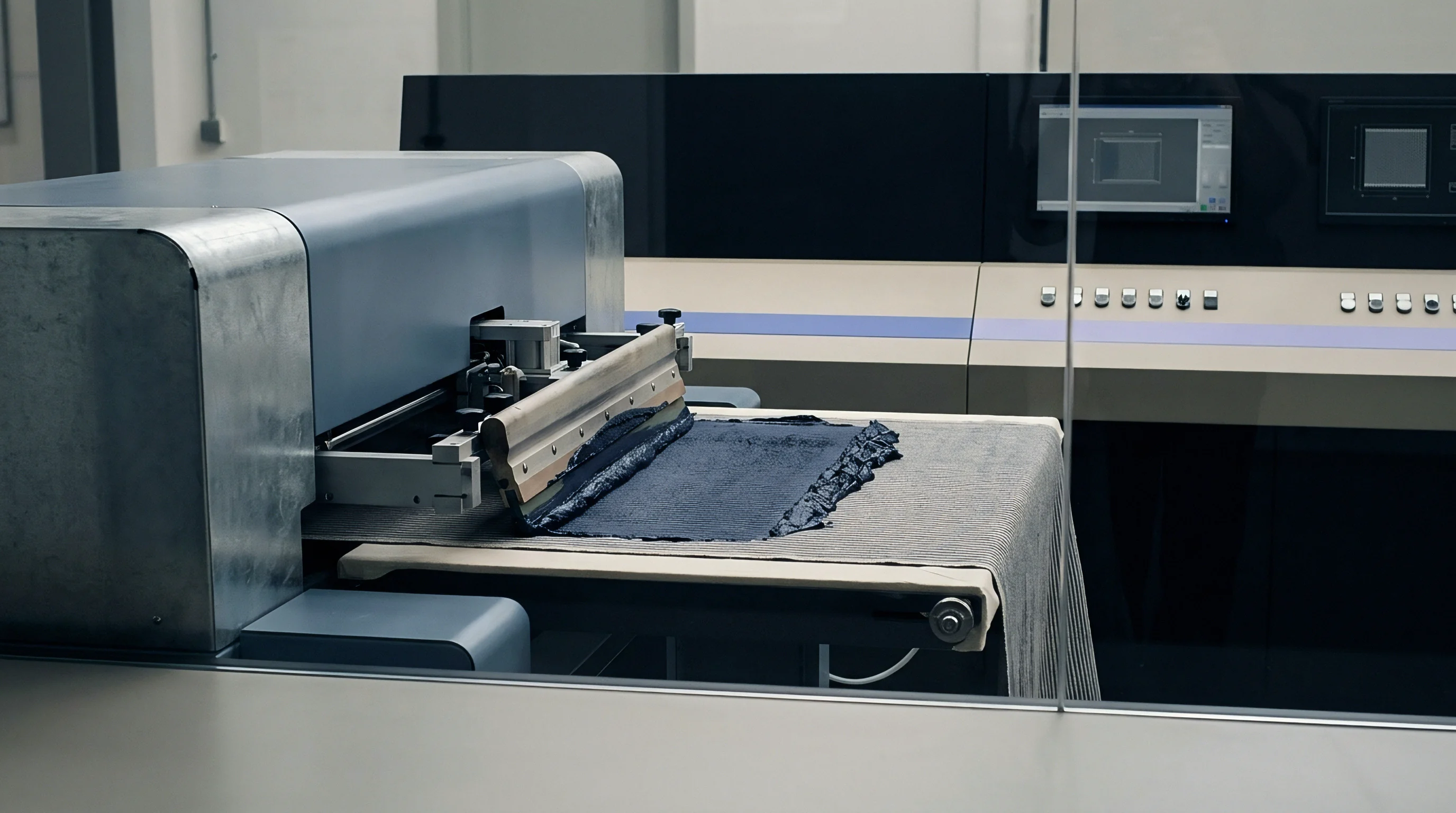
Wet print paste under a squeegee blade behaves fundamentally differently from micro-droplets fired through piezo nozzles. Rotary screen printing drives high-viscosity paste through open nickel mesh under heavy mechanical pressure, driving paste deep into yarn bundles to encase fibers in a polymer, thickener, and pigment matrix. Direct-to-textile inkjet heads fire low-viscosity inks formulated with fine pigment dispersions or dissolved dyes.
Without mechanical squeegee force, inkjet penetration relies on surface tension, drop momentum, and capillary draw. These differences in laydown, penetration depth, and surface coverage alter visual depth and light scattering on the exact same base cloth.
Digital printing requires chemical pre-treatments on greige fabric prior to jetting. For reactive dye printing, the pre-treatment pad applies sodium carbonate or sodium bicarbonate alongside urea and synthetic thickeners. The alkali shifts fiber pH so reactive dyes can form covalent bonds with cellulosic hydroxyl groups during steaming; urea acts as a humectant, absorbing moisture inside the steam chamber to swell fibers and accelerate dye diffusion into the yarn core.
For digital pigment printing, the fabric is padded with multivalent metal salts, cationic polymers, or cross-linking agents. These chemicals rapidly coagulate negatively charged ink drops on contact, preventing excessive bleeding and keeping pigment particles near the surface.
Substrate Pre-Treatment and Rheological Divergence
Chemical preparation determines how colorants settle on raw yarns during processing. Rotary screen printing blends thickener polymers directly into the paste to control rheology. These pastes exhibit shear-thinning thixotropy: high shear under the squeegee blade drops viscosity instantly so the paste flows through fine nickel mesh.
Once on the cloth, shear drops to zero and viscosity recovers immediately, preventing image bleeding across weave intersections. Synthetic acrylic thickeners and sodium alginates create a stable network that holds dense pigment particles suspended until drying locks them into place.
Digital inkjet inks must operate within tight physical limits dictated by drop ejection physics. Viscosity must remain between 3 and 12 mPa.s at standard jetting temperatures around 30 degrees Celsius, with surface tension held between 25 and 35 mN/m. High-viscosity thickeners cannot pass through 15- to 30-micrometer nozzles without clogging jets or deflecting drops.
Consequently, control over dot spread, line definition, and color yield shifts from the ink formulation to the pre-treated fabric surface. Any unevenness in chemical pick-up across the cloth directly alters drop spread, color density, and shade uniformity.
Fabric construction widens these physical differences between rotary screen and digital runs. Dense wovens with high cover factors, such as tight 40s poplins, resist deep penetration and hold both screen paste and digital droplets near the surface. Open structures ~ including loose 30s single jerseys or slub linen weaves ~ draw fluid inward quickly.
Squeegee pressure forces rotary paste deep into open knits, coating the back of the yarns. Digital droplet deposition, however, can leave the underside of thick yarn intersections partially uncolored, resulting in a lighter reverse face. When a garment stretches during wear, these uncolored yarn cores in digital reorders show through, changing perceived color depth compared to solid screen-printed pieces.
Drop Deposition Mechanics versus Rotary Squeegee Pressure
Mechanical force from stainless steel squeegees pushes thick emulsion paste through nickel mesh directly into the yarn core. Mesh counts range from 60 to 155 holes per inch; coarse meshes deposit wet paste up to 80 grams per square meter, yielding deep saturation and full yarn encapsulation. Drop-on-demand piezo printheads fire drop volumes between 3 and 30 picoliters at frequencies up to 30 kilohertz, but total fluid laydown in digital pigment printing rarely exceeds 15 to 25 grams per square meter.
Reaching dark, saturated shades digitally requires concentrating pigment into very thin surface layers.
Surface laydown dictates perceived depth. Thick binder films from rotary screen printing reflect light evenly across the fabric plane. Conversely, thin multi-pass ink layers from digital printheads form microscopic dot overlaps.
Slight drop misregistrations leave unprinted fiber peaks exposed between dots. These micro-gaps alter directional light scattering, reducing perceived color depth relative to a continuous screen film. Matching a deep rotary screen shade digitally demands higher ink limit settings, which elevates wet rub failure risks if cross-linking finishes fail to bind the heavy surface pigment layer.
A fabric batch failing ISO 105 C06 colorfastness to washing at forty degrees Celsius forfeits commercial acceptance regardless of initial colorimetric accuracy.
Fluid mechanics, chemistry, and surface laydown together determine final shade depth. The table below compares physical fluid dynamics, chemical delivery mechanisms, and depth performance parameters across rotary screen pigment, direct digital reactive, and direct digital pigment channels.
| Process Parameter | Rotary Screen Pigment | Direct Digital Reactive | Direct Digital Pigment |
|---|---|---|---|
| Fluid Viscosity Range | 3,000 – 8,000 mPa.s | 3 – 8 mPa.s | 4 – 10 mPa.s |
| Wet Pickup Mass | 50 – 90 g/m² | 30 – 60 g/m² | 12 – 25 g/m² |
| Penetration Depth into Yarn | 60 – 90 percent yarn core | 70 – 100 percent yarn core | 15 – 35 percent yarn surface |
| Fixation Mechanism | Thermal binder cure (150°C) | High-pressure steam (102°C) | Thermal crosslinking (160°C) |
| Surface Film Thickness | 5 – 15 micrometers | Monomolecular dye diffusion | 1 – 3 micrometers |
Natural batch variations in yarn dye absorption explain only a portion of the shade spread observed between printing routes.
Variance
Batch-to-batch repeatability across manufacturing facilities determines component scrap rates. Primary production runs on rotary screen equipment offer substantial economies of scale once screens are engraved and paste recipes dialed in. However, rotary screen setups require minimum runs between 2,000 and 5,000 meters per colorway to absorb screen preparation, registration adjustments, and wash-down waste.
Replenishment orders typically call for small quantities ~ often between 100 and 500 meters ~ to follow retail sell-through. Running small reorders on rotary lines carries heavy financial penalties from fixed setup losses and paste waste. Digital printing avoids screen engraving and setup scrap, making short runs practical, but shifting replenishment to digital channels introduces shade variance risks that can lead to rejections in the cutting room.
Managing shade variance across dual routes requires automated shade sorting instead of basic pass/fail checks. Industrial sorting groups printed fabric rolls into distinct shade bins using three-dimensional tolerance ellipsoids in CIELAB space. The 555 Shade Sorting system assigns a three-digit code to each roll based on its position relative to the master standard.
The first digit reflects lightness (L ), the second hue angle (h ), and the third chroma (C ). A 555 roll matches the target standard coordinates precisely. Digits above 5 indicate higher lightness, greener hue, or greater chroma, while digits below 5 indicate darker, redder, or duller fabric.

Shade Sorting Metrics and Commercial Acceptance Gates
Ellipsoidal tolerance zones define boundaries for allocating fabric rolls in cutting rooms. Garment assembly requires that panels from different shade bins remain unmixed; a front panel cut from a 555 roll stitched to a back panel from a 565 roll creates a distinct, visible seam mismatch. Dual-route replenishment strategies must ensure digital reorder rolls fall within the exact 555 shade sorting spread established by the initial rotary screen run.
If bulk production spanned codes 554, 555, and 556, digital replenishment rolls must fit within that envelope rather than introducing outliers such as 545 or 655.
Establishing commercial acceptance gates relies on statistical process control rather than single sample checks. Tracking process capability (Cpk) across consecutive production lots verifies whether a dyehouse controls shade variance; a Cpk above 1.33 confirms stable control within tolerance limits. Tightening Delta E 2000 tolerances below 0.6 increases mill scrap rates by eighteen percent.
Balancing mill yield against visual consistency requires clear, tiered acceptance gates:
Grade A (Unrestricted Pass): Delta E 00 under 0.7 units; Metamerism Index under 0.4 units. Rolls enter automated spreading tables without grouping restrictions.
Grade B (Restricted Allocation): Delta E 00 between 0.71 and 1.10 units; Metamerism Index between 0.41 and 0.75 units. Rolls tagged for isolated batch cutting; panels must not blend with Grade A stock.
Grade C (Commercial Reject): Delta E 00 exceeds 1.10 units; Metamerism Index exceeds 0.75 units. Material quarantined for off-shade concession or re-processing.
Managing dual-route supply requires verified technical consistency. The checklist below defines mandatory documentation required from supplying mills before approving a dual-route replenishment contract.
- Aperture geometry alignment documentation proves that spectrophotometers across all supplying mills utilize identical measurement openings and specular inclusion settings.
- Standard illuminant file distribution records verify that screen and digital facilities load matching spectral distribution tables into color calculation software.
- Fabric conditioning log sheets track relative humidity and temperature exposure duration for test specimens prior to colorimetric evaluation.
- Multi-fiber strip certification tags confirm that testing laboratories use identical adjacent fabrics during wet fastness assessment procedures.

Economic Thresholds for Route Selection in Replenishment
Fixed setup costs for rotary nickel screens cause steep unit cost spikes on small reorders. Engraving eight rotary screens for a complex floral pattern costs roughly 3,200 USD, with another 150 kilograms of paste lost during pump priming and squeegee alignment. Spread over a 5,000-meter primary run, screen setup adds less than 0.70 USD per meter to landed costs.
On a 300-meter reorder, that setup overhead climbs to 11.20 USD per meter, making rotary production economically impractical. Digital printing eliminates screen engraving fees and holds setup waste under five meters of cloth, though digital ink remains substantially more expensive at 12.00 to 18.00 USD per liter compared to 2.50 to 4.50 USD per kilogram for rotary paste.
Locating the economic crossover between rotary screen and digital inkjet routes requires calculating landed cost per meter across different reorder volumes. Digital printing maintains a nearly flat cost curve from 50 meters to 2,000 meters. Rotary screen printing shows a steep decline in unit cost as yardage increases.
The intersection of these two curves defines the operational crossover point. The table below outlines landed costs, lead times, and shade variance risks across order sizes for a standard 8-color printed cotton sateen.
| Order Volume (Meters) | Rotary Landed Cost (USD/m) | Digital Landed Cost (USD/m) | Rotary Lead Time (Days) | Digital Lead Time (Days) | Shade Variance Risk Factor |
|---|---|---|---|---|---|
| 100 | 38.50 | 8.20 | 21 | 3 | High (Screen setup instability) |
| 300 | 14.80 | 8.10 | 21 | 4 | Moderate (Paste mixing error) |
| 500 | 9.90 | 8.05 | 21 | 5 | Low (Standard production) |
| 1,000 | 6.40 | 8.00 | 25 | 7 | Low (Standard production) |
| 3,000 | 4.10 | 7.95 | 28 | 12 | Very Low (Bulk continuous) |
| 5,000 | 3.60 | 7.90 | 30 | 18 | Very Low (Bulk continuous) |
Weighing financial trade-offs also means accounting for inventory holding costs and out-of-stock markdowns. Shifting small replenishment orders to digital inkjet cuts lead times from three weeks to four days, avoiding retail stockouts during peak selling periods. The higher unit cost of digital printing is easily balanced by preserving retail margins on active inventory.
A workable dual-route strategy depends on keeping pre-treated greige fabric staged at digital print houses, ready to run as soon as point-of-sale data triggers a replenishment order.
Digital replenishment yields immediate lead time reductions only when pre-treated greige stock remains continuously staged at the finishing plant.
Shade mismatches across retail racks lead straight to price markdowns, inventory write-downs, and customer returns.

Fastness
Durability determines whether reordered fabric holds its appearance throughout its intended product life. Fastness properties measure resistance to chemical, thermal, and mechanical wear from laundering, sunlight, rubbing, and perspiration. Matching color between rotary screen primary runs and digital reorders provides little value if the digital fabric fades prematurely in the wash or fails crocking tests.
Pigment chemistry and fixation mechanisms differ fundamentally between the two methods, creating performance gaps whenever digital binder formulations lack adequate cross-linking catalysts.
Rotary screen pigment printing blends high molecular weight acrylic or butadiene binder polymers directly into the print paste emulsion. During stenter curing at 150 to 160 degrees Celsius, these polymers cross-link thermally into a resilient film across the fibers. This continuous matrix encapsulates pigment particles, providing durable resistance to water, detergent, and mechanical abrasion.
Digital pigment inks rely on lower molecular weight resins or external cross-linkers applied through pre-treatment pad baths or inline post-jetting sprays. Lower binder concentration in digital inks can compromise wash fastness and crocking performance if curing temperatures or dwell times drift during finishing.

What Colorimetric Spread Survives Washing across Dual Routes?
Laundering removes poorly bonded pigment particles and alters surface micro-reflectance. Wash fastness testing follows ISO 105-C06 protocols: specimens are washed in stainless steel canisters with specified detergent solutions and steel balls to simulate mechanical action at 40 to 60 degrees Celsius. Testing evaluates two metrics: color change in the printed specimen and staining on adjacent multifiber strips containing acetate, cotton, nylon, polyester, acrylic, and wool.
Color change and staining are evaluated on the ISO Grey Scale, from Grade 1 (severe change/staining) to Grade 5 (no visible change/staining). Rotary screen reactive prints on cellulosics achieve Grade 4-5 wash fastness due to strong covalent bonding between dye molecules and cellulose hydroxyl groups. Digital reactive prints can match these ratings, provided unfixed hydrolysed dye is thoroughly washed off.
Skipping adequate wash-off leaves residual dye on fiber surfaces, dropping staining ratings to Grade 2-3 and bleeding onto adjacent light garments during home laundering.
Digital pigment prints face greater wash fastness challenges than reactive prints. Repeated laundering breaks down thin digital binder films, shedding surface pigment particles. As pigment sloughs off, light reflectance shifts and the fabric looks faded.
While a rotary screen pigment print retains a Grade 4 color change rating after five ISO 105-C06 C2S cycles, a digital pigment print with weak binder cross-linking can fall to Grade 3. Dual-route specifications must enforce matching fastness minimums across screen and digital suppliers to prevent uneven garment wear over time.
Polymer Crosslinking and Rubbing Fastness Degradation
Chemical cross-linkers in pigment pastes create flexible molecular networks that bind color particles to cellulosic fibers. Fastness to rubbing ~ or crocking ~ measures color transfer from printed fabric onto dry or wet white cotton cloth under mechanical pressure according to ISO 105-X12. A motorized crockmeter moves a finger covered with standard cotton cloth back and forth across the specimen twenty times under a 9-Newton load.
Dry crocking measures mechanical binder shear resistance; wet crocking assesses binder swelling and moisture-induced friction breakdown.
Meeting acceptable wet crocking ratings remains a primary obstacle in digital pigment replenishment. Rotary screen formulas achieve Grade 3-4 wet crocking on heavy cotton because they deposit substantial binder volume. Digital pigment inks, restricted by low jetting viscosity requirements, deposit far less resin.
Wet rubbing drives moisture into that thin film, softening the resin matrix and transferring pigment onto the test cloth ~ often dragging results down to Grade 2. Improving digital wet crocking requires padding polyisocyanate or silane cross-linkers onto the fabric in post-treatment finishing, followed by controlled thermal curing at 160 degrees Celsius for two minutes.
Crosslinking temperatures during stenter curing dictate whether digital pigment prints reach acceptable wet rubbing fastness ratings.
Binder durability and dye fixation dictate whether a print survives routine care. The table below outlines international fastness test methods, minimum commercial performance thresholds, and common failure modes across rotary screen and direct digital routes.
| Fastness Property | International Test Method | Minimum Commercial Standard | Rotary Screen Failure Mode | Digital Print Failure Mode |
|---|---|---|---|---|
| Color Fastness to Washing | ISO 105-C06 A2S (40°C) | Grade 4 (Change), Grade 4 (Stain) | Under-curing of binder emulsion | Incomplete wash-off of hydrolysed reactive dye |
| Dry Rubbing Fastness | ISO 105-X12 | Grade 4.0 | Excessive surface paste buildup | Rough substrate surface micro-abrasion |
| Wet Rubbing Fastness | ISO 105-X12 | Grade 3.0 (Dark shades) | Binder swelling under moisture | Insufficient binder crosslinking resin volume |
| Light Fastness | ISO 105-B02 (Xenon Arc) | Grade 4.0 (Blue Wool Scale) | Poor intrinsic chromophore stability | UV degradation of thin surface ink layer |
| Acid/Alkali Perspiration | ISO 105-E04 | Grade 4 (Change), Grade 3-4 (Stain) | Chemical hydrolysis of binder film | Dye-fiber bond cleaving under alkaline pH |
Inserting ISO 105-X12 Grade 4 dry crocking requirements directly into master purchase contracts obligates dyehouses to refine binder formulations before launching bulk runs.
Discipline
Sourcing governance requires tight laboratory alignment among greige mills, digital print houses, and audit labs. Fragmented supply chains often yield conflicting color reports due to uncalibrated spectrophotometers, differing conditioning environments, or inconsistent sample handling. A unified quality framework requires all tier-one and tier-two suppliers to run standardized instrument audit routines.
Spectrophotometers across the network need bi-weekly calibration with certified ceramic tiles traceable to national standards institutes. Tracking instrument drift prevents false color variations caused by aging light sources or contaminated optics inside integrating spheres.
Sample conditioning directly affects color measurement repeatability. Textiles take up or release moisture depending on ambient relative humidity and temperature. Moisture alters yarn swelling, light absorption, and surface micro-texture, causing measurable color shifts.
Readings taken from warm, dry fabric straight off a stenter frame diverge noticeably from readings taken after twenty-four hours of conditioning. Governance protocols must mandate that all swatches undergo pre-conditioning in a lab held at 20 +/- 2 degrees Celsius and 65 +/- 4 percent relative humidity per ISO 139 standards before color measurement or fastness testing.
Audit Parameters for Quality Control Laboratories
Calibration protocols ensure measurement parity across geographically separated facilities. Inter-instrument agreement measures how closely two spectrophotometers read the identical sample. High-end sphere spectrophotometers maintain inter-instrument agreement within 0.15 Delta E CIELAB units, whereas lower-cost benchtop or portable devices can vary by up to 0.60 Delta E units.
If a digital print house uses a portable unit while the buyer’s quality lab uses a reference sphere benchtop, that instrument gap alone can consume the entire allowable color tolerance. Sourcing teams must require matching spectrophotometer models, aperture sizes, and specular modes across all testing points.
Standardizing sample orientation and folding eliminates measurement noise caused by fabric structure and backing show-through. Directional weaves and knits ~ such as twills, satins, or jerseys ~ reflect light differently depending on warp or wale orientation relative to the light beam. Reliable readings require folding the cloth into four layers to eliminate backing show-through, followed by four separate measurements taken at 90-degree rotations.
Averaging those four readings produces a spectral curve that smooths out surface directional artifacts, while quality software should automatically flag or discard individual readings that deviate significantly from the mean.

Integrating Spectrophotometric Thresholds into Purchase Specifications
Contract terms must set unambiguous boundaries for color difference and fastness requirements. Master fabric purchase agreements require explicit spectrophotometric tolerances, fastness minimums, and standardized test methods. Vendor manuals with vague wording such as “shade must match approved lab dip” provide zero protection during commercial shade disputes.
Purchase specifications must explicitly define primary and secondary illuminant limits, CIEDE2000 parametric factors, instrument geometries, fastness test conditions, and required shade sorting bands.
Resolving commercial shade disputes requires predetermined referee testing procedures. When a buyer rejects a replenishment lot for off-shade or poor fastness while the mill maintains the batch meets specification, an independent accredited testing laboratory performs referee testing. Operating under ISO 17025 standards, the referee lab uses sealed master swatches stored under nitrogen or cold storage to prevent aging.
Its findings provide a binding commercial determination, governing whether the mill receives full payment, must re-process the goods, or absorbs lot rejections and financial penalties.
Sourcing teams maintain quality standards by combining strict mill audits, ongoing spectrophotometric monitoring, and unambiguous purchase specifications across every link in the supply chain.
How supply networks will harmonize inline spectral camera measurements with legacy laboratory spectrophotometer benchmarks remains an open engineering challenge for mill managers.